

Opinion
Animals in human skin
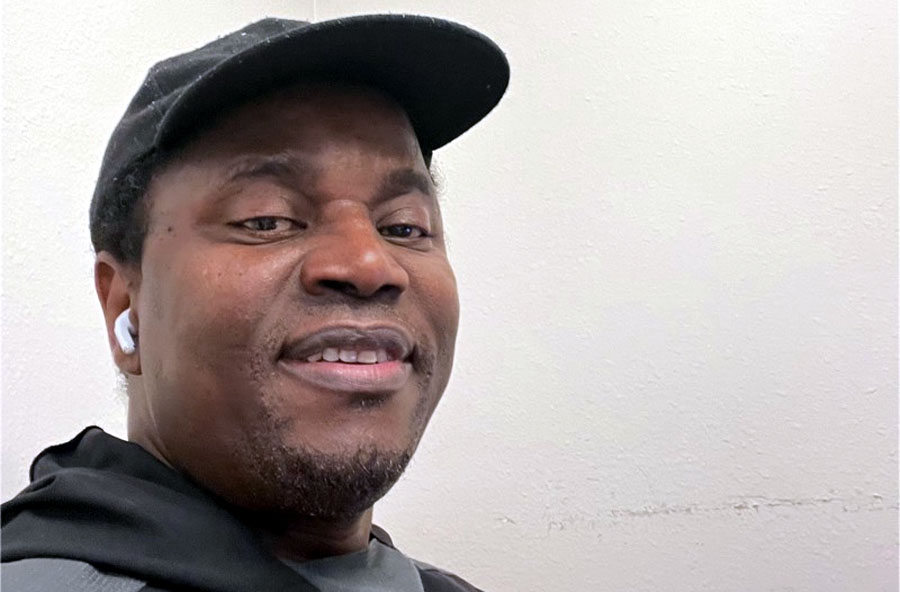
Animals in human skin
Tunde Odesola
(Published in The PUNCH, on Friday, May 30, 2025)
Situated in a dark groove is a drum never to be beaten. Thin as a strand of hair, the delicate drum transmits sound waves. This drum does not speak; it only listens and understands, even before its owner does. This drum is located deep inside the ear, rightfully earning its name, eardrum.
Sounds travel into the ear canal in waves, vibrating the eardrum, which transmits sounds to the three tiny bones behind it. The tiny bones are named malleus, incus and stapes–fragile trinity inside the shrine of sound. Located in the middle ear, these three bones, also nicknamed the hammer, anvil and stirrup, are collectively called the ossicles, and they are the tiniest bones in human anatomy.
The little bones amplify sound vibrations from the eardrum and transmit them to the inner temple called the cochlea, where the mechanical sounds are converted into electric signals, which are sent to the brain.
Like an expert sound engineer mastering a tape, the brain reads the signals from the cochlea and, for instance, interprets the wah, wah of a crying baby and elicits empathy; transmits the clap of thunder and evokes fear; dissects the promises of politicians to provokes disdain; even as it identifies the blindfold of justice and demands fairness. To beat this drum is to shatter the membrane separating hearing from deafness; it is to wave sound goodbye.
But I know many drums that rejoice when sticks rain fierce strokes on them. Long before the written word wormed its way into print to produce a code of morality, the drum encapsulated society’s moral codes. The drum instructed, warned, praised, rebuked, prophesied and cursed. It told the truth absent in a million lying mouths. Give me a drum; drown the Nigerian political elite.
In Yoruba cosmology, drums are objects of worship because Àyàn Àgalú, the god of drumming, is capable of rewarding or reprimanding drummers, depending on the work of their hands. Àyàn Àgalú is the primordial spirit of drumming and divine custodian of rhythm. He’s believed to be the first ever deified ancestor to make the drum talk like a human, not just beat.
Every drummer in Yorubaland is called Àyàn, in relation to Àyàn Àgalú’s ancestral origin. For the African, particularly the Yoruba, the drum is a link to the past. It is not just the skin of an animal talking in a human voice, no; it is much more than òkùewúré ti o n fo ohùn bi ènìyàn, the drum provides a spiritual communication between the dead and the living.
READ ALSO:
- Senators link upsurge in banditry, Boko Haram activities to 2027 polls
- FG introduces HND programs in AI, cybersecurity, software engineering to boost tech talent
- Enugu residents discover pits where ritualist buries victims alive
When things are looking down for the Àyàn, he performs rites on his drums and calls on Àyàn Àgalú for a turnaround. The power of Àyàn Àgalú to change the fortunes of the drummer for good is encased in the saying, “Sèkèrè kii ba won re òdeìbànújé,” which means that the rattling gourd is never found at mournful occasions. It symbolises an expectation that the downturn being experienced by the drummer will fade away as joy is coming.
Aside from the foregoing roles drummers played in societal cohesion in time past, they are also intelligence officers in palaces–processing and disseminating signals, and on the warfronts–inspiring soldiers on courage, patriotism, gallantry and history.
Despite these roles, however, drummers were regarded as the dregs of society, whose reward included water suspension from pap, hence, they were referred to as “Alùlù gbomi èko”.
Many, many years ago, palaces had a retinue of drummers who woke, warned, praised and entertained kings and their royal households. Then, kings were not expected to entertain their subjects by playing the drum for them. But this narrative began to change when Prince Adetoyese Laoye emerged as the Timi of Ede on December 9, 1946, and embarked on a 29-year reign, which terminated in 1975.
Professor of History, Siyan Oyeweso, in his book, “The Quintessential Oba John Adetoyese Laoye I (1946 – 1975): Personification of Royalty and Culture”, describes Oba Adetoyese Laoye as the first Timi of Ede, who had a Western education.
Oyeweso says Oba Laoye, a dispenser, druggist and pharmacist, “Belonged to the tiny club of those Nigerian traditional rulers who historians refer to as ‘Intellectual Monarchs’ or ‘Philosopher Kings’…This class of monarchs has acquired Western education in the opening years of the 20th Century, and also distinguished themselves as authors and historians…”
According to Oyeweso, the father of Oba Laoye I, Prince Oyebisi Omolaoye, was a successful Muslim trader in Togo and a protégé of a white missionary named Dr Greene, who later returned with him to Ede. Prince Omolaoye begot a son and named him Yusuf Adetoyese Omolaoye. “At baptism, Adetoyese was christened John, but because Dr Greene could not pronounce the name Omolaoye properly, he shortened it to ’Laoye,” says Oyeweso.
Throughout his reign, Oba Laoye was a major protagonist of Yoruba renaissance as he upheld the dignity and unity of the traditional institution, says Oyeweso.
READ ALSO:
- U.S. unveils Visa ban for foreign officials who censor Americans
- Tinubu urges leaders to embrace unity at ECOWAS 50th anniversary
- Ground rent: FIRS personnel assault ministerial task force
In the view of Oyeweso, Oba Laoye was an uncommon king who elevated drumming into an aristocratic art, not minding the view of the palace and society on drumming. He was the author of the signature tune for the Western Nigeria Broadcasting Service Corporation/Western Nigeria Television, (which says) ‘This is Nigeria Broadcasting Service’ (but) which has been variously interpreted as ‘B’olubadan ba ku, ta ni o joye’, ‘Ninu ikoko dudu lati n se’be’, ‘Gomina akoko o n’imu oru’, ‘Ko sionigbese ni bi, lo si ile keji’, ‘Ojegede dudu, inu ta bon’, ‘Belo Gbadamosi Olori Ole’, ‘Eko je’badan lowo, 13 pounds’.
Explaining the significance of drums to the African, the late Alaafin of Oyo, Oba Lamidi Adeyemi, said Yoruba talking drums were unique in their characteristic mimicry of human voice, stressing that no other drums worldwide had such a function. Adeyemi, who said this in an address captured in a viral video, maintained that drums were used for reasons such as teaching, worshipping, informing, news dissemination, intelligence and warfront duties, and entertainment.
“Drums are used in palaces and in the residences of dignitaries. Drummers advise the king about how to behave in public,” Adeyemi said. The close relationship between the king and drummers bred the proverb, “Oba kii mu o nkorin.” But this is not the case with Nigeria’s political class that gags freedom of speech and disregards the Freedom of Information Act.
In a telephone interview with me, cousin to Oba Laoye, Prince Adewale Laoye, says the late monarch picked drumming from the family of his mother, revealing that his own father, Prince Elkanah Olatinwo Laoye, was the Baba Kekere–a synonym for Chief of Staff–to Oba Laoye throughout his reign.
Adewale, who is the founder, Aafin Ilu–Palace of Drums–located in Ede, Osun State, says he established the institution to revamp various Yoruba drums, which are gradually going into extinction.
“My father was the younger brother of Timi Laoye I. Their mother had two boys and a girl, who was the lastborn. I was gifted a talking drum when I was three, and I still have the drum with me to date. It was given to me by my big uncle, Pa Ajao Ayangbayi, from my father’s mother’s side. My grandmother, Iya Odefunke Omoware Ayangbayi, was a drummer from Ile Ologun Compound in Ede,” Adewale explains.
READ ALSO:
- Dangote, Okonjo-Iweala, Osimhen, Burna Boy make 100 Most Notable Peace Icons list
- How Chelsea made history after winning Conference League trophy
- Osun students, teachers lament nightfall WAEC exam
He continues, “I went to some towns and realised they didn’t have a complete drum set like the dundun at their egungunfestival–this was what prompted the idea behind Palace of Drum. Many people tried to discourage me from playing drums, saying a prince shouldn’t be seen playing drums. Thank God for my supportive mother who stood by me, but she didn’t live to see me actualise my dream on drums. Oba Laoye and my father were both choir masters, who invested in music, with my father teaching me the art of music. I see Oba Laoye in my dreams, asking me who would continue the family’s tradition if I stopped?”
Despite the inroads of some monarchs into music, royalty and society still look down on musicians and drummers, in the main. Juju music maestro and Ondo prince, Sunday Adegeye, MFR, popularly known as King Sunny Ade, had to lie to his parents that he had gained admission into the University of Lagos, for him to leave Ondo and pursue his music career in Lagos. King of Fuji and Ijebu prince, Wasiu Ayinde, was luckier as his mother supported him when he decided to go and live with Fuji music creator, Alhaji Sikiru Ayinde Barrister, at a tender age.
It’s not only crowns that frown on princes taking up music as careers; wealthy and educated families also discourage their scions from becoming musicians. Afrobeats superstar, David Adeleke, aka Davido, is an example. His billionaire father, Dr Deji Adeleke, once got him arrested by the police, just to discourage him from singing.
I once had an interview with Deji’s elder brother and first Executive Governor of Osun, Alhaji Isiaka Adeleke, the Serubwon of Osun politics and patriarch of the Adeleke family. In the interview, Serubawon revealed how Davido blew all his school upkeep on a big piano while studying in the US and he had to give him another money, though not as much as the money he blew – just to teach him a lesson.
Culture expert, musician and ewi exponent, Chief Sulaimon Ayilara, aka Ajobiewe, advises, “If you visit a town and there’s no drumming there for three days, please, leave the town,” adding that the use of metals in martial music was a form of drumming too.
It is normal when animal skin talks like humans. But it is strange when animals wear human skin, according to Afrobeat king, Fela Anikulapo-Kuti, in Beasts of No Nation.
Plateau, Borno and many parts of the North have been turned into killing fields by terrorists, just as other parts of the country have been battling with other forms of killings and insecurity. The hopelessness of the government in tackling security and economic challenges is disturbing; the preoccupation of the government with corruption and politicking while the country boils is heartbreaking.
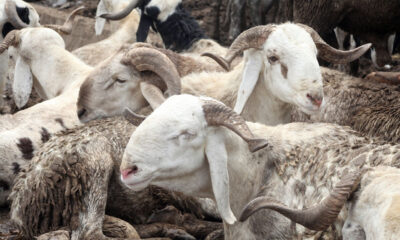
I see more animals in human skin at the helm nationwide than I see real humans. Animals are lording it over human beings. What do you see?
—————
Email: tundeodes2003@yahoo.com
Facebook: @Tunde Odesola
X: @Tunde_Odesola



Opinion
2027: Competence, Not Zoning, Should Decide Nigeria’s Next President — Imasuagbon

Nigerians should look beyond ethnicity, region and the longstanding debate over rotational presidency when choosing the country’s next leader, according to a chieftain of the African Democratic Congress (ADC), Kenneth Imasuagbon.
The former Edo State governorship aspirant said the priority ahead of the 2027 election should be finding a president with the ability to confront Nigeria’s economic, security and infrastructure challenges.
Speaking to journalists in Benin, Imasuagbon argued that presidential rotation is not a requirement of the Nigerian Constitution and should therefore not outweigh the question of competence.
He said voters should be more concerned about replacing poor schools with better ones, improving healthcare and addressing hardship than debating where the next president comes from.
Imasuagbon specifically appealed to voters in the South to support former Vice President Atiku Abubakar, who is contesting the 2027 presidency on the ADC platform.
According to him, Atiku has demonstrated the experience and determination needed to improve the country, describing the former vice president as someone capable of promoting national unity and fairness.
He also accused the Bola Tinubu administration of worsening economic pressure through policies including the removal of fuel subsidy, while expressing concern about the condition of roads, electricity and other infrastructure.
Imasuagbon argued that the next administration must focus on practical improvements in areas such as power, transportation, employment, security and public services.
The ADC chieftain also dismissed the idea that the ruling All Progressives Congress (APC) would automatically benefit from its incumbency advantage in 2027.
He maintained that the electorate ultimately determines the outcome of an election, arguing that voters could change the political direction of the country if they were determined to do so.
Imasuagbon further criticised what he described as regional and ethnic considerations in the distribution of political appointments and opportunities, insisting that the next president should give Nigerians across different parts of the country a sense of belonging.
His comments come as political parties and their candidates intensify preparations for the 2027 presidential election.
Opinion
Lesson from Dotun Oladipo’s Brave Daughters, by Bamidele Johnson

Lesson from Dotun Oladipo’s Brave Daughters, by Bamidele Johnson
I hope to grow old. I want to see my kids become real adults, find their own feet, make mistakes, recover from them, and perhaps one day complain that their own children are giving them grey hairs. I want that plainly stated before anything else, as everything that follows might read as a man agreeing to an early exit rather than a man simply being honest about the odds.
I want the decades. I want to become the grandfather who repeats the same stories until nobody bothers correcting him anymore. But wanting a thing and being granted are different things. The last year has made that difference harder to ignore than I would like. I have lost many friends recently to keep thinking that optimism is my natural resting state. Some of these men had better blood pressure than mine, better habits, better everything that is supposed to count. It did not save them.
There is no formula I know that reliably separates the men who make it to 70 from those who do not. Anyone who says he knows one is selling something. So, I do not assume that old age is an already booked destination. Even if I once did, which I doubt, the last three years have cured me of such an illusion. As such, I treat it as a hope rather than an expectation, and I have found that a more honest way to live.
It is exactly why I want something placed on record now, while I am still able to place things on record, rather than leave it for people to guess what my wishes were in the fog of a funeral week. If I do not make old bones, my children are not to be asked to read tributes at my funeral. Not one line, however short, however lovingly written.
This, for me, was settled today rather than re-opened. At Dotun Oladipo’s funeral service, his three daughters took turns to read their tributes to their dad, and I found myself watching them with awe. There was a kind of strength in them that I do not possess. It is the strength needed to stand in front of a hall brimming with grieving adults and speak about a man they have just lost. Forever. Strength, however, is not the same as ease. I could see plainly what that strength was costing them as they read. Their voices caught. Their composure held and then did not hold and then held again through sheer will.
In front of them, in the pews, men and women considerably older than them came undone in ways the girls themselves were somehow managing to resist. I went mightily close. Some of the sobbing was quiet, the type people try to fold into a handkerchief. Some of it was not quiet at all, the kind that announces itself whether or not you want it.
Those young women honoured their father with a grace that is beyond me. What they did was astonishing. So, what I am attempting is an observation of a custom I have now watched wound people. This was not the first time I had watched this particular ritual extract more than it should from people already running on fumes. I saw an earlier and harder version of it at a friend’s wake back in 2015.
The first son was called forward to read his father’s tribute, and he could not do it. He tried, but the words would not come, and he stood there in front of a crowd of mourners, with his grief simply refusing to organise itself into sentences. The officiating minister, rather than releasing him from the task, urged him to continue. I sat fizzing with sorrow and ire. He could not go on and, eventually, the minister accepted, but not before insisting a while longer than it should have reasonably taken. His younger brother was called up next, presumably on the theory that if one grieving son could not manage it, maybe another one could. He flunked it in the same way. Grief does not distribute itself more conveniently among siblings just because a programme has been printed and needs to be followed.
I have turned that memory over many times since, trying to work out why this part of the rites is treated as mandatory in the first place. I have not found a satisfying answer. Maybe it comes from a belief that a child’s words carry more weight than anyone else’s, which may even be true, but weight is exactly the problem when those carrying it are struggling to hold themselves together with nothing but adrenaline and the fear of dissolving in public.
Maybe it is simply inertia, the reason we still do a hundred things at funerals that nobody can explain the original purpose of. Either way, I have stopped looking for the justification. I no longer think one exists that is good enough to weigh against what I watched happen to that boy in 2015.
So, let this stand as my instruction rather than my preference, the kind of thing I would rather state plainly now than leave for my children to infer later from how uncertain I sound when the subject comes up in passing. If I do not get the old age I am hoping for, my children will not be asked to read a single word over my body. Someone else can speak for me. A friend, a stranger with a steadier voice and a smaller stake in the loss, anyone whose grief will not be quite so total that standing upright becomes almost impossible.
My children, of course, will sit in front and fall apart if that is what the day requires of them, but without the microphone. That, at least, is one small mercy I intend to arrange for them while I am still here to arrange it.
Dotun deserved every bit of the send-off his daughters gave him today, and I suspect he would have been the first to tell them to sit down and let someone else carry the weight for a while. He did not get a say in that, as none of us ever do once we are the ones being spoken of rather than the ones speaking. Rest well, Dotun. You raised three young women whose strength I will not soon forget. That alone says everything worth saying about the man you were.
Opinion
‘Tinubu Will Win Again in 2027’ — Charismatic Bishops’ Secretary
‘Tinubu Will Win Again in 2027’ — Charismatic Bishops’ Secretary
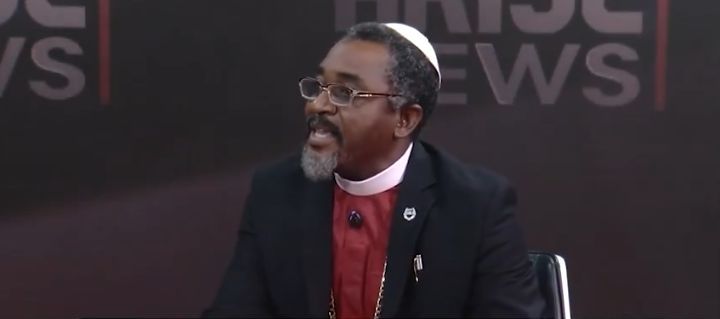
A senior Nigerian cleric, Archbishop Chivir Chianson, has declared that President Bola Tinubu will retain the presidency after the 2027 general election, attributing the prediction to a message he said came from God.
Chianson, who serves as Secretary General of the Charismatic Bishops’ Conference of Nigeria, made the statement while appearing on Arise Television on Saturday.
Rather than basing his prediction on political calculations, the archbishop said his confidence came from what he described as the prophetic role of bishops.
He maintained that the conference had previously spoken about Tinubu’s political future based on what he said was divine revelation and that the President would return for another term.
Chianson also predicted that Tinubu’s performance would improve if he wins the 2027 election.
READ ALSO:
- DSS warns Osun churches, mosques, markets over alleged terrorist attack plot ahead of 2027
- ‘Tinubu Will Win Again in 2027’ — Charismatic Bishops’ Secretary
- Fake miracles, bogus grants: How clerics allegedly fleece Nigerians of millions
Addressing the political opposition, the cleric said the bishops could not be blamed if rival parties failed to unite or organise themselves effectively ahead of the election.
He also sought to clarify the position of the bishops when dealing with government, saying their role in speaking truth to power did not mean they should approach political leaders with hostility or disrespect.
According to him, the Constitution, alongside their religious convictions, should guide how they engage the President and the country.
Chianson said he was sufficiently confident in his prediction to promise that he would return to the Arise TV studio after the 2027 election, when he expects the result to demonstrate that the bishops’ prophecy was correct.
His comments add a religious dimension to the increasingly active political conversation surrounding the 2027 presidential race.
‘Tinubu Will Win Again in 2027’ — Charismatic Bishops’ Secretary
-

 Business3 days ago
Fuel Prices Climb to ₦1,500 per Litre Across Nigeria, Sparking Calls for Urgent Action
-

 News3 days ago
OAU Investigates Death of Final-Year Student as Police Begin Probe
-

 News2 days ago
ECOWAS Biometric Card Expands as Seven Countries Begin Rollout
-

 Business3 days ago
NCAA Moves Against Airlines Over Rising Flight Delays
-

 metro2 days ago
FG Suspends Niger NSCDC Commandant As 37 Suspected Illegal Miners Die In Custody
-
 Politics3 days ago
Aisha Buhari Visits Atiku Amid Opposition Coalition Activities
-
 Interview3 days ago
He Does Not Lose Elections”: Abdulmumin Jibrin Predicts 65% Landslide for Tinubu in 2027
-

 Sports2 days ago
Ballon d’Or 2026: Mbappe Responds to Yamal’s Bold Claim