BREAKING: Lawal excited as tribunal affirms his election as Zamfara Gov - Newstrends
Connect with us

Politics

BREAKING: Lawal excited as tribunal affirms his election as Zamfara Gov
Published

on

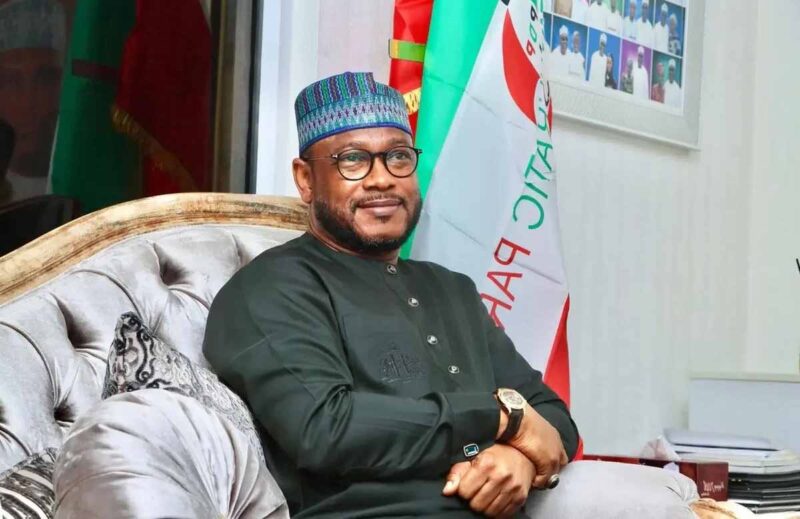
Governor Dauda Lawal

BREAKING: Lawal excited as tribunal affirms his election as Zamfara Gov

Governor Dauda Lawal has described the affirmation of his electoral victory by the Zamfara State Governorship Election Petition Tribunal, as a confirmation of the will of the good people of the State.

Governor Lawal emerged victorious in the March 18, 2023 governorship election by defeating the then incumbent Governor Muhammad Bellow Matawalle with a landslide.

The Spokesperson to the Governor, Sulaiman Bala Idris, in a statement on Monday in Gusau, stressed that the Tribunal’s verdict represented the will and decision of the people.

Idris said: “A moment ago, Dauda Lawal was affirmed as the winner of the March 18, 2023, Governorship election by the Zamfara Governorship election tribunal sitting in Sokoto.

READ ALSO:

“The judgement was not surprising but rather an affirmation of the collective decision made by the unwavering people of Zamfara.

“Governor Dauda Lawal emerged victorious in the governorship election with an impressive margin of 65,750 votes.

“Let it be known that this victory belongs to all the people of Zamfara, not just the Governor and his party.

“The judgement would encourage Governor Lawal to continue with his resolve to fulfil his mandate and work tirelessly to ensure that the people of Zamfara State experience the benefits of good governance.

“Governor Dauda Lawal’s rescue mission, which began on May 29th after his administration was sworn in, has already made remarkable strides in improving security, education, infrastructure, and agriculture.”

BREAKING: Lawal excited as tribunal affirms his election as Zamfara Gov

Loading

Politics

Court Stops EFCC’s “Fishing Expedition” as Makinde Links Probe to APC Warning Over 2027 Election

Published

on

Court Stops EFCC's "Fishing Expedition" as Makinde Links Probe to APC Warning Over 2027 Election
Governor of Oyo State, Engr. Seyi Makinde

Court Stops EFCC’s “Fishing Expedition” as Makinde Links Probe to APC Warning Over 2027 Election

Oyo State Governor, Seyi Makinde, has alleged that a chieftain of the All Progressives Congress (APC) warned him against contesting the 2027 presidential election against President Bola Tinubu, just one day before the Economic and Financial Crimes Commission (EFCC) requested extensive financial records from his administration.

Makinde disclosed this in his July 2026 monthly newsletter while reacting to Wednesday’s judgment of the Federal High Court sitting in Ibadan, which restrained the EFCC from proceeding with aspects of its planned investigation into the finances of the Oyo State Government. The governor said the warning came on June 1, 2025, shortly after President Tinubu had been endorsed by the APC as its sole presidential candidate for the 2027 election.

According to Makinde, the sequence of events began after he appeared on Channels Television on April 15, 2025, where he responded to a question on his presidential ambition, stating that he had the capacity to occupy the highest office in the country, although he had not formally declared his intention to run. The governor said political reactions followed the interview, and on June 1, 2025, an APC chieftain publicly warned him against contesting the presidency, describing such a candidacy as “an exercise in futility” and advising the opposition not to waste its time. The warning came shortly after the APC endorsed President Bola Tinubu as its sole presidential candidate for the 2027 election. “The following day, 2 June 2025, the EFCC wrote to the Accountant-General of Oyo State demanding copies of every contract involving the Oyo State Government and details of all transactions and payments made to contractors from 2021 to the date of its letter. No contractor was identified. No company was named. No questionable transaction or alleged offence was stated.” Makinde said his administration did not refuse to cooperate with the anti-graft agency but instead asked the EFCC to specify the contractors, companies, or transactions under investigation so that the relevant documents could be provided. “The EFCC did not respond, prompting the Oyo State Government to seek judicial interpretation of whether such a broad request was lawful,” he added.

READ ALSO:

The Federal High Court delivered judgment in suit number FHC/IB/CS/61/2025, filed by the Oyo State Government against the anti-graft agency. Justice Nkeonye Maha, who delivered the judgment on Wednesday, July 22, 2026, acknowledged the EFCC’s statutory powers to investigate financial crimes but held that such powers must be exercised in accordance with the Constitution and the rule of law. According to a statement by Makinde’s Special Adviser on Media, Sulaimon Olarenwaju, the court found that “The EFCC’s proposed investigation into Oyo State’s finances, particularly the demands contained in its letter of 2 June 2025, was speculative and amounted to a fishing expedition. His Lordship noted that the constitutional rights of the plaintiffs to fair hearing could not be trampled upon under the guise of investigation.” The court held that any request for information by the EFCC must be reasonable and linked to identifiable allegations or offences under the EFCC Act. Justice Maha ruled that Section 38 of the EFCC Act empowers the Commission to obtain information only for the purpose of investigating offences within its jurisdiction and does not authorise speculative or blanket investigations into the affairs of individuals or institutions. The judge set aside the EFCC’s letter dated June 2, 2025, and declared that any request by the Commission must be reasonable and tied to specific allegations.

Makinde stressed that his administration was not opposed to accountability or legitimate scrutiny and that no government should be shielded from investigation. However, he argued that such probes must be based on identifiable facts. “Accountability must be evidence-based,” he said, warning against broad investigations conducted merely in the hope of discovering wrongdoing. The governor described the court’s judgment as “a victory for the rule of law, not against the EFCC,” saying it reinforces the principle that government institutions, including law enforcement agencies, must operate within established constitutional and legal boundaries. “No government should be beyond legitimate investigation. Our administration is not beyond scrutiny, and we have never asked to be. But accountability must be based on evidence. An investigation should not begin with a blanket search through years of records in the hope that something incriminating might eventually be found.” Makinde said he would not speculate on the motive behind the EFCC’s letter but invited Nigerians to consider the sequence of events and draw their own conclusions. “Perhaps the timing of the EFCC’s letter was coincidental. I will not speculate about motives. Nigerians can consider the chronology and reach their own conclusions.”

Meanwhile, the Oyo State chapter of the APC has condemned the court ruling, describing it as a setback for accountability. The party’s Publicity Secretary, Wasiu Sadare, alleged that Governor Makinde was making desperate efforts to prevent the EFCC from examining the financial records of his administration. “The question on the lips of many patriots now is: Why would a governor be afraid to render an account of resources entrusted to him for the benefit of the citizenry? What size of skeleton does Governor Makinde have in the cupboard that he is keeping away from us?” the APC stated. The APC listed several projects it claimed would eventually come under investigation, including the exercise book printing contract, rehabilitation of the Lekan Salami Stadium, the Circular Road project, renovation of the Agodi Government House, construction of bus terminals, upgrade of Alakia Airport, and alleged unremitted deductions from workers’ salaries. “The truth is that he can only run but he cannot hide. EFCC and other anti-graft agencies will do their work at the appropriate time, and all the lid will be blown open,” the party added. In response, Makinde’s administration dismissed the allegations, insisting that its decision to approach the court was not an attempt to stop any investigation but to seek judicial clarification. The government stated that Governor Makinde has managed the state’s resources prudently and has nothing to hide. “Seeking judicial interpretation of the EFCC’s powers is neither cowardice nor an act of fear. Governor Makinde and the Oyo State Government are not afraid of the EFCC or any other federal agency. The state’s account books will be made available whenever a proper and lawful request is made.” The government added that the APC’s claim that Makinde’s decision to seek judicial intervention amounts to avoiding investigation is “both misleading and legally unfounded. Resorting to the courts is not an admission of guilt but a constitutional right guaranteed under Nigerian law.” The governor also addressed speculation about his presidential ambition, saying: “Let me be clear: I did not step forward in order to step down. I am going forward. I am going forward because Nigerians deserve better.” He added that Nigerians deserve institutions that serve the law rather than political interests and leaders who will defend the public interest even when doing so is inconvenient.

Court Stops EFCC’s “Fishing Expedition” as Makinde Links Probe to APC Warning Over 2027 Election

Loading

Continue Reading

Politics

Presidency, Obasanjo attack Atiku over US lobbying, reopen decades-old loyalty dispute

Published

on

Presidency, Obasanjo attack Atiku over US lobbying, reopen decades-old loyalty dispute
Former Vice President Atiku Abubakar

Presidency, Obasanjo attack Atiku over US lobbying, reopen decades-old loyalty dispute

The political battle ahead of Nigeria’s 2027 presidential election intensified on Thursday as the Presidency and former President Olusegun Obasanjo launched separate attacks on African Democratic Congress (ADC) presidential candidate Atiku Abubakar, accusing him of attempting to internationalise Nigeria’s domestic politics and reviving long-standing allegations of political disloyalty.

The Presidency faulted Atiku over reports that he engaged a United States lobbying firm to petition U.S. President Donald Trump, the U.S. State Department and members of the U.S. Congress over President Bola Tinubu’s 1993 civil forfeiture case in the United States.

According to the Presidency, the matter had been conclusively settled by both American authorities and Nigeria’s Supreme Court, making any fresh attempt to revive it unnecessary and politically motivated.

In a statement titled “When Will Atiku Abubakar Report Himself to President Trump?”, Special Adviser to the President on Information and Strategy, Bayo Onanuga, described Atiku’s reported move as an attempt to draw foreign governments into Nigeria’s internal political affairs.

Onanuga argued that Nigeria is a sovereign nation whose electoral and constitutional disputes should be resolved through its democratic institutions rather than by foreign governments.

He said the issue surrounding President Tinubu’s U.S. civil forfeiture had already undergone extensive judicial scrutiny during the 2023 presidential election litigation.

Following the 2023 election, Atiku Abubakar had challenged Tinubu’s eligibility before the Supreme Court, citing records relating to the 1993 civil forfeiture case in the United States.

However, the apex court ruled that the forfeiture was a civil settlement involving bank accounts and not a criminal conviction or indictment against Tinubu. The court held that there was no evidence that the President had been arraigned, tried or convicted of any criminal offence in the United States.

The Presidency also recalled that in December 2024, the Supreme Court dismissed a similar suit filed by Ambrose Owuru of the Hope Democratic Party seeking Tinubu’s removal over the same issue. The court described the case as frivolous and imposed a ₦5 million fine on the plaintiff.

Onanuga maintained that the legal questions surrounding the matter had been settled both judicially and politically through the electoral process.

READ ALSO:

He criticised Atiku for allegedly hiring foreign lobbyists to revisit issues already determined by Nigeria’s highest court, saying such actions amounted to externalising Nigeria’s domestic politics.

According to him, lobbying may be acceptable within the American political system, but using it to challenge decisions already settled by Nigerian institutions undermines the country’s sovereignty.

The presidential spokesman also questioned Atiku’s political approach, arguing that rather than presenting alternative solutions to Nigeria’s economic, security and governance challenges, the former vice president had chosen to focus on lobbying efforts abroad.

He further alleged that Atiku had spent about $1.2 million on lobbying activities in the United States aimed at reviving the decades-old forfeiture issue.

Beyond the lobbying controversy, Onanuga also revisited allegations linked to the administration in which Atiku served as vice president between 1999 and 2007, accusing him of supervising a privatisation programme that allegedly transferred strategic national assets to politically connected individuals at undervalued prices.

He claimed the programme resulted in job losses and pension challenges, allegations that have long remained part of Nigeria’s political debates.

The Presidency insisted that President Tinubu remains focused on implementing his Renewed Hope Agenda, stabilising the economy, attracting investment and improving national security rather than responding to political attacks.

Obasanjo revives loyalty allegations

Former President Olusegun Obasanjo separately reopened his long-running political disagreement with Atiku, accusing his former deputy of working against his administration during the build-up to the 2003 presidential election.

In a letter dated July 23, 2026, titled “Reply to Your Inaccurate Posture: How Obasanjo Deceived Us in 2003,” Obasanjo alleged that Atiku supported efforts by the House of Representatives under then Speaker Ghali Umar Na’Abba to impeach him while both men were serving in office.

According to the former president, the alleged impeachment plot originated from within the Presidency and formed part of a broader political strategy to prevent him from securing a second term.

Obasanjo also revisited the controversial “Mandela Option”, a political proposal advanced by Atiku and some governors before the 2003 election, which suggested that he should complete only one term before handing over power.

He claimed the proposal was designed to position Atiku as president and ultimately destroyed the trust that had existed between them.

The former president recalled that after eventually securing re-election in 2003, relations between him and Atiku deteriorated significantly.

Throughout his second term, Obasanjo gradually withdrew many of the official responsibilities previously assigned to Atiku, with both leaders operating in an atmosphere of growing political mistrust until they left office in 2007.

Obasanjo also defended his decision not to support Atiku’s presidential ambition after leaving office, maintaining that he believed the former vice president had not demonstrated the loyalty expected of a deputy.

Political tensions rise ahead of 2027

The latest exchange highlights the increasingly heated political atmosphere ahead of the 2027 general election, with the opposition ADC positioning itself as a major challenger to the ruling All Progressives Congress (APC).

Political analysts believe the renewed confrontation underscores how past political relationships and unresolved rivalries are resurfacing as parties intensify consultations, coalition talks and campaign preparations.

While the Presidency insists that the legal issues surrounding President Tinubu’s U.S. forfeiture case have been conclusively settled, Atiku’s allies have continued to argue that questions relating to transparency, accountability and public interest deserve continued scrutiny.

With political alignments gathering momentum, observers expect the exchanges between leading political figures to become even more pronounced as Nigeria moves closer to the next presidential election.

Presidency, Obasanjo attack Atiku over US lobbying, reopen decades-old loyalty dispute

Loading

Continue Reading

Politics

Ondo Speaker given Sunday deadline to resign or face impeachment

Published

on

Ondo Speaker given Sunday deadline to resign or face impeachment
Speaker Olamide Oladiji

Ondo Speaker given Sunday deadline to resign or face impeachment

A fresh political crisis has erupted in the Ondo State House of Assembly after a majority of lawmakers reportedly gave Speaker Olamide Oladiji until Sunday to resign or face impeachment over allegations of financial misconduct linked to the Ondo State Oil-Producing Areas Development Commission (OSOPADEC) budget.

The latest development marks a significant escalation in the leadership dispute within the Assembly, with 21 of the 26 lawmakers said to have endorsed an impeachment notice against the Speaker, signalling that he may have lost the confidence of a substantial majority of members.

The lawmakers accuse Oladiji of improperly handling funds connected to the reordering of the OSOPADEC budget and authorising a legislative resolution without the knowledge or approval of members.

The controversy follows earlier allegations that the Speaker and his deputy were involved in the diversion of ₦44 million earmarked for the reordering of the OSOPADEC budget. While the allegations have fuelled calls for his removal, Oladiji has consistently denied any wrongdoing.

Chairman of the House Committee on Information, Olatunji Fabiyi, confirmed that lawmakers had resolved that the Speaker should vacate office, saying the decision was reached after members lost confidence in his leadership.

According to Fabiyi, the lawmakers deliberately informed Governor Lucky Aiyedatiwa of their decision before commencing impeachment proceedings to dispel speculation that the governor or external political interests were behind the move.

“We have resolved that Mr Speaker should go. But in the wisdom of the leadership of the House, we felt we should meet with Mr Governor,” Fabiyi said.

He explained that the Assembly leadership wanted the governor to understand that the crisis stemmed from internal legislative concerns rather than political interference.

READ ALSO:

“The one we did before, they were castigating us, saying somebody was sponsoring us. So, to avoid that, the leadership of the House went to Mr Governor to tell him that this one is not about him.”

Fabiyi disclosed that 21 lawmakers had already signed the impeachment notice, insisting that the Speaker no longer enjoys the support of the majority of Assembly members.

He added that the lawmakers decided to give Oladiji an opportunity to resign voluntarily before taking the matter to the floor of the House.

“We are giving him till Sunday. If he fails to resign, we will remove him,” he declared.

At the heart of the dispute is the reordering of the OSOPADEC budget. The lawmakers alleged that a resolution concerning the budget was prepared and presented in the name of members without their consent.

Fabiyi claimed lawmakers neither met to approve the resolution nor authorised anyone to present it as the collective position of the Assembly. According to him, the action amounted to a serious breach of legislative procedure and was one of the major reasons members initiated the impeachment process.

He also accused the Speaker of failing to carry lawmakers along on decisions affecting the House and the management of legislative affairs.

An anonymous lawmaker similarly alleged that adjustments made to the OSOPADEC budget were carried out without the approval of most Assembly members.

The source claimed impeachment proceedings had begun about three weeks ago but were delayed after Governor Lucky Aiyedatiwa intervened and requested more time to resolve the crisis.

The lawmaker maintained that members remain determined to remove the Speaker if he refuses to resign before the deadline.

Despite mounting pressure, Speaker Olamide Oladiji has rejected all allegations against him.

He denied any involvement in financial misconduct and dismissed reports suggesting that a valid impeachment process was already underway.

The Speaker insisted he was unaware of any impeachment notice and described the accusations as unfounded.

Supporters of the Speaker have also argued that all actions taken regarding the Assembly’s finances and legislative resolutions complied with established procedures.

Under Section 92(2)(c) of the Constitution of the Federal Republic of Nigeria, 1999 (as amended), a Speaker of a State House of Assembly can only be removed through a resolution supported by not less than two-thirds of the members of the House.

With 21 lawmakers reportedly backing the impeachment in the 26-member Ondo State House of Assembly, the constitutional threshold appears to have been met if the reported signatures are verified and all procedural requirements are fulfilled.

Political observers believe the Assembly’s next plenary session could determine whether the Speaker resigns voluntarily or faces a formal impeachment vote.

The unfolding crisis is expected to shape political developments in Ondo State, as stakeholders watch to see whether last-minute interventions can prevent another leadership shake-up in the Assembly.

Ondo Speaker given Sunday deadline to resign or face impeachment

Loading

Continue Reading

Trending