Confusion in Abia Assembly as two speakers emerge - Newstrends
Connect with us

Politics

Confusion in Abia Assembly as two speakers emerge

Published

on

Confusion in Abia Assembly as two speakers emerge

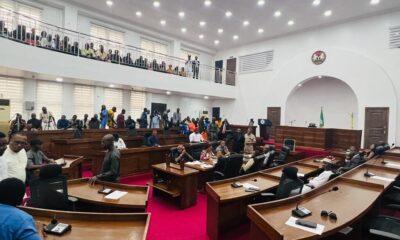
There is trouble in Abia State House of Assembly over the alleged election of a new speaker to replace Chinedum Orji.
A faction of the House presided over by the Deputy Speaker, Ifeanyi Uchendu, was said to have met and impeached Orji. They later elected Chukwudi Apugo, representing Umuahia East constituency, as a new speaker.
Former speaker of the House, Kennedy Njoku, had moved a motion which was seconded by Chijioke Chukwu, after accusing Orji of insensitivity to the welfare of the members, among sundry offences.
Two after hours after Apugo’s emergence, Orji stormed the Assembly complex and commenced sitting with his loyalists and suspended nine members including the new speaker.

They also elected Mandela Obasi as the new Deputy Speaker and Emeka Okoroafor as a new minority leader.

Those suspended are the deputy speaker, Ifeanyi Uchendu, and former speaker Chikwendu Kalu, Kennedy Njoku, Minority Leader Chijioke Chukwu,  Obinna Ichita, Okey Igwe, Thomas Nkoro and Aaron Uzodike.
The Majority Leader of the Assembly, Solomon Akpulonu, said the factional group lacked the required number to impeach the speaker and could not carry out an impeachment in a private building.
“You can’t impeach a speaker from the comfort of your home. If the speaker had committed any offence, the process of impeachment must be followed. But they went to a private building; the clerk of the House wasn’t present; they didn’t bring any motion to the House to consider; they didn’t have the required two thirds majority to impeach the Speaker. Some of the signatures of members were forged,” he said.

Abia State Governor Okezie Ikpeazu has offered to mediate in the crisis.
Ikpeazu said barely less than one month to the end of his administration and the ushering of a new administration, it would make no sense to engage in any issue likely to plunge the state into confusion.

In a statement by his Chief Press Secretary, Sir Onyebuchi Ememanka, the governor said his preoccupation was how to pilot the ship of state peacefully and steadily to the handover time as well as the completion of key projects.

He urged the Assembly to maintain the peace and allow reason and patriotism to guide their actions.

Confusion in Abia Assembly as two speakers emerge
 

Politics

Appeal Court Confirms Nenadi Usman as Labour Party Leader, Dismisses Abure’s Suit

Published

on

Labour Party National Chairperson, Nenadi Usman

Appeal Court Confirms Nenadi Usman as Labour Party Leader, Dismisses Abure’s Suit

The Court of Appeal has affirmed Nenadi Usman as the legitimate leader of the Labour Party, bringing to a close a protracted leadership crisis that has unsettled the party for months.

In a unanimous judgment delivered by a three-member panel, the appellate court dismissed an appeal filed by Julius Abure, describing it as lacking merit. The court upheld an earlier ruling of the Federal High Court, which recognised Usman as the party’s leader.

The case stemmed from Abure’s challenge to a January 2026 judgment of the Federal High Court in Abuja, which had reaffirmed the position earlier taken by the Supreme Court of Nigeria. The apex court had nullified the Labour Party convention that returned Abure as National Chairman, effectively invalidating his claim to the position.

Delivering the lead judgment, Justice Oyejoju Oyewumi held that the matter had already been conclusively determined by the Supreme Court, stressing that there was no legal basis to reopen the issue. The panel unanimously agreed that the appeal lacked substance.

The appellate court also upheld the directive compelling the Independent National Electoral Commission (INEC) to recognise Usman as the party’s leader, ruling that the Federal High Court acted within its constitutional authority in mandating the electoral body to perform its statutory duties.

On the question of party leadership, the court endorsed the caretaker committee headed by Usman, describing it as a necessary and pragmatic measure to address the leadership vacuum within the party at the time.

The judges further criticised Abure for what they termed an abuse of court process, accusing him of forum shopping by pursuing the same matter in different courts despite a clear and binding decision from the Supreme Court. They held that his continued claim to the leadership position was in defiance of an already settled legal position.

Consequently, the court dismissed the appeal in its entirety and imposed a cost of N10 million against Abure, describing the suit as a waste of judicial time.

Reacting to the judgment, Usman hailed the ruling as a victory for democracy and the rule of law, commending the judiciary for its firmness. She expressed appreciation to party members and supporters for their patience during the crisis and called on stakeholders to unite in rebuilding the party ahead of its forthcoming congresses and national convention.

The Labour Party leadership also urged Nigerians to continue supporting the party as it intensifies preparations for the 2027 general elections.


Appeal Court Confirms Nenadi Usman as Labour Party Leader, Dismisses Abure’s Suit

Continue Reading

Politics

House of Reps Hit by Massive Defections as PDP Loses Five Members

Published

on

House of Reps

House of Reps Hit by Massive Defections as PDP Loses Five Members

Nigeria’s political landscape witnessed another round of realignments on Tuesday as members of the House of Representatives defected from major political parties, including the Peoples Democratic Party (PDP), All Progressives Congress (APC), and Labour Party (LP), in a move linked to internal party crises and preparations for the 2027 general elections.

During plenary after the Easter break, Deputy Speaker Benjamin Kalu formally read out a series of defection letters, confirming shifts involving lawmakers across multiple constituencies. The development saw the PDP lose five members in a single sitting, while other parties also recorded gains and losses.

Kalu, however, dismissed concerns that the growing trend signals a drift toward a one-party state, arguing that the movements reflect constitutional political freedom.

“This is to show the country that no party is stifled. People are leaving the majority party to the minority parties and the minority parties for the majority party. This is the beauty of democracy,” he said.

READ ALSO:

One of the notable defections was from Lagos State, where Thaddeus Attah of Eti-Osa Federal Constituency left the Labour Party for the African Democratic Congress (ADC). In his letter, he cited the ongoing leadership crisis within the LP as a key reason for his decision, saying it had hindered effective representation of his constituents.

The PDP recorded the most significant losses in the latest wave. Abubakar Abdul from Niger State defected to the APC, while Yakubu Noma from Kebbi State joined the ADC. Another lawmaker from Kebbi State, Ibrahim Mohammed, also moved to the APC.

In Osun State, Mudashiru Alani (Ayedire/Iwo/Ola-Oluwa) and Adetunji Olusoji (Odo-Otin/Ifelodun/Boripe) exited the PDP for the Accord Party, further weakening the party’s presence in the lower chamber.

The APC also suffered setbacks, as David Fuoh from Taraba State defected to the PDP, while Bashir Zubair from Kaduna State joined the ADC, highlighting the two-way nature of political defections in Nigeria’s National Assembly.

The latest realignments have been largely attributed to unresolved leadership disputes within major opposition parties, particularly the PDP and LP, as well as strategic repositioning ahead of the 2027 elections.

Since the inauguration of the 10th National Assembly in 2023, the APC has maintained numerical dominance in the House, while opposition parties continue to struggle with internal divisions, prompting frequent defections and coalition discussions.

Political analysts say the growing visibility of smaller parties such as the ADC signals a gradual reshaping of Nigeria’s political space, as lawmakers increasingly explore alternative platforms beyond the traditional APC–PDP rivalry.

The House adjourned plenary to Wednesday in honour of Kano lawmaker Hassan Danjuma, who passed away on April 10, 2026, at the age of 66.

House of Reps Hit by Massive Defections as PDP Loses Five Members

Continue Reading

Politics

APC Releases 2027 Election Timetable, Fixes Presidential Form at N100 Million

Published

on

All Progressives Congress (APC)

APC Releases 2027 Election Timetable, Fixes Presidential Form at N100 Million

The All Progressives Congress (APC) has released its official timetable and schedule of activities ahead of the 2027 general elections, outlining key dates for party primaries and detailing the cost of nomination and expression of interest forms for various elective offices.

In a statement issued on Monday night and signed by the party’s National Organising Secretary, Sulaiman Argungu, the ruling party confirmed the full breakdown of fees for presidential, governorship, and legislative aspirants.

According to the schedule, the presidential expression of interest form is pegged at N30 million, while the nomination form costs N70 million, bringing the total to N100 million for aspirants seeking the party’s highest ticket.

For the governorship race, aspirants will pay N10 million for expression of interest and N40 million for the nomination form. Senate aspirants are required to pay N3 million and N17 million, while House of Representatives aspirants will pay N1 million and N9 million respectively.

At the state level, aspirants seeking seats in the State Houses of Assembly will pay N1 million for expression of interest and N5 million for nomination forms.

The APC also announced concessions for specific categories, stating that female aspirants, youths, and persons with disabilities will pay the full expression of interest fee but only 50 percent of the nomination fee, in a move aimed at promoting inclusion within the party’s internal electoral process.

READ ALSO:

Primary election timetable released

The party also confirmed dates for its primary elections ahead of the 2027 polls. According to the timetable:

  • Presidential primary: May 15–16
  • House of Representatives primary: May 18
  • Senate primary: May 20
  • State House of Assembly primary: May 21
  • Governorship primary: May 23

The schedule signals the formal start of internal political activities within the APC as aspirants begin mobilisation for party tickets ahead of the general elections.

Political implications

Analysts say the release of the timetable marks a major step in Nigeria’s 2027 election cycle, with the APC setting the pace for other political parties to follow.

The cost of nomination forms—particularly the N100 million presidential ticket—is already generating public debate, with concerns around affordability, political inclusion, and youth participation in governance.

With President Bola Ahmed Tinubu expected to complete his first term by 2027, the timetable is likely to trigger increased political activity within the ruling party as aspirants begin consultations and alliances.

The APC stated that the structured timetable is designed to ensure a smooth, transparent, and orderly selection process in line with internal party regulations and national electoral expectations.

APC Releases 2027 Election Timetable, Fixes Presidential Form at N100 Million

Continue Reading
HostArmada Affordable Cloud SSD Shared Hosting
HostArmada - Affordable Cloud SSD Web Hosting

Trending