

International
Dozens of bodies found in Gaza City neighbourhood, Palestinian rescuers say
Dozens of bodies found in Gaza City neighbourhood, Palestinian rescuers say
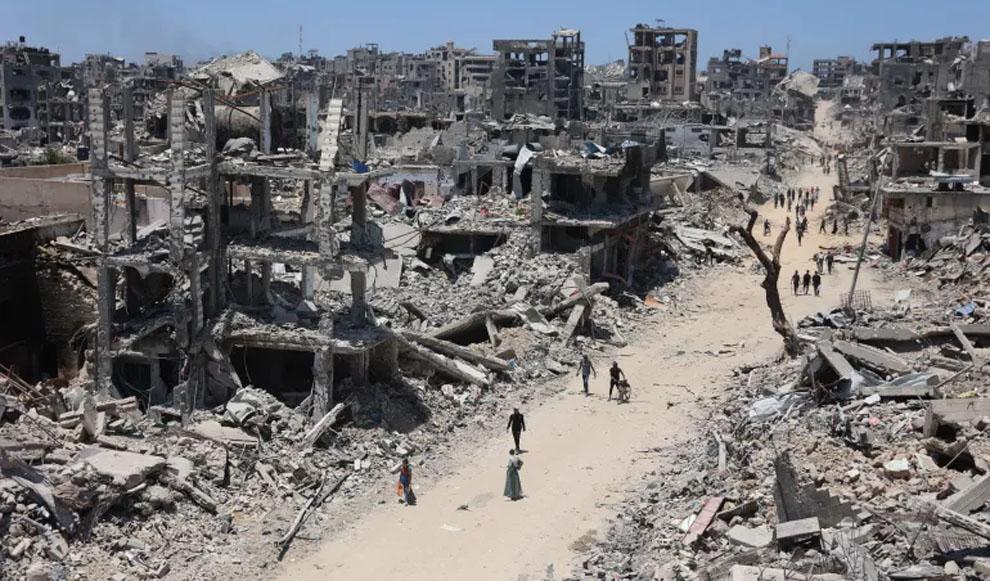
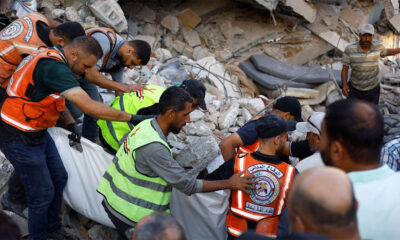
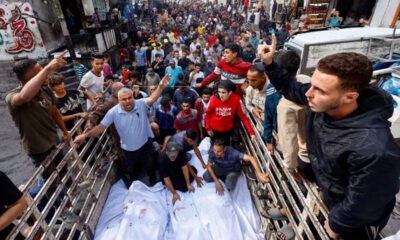
The bodies of dozens of Palestinians have been retrieved from the Tal al-Hawa neighbourhood after Israeli forces withdrew from parts of Gaza City, Palestinian rescue workers have said.
“The Gaza civil defence teams moved in to rescue survivors. They found dozens killed. Most of those killed are families, women, and children. Some bodies were eaten by dogs,” Gaza’s civil defence spokesperson Mahmoud Basal said on Friday.
“At least 60 bodies were counted. Some bodies were buried on the spot. Others were taken to nearby hospitals.”
Israeli forces had entered the neighbourhood this week after ordering civilians to evacuate on Monday.
“Many bodies are still under the rubble. The Israeli forces are stationed nearby and the rescue efforts are interrupted regularly,” Basal said.
The discovery has come after Israeli forces withdrew from Gaza City’s Shujayea neighbourhood. On Thursday, Basal said civil defence teams recovered dozens of bodies from there, as well, adding that the neighbourhood has become uninhabitable.
“Documented testimonies” have been taken that Israeli forces opened fire on residents in the neighbourhood despite being located on designated evacuation routes, he said.
Home to more than a quarter of Gaza’s residents before the war, Gaza City was largely razed to the ground in late 2023, but hundreds of thousands of Palestinians had returned to homes in the ruins before Israel once again ordered them to leave.
Hamas, the Palestinian group that governs Gaza, accused Israeli forces of “atrocities” and called for international accountability. In a statement, the group accused Israel of committing “heinous abuses” in Gaza City.
READ ALSO:
- LASTMA denies being responsible for body found hanging on tree
- Eight Chinese remanded in Kuje prison over illegal mining
- Tinubu appoints Dantsoho as new NPA MD, Adeyeye board chairman
“The atrocities revealed after the terrorist occupation army’s withdrawal from Tal al-Hawa in southwest Gaza City, after days of incursion and intense bombing that targeted all aspects of life, are war crimes of genocide and ethnic cleansing,” Hamas said.
It called on the UN and international community to take immediate steps to end a “war of extermination” that Israel is waging against Palestinians.
‘Stalling’ ceasefire talks
As Israeli forces step up attacks in Gaza’s north, they have also continued targeting areas in the besieged enclave’s south.
In Khan Younis, an Israeli air raid killed at least four aid workers from UK humanitarian organisation Al-Khair Foundation.
They were “targeted in a distribution point where they were preparing to distribute aid in Khan Younis,” Al Jazeera’s Hind Khoudary, reporting from Deir el-Balah, said.
“Al-Khair Foundation has been working in the Gaza Strip since day one, trying to provide people with food assistance, and with a lot of other commodities, and we lost another four aid workers today,” Khoudary said.
This is not the first time that Israeli forces have targeted aid workers. In April, seven people working with the United States-based NGO World Central Kitchen (WCK) were killed in an Israeli air raid in Gaza.
At the time, Israel’s military said the attack on the WCK team’s convoy was a “grave mistake” and pledged to protect aid workers.
Mediators are still trying to reach a ceasefire deal that would free Israeli captives in return for Palestinians jailed by Israel.
On Friday, a senior Hamas official blamed Israel for a failure to build on the momentum created when the group dropped a key demand in the US-drafted ceasefire offer a week ago to clear the way for a deal.
“Israel hasn’t given a clear stance over Hamas proposal,” the official, who asked not to be named, told the Reuters news agency, accusing Israel of “stalling and wasting time”.
Israeli Prime Minister Benjamin Netanyahu said on Thursday he remained committed to the Gaza ceasefire framework and accused Hamas of making demands that contradicted it, without saying what those demands were.
Two Egyptian sources said on Thursday that talks had made progress but security arrangements and ceasefire guarantees were still being worked on.
Dozens of bodies found in Gaza City neighbourhood, Palestinian rescuers say










International
Ninth Body Discovered in South Africa: Nigeria Issues Urgent Safety Alert to Nationals
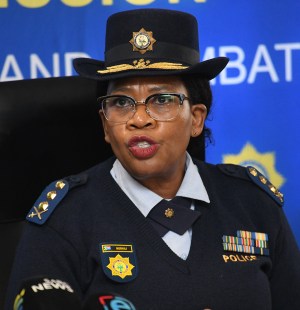
Ninth Body Discovered in South Africa: Nigeria Issues Urgent Safety Alert to Nationals
Police cordon off Kempton Park and post a $56,000 combined bounty as the Nigerian Consulate warns citizens to exercise heightened vigilance.
South African police recovered the body of a ninth woman on Thursday along a roadside in Dawn Park, intensifying public alarm and prompting the Nigerian Consulate-General in Johannesburg to issue an emergency safety advisory to its citizens.
In response to the discoveries, law enforcement teams placed Kempton Park in the Ekurhuleni municipality under lockdown and established roadblocks to inspect vehicles and restrict suspect movement.
Deputy Police Chief Tebello Mosikili declared during a press conference that authorities will deploy specialized investigative units to track down those responsible.
To accelerate breakthroughs, police offered a 400,000 rand ($25,000) reward for credible tips, while South Africa’s Democratic Alliance provided an additional $31,000, establishing a combined bounty of $56,000.
Detectives are now evaluating forensic evidence to determine whether one perpetrator committed the murders or whether independent offenders copied earlier attacks.
Meanwhile, the Nigerian Consulate-General urged Nigerian residents, especially women and young people who commute, exercise, or study around Ekurhuleni, to take deliberate personal precautions.
The mission advised community members to travel in groups, stay clear of isolated trails, and share real-time travel details with trusted family members.
Furthermore, diplomatic officials emphasized that safety precautions must not shift the burden of crime prevention onto women, calling on South African authorities to ensure thorough investigations and justice for every victim.
Ninth Body Discovered in South Africa: Nigeria Issues Urgent Safety Alert to Nationals
Health
Fiji Declares National HIV Emergency as Diagnoses Surge Sixteenfold
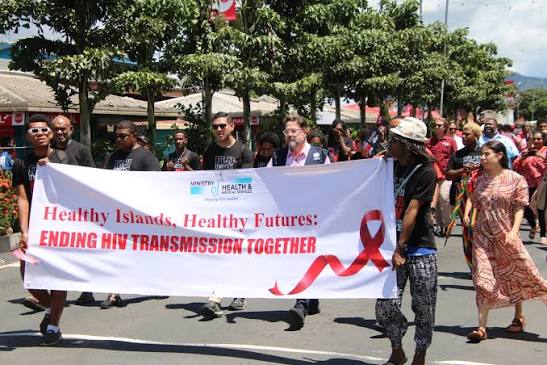
Fiji Declares National HIV Emergency as Diagnoses Surge Sixteenfold
Authorities launch a multi-agency public health campaign to expand free testing, treatment, and harm-reduction services
Fiji has announced a nationwide health response to address a significant rise in HIV cases and ensure that all residents can access essential medical care.
On Wednesday, Health Minister Dr. Atonio Lalabalavu shared the emergency declaration, explaining that national agencies are joining forces to provide rapid medical support, expand testing, and protect community well-being across the islands.
Official reports indicate that about one in every 60 adults in Fiji currently lives with HIV, following an increase in new infections over recent years. Health specialists explain that the virus spreads primarily through intimate sexual contact and shared needles among individuals using illicit substances.
Additionally, routine screenings revealed that two out of every 100 expecting mothers carry the virus, highlighting an urgent need for early maternal healthcare to protect newborns from infection.
To safeguard public health, authorities are delivering free daily treatments, distributing protective preventive medications, and setting up clean needle programs to stop infections before they start.
Furthermore, global partners, including Australia, New Zealand, India, and United Nations health bodies are providing financial resources and medical supplies to back the local effort.
By encouraging open community conversations and delivering accessible healthcare without judgment, health workers aim to ensure that everyone receives the care and dignity they deserve.
Fiji Declares National HIV Emergency as Diagnoses Surge Sixteenfold
International
Kim Yo-jong: Only ‘Idiots’ Think North Korea Will Give Up Nuclear Weapons

-

 International2 days ago
Islamic Council Condemns Attempted Attack on Holy City of Mecca
-

 metro3 days ago
Lagos Power Outage: Ikeja Electric Blames TCN as Businesses, Homes Groan
-
 News2 days ago
Keep Politics Out of My Office — Ogbomoso Grand Chief Imam Warns Politicians, Bloggers
-

 metro2 days ago
Niger Mosque Abductions: Terrorists Execute 30 of 500 Captive Muslim Worshippers
-

 International3 days ago
US Court Blocks Trump Visa Rule Limiting Stay of Foreign Students, Journalists
-

 Entertainment2 days ago
BREAKING: Olu Jacobs Dies at 84, Atiku Mourns Cultural Icon
-
 metro3 days ago
Fatal NURTW Leadership Clash in Osun Leaves Two Dead; State Orders Park Shut Down
-

 Business1 day ago
Fuel Prices Climb to ₦1,500 per Litre Across Nigeria, Sparking Calls for Urgent Action