

metro
EFCC, Sowore clash over unnamed owner of 753 forfeited Abuja duplexes
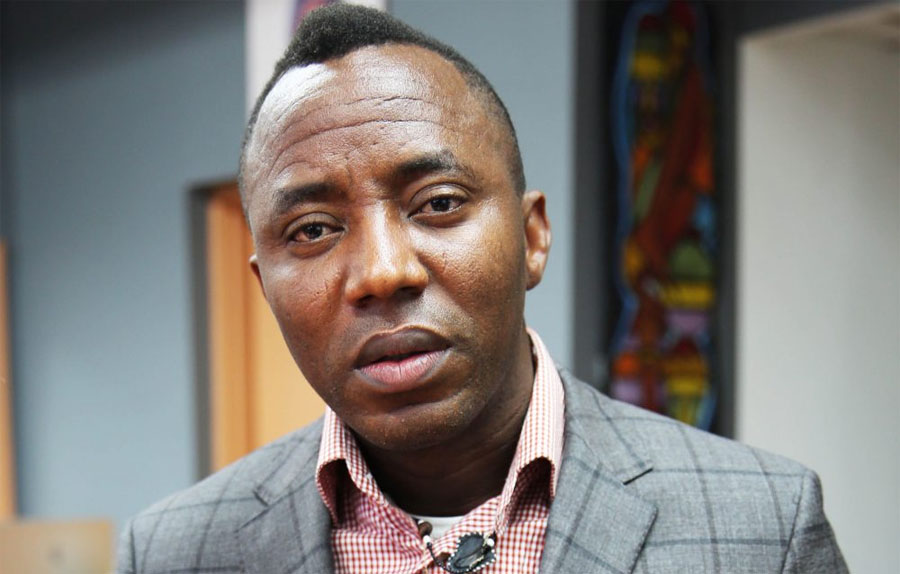
EFCC, Sowore clash over unnamed owner of 753 forfeited Abuja duplexes
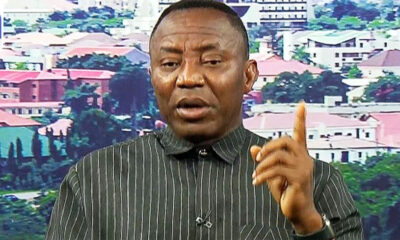
The Economic and Financial Crimes Commission (EFCC) and the former presidential candidate of the African Action Congress (AAC), Omoyele Sowore, on Tuesday locked horns over non-disclosure of the identity of an alleged former government official who owned the forfeited 753 units of duplexes in Abuja.
While Sowore said the anti-graft agency was doing Public Relations (PR) for those whom he described as “criminals”, the EFCC said the activist was unpatriotic for not joining other Nigerians in commending the commission for the “landmark recovery”.
Daily Trust reports that the commission had on Monday announced that Justice Jude Onwuegbuzie of the Federal Capital Territory High Court forfeited an Abuja estate measuring 150,500 square metres containing about 753 units of duplexes and other apartments to the government.
The commission said the forfeited property, located on Plot 109 Cadastral Zone C09, Lokogoma District, Abuja, belonged to an undisclosed government official, adding that it was the single largest asset recovery since its inception in 2003.
But reacting to the non-disclosure of the owner’s identity, Sowore lampooned the commission for not revealing the identity of the owner, saying they are afraid of big thieves.
“What is the name of the ‘former top brass’ with 753 duplexes seized by the EFCC in Abuja? The @officialEFCC is now doing PR for thieves. They seized this large estate with 753 duplexes from a single individual in Abuja but can’t mention his or her name.
READ ALSO:
- Imo: Security operatives dislodge notorious IPOB Commander, Ifeanyi Okorienta, gang members
- Switzerland to extend work visa quotas for foreign workers in 2025
- S/Africa offers Nigerians 5-year visa policy without passport
“If it is Yahoo boys, they will line laptops and Nokia phones in front of them and send their photos globally even before their trial is commenced. The same EFCC is now AFRAID of BIG Thieves!”, Sowore wrote in a post on his official social media handles.
In a swift reaction, the EFCC said what it did was in line with the laws that established the commission, saying it did not mention the name of the owner because substantive criminal investigation on the matter was ongoing.
The spokesman of the anti-graft agency, Dele Oyewale, told journalists that it would be unprofessional of the EFCC to go to town by mentioning names of individuals whose identities were not directly linked to any title document of the properties.
Oyewale said, “EFCC is following with keen interest, the flurry of reactions to its record-breaking recovery of 753 duplexes and other apartments on Plot 109 Cadastral Zone C09, Lokogoma District, Abuja.
“The commentaries of reform-minded Nigerians to the Commission’s painstaking efforts in securing the final forfeiture of the Estate to the Federal Government of Nigeria, are appreciated.
“However, the denigration of such efforts by Omowole Sowore and his think-same and act-same, is unacceptable and grossly un-charitable.
“The allegation of cover up of the identity of the promoters of the Estate stands logic on the head in the sense that the proceedings for the forfeiture of the Estate were in line with Section 17 of the Advance Fee Fraud Act which is a civil proceeding that allows for action-in-rem rather than action-in-personam.
“The former allows legal actions against a property and not an individual, especially in a situation of an unclaimed property. This Act allows you to take up a forfeiture proceeding against a chattel that is not a juristic person. This is exactly what the Commission did in respect of the Estate.
“The proceedings that yielded the final forfeiture of the Estate were products of actionable intelligence available to the Commission.
“The company flagged by our investigations denied ownership of the Estate following publications made in leading national newspapers.
“On the basis of this, the Commission approached the court for an order of final forfeiture which Justice Jude Onwuegbuzie of the Federal Capital Territory High Court granted on Monday, December 2, 2024.
“The expectation of the EFCC from citizen Sowore is a patriotic appreciation of its efforts in securing such a landmark forfeiture. It is shocking that the activist is not concerned about the systemic lassitude and unhelpful permissiveness that allowed such a monstrous corrupt act in the first instance.
“Nigerians should gear up more against lapses and loopholes in our system that continue to make the nation vulnerable to corrupt tendencies. The EFCC will continue to safeguard the financial space of the nation against manipulators and organised brigandage.”
He added that the EFCC is unwavering in its no-sacred-cow approach to every matter and together we will make Nigeria greater.
EFCC, Sowore clash over unnamed owner of 753 forfeited Abuja duplexes







metro
FG Declares Thursday Public Holiday for Nigeria’s 66th Independence Anniversary
FG Declares Thursday Public Holiday for Nigeria’s 66th Independence Anniversary
The Federal Government has declared Thursday, October 1, 2026, a public holiday to mark Nigeria’s 66th Independence Anniversary.
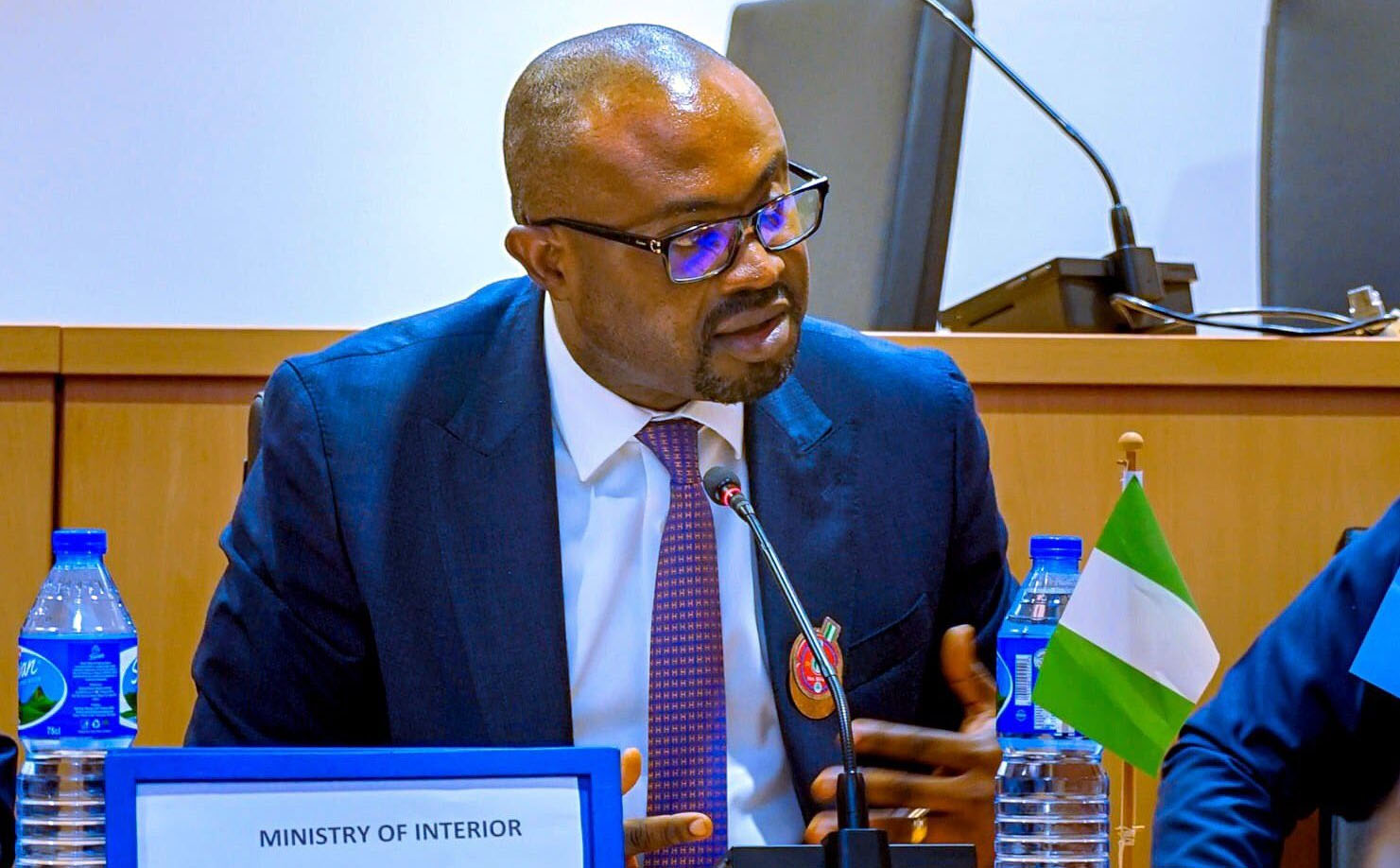
The Minister of Interior, Olubunmi Tunji-Ojo, announced the declaration on behalf of the Federal Government on Wednesday, congratulating Nigerians at home and abroad on the national celebration.
The minister urged Nigerians to use the occasion to promote national unity, patriotism, peaceful coexistence and mutual respect, while reflecting on the sacrifices of the country’s founding fathers and heroines.
Tunji-Ojo said peace and stability remained important to national development and called on citizens to remain committed to building a stronger and more prosperous Nigeria.
The minister also assured Nigerians that the Federal Government remained committed to strengthening national security, improving public safety and creating an environment where citizens could live and work with confidence.
The 2026 celebration marks 66 years of Nigeria’s independence, following the country’s attainment of independence from British colonial rule on October 1, 1960.
READ ALSO:
- Flood Cuts Off Part of Agbarho-Ughelli Road, Strands Commuters in Delta
- Dangote Draws Battle Lines as Fuel Import Fight Heads Back to Court
- Tinubu Returns After 30 Days in Europe, Says ‘I’m Healthy and Ready to Work’
The Federal Government is marking the anniversary under the theme, “From Reforms to Stability: Consolidating Nigeria’s Renewed Hope for Shared Prosperity.” The anniversary programme was earlier announced as a low-key celebration.
As part of the programme, an Independence Day Public Lecture is scheduled for Wednesday, September 30, while President Bola Ahmed Tinubu is expected to deliver a nationwide broadcast on Thursday, October 1.
The President is also expected to participate in other anniversary activities in Lagos, including the premiere of a documentary on the late businessman and politician MKO Abiola at the National Theatre.
The Federal Government has urged Nigerians to use the Independence Day celebration to reflect on the country’s journey since 1960 and renew their commitment to a united and peaceful Nigeria.
The October 1 public holiday applies nationwide, giving workers and other citizens an official day off to commemorate Nigeria’s Independence Day.
FG Declares Thursday Public Holiday for Nigeria’s 66th Independence Anniversary
metro
Five Remanded Over ‘Tinubu Must Go’ T-Shirts in Borno

Five Remanded Over ‘Tinubu Must Go’ T-Shirts in Borno
Five men have been remanded in custody in Maiduguri, Borno State, after they were arraigned over the alleged printing and wearing of “Tinubu Must Go” T-shirts.
The defendants — Baba Aji Gremami, 44; Mustapha Abba Yemen, 28; Abbacha Mohammed Ali, 32; Adam Umar Gubio, 21; and Abdulhamid Mohammed, 21 — were arrested on September 25 around the West End Roundabout area of Maiduguri, according to a First Information Report issued by the State Criminal Investigation Department.
Police alleged that the five men conspired to print and wear the T-shirts bearing the inscription “Tinubu Must Go”, with the intention of causing a breach of public peace in the area.
They were subsequently charged with criminal conspiracy, inciting disturbance, disturbance of public peace and thuggery under Sections 60, 78, 79 and 392 of the Borno State Penal Code.
The defendants appeared before the Chief Magistrate Court I in Maiduguri and pleaded not guilty to the allegations. Their lawyers subsequently applied for bail.
The court remanded the five men in custody and adjourned the matter to October 6, 2026, for a ruling on the bail application. The substantive case was also listed for October 26, 2026.
The police case centres on the alleged intention behind the production and wearing of the shirts, with the authorities maintaining that the conduct was capable of causing a breach of public peace. The charges, rather than the political slogan alone, form the basis of the criminal proceedings.
READ ALSO:
- Flood Cuts Off Part of Agbarho-Ughelli Road, Strands Commuters in Delta
- Dangote Draws Battle Lines as Fuel Import Fight Heads Back to Court
- Tinubu Returns After 30 Days in Europe, Says ‘I’m Healthy and Ready to Work’
The arrests have generated controversy, particularly over the balance between freedom of expression and public-order laws.
Amnesty International condemned the detention, arguing that wearing a shirt expressing political dissent should not, by itself, constitute a criminal offence. The organisation called for the men’s release and urged the authorities to protect the rights to freedom of expression and association.
The African Democratic Congress (ADC) in Borno State also condemned the arrests. The party said the men were being detained for expressing a political opinion and called for their immediate release. The party’s position is separate from the police allegations before the court.
There have also been claims that the arrests were politically directed, including an allegation that a senior political figure in Borno ordered the action. However, such claims have not been independently established, and the police report cited in the case does not establish that a political figure ordered the arrests.
The development comes as political activity increases ahead of the 2027 general elections, with opposition parties and supporters using different platforms to express criticism of the Federal Government and promote alternative political positions.
The case has consequently drawn attention to the application of freedom of expression, political dissent and public-order laws in Nigeria.
For now, the five men remain defendants in an ongoing criminal case. They have pleaded not guilty, and the allegations against them have yet to be determined by the court.
Five Remanded Over ‘Tinubu Must Go’ T-Shirts in Borno
metro
FG Targets 24-Hour Electricity in Lagos, Abuja, Kano, Others
FG Targets 24-Hour Electricity in Lagos, Abuja, Kano, Others
The Federal Government has begun discussions with electricity distribution companies on plans to establish Energy Zones aimed at delivering stable 24-hour electricity supply to homes, businesses and industries in major high-demand areas across Nigeria.
The proposed zones will initially focus on the Lagos axis, Abuja-Kaduna-Kano corridor and Enugu-Port Harcourt corridor, according to the Minister of Power, Joseph Tegbe.
Tegbe disclosed the plan after a strategic meeting with the leadership of selected electricity distribution companies (DisCos) as the government intensifies efforts to improve reliability across the power sector.
The proposed Energy Zones are designed to address bottlenecks at the distribution end of the electricity supply chain and ensure that more of the power generated and transmitted through the national grid reaches consumers.
Tegbe said the country’s power challenge extends beyond generation and transmission, stressing that the ability of distribution companies to take up available electricity and deliver it to homes, businesses and industries remains a major constraint.
He said the proposed zones would help close that gap, unlock additional commercial and industrial demand and improve the revenue and collection performance of DisCos.
The government also plans to expand electricity infrastructure in high-demand areas so that supply capacity can grow alongside the needs of Nigeria’s expanding economy.
The Energy Zones proposal comes as the government reports recent improvements in electricity generation and transmission. Tegbe said generation and transmission had risen above 5,000 megawatts (MW) in recent weeks, compared with about 3,700MW to 4,700MW before June, with generation reaching a reported peak of 5,330MW in August and September.
READ ALSO:
- Flood Cuts Off Part of Agbarho-Ughelli Road, Strands Commuters in Delta
- Dangote Draws Battle Lines as Fuel Import Fight Heads Back to Court
- Tinubu Returns After 30 Days in Europe, Says ‘I’m Healthy and Ready to Work’
However, the minister has acknowledged that higher national generation figures do not automatically translate into reliable electricity for every community because of problems across the transmission and distribution networks.
The government has therefore been prioritising infrastructure repairs and upgrades along major electricity corridors. Tegbe previously said transformers commissioned at Apapa, Ijora, Alausa and Lekki in Lagos had unlocked 672MW of transmission capacity, while a 300MVA transformer at Katampe in Abuja added another 240MW.
The government has also been working to increase electricity metering. Tegbe said about 350,000 meters were installed during his first 100 days in office, bringing cumulative installations to more than one million by August 2026.
He also said the resolution of legal issues surrounding the AMMON smart-meter programme had cleared the way for procurement of about 1.4 million additional smart meters.
The minister has identified the Lagos, Enugu-Port Harcourt and Abuja-Kaduna-Kano corridors as priority areas for stabilisation, alongside plans for a proposed Transmission Super Grid.
The focus on Lagos reflects the state’s substantial industrial and commercial electricity demand. The Federal Government has been conducting technical assessments along major industrial corridors, including the Lagos-Sagamu corridor, to identify infrastructure problems affecting power delivery.
The government has also been pursuing targeted projects to improve electricity supply to industrial areas. In Abuja, Tegbe said the Idu Industrial Area was being targeted for a 50MW electrification project, with the first 10MW phase expected by December 2026 and the remaining capacity planned for 2027.
The proposed Energy Zones are expected to complement such targeted interventions by concentrating infrastructure and distribution improvements in areas where electricity demand is already high.
The initiative is also expected to support manufacturing, businesses and industrial production, with the government linking more reliable electricity to economic growth, job creation and industrialisation.
However, the Federal Government has not announced a specific implementation date, capacity target or detailed infrastructure investment plan for the proposed Energy Zones. The 24-hour electricity supply therefore remains a government target under the initiative and should not be interpreted as a guarantee that consumers in Lagos, Abuja, Kano or the other identified areas will immediately receive uninterrupted power.
The proposed zones also come against the backdrop of continuing financial and operational challenges in the electricity market. Tegbe said the government had mobilised about N1.23 trillion to address part of the sector’s accumulated debt burden.
He has also said the government currently has no plan to increase electricity tariffs, with the immediate focus instead on improving supply reliability, strengthening infrastructure, metering consumers and addressing financial weaknesses across the power value chain.
The minister has acknowledged that many Nigerians are still without reliable electricity, despite reported improvements in generation and transmission. He said the government would continue to focus on incremental improvements rather than promise a quick solution to the sector’s longstanding problems.
Representatives of the Abuja Electricity Distribution Company (AEDC), Ikeja Electric, Eko Power, Ibadan Electricity Distribution Company (IBEDC) and Sahara Energy Group participated in the latest discussions on the proposed Energy Zones.
The Federal Government now intends to work with the participating electricity companies on strengthening distribution infrastructure and ensuring that available electricity can be delivered more efficiently to high-demand customers.
For consumers, the key issue will be whether the proposed investments can translate improvements recorded at the generation and transmission levels into more dependable electricity at the distribution and household level.
For now, the 24-hour electricity plan remains at the development and engagement stage, with the government yet to provide a firm rollout date or detailed specifications for the proposed Energy Zones.
FG Targets 24-Hour Electricity in Lagos, Abuja, Kano, Others
-

 metro2 days ago
Osogbo Food Bonanza Turns Nightmare as Discount Vendor Vanishes With Customers’ Millions
-

 metro2 days ago
24 Hours in Darkness: Iju Ishaga Residents, Businesses Count Losses as Ikeja Electric Fails to Restore Power
-

 metro3 days ago
Passenger Dies After Jumping From Moving Bus In Lagos
-
 Politics3 days ago
APC Sweeps Enugu LG Election, Wins All 17 Chairmanship, 260 Councillorship Seats
-

 News2 days ago
Agbede Mourns Baba Alado, Says Mushin Has Lost Pillar of Peace
-
 Education1 day ago
FG Releases 2026–2028 Approved Textbooks, Introduces QR Codes for Tracking
-

 Sports1 day ago
Nigeria XI vs Guinea-Bissau: Awoniyi, Lookman, Adams Lead Super Eagles Attack
-
 News1 day ago
Breaking: Tinubu Ends Extended European Vacation, Departs Paris for Nigeria