
Africa
Guinea-Bissau military seizes power as army detains President amid election chaos
Guinea-Bissau military seizes power as army detains President amid election chaos
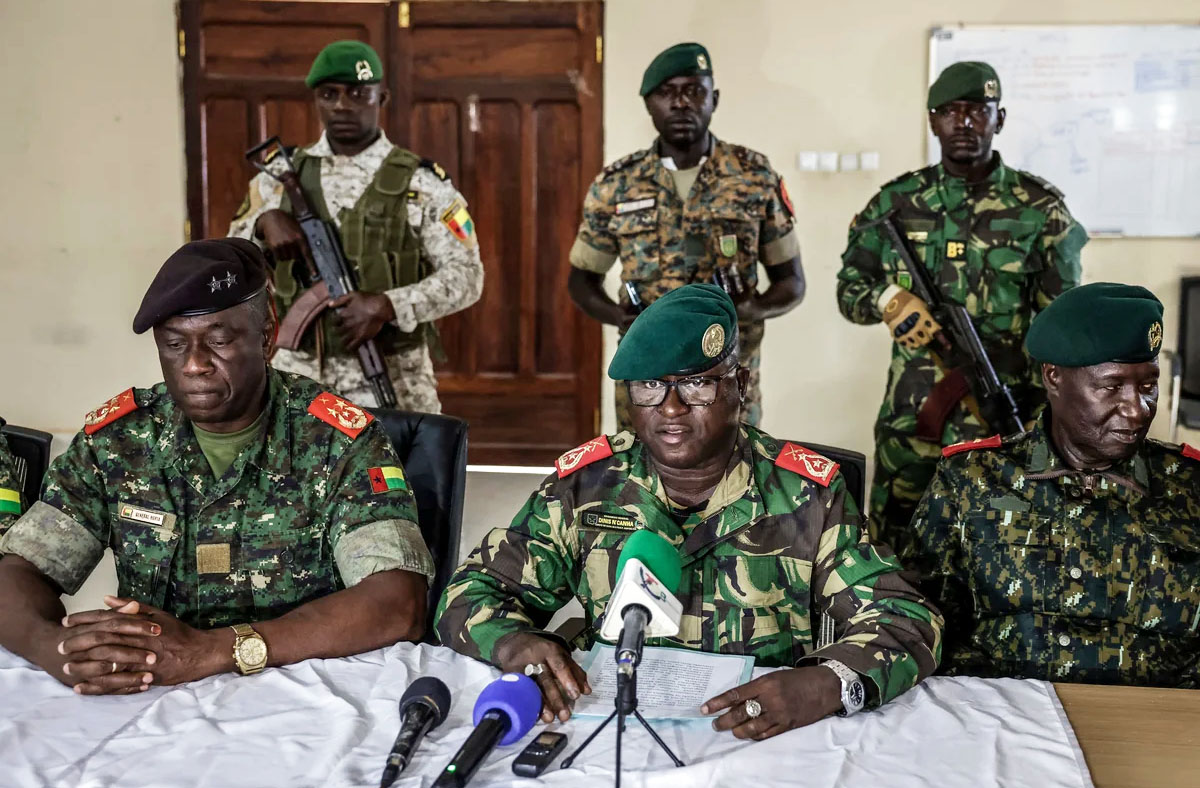
Guinea-Bissau has plunged into fresh political turmoil after a group of military officers announced they had taken control of the country, following the arrest of President Umaro Sissoco Embaló and heavy gunfire in the capital, Bissau.
The takeover occurred just days after a disputed national election marked by the disqualification of the leading opposition contender, heightening tensions across the nation. Though official results were expected on Thursday, both Embaló and his closest rival, Fernando Dias, declared themselves winners, further escalating uncertainty.
Residents reported hearing sustained gunshots around 13:00 GMT near key government buildings on Wednesday, prompting thousands to flee on foot and by vehicle as panic spread. The military later appeared on state television, claiming they had assumed authority to “restore stability” and accusing the government of undermining the electoral process.
READ ALSO:
- Tinubu Nominates New Non-Career Ambassadors for U.S., U.K., France
- Tinubu Unveils Electric Tricycle Scheme to Reduce Transport Costs, Create Youth Jobs
- Kogi Vigilantes Foil Bandit Attack at Kiri High School, Two Dead
According to reports, the mutinous officers have formed a new governing structure and sealed borders, imposing a curfew and suspending state institutions. Their actions mirror a growing pattern of military coups in West Africa, including recent takeovers in Niger, Mali, Burkina Faso and Guinea, deepening concerns over democratic backsliding in the region.
The presidency confirmed that Embaló was detained alongside senior security figures in what is now the third attempt to unseat him since he took power. Embaló had survived previous coup attempts in 2022 and 2023.
Home to fewer than two million citizens, Guinea-Bissau is one of the world’s poorest countries and has recorded nine coups or attempted coups since 1980, making it one of Africa’s most politically unstable states.
The latest upheaval underscores the fragility of institutions in the former Portuguese colony and adds to a growing list of crises rocking the West African sub-region, where political tensions, election disputes and military interventions have become increasingly common.
Guinea-Bissau military seizes power as army detains President amid election chaos





Africa
Starvation Cult Preacher Faces Expanded Murder, Terrorism Charges in Kenya
Starvation Cult Preacher Faces Expanded Murder, Terrorism Charges in Kenya
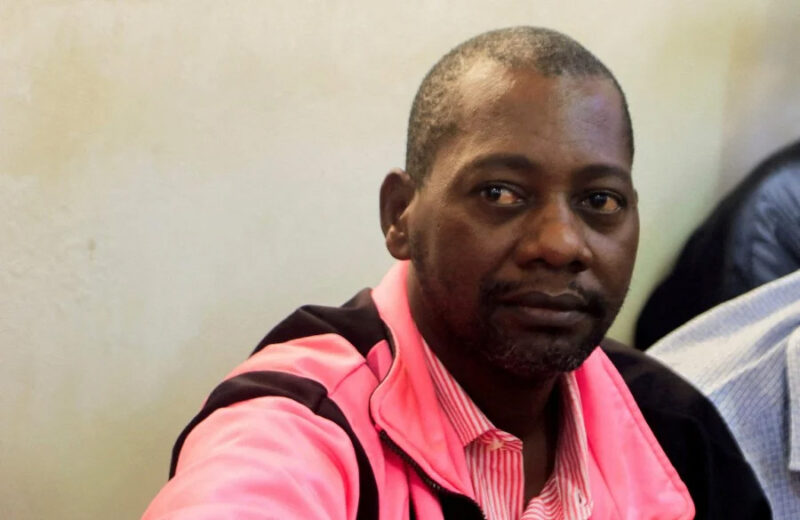
A Kenyan court has expanded charges against self‑proclaimed preacher Paul Nthenge Mackenzie and seven associates over the deaths of 52 more victims linked to the notorious Good News International Church starvation cult. The new charges come as part of ongoing investigations into one of the deadliest cult-related tragedies in Kenya.
Mackenzie, already facing trial in Mombasa for multiple counts of murder, manslaughter, and terrorism, appeared in court Wednesday with the seven co-accused. Prosecutors allege that even after his initial arrest in 2023, Mackenzie continued to influence followers through radical teachings, encouraging them to travel to Kwa Binzaro, where victims died from prolonged starvation.
Authorities say the additional 52 deaths occurred between January and July 2025, in shallow graves near Kwa Binzaro in Kilifi County. Prosecutors describe the group as a structured criminal sect, using extremist ideology to coerce followers into life-threatening practices. The defendants face charges including organized criminal activity, radicalization, and facilitating terrorism.
READ ALSO:
- Lagos Allocates 180 Shops to Displaced Alabarago Market Traders
- Cubana Chief Priest Vows to Oppose Peter Obi in 2027 Presidential Race
- US Lawmakers Introduce Bill to Sanction Kwankwaso, Miyetti Allah
All eight accused pleaded not guilty, and the next hearing is scheduled for March 4, 2026. Legal experts note that the expanded charges reflect the complexity of prosecuting cult-related killings and the ongoing effort to hold both leaders and their network accountable under Kenya’s legal system.
The Shakahola Forest case first drew global attention in 2023, when investigators discovered hundreds of bodies in shallow graves, following claims that Mackenzie had persuaded followers and children to starve themselves to “meet Jesus.” Over 400 victims were recovered from Shakahola, making it one of the worst cult-linked tragedies in modern Kenyan history.
Authorities warn that the expanded prosecution aims to dismantle the deadly network and prevent future tragedies, while sparking national debate about the regulation of fringe religious groups and doomsday cults in Kenya.
Starvation Cult Preacher Faces Expanded Murder, Terrorism Charges in Kenya
Africa
Nigeria Reopens Kebbi Borders With Benin, Niger

Nigeria Reopens Kebbi Borders With Benin, Niger
The Nigeria Customs Service (NCS) Area Command in Kebbi State has officially reopened the Kamba and Tsamiya borders in Dandi and Bagudo local government areas, enabling trade with the Republic of Benin and the Niger Republic. The move comes after the borders were closed for several years due to growing insecurity in border areas, affecting the movement of goods and disrupting bilateral trade.
The reopenings follow a series of talks and agreements between Nigeria and Benin, with clearance approved at the highest level of government. The Customs Area Comptroller in Kebbi State, Mahmud Matawalle Ibrahim, said the borders were reopened on presidential approval to facilitate the movement of legitimate goods through the Tsamiya border into Niger via the Kamba border in Kebbi.
According to Matawalle, the reopening has already allowed many trapped trucks from Benin to be cleared at Tsamiya, continuing their journey to the Niger Republic’s Tunga Jado border through Kamba. He emphasized that the initiative will boost trade, strengthen border security, and enhance economic cooperation between Nigeria and its neighbouring countries.
Matawalle highlighted that the Customs Service, in collaboration with border security agencies, is committed to maintaining agreements, ensuring the smooth operation of commercial activities, and preventing illegal cross-border activities. He added that this reopening will revive trade corridors, support local economies in border communities, and facilitate lawful transit of goods across West Africa.
The Kamba and Tsamiya corridors are crucial links for Nigeria’s regional trade network, allowing agricultural produce, manufactured goods, and other commodities to move efficiently between Nigeria, Benin, and Niger. The reopening is also expected to strengthen regional integration, improve supply chains, and reduce bottlenecks caused by previous border closures.
READ ALSO:
- Fuel Self-Sufficiency: Dangote Refinery Counters Misinformation on Petrol Imports
- “Electoral Act Amendment: El-Rufai Calls Akpabio ‘Tinubu’s Lapdog’”
- Lookman Reflects on Bittersweet La Liga Debut as Atletico Madrid Fall at Home
Officials noted that while trade will resume, strict compliance and security measures remain in place to ensure that only legitimate activities are conducted. The reopening marks a key milestone in Nigeria’s border management strategy, balancing economic growth, trade facilitation, and national security priorities.
How Nigeria’s Kebbi Border Reopening Will Affect Trade and Local Markets
The reopening of the Kamba and Tsamiya borders in Kebbi State to Benin and Niger is set to have immediate and long-term effects on regional trade, logistics, and border communities:
-
Boost to Cross-Border Trade
Traders can now legally move agricultural produce, manufactured goods, and essential commodities from Nigeria to Benin and Niger. Trucks that were previously stranded at border posts are now being cleared, reducing delays and losses for businesses. -
Revival of Transit Corridors
The Tsamiya border (Bagudo) and Kamba border (Dandi) serve as key transit routes. Goods from Benin can now pass through Tsamiya and reach Niger at the Tunga Jado border, creating a smoother flow of trade across West Africa. -
Support for Local Economies
Border communities in Kebbi and neighbouring regions rely heavily on trade for income. Reopening the borders is expected to revive local markets, create jobs, and stimulate small-scale businesses that depend on cross-border commerce. -
Enhanced Security and Compliance
The Customs Service and security agencies are monitoring trade activities to ensure only legitimate goods move across borders. This aims to reduce smuggling, trafficking, and other illegal activities, while maintaining safe commercial operations. -
Reduced Logistic Bottlenecks
The reopening clears hundreds of trucks previously stuck at the borders, saving time and transport costs for traders and logistics companies. This also ensures a steady supply of goods for Nigerian and regional markets. -
Strengthened Regional Integration
By facilitating smoother trade with Benin and Niger, Nigeria contributes to ECOWAS objectives of free movement, economic cooperation, and regional market growth. The borders now function as cooperation corridors rather than restricted zones.
The Kebbi border reopenings are expected to revive trade, improve livelihoods, reduce delays, and strengthen regional economic ties, while keeping security a top priority.
Nigeria Reopens Kebbi Borders With Benin, Niger
Africa
Electoral Malpractice: President Mahama Orders Immediate Recall of Ghana’s High Commissioner to Nigeria
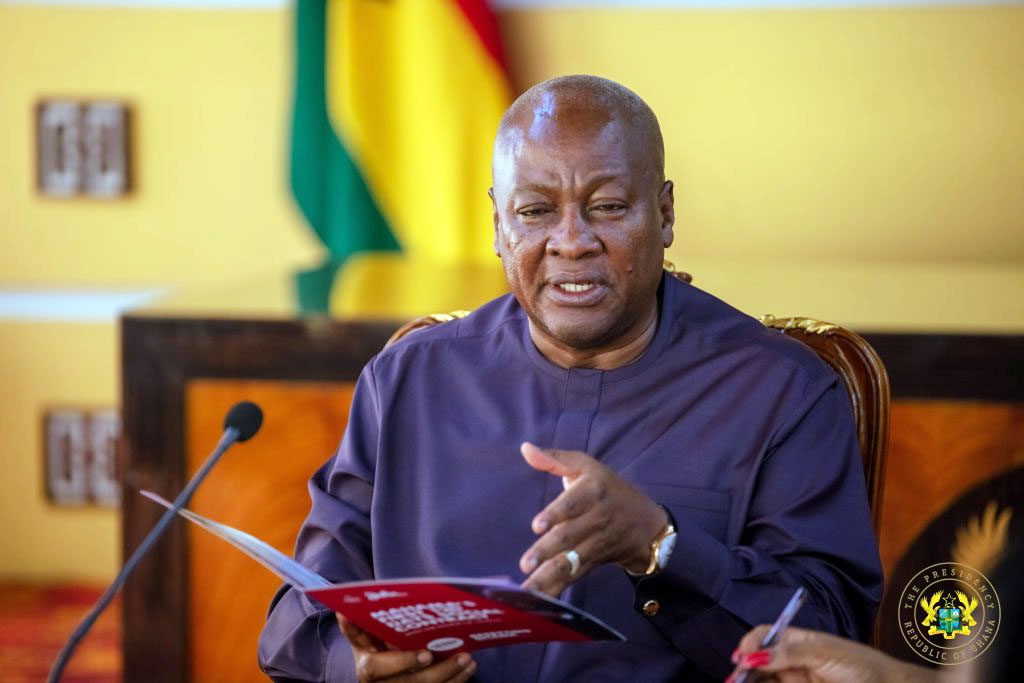
Electoral Malpractice: President Mahama Orders Immediate Recall of Ghana’s High Commissioner to Nigeria
President John Dramani Mahama of Ghana has ordered the immediate recall of Mohammed Baba Jamal Ahmed, Ghana’s High Commissioner to Nigeria, following allegations of electoral malpractice linked to his participation in the National Democratic Congress (NDC) parliamentary primary in the Ayawaso East Constituency. The decision marks a significant development in Ghana–Nigeria diplomatic relations and reflects Accra’s efforts to safeguard diplomatic integrity and public confidence in its foreign service.
The directive, contained in a press statement signed by the Minister of Government Communication, Felix Kwakye Ofosu, was issued on February 7, 2026, and directs the Minister for Foreign Affairs, Samuel Okudzeto Ablakwa, to complete all administrative and diplomatic procedures to effect the recall.
The recall follows allegations that Baba Jamal engaged in voter inducement during the NDC’s parliamentary primary in Ayawaso East, where he emerged victorious with 431 votes amid claims that his campaign team distributed 32‑inch television sets and boiled eggs to delegates. Baba Jamal has defended the distribution of goods as gifts and goodwill gestures, insisting they were not meant to influence the outcome. Meanwhile, the NDC’s General Secretary, Fifi Fiavi Kwetey, described the alleged conduct as a serious breach of party values and announced a full-scale investigation, warning that violations could lead to sanctions, including possible cancellation of controversial internal elections.
READ ALSO:
- Nigeria’s Unity Under Scrutiny: IPOB, US Lawmaker Clash Over Christian Safety
- Historic Nigeria-UK Ties: Tinubu to Meet King Charles III in Landmark State Visit
- Gospel Artiste, Three Crew Members Found Dead in Lagos Studio
What sets Baba Jamal’s case apart, and what appears to have prompted Mahama’s swift action, is his status as a serving public official and Ghana’s top diplomat in Nigeria. The presidency stressed that although similar allegations were made against other aspirants, Baba Jamal’s dual role as a diplomat and candidate raised questions about the integrity and ethical standards expected of public office holders. President Mahama’s move reflects a broader emphasis on accountability and transparency in public service — a key component of his government’s Reset Agenda, which includes strengthening foreign service standards and performance accountability.
The recall takes place against the backdrop of historically close ties between Ghana and Nigeria, two influential West African neighbours with deep cultural, economic, and political links. Earlier diplomatic efforts, including President Mahama’s official visits to Nigeria to discuss regional security and cooperation, underscored a shared commitment to peace, diplomacy, and mutual interest within ECOWAS. Analysts say President Mahama’s decision may resonate both domestically and internationally as a demonstration of Ghana’s commitment to upholding ethical conduct among its diplomats, even if it means recalling a key envoy from a strategic post like Nigeria. The recall also signals caution in balancing internal political developments with bilateral diplomatic responsibilities.
Domestically, the decision could bolster Mahama’s credentials among critics who have urged stricter enforcement of codes of conduct for political appointees. In Ghana’s competitive party politics — particularly within the ruling NDC — perceptions of fairness, accountability, and adherence to ethical standards are increasingly central to public confidence. The controversy also highlights broader debates about election integrity, campaign conduct, and the role of public officials seeking partisan office, issues that could shape political campaigns leading up to future general elections.
Electoral Malpractice: President Mahama Orders Immediate Recall of Ghana’s High Commissioner to Nigeria

-

 metro2 days ago
Leadership Crisis at NAHCON as Chairman Abdullahi Saleh Usman Resigns
-

 News2 days ago
Oyo Muslims Reaffirm Loyalty to Sultan on Islamic Matters — Grand Chief Imam
-
 News2 days ago
US Judge Orders FBI, DEA to Release Tinubu’s Criminal Records, Faults Delays
-

 News3 days ago
OWN Calls for Immediate Resignation of INEC Chairman
-

 International2 days ago
US to Deport 18 More Nigerians on ‘Worst-of-the-Worst’ Criminal List (Full Names)
-
metro2 days ago
Former NAHCON Chief Explains Why He Stepped Down, Denies Conflicts
-

 Business2 days ago
Naira Posts Strong Comeback, Breaking Two‑Year High Against Dollar
-
 Business3 days ago
CAC Deploys AI, Partners Google to Tackle Rising Business Registration Demand