
International
Heavy fighting rocks Gaza, thousands flee war zone
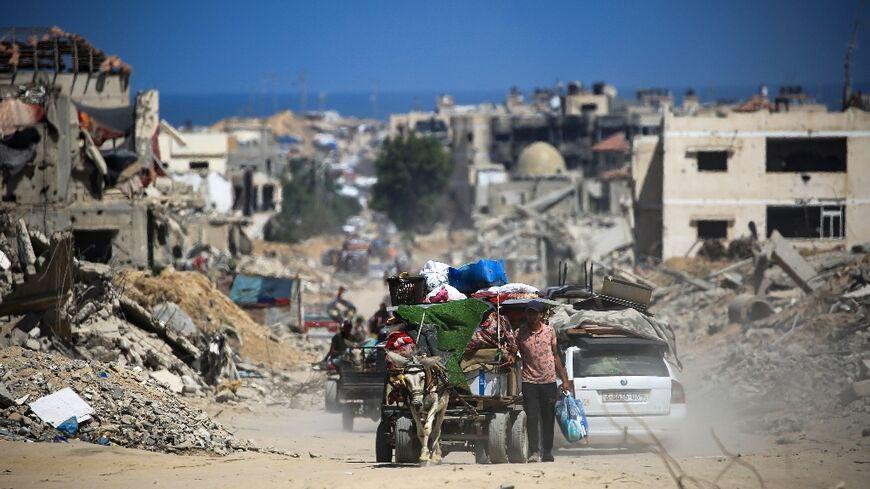
Heavy fighting rocks Gaza, thousands flee war zone
GAZA STRIP, Palestinian Territories: Israeli forces bombed and battled Hamas in Gaza City on Wednesday as tens of thousands of Palestinians scrambled for a safe haven after the army issued an evacuation order for a vast swathe in the territory’s south.
Apache helicopters and Israeli quadcopter drones flew above Gaza City’s Shujaiya district as heavy gunfire echoed through the streets, said AFP reporters.
Prime Minister Benjamin Netanyahu rejected a US media report saying his generals were urging a Gaza truce even with Hamas undefeated, stressing on Tuesday that “this will not happen.”
Military chief Herzi Halevi meanwhile said Israel is engaged in “a long campaign” to destroy Hamas over the October 7 attack and to bring home the hostages held by Palestinian militants.
The United Nations warned that the almost nine-months-old war had “unleashed a maelstrom of human misery” and that the latest evacuation order had plunged yet more Palestinians into “an abyss of suffering.”
Ten days after Netanyahu said the war’s “intense phase” was winding down, the Israeli military again rained down air strikes and artillery fire on militants in the Shujaiya district.
The air force struck “over 50 terror infrastructure sites” across Gaza in 24 hours while ground troops “eliminated terrorists,” located tunnels and found weapons including AK-47 assault rifles, the military said.
The Israeli army — which issued an evacuation order for Shujaiya a week ago — on Sunday did the same for a larger area near Khan Yunis and Rafah in the south, raising fears of renewed heavy battles there.
READ ALSO:
- We can’t pay minimum wage without increased allocation – Ekiti gov
- Lagos state govt seals house over emptying of waste into flood
- JUST IN: Senate holds executive session over FCT Senator Ireti Kingibe/Wike dispute
Tens of thousands of Palestinians have again taken to the road there, many bundling their scant belongings on top of cars or donkey carts as they sought safety elsewhere in the bombed-out wasteland.
The UN agency supporting Palestinian refugees, UNRWA, said 250,000 people had been impacted by the latest evacuation order that covers southern areas bordering Israel and Egypt.
UN Secretary-General Antonio Guterres’s spokesman Stephane Dujarric said the order covers 117 square kilometers (45 square miles), or “about a third of the Gaza Strip, making it the largest such order since October.”
The UN humanitarian coordinator for Gaza, Sigrid Kaag, told the UN Security Council in New York on Tuesday that the war had now displaced 80 percent of Gaza’s population.
She also said not enough aid was reaching the besieged territory and that crossings must be reopened, particularly to southern Gaza, to avert a humanitarian disaster.
“Palestinian civilians in Gaza have been plunged into an abyss of suffering, their home lives shattered, their lives upended,” she said. “The war has not merely created the most profound of humanitarian crises. It has unleashed a maelstrom of human misery.”
Amid the war, siege and mass displacement, more than 150,000 people have contracted skin diseases in the squalid conditions, said the World Health Organization.
Wafaa Elwan, a Palestinian mother of seven who now lives in a tent city by the sea, said: “We sleep on the ground, on sand where worms come out underneath us.”
She said her five-year-old son, much of whose body was covered in rashes and welts, “can’t sleep through the night because he can’t stop scratching his body.”
The bloodiest ever Gaza war broke out after Hamas’s October 7 attack on southern Israel resulted in the deaths of 1,195 people, mostly civilians, according to an AFP tally based on Israeli figures.
The militants also seized 251 hostages, 116 of whom remain in Gaza including 42 the army says are dead.
Israel’s retaliatory offensive since then has killed at least 37,925 people, also mostly civilians, according to data from the health ministry in the Hamas-run territory.
The Israeli military said Wednesday that “operational activities continue throughout the Gaza Strip.”
The Gaza civil defense agency said seven people were killed when a strike hit a family house north of Gaza City.
Another strike killed three people in a car at Al-Maghazi refugee camp in the central Deir Al-Balah area, said an AFP reporter.
Air strikes also hit homes in Rafah, according to Gaza’s government media office.
The New York Times has quoted Israeli security officials as saying top generals see a truce as the best way to secure the release of the remaining hostages, even if that meant not achieving all of the war goals.
Netanyahu, who heads a government including hard-line right-wing parties, strongly rejected this on Tuesday and vowed Israel would not give in to the “winds of defeatism.”
“The war will end once Israel achieves all of its objectives, including the destruction of Hamas and the release of all of our hostages,” he said.
Heavy fighting rocks Gaza, thousands flee war zone
ARAB NEWS








International
Putin Offers Iran Diplomatic Support After Collapse of US–Iran Talks

Putin Offers Iran Diplomatic Support After Collapse of US–Iran Talks
Russian President Vladimir Putin has offered diplomatic support to Iran following the collapse of high-level negotiations between Tehran and the United States, as tensions continue to escalate across the Middle East.
According to a Kremlin readout reported by AFP, Putin held a phone conversation on Sunday with Iranian President Masoud Pezeshkian, during which he expressed Russia’s readiness to help facilitate a political and diplomatic settlement to the crisis.
The Kremlin said Putin emphasized Moscow’s willingness to support efforts aimed at achieving what he described as a “just and lasting peace” in the region, including acting as a mediator if required.
The call came shortly after the breakdown of US–Iran talks, which had been aimed at resolving long-standing disputes over Iran’s nuclear programme and wider regional security issues but ended without agreement.
US–Iran Negotiations Collapse After Months of Tension
The negotiations reportedly involved senior US officials, including lead negotiators Steve Witkoff and Jared Kushner, but collapsed after prolonged discussions failed to produce meaningful progress.
READ ALSO:
- BREAKING: Military Intensifies Offensive, Destroys ISWAP Enclave in North-East
- NDLEA Smashes Drug Networks, Arrests Nonagenarian, Doctor in Nationwide Raids
- 17-Year-Old Student Allegedly Hacks Celebrity WhatsApp Accounts, Sells Explicit Content in School
A US official said the delegation withdrew following what it described as unproductive talks, while confirming that no immediate follow-up meeting had been scheduled.
Iranian Parliament Speaker Mohammad Bagher Ghalibaf blamed Washington for the breakdown, saying US negotiators failed to build trust during the discussions. He added that Iranian proposals were constructive but were not properly considered.
Diplomatic Breakdown Raises Regional Tensions
The collapse of the talks has further deepened uncertainty in the Middle East, where tensions have already been heightened by recent military and political disputes involving Iran, the United States, and Israel.
Analysts warn that continued failure to reach diplomatic compromise could worsen instability in the region and increase pressure on global energy markets, particularly oil and gas supply routes.
Russia Seeks Greater Role in Mediation Efforts
Putin’s engagement with Iran is being viewed as part of Russia’s broader effort to position itself as a key diplomatic actor in the crisis.
The Kremlin said Russia remains open to supporting dialogue between all sides, suggesting Moscow could play a more active role in future mediation efforts if both parties agree.
For now, no new date has been announced for the resumption of US–Iran negotiations, leaving diplomatic efforts at a standstill as international calls for restraint continue.
Putin Offers Iran Diplomatic Support After Collapse of US–Iran Talks
International
Trump Orders US Navy to Blockade Strait of Hormuz After Iran Talks Collapse

Trump Orders US Navy to Blockade Strait of Hormuz After Iran Talks Collapse
Donald Trump has ordered the United States Navy to begin an immediate blockade of the Strait of Hormuz, escalating tensions with Iran after the collapse of critical peace talks in Islamabad.
The directive, announced Sunday via Truth Social, signals a major shift from diplomacy to military pressure in one of the world’s most sensitive geopolitical flashpoints. Trump said U.S. naval forces would intercept all vessels attempting to enter or leave the Strait of Hormuz, particularly those suspected of paying transit tolls to Iran, which he described as “extortion.”
The move follows the breakdown of high-level negotiations between Washington and Tehran, widely seen as a rare attempt to de-escalate tensions. Although Trump acknowledged that discussions were partly productive, he insisted that the core issue—Iran’s nuclear programme—remained unresolved.
Sources familiar with the talks revealed that the مذاکرات collapsed over Iran’s refusal to give up its enriched uranium stockpile and its insistence on maintaining control over shipping activities in the strategic waterway. The Iranian delegation, led by Mohammad Baqer Ghalibaf, blamed the United States for failing to build trust during the negotiations.
The Strait of Hormuz blockade carries enormous global implications. The narrow waterway handles roughly 20% of global oil and liquefied natural gas shipments, making it one of the most critical energy chokepoints in the world. Any disruption threatens to send shockwaves through global markets.
READ ALSO:
- Elon Musk Slams South Africa Over Starlink Ban, Calls Policy ‘Racist’
- Court Orders Forfeiture of Pastor Ebonyi’s Hotel, School, Factory Over Alleged N1.39bn Fraud
- Lagos 2027: APC Succession War Intensifies as Tinubu Reportedly Backs Hamzat
Indeed, oil prices have already surged amid the crisis, with Brent crude and WTI climbing above $115 per barrel at peak levels. Analysts warn that the blockade could push prices even higher, worsening inflation and straining economies heavily dependent on energy imports.
The escalation comes just a day after the U.S. military intensified operations in the region. The United States Central Command confirmed that American forces had begun mine-clearing operations in the Strait of Hormuz, amid allegations that Iran’s Islamic Revolutionary Guard Corps deployed naval mines to restrict shipping.
Two U.S. Navy destroyers, USS Frank E. Peterson and USS Michael Murphy, were spotted transiting the strait as part of efforts to secure maritime routes and ensure safe passage for commercial vessels.
Trump framed the blockade as a defence of global shipping freedom, warning that any Iranian attack on U.S. or allied vessels would be met with overwhelming force. However, the Pentagon has yet to release full operational details, leaving uncertainty around how the blockade will be enforced.
The situation is further complicated by developments involving Israel. Prime Minister Benjamin Netanyahu recently signalled that Israeli military operations against Iran are ongoing, despite ceasefire discussions. He stressed that Israel would act independently to protect its national interests.
Experts warn that the U.S.-Iran conflict escalation could rapidly spiral into direct military confrontation, with far-reaching consequences for global security. Shipping companies have already begun rerouting vessels, while insurers are raising premiums due to heightened risks in the Gulf.
As of now, Iranian authorities have not issued an official response to the blockade order. Meanwhile, global markets are bracing for volatility as trading resumes, with investors closely monitoring developments in the region.
The unfolding crisis highlights the fragile state of U.S.-Iran relations and underscores the strategic importance of the Strait of Hormuz to global energy supply and economic stability.
Trump Orders US Navy to Blockade Strait of Hormuz After Iran Talks Collapse
International
Elon Musk Slams South Africa Over Starlink Ban, Calls Policy ‘Racist’

Elon Musk Slams South Africa Over Starlink Ban, Calls Policy ‘Racist’
Elon Musk has escalated his criticism of South Africa, accusing the government of racial discrimination following the continued refusal to grant an operating licence to his satellite internet service, Starlink.
In a strongly worded post on X (formerly Twitter) on Sunday, the SpaceX founder claimed that Starlink’s application had been blocked because he is not Black, despite being born in South Africa. The billionaire further alleged that the company was informally offered a workaround involving the appointment of a Black executive to satisfy ownership requirements, a move he said he rejected on principle.
The controversy centres on South Africa’s Broad-Based Black Economic Empowerment (B-BBEE) policy, which requires companies operating in sectors like telecommunications to meet equity thresholds, typically mandating at least 30 percent Black ownership. The policy was introduced to correct deep economic imbalances created during apartheid, but it has increasingly become a point of friction for foreign investors.
South African regulators, including the Independent Communications Authority of South Africa, have consistently maintained that the rules apply uniformly to all operators and are a legal requirement for licensing. Authorities have pushed back against claims of discrimination, insisting that the policy is aimed at economic redress rather than racial exclusion.
READ ALSO:
- Court Orders Forfeiture of Pastor Ebonyi’s Hotel, School, Factory Over Alleged N1.39bn Fraud
- Lagos 2027: APC Succession War Intensifies as Tinubu Reportedly Backs Hamzat
- Machete-Wielding Man Shot Dead After Injuring Three in New York
Musk has repeatedly criticised the framework, describing it as “unashamedly racist” and claiming that such policies contradict the legacy of Nelson Mandela. He has also alleged that numerous laws in the country unfairly disadvantage non-Black citizens, further fuelling the ongoing debate.
Despite the standoff, Starlink has continued its rapid expansion across Africa, now operating in nearly two dozen countries where it provides high-speed internet access to underserved communities, including schools and healthcare centres. South Africa, however, remains one of the few major economies on the continent where the service is unavailable.
Musk had previously proposed initiatives to support connectivity in rural South African communities, including offers to provide internet access to thousands of schools, but those plans have stalled due to regulatory hurdles tied to ownership compliance.
As of now, the South African government has not issued an official response to Musk’s latest remarks. However, previous statements suggest that there is unlikely to be any regulatory concession without full adherence to B-BBEE requirements.
The dispute highlights a broader tension between South Africa’s post-apartheid transformation policies and the expectations of global technology investors. Analysts say the outcome could shape future investment decisions and influence how African nations balance economic redress with the need to attract international business.
Elon Musk Slams South Africa Over Starlink Ban, Calls Policy ‘Racist’

-

 metro1 day ago
JUST IN: FG Publishes List of 48 Individuals, Groups Linked to Terrorism Financing in Nigeria
-
 Politics1 day ago
Did Faleke Just Reveal Lagos’ Next Governor? Party Moves Begin
-

 metro1 day ago
42-Year-Old Married Woman Declared Missing Found in Hotel with Man
-

 Education2 days ago
Germany Opens Fully Funded Scholarships for Nigerians, Africans
-

 Politics1 day ago
2027: Oyo APC Governorship Aspirant Saheed Oladele Resigns From Party
-
 metro1 day ago
ADC Threatens Civil Disobedience To Force INEC Chairman To Resign
-
 Business2 days ago
Nigeria May Face ₦2,000 Petrol Price Without Intervention, TUC Warns FG
-

 Business2 days ago
Naira Strengthens to ₦1,359.31/$ as CBN Data Shows Further Gain in Official Market