
International
Israel indefinitely delays Palestinian prisoner release as hostages freed
Israel indefinitely delays Palestinian prisoner release as hostages freed
Israel says it is indefinitely delaying the release of more than 600 Palestinian prisoners, in another potentially major setback in the ceasefire process.
It came after six Israeli hostages, including four kidnapped during the 7 October 2023 deadly Hamas attack on Israel, were released on Saturday.
Israeli Prime Minister Benjamin Netanyahu said the release of the Palestinian prisoners was now going to be delayed until the next handover of hostages by Hamas was guaranteed – and without what he called the degrading ceremonies that Hamas has put on each week.
There’s only one more handover of hostages due in the first phase of the ceasefire, involving four of the hostages who’ve died in captivity.
No arrangements for the release of other living hostages, due to take place in phase two of the ceasefire, have yet been made.
Mediators will be working overtime to try to get the deal back on track and avert a possible collapse of the ceasefire.
Netanyahu accused Hamas of “repeated violations”, including the “cynical use of the hostages for propaganda purposes”.
His statement came after four hostages who were taken captive during the Nova music festival – Tal Shoham, Omer Shem Tov, Eliya Cohen and Omer Wenkert – were released on Saturday.
The two other released hostages, Avera Mengistu and Hisham al-Sayed, were held in Gaza for years – Mr Mengistu since 2014 and Mr al-Sayed since 2015.
The six Israeli hostages are the final living hostages to be returned as part of the first phase of a ceasefire deal which is set to end next Saturday.
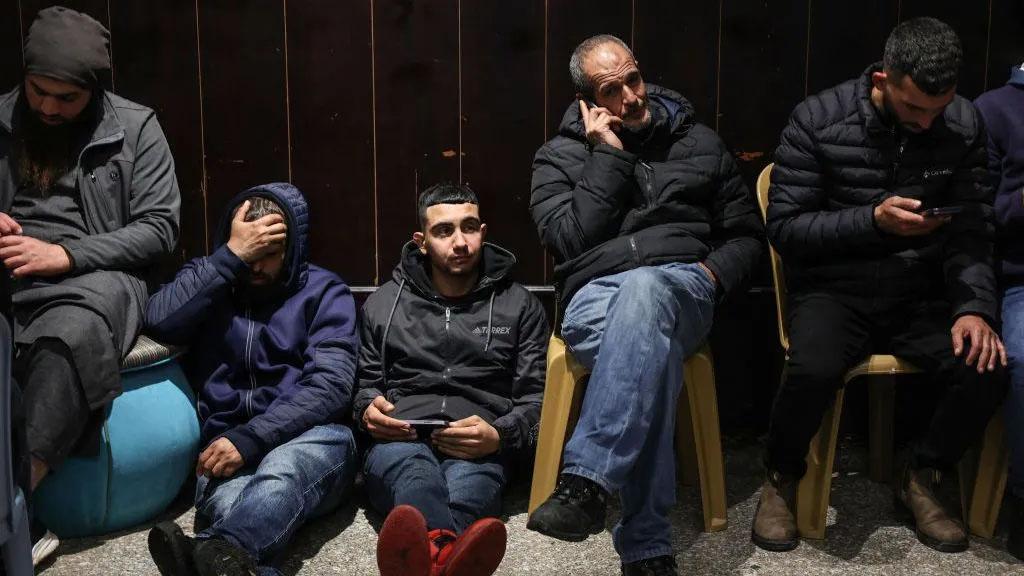
Meanwhile outside the Ofer Prison in the occupied West Bank, family and friends waited for the release of Palestinian prisoners.
An 80-year-old mother in Khan Younis, Gaza, told the AFP news agency that she “can’t believe” her son would be free after 33 years in prison.
READ ALSO:
- Trump blames Starmer, Macron for ‘doing nothing’ to end Russia-Ukraine war
- Mohbad’s widow Wunmi weeps, says father-in-law supports Naira Marley
- Reps reject 31 state creation proposal, plan new arrangement
By the evening, Hamas accused Israel of violating the agreement by delaying the release.
There was no immediate response from Hamas to Netanyahu’s statement.
According to Palestinian authorities, 50 of the prisoners who were going to be released were serving life sentences, 60 had long sentences, and 445 were detained by Israel since 7 October.
There are 62 hostages taken on 7 October 2023 who are still being held by Hamas, around half of whom are believed to be alive.
Hamas began releasing hostages, facilitated by the Red Cross, in exchange for Palestinian prisoners after the ceasefire agreement took effect on 19 January.
Initial chaotic scenes have become more choreographed, with hostages flanked by fighters on stages before the handovers.
On Saturday, Mr Shoham, 40, and Mr Mengistu, 39, were passed to the Red Cross in Rafah, south Gaza before being transferred to the Israel Defense Forces (IDF).
Mr Shoham was visiting family at Kibbutz Be’eri in October 2023 when he and others, including his wife and two children, were kidnapped by Hamas. His captured family members were released after 50 days.
In a statement, his family said: “This is an unforgettable moment, where all emotions are rapidly mixing together. Our Tal is with us.”
Mr Mengistu, who is Ethiopian-Israeli, had been held by Hamas since September 2014 when he crossed into northern Gaza.
He and Mr al-Sayed, a Bedouin Arab Israeli who entered Gaza in 2015, had both suffered with mental health problems in the past, according to their families.
Mr al-Sayed’s release was conducted privately in Gaza City on Saturday.
READ ALSO:
- Portable sober, says, ‘I will no longer look for trouble’
- Why I dumped LP for APC – Obi’s ally Ozigbo
- Babangida belongs to dustbin of history – Sowore
“After nearly a decade of fighting for Hisham’s return, the long-awaited moment has arrived,” his family said in a statement.
“During these days, we need privacy for Hisham and the entire family so we can begin to care for Hisham and ourselves.”
Separately, at Nuseirat in central Gaza, Mr Shem Tov, 22, Mr Cohen, 27, and Mr Wenkert, 23, were freed in another public show by Hamas.
All three were taken captive at the Nova music festival.
Mr Shem Tov had initially escaped by car when Hamas fighters descended on the festival, but was captured when he went back to rescue his friends.
Mr Cohen had hid with his girlfriend, Ziv Abud, in a shelter at the festival, but was discovered and driven away. The shelter was bombed, but Ms Abud survived and escaped.
Mr Wenkert managed to send text messages to his family when festival-goers were being attacked, to tell them he was going to a safe shelter, but they lost contact with him.
Crowds in Tel Aviv’s Hostages Square greeted the public releases with cheers as they watched them unfold on a live feed.
Families celebrating the return of the six men called for all remaining hostages to be released.
“Our only request is to seize this window of opportunity to secure a deal that will… return all hostages home,” Mr Shoham’s family said.
Remaining hostages include Edan Alexander, a 21-year-old Israeli-American soldier captured on 7 October.
His mother, Yael Alexander, who was watching Saturday’s hostage release, told the BBC it was “amazing” to see them freed, but for her family it is “very tough” waiting.
“There are more than dozens of young men alive, like my son, still waiting to be released,” she said. “This is the main goal, to release the live people now from Gaza.”
Saturday’s joyful scenes contrasted with earlier this week, when the bodies of hostages Shiri Bibas, her two young sons and another captive Oded Lifschitz were returned to Israel.
About 1,200 people – mostly civilians – were killed in the Hamas attacks on 7 October 2023 and 251 others taken back to Gaza as hostages.
Israel launched a massive military campaign against Hamas in response, which has killed at least 48,319 Palestinians – mainly civilians – according to the Hamas-run health ministry.
Israel indefinitely delays Palestinian prisoner release as hostages freed
BBC










International
Muslim Nations Condemn Israel’s New Death Penalty Law for Palestinians

Muslim Nations Condemn Israel’s New Death Penalty Law for Palestinians
Several Muslim-majority countries have strongly condemned Israel’s new death penalty law, which reintroduces capital punishment for certain terrorism-related offenses, warning that it could further escalate tensions in the Middle East. The legislation, passed by Israel’s Knesset on March 30, 2026, allows death by hanging as the default sentence for Palestinians convicted in military courts of deadly attacks classified as terrorism, with executions scheduled within 90 days of conviction.
The foreign ministers of Saudi Arabia, Egypt, Jordan, Indonesia, Pakistan, Qatar, Turkey, and the United Arab Emirates issued a joint statement criticizing the law, describing it as a discriminatory measure that undermines the fundamental rights of Palestinians in the occupied West Bank. The ministers warned that the legislation reinforces an apartheid-like system and could inflame tensions on the ground.
READ ALSO:
- Lagos Ranks Fourth Most Expensive City for House Rent in Africa — Report
- China Blames US‑Israeli Strikes on Iran for Strait of Hormuz Blockage
- Soaring Fuel Prices Drive Nigerians Toward Electric Vehicles
Human rights organizations, including the Association for Civil Rights in Israel and the International Bar Association’s Human Rights Institute, have opposed the law, filing petitions with Israel’s Supreme Court to block it. Critics argue that the legislation disproportionately targets Palestinians, applying primarily in military courts in the occupied territories, while allowing Israeli civilians discretion in sentencing for terrorism-motivated murder.
The law was introduced by the far-right Otzma Yehudit party, led by National Security Minister Itamar Ben-Gvir, who argued that stricter penalties are necessary to deter terrorism and protect citizens. However, opponents say that the measure risks undermining the rule of law and exacerbating ongoing conflicts.
The legislation has drawn strong international criticism. The Palestinian Authority condemned the law as a violation of international law, potentially amounting to a war crime under the Fourth Geneva Convention. UN human rights officials have also expressed concern, highlighting the risk to civilian safety, due process, and human rights protections.
Muslim nations and international observers continue to call for restraint and adherence to international legal standards. They emphasize that reinstating the death penalty in a volatile conflict zone could heighten instability and hinder prospects for peace.
Muslim Nations Condemn Israel’s New Death Penalty Law for Palestinians
International
China Blames US‑Israeli Strikes on Iran for Strait of Hormuz Blockage

China Blames US‑Israeli Strikes on Iran for Strait of Hormuz Blockage
China has accused the United States and Israel of being the “root cause” of the disruption of shipping in the Strait of Hormuz, following recent military strikes on Iran. Chinese foreign ministry spokeswoman Mao Ning said on Thursday that the interruption to navigation resulted directly from what Beijing described as “illegal military operations” by Washington and Tel Aviv against Tehran.
The Strait of Hormuz, a crucial maritime corridor connecting the Persian Gulf to the Gulf of Oman, is one of the world’s busiest shipping lanes for crude oil and liquefied natural gas (LNG). Iran has effectively restricted access to the strait in retaliation for the joint strikes, escalating tensions in the Middle East and threatening global energy supply chains.
China, as the largest importer of Iranian crude, has been particularly affected. Mao Ning warned that further military escalation would not resolve the crisis, saying, “Military means cannot fundamentally solve the problem, and the escalation of conflicts is not in the interests of either side.” Beijing called for an immediate ceasefire and de-escalation to restore safe passage and regional stability.
READ ALSO:
- Soaring Fuel Prices Drive Nigerians Toward Electric Vehicles
- Ogun Partners with NAHCON, Names Key Hajj Leadership Team
- Timi Frank: INEC Actions Threaten Democracy, Calls on Trump to Support Nigeria
The remarks came after U.S. President Donald Trump urged nations dependent on oil shipments through the strait to “take care of that passage” themselves. Trump also indicated that the conflict could continue for another two to three weeks, with potential strikes targeting critical Iranian infrastructure if negotiations fail.
The disruption has already sent shockwaves through global energy markets, with oil prices surging between 40 to 50 percent. Industries reliant on fuel have been hard hit, including airlines such as Air China, which announced increases in fuel surcharges on domestic routes. Analysts warn that sustained instability in the strait could prolong energy price volatility and further strain global supply chains.
Market experts say that reopening the Strait of Hormuz is crucial for stabilising international energy flows. Private and public sectors are closely monitoring developments, with international diplomacy expected to play a key role in resolving the crisis. China’s call for a negotiated solution highlights its strategic interest in protecting maritime energy imports and preventing long-term disruption to global oil supply.
China Blames US‑Israeli Strikes on Iran for Strait of Hormuz Blockage
International
Qatar Petitions UN Over Iranian Missile Strikes on Maritime Assets

Qatar Petitions UN Over Iranian Missile Strikes on Maritime Assets
The government of Qatar has formally appealed to Antonio Guterres, strongly condemning what it described as Iranian drone and cruise missile attacks on its territory and maritime infrastructure, calling them clear violations of international law and national sovereignty.
In a detailed communication to the United Nations, Qatari authorities outlined a series of incidents that occurred between March 28 and April 1, 2026, describing them as “unlawful acts” that pose a serious threat to regional stability and global energy security. The letter is part of a broader diplomatic push, with Qatar submitting multiple complaints to the UN and Security Council in recent weeks over what it calls sustained aggression by Iran.
The most recent and severe incident took place on April 1, when three cruise missiles were launched from Iranian territory toward Qatari waters. According to officials, Qatari air defense systems intercepted two of the missiles, while a third struck the Aqua 1 fuel oil tanker operating within Qatar’s territorial waters. The vessel is leased to state-owned QatarEnergy.
QatarEnergy confirmed that all 21 crew members aboard the tanker were safely evacuated. Authorities reported no casualties and no environmental damage, but warned that the attack underscores growing risks to maritime safety and critical energy infrastructure in the Gulf.
READ ALSO:
- Macron Hits Back at Trump, Says Marriage Jibe “Not Worth a Response”
- Akwa Ibom Barber Jailed 14 Years for Defiling 12-Year-Old Girl
- Lagos Taskforce Launches Anti‑Crime Patrol Unit to Curb Rising Criminality
Qatar invoked Article 51 of the UN Charter, affirming its right to self-defense, and indicated that a full assessment of damages and losses is ongoing. The government also called for urgent international intervention, accountability, and enhanced protection of vital shipping lanes and offshore facilities.
Officials stressed that repeated attacks on commercial vessels and energy assets threaten not only Qatar but also the broader global economy, given the Gulf’s strategic role in oil and gas exports. The incidents have intensified concerns among Gulf states about the vulnerability of energy infrastructure, commercial shipping routes, and key maritime corridors.
The latest escalation comes amid heightened regional tensions involving Iran, the United States, and Israel, with fears growing that continued hostilities could spiral into a wider conflict. Maritime security bodies, including the United Kingdom Maritime Trade Operations, have continued to monitor the situation closely and warn of increased risks in the Gulf.
Despite the attacks, QatarEnergy stated that operations at affected facilities remain fully operational, signaling resilience in the country’s energy sector. However, analysts warn that sustained threats could disrupt supply chains and shake investor confidence if the situation deteriorates further.
Qatar has repeatedly emphasized that such actions are inconsistent with principles of good neighborliness and international norms, urging the global community to act decisively to prevent further escalation.
As of now, there has been no official response from Iran regarding the latest accusations.
Qatar Petitions UN Over Iranian Missile Strikes on Maritime Assets

-

 Education2 days ago
WAEC Releases 2026 WASSCE Timetable for School Candidates
-

 Auto2 days ago
Lagos NURTW Chairman Sego Distributes Exotic Cars, Luxury Items to Cabinet Members (Video)
-

 metro2 days ago
Cars Torched as South Africans Protest Alleged Nigerian ‘Igbo King’ Coronation
-

 Railway1 day ago
Easter train: NRC increases Lagos-Ibadan trips, offers free Osun holiday transit
-

 Sports2 days ago
Osimhen Among Highest-Paid African Footballers in 2026 — See Full List
-

 Education2 days ago
JAMB Releases 2026 UTME Mock Results, Delists Over 20 CBT Centres
-

 Business2 days ago
Bottles of Death: SWAN rallies media to combat ₦472bn illicit alcohol crisis
-

 Politics2 days ago
Adebayo Adelabu Resigns as Power Minister to Run for Oyo State Governorship