
News
JUST IN: Obaseki assigns Shaibu’s office in Government house to Alaghodaro

JUST IN: Obaseki assigns Shaibu’s office in Government house to Alaghodaro
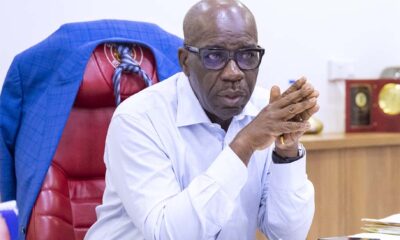
Edo Governor Godwin Obaseki has allocated the office of his Deputy, Comrade Philip Shaibu, in Government House, Benin to Alaghodaro as secretariat.
This contradicts Obaseki’s claim that the one-story building is being renovated.
Alaghodaro, a Benin catch phrase meaning progress or moving forward, is an annual investment drive by Edo State Government, which is Obaseki’s initiative.
In a leaked memo on Thursday dated September 18, 2023, Edo Governor asked the Secretary to the State Government (SSG), Osarodion Ogie, to “immediately” allocate the deputy governor’s office building to the trustees of Alaghodaro summit as their Secretariat.
The chairman of Alaghodaro, through its secretary, had written to Obaseki for a permanent secretariat building to aid planning and logistics for the 2023 summit holding in the second week of November.
READ ALSO:
-
LUTH denies late doctor worked 72-hour call duty
-
We’ll start refining with Nigerian crude in few weeks, says Dangote
-
CCECC promises to deliver Abuja light train in eight months – Shettima
According to Edo Governor ‘s leaked memo, the office space closest to the venue of the summit, the New Festival Hall of Government House, which until few days ago, was occupied by Shaibu, should be allocated to the board of trustees of the Alaghodaro summit, expected to attract potential investors from different parts of Nigeria.
Shaibu was pushed out of Government House, and allocated new office at No. 7, Dennis Osadebey Avenue, GRA, Benin with a bold inscription “Office of the Deputy Governor, No. 7, Dennis Osadebey Avenue, GRA, Benin City,” at a location not far from the Government House.
Conspicuously at the entrance of the one-storey building is an unveiled inauguration plaque,with this inscription: “Edo State Public Procurement Agency – This building was commissioned by His Excellency, The Comrade Governor, Adams Aliu Oshiomhole, MNI, OON, Edo State Governor, on Tuesday, 16th December, 2014.”
Shaibu’s aides and civil servants attached to his office moved two weeks ago in line with the directive of Edo Head of Service, Anthony Okungbowa.
On September 5, Shaibu withdrew his anti-impeachment suit with reference number: FHC/ABJ/CS/1027/2023 but remains determined to succeed Obaseki on November 12, 2024.
JUST IN: Obaseki assigns Shaibu’s office in Government house to Alaghodaro
(Nations)







News
Presidency Clarifies Why Tinubu Met Plateau Victims Only at Airport

Presidency Clarifies Why Tinubu Met Plateau Victims Only at Airport
The Presidency has clarified why President Bola Tinubu did not leave the airport during his recent visit to Jos, amid public criticism. Officials said the decision was driven by tight scheduling, logistical constraints, and aviation safety concerns.
President Tinubu visited Jos North Local Government Area, where he met with families of victims killed in the Angwan Rukuba attack. Speaking to the bereaved, he said, “You have no light at the airport, and I have to fly back within the next 10 minutes. To the victims, there’s nothing I can give you, whether it’s money in millions, but console you and promise you that this experience will not repeat itself.”
The visit was attended by political supporters, traditional rulers, security operatives, and other stakeholders. However, Tinubu’s airport-only engagement drew criticism, with some accusing him of insensitivity toward grieving families.
In response, the President’s Special Adviser on Information and Strategy, Bayo Onanuga, explained that Tinubu’s schedule on Thursday included receiving Chadian President Mahamat Idriss Déby Itno at the Presidential Villa before traveling to Iperu in Ogun State. Following a security briefing by Plateau Governor Caleb Mutfwang, the Ogun trip was canceled, and an emergency visit to Jos was arranged overnight.
READ ALSO:
- Iran’s IRGC Threatens Google, Microsoft, Apple as ‘Legitimate Military Targets’
- Nigeria Apologises Over ‘Igbo King’ Controversy in South Africa as Protests Turn Violent
- Plateau Killings: Ezekwesili Blasts Tinubu, APC Over ‘Failure to Act’
Officials said logistical challenges made a town visit impractical. The airport runway does not support night flights, and the road distance from the airport to Jos township is about 40 minutes. These factors made it unfeasible for the President to visit the conflict site, meet victims in town, and return to the airport safely before dusk.
To ensure engagement, representatives of affected communities were brought to a hall adjoining the airport, allowing Tinubu to meet directly with victims, local leaders, and security officials. Among attendees were the Minister of Defence, the Chief of Army Staff, and the Inspector General of Police, who had visited Rukuba to assess security operations.
During the meeting, the President consoled victims, listened to their concerns, and assured justice would be delivered. He also promised the deployment of 5,000 AI-enabled surveillance cameras to monitor the city and enhance the identification and arrest of troublemakers. Furthermore, he invited community leaders to Abuja for additional talks on long-term solutions to recurring violence in Plateau State.
The Presidency described the visit as a strategic, high-level engagement aimed at addressing the root causes of conflict, rather than a symbolic gesture. Officials emphasized that Tinubu’s approach prioritized safety, efficiency, and direct interaction with key stakeholders while adhering to flight and logistical constraints.
Despite the criticisms, the televised meeting was seen as reassuring by residents, signaling the President’s commitment to peace, security, and community-driven solutions in Plateau State.
Presidency Clarifies Why Tinubu Met Plateau Victims Only at Airport
News
Heavy Security Deployed at INEC Headquarters Abuja Amid Planned ADC Protest

Heavy Security Deployed at INEC Headquarters Abuja Amid Planned ADC Protest
Armed security forces on Thursday surrounded the Independent National Electoral Commission (INEC) headquarters in Abuja as tensions escalated over a planned protest by supporters of the African Democratic Congress (ADC). The move comes amid a deepening leadership crisis within the party, which has split into rival factions, prompting agitation and nationwide attention.
Eyewitnesses reported a strong presence of Nigeria Army personnel, with armoured vehicles stationed at strategic points around the INEC complex in the Maitama district. The Nigeria Police Force, Department of State Services (DSS), and Nigeria Security and Civil Defence Corps (NSCDC) also reinforced security, restricting movement and monitoring activities closely to prevent potential clashes.
The heightened security follows INEC’s decision to remove the names of Senator David Mark and former Osun State Governor Rauf Aregbesola as National Chairman and National Secretary of the ADC from its official portal. The commission said this action complied with preservatory orders issued by the Court of Appeal, directing all parties to maintain the status quo until the Federal High Court delivers a final judgment.
READ ALSO:
- Obi Criticises Former NADECO Figures, Compares Them to Abacha
- 7‑Month‑Old Baby Killed in Brooklyn Stroller Shooting, Suspect in Custody
- Trump Leaves Key Questions Unanswered as Iran War Enters Second Month
The ADC dispute has created two competing camps: one backing David Mark and the other supporting Nafiu Bala Gombe as acting chairman. Both sides have sent conflicting communications to INEC, further complicating the situation and sparking the threat of protests at the commission’s headquarters.
“The names of the current National Working Committee members led by Senator David Mark… would be removed from the INEC portal pursuant to the order of the Court of Appeal to maintain the status quo ante bellum,” INEC stated, clarifying that it would suspend recognition of any faction until judicial resolution.
Supporters of the ADC have accused INEC of bias and interference in the party’s internal affairs. Civil society groups and political commentators have urged restraint and neutrality from the electoral commission to prevent further escalation of tensions.
Security operatives set up checkpoints and roadblocks around INEC headquarters, with armed personnel maintaining a visible presence. The deployment is viewed as a preventive measure to avert potential clashes or breakdown of law and order while the legal dispute unfolds.
Political observers note that the heavy security presence at INEC highlights the growing intersection of party politics and public order in Nigeria, as the ADC leadership tussle remains unresolved and could influence upcoming electoral processes.
Heavy Security Deployed at INEC Headquarters Abuja Amid Planned ADC Protest
News
Amnesty Int’l Condemns Canada for Abstaining from UN Slavery Reparations Vote
Amnesty Int’l Condemns Canada for Abstaining from UN Slavery Reparations Vote
Human rights organisation Amnesty International Canada has strongly criticized Canada for abstaining from a landmark United Nations vote on reparations for the harms caused by the transatlantic slave trade, describing the decision as a missed opportunity to uphold justice and defend the rights of people of African descent.
The UN General Assembly resolution, adopted on March 25, formally recognised the transatlantic trafficking and enslavement of African people over more than four centuries as the gravest crime against humanity. Spearheaded by Ghana, the resolution received 123 votes in favour, with three countries voting against—Argentina, Israel, and the United States—and 52 countries, including Canada, abstaining.
Amnesty International Canada and the Black Canadians Civil Society Coalition (BCCSC) welcomed the resolution as a long-overdue acknowledgment of historical truth and a necessary step toward reparatory justice. However, both organisations expressed disappointment that Canada chose not to support the resolution.
READ ALSO:
- Madam Saje brokers peace in Akindele–Abraham feud
- 2027: APC Confident of Landslide Victory in Kaduna – Abbas Assures Tinubu
- INEC Derecognition: ADC Alleges Plot to Silence Opposition
Racial justice campaigner Melak Gebresilassie of Amnesty International Canada said, “Canada’s abstention is deeply discouraging. This was not a neutral act. It was a choice to step back from a moment of accountability, prioritising political comfort over moral clarity.” He stressed that the Canadian government must acknowledge historical wrongs, commit to reparatory justice, and stand in meaningful solidarity with Black communities to promote dignity, healing, and justice.
Hodan Ahmed, co-founder of the BCCSC, added that the resolution is “a powerful, necessary, and long-overdue acknowledgment of truth—one that survivors, descendants, scholars, and activists have demanded for centuries.” She emphasised that such recognition should serve as the foundation for concrete actions addressing the legacies of slavery, including systemic inequalities and discrimination that persist today.
The UN resolution also encourages participating states to explore reparations measures, including apologies, restitution, compensation, rehabilitation, and initiatives to tackle systemic racial inequalities. While non-binding, the resolution represents a critical step toward global acknowledgment of historical injustices and the promotion of international human rights.
Amnesty International Canada and its partners are urging the Canadian government to reconsider its abstention, actively support reparatory initiatives through the UN framework, and work domestically to address persistent anti-Black racism rooted in slavery and colonialism.
International observers have noted that Canada’s abstention risks undermining its moral authority on human rights issues and may signal hesitation to fully engage in the ongoing global dialogue on reparations and accountability.
Amnesty Int’l Condemns Canada for Abstaining from UN Slavery Reparations Vote

-

 Railway2 days ago
Easter train: NRC increases Lagos-Ibadan trips, offers free Osun holiday transit
-

 Education3 days ago
JAMB Releases 2026 UTME Mock Results, Delists Over 20 CBT Centres
-

 Entertainment3 days ago
Iyabo Ojo Quits Mediation Between Funke Akindele, Toyin Abraham
-

 metro23 hours ago
VeryDarkMan Dares Sowore Over Blord’s Kuje Prison Remand
-

 Politics3 days ago
Adebayo Adelabu Resigns as Power Minister to Run for Oyo State Governorship
-

 metro1 day ago
Nigerians to Enjoy Four-Day Break as FG Declares Easter Holidays
-

 Business1 day ago
NNPC Boosts Crude Supply to Dangote Refinery to Address Rising Fuel Prices
-

 metro2 days ago
Power Crisis Looms as NLC Shuts AEDC, Protests Sack of 900 Workers