Lawyer: We have CCTV evidence of how Kanu was abducted from Kenya - Newstrends
Connect with us

News

Lawyer: We have CCTV evidence of how Kanu was abducted from Kenya

Published

on

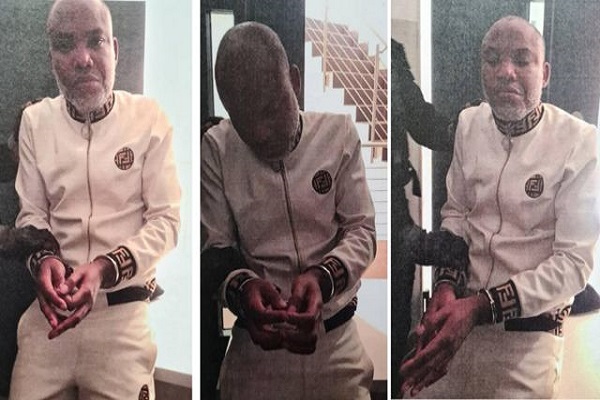
Details of a N5 billion suit filed by the leader of the Indigenous People of Biafra (IPOB) against the Kenyan government have hinted on the torture the IPOB leader allegedly went through in the custody of security agents in the East African country.

Kanu’s lawyer, George Wajackoyah, claimed in an audio tape that he had CCTV and other evidence of how his client was abducted in Nairobi, Kenyan capital by the Muhammadu Buhari government.

“We have copies of his passport and a stamp that he was indeed in Kenya. We also have evidence he was in his residence on a particular day.

“We also have material proof that he was at the airport on a particular day to meet a friend and there he was arrested.

“Definitely, he was kidnapped,” Wajackoyah said.

The Kenyan government had strongly denied involvement in the process that led to the arrest and repatriation of Kanu back to Nigeria, with its High Commissioner to Nigeria, Wilfred Machage, describing the claim that Kanu was arrested in the East African country as “deliberately concocted to fuel antagonistic feelings in the minds of certain sections of the Nigerian people against the people of Kenya.”

The high point of Kanu’s ugly experience, according to the law suit, was that he got his body smeared with his own urine and faeces because the security agents allegedly denied him permission to use the toilet.

The suit, which was filed in Umuahia, Abia State by Kanu’s counsel Aloy Ejimakor on September 7, revealed that Kanu was beaten severely until he fainted and was revived with cold water.

The suit is seeking to enforce Kanu’s right to life, dignity of the human person, personal liberty and fair hearing.

The affidavit in support of the originating motion, which was done by Kanu’s brother, Emmanuel, stated: “That the facts and violations deposed to in this affidavit started at the applicant’s residence in Isiama Afaraukwu Ibeku, Umuahia North Local Government Area of Abia State; to wit; the military invasion of the applicant in September 2017 by a combined team of Ohafia-based 14 Brigade of the Nigerian Army, the Abia State Command of Nigeria Police Force and the Abia State Directorate of the State Security Service.”

“That it was the said invasion that nearly took the life of the applicant that caused him to seek refuge abroad which ultimately to Kenya, where the respondents lawfully pursued him, abducted him, disappeared with him and ultimately brought him to Nigeria and detained him.

“That in October 2015, the applicant was arrested in Lagos upon his return from the United Kingdom, detained in Abuja and ultimately charged for certain offences Charge No: FHC/ABJ/CR/383/2015 (Federal Republic of Nigeria vs Nnamdi Kanu).

“That the applicant was detained for 18 months, but was later released on bail whereupon he returned to his home in Isiama Afaraukwu Ibeku, Umuahia North, Abia State, and there awaiting his next trial date set for October 2017.

“That on or about 10 September, while the applicant was resting at home with some family members and friends, the Ohafia-based Nigerian Army, police and DSS launched military invasion and assaults at the applicant’s residential building and premises.

“That in the course of the military action, 28 people were killed and several others, including the applicant, were wounded. Both of the applicant’s parents sustained grave injuries from the military invasion and both of them eventually succumbed to those injuries and are now late.

“That in the course of the invasion, the applicant managed to escape to a safe location from where he managed to flee overseas to save his life. That there was neither a court order revoking the applicant’s bail nor any arrest warrant that could have justified the deadly military assault.

“That had the President implemented the provisional measures, the applicant would have felt safe enough to voluntarily end his exile and return to Nigeria to face prosecution in the said charge under reference therein.

“That in the course of his exile, the applicant on or about May 5, 2021, entered the Republic of Kenya on his British passport and was admitted as such at Jomo Kenyatta International Airport, Nairobi. After his admission, the applicant settled in at a temporary location in Nairobi, Kenya.”

Giving details of the alleged abduction of Kanu from the East African country as well as his ordeal at the hands of the Nigerian security operatives at a private residence where he was taken to, Emmanuel said: “That on June 19, 2021, the applicant drove himself and without any companion to Jomo Kenyatta International Airport, to drop off a friend at the airport.

“That as soon as the applicant pulled to stop at the parking lot and alighted from his vehicle, about twenty respondent’s agents (hereafter abductors) violently accosted and abducted the applicant, handcuffed and blindfolded him, bundled him in a vehicle and sped away, while telling onlookers that the applicant is a “terrorist separatist.”

“That the applicant’s abductors took him to a nondescript private house (not a police station) somewhere in Nairobi, Kenya, and chained him to the floor. That while chained to the floor, the applicant’s abductors took turns to beat him torturing him to a point that he fainted several times and was intermittently revived when they poured cold water on him.

“That to prevent the applicant’s anguished screaming from being heard in the vicinity, the applicant’s abductors tied a cloth over his mouth and so close to covering his nostrils that the applicant struggled to breathe.

“That the applicant remained chained to the floor for eight days and was thus forced to relieve himself of urine and excrement where he was chained with same being smeared all over his body.”

That throughout the duration of the applicant’s captivity, he was not allowed to bathe and was fed only on bland bread once a day and given non-sanitary water to drink.”

Advertisement

News

MURIC Urges Security Agencies to Protect JAMB Candidates, Exam Centres Nationwide

Published

on

Executive Director of MURIC, Professor Ishaq Akintola

MURIC Urges Security Agencies to Protect JAMB Candidates, Exam Centres Nationwide

The Muslim Rights Concern (MURIC) has called on security agencies in Nigeria to ensure maximum protection for candidates and officials participating in the forthcoming Joint Admissions and Matriculation Board (JAMB) examinations scheduled to begin on April 16, 2026.

In a press statement issued on Tuesday, April 14, 2026, the Islamic human rights organisation stressed the need for heightened security measures across all examination centres nationwide, citing growing insecurity in several parts of the country.

The statement, signed by the Executive Director of MURIC, Professor Ishaq Akintola, urged the Nigeria Police Force, the Nigerian Army, and the Nigeria Security and Civil Defence Corps (NSCDC) to collaborate effectively in safeguarding candidates and examination personnel throughout the examination period.

According to the group, the appeal became necessary due to rising security concerns in parts of northern Nigeria, where banditry, communal tensions, and violent attacks have continued to threaten public safety.

READ ALSO:

MURIC specifically raised concerns about states such as Plateau, Borno, Katsina, Sokoto, and Kwara, warning that some of these areas remain vulnerable to attacks and mass abductions, particularly targeting young students and examination candidates.

The organisation warned that candidates travelling to and from examination centres could be at risk in volatile locations and called for “special attention” to ensure their safety before, during, and after the examinations.

It further urged security agencies to remain vigilant, noting that “eternal vigilance is the price of freedom,” and emphasised the need for proactive intelligence gathering and rapid response mechanisms to prevent any disruption of the exercise.

MURIC also highlighted the importance of securing examination venues themselves, stressing that any attack on candidates or officials would have far-reaching consequences on education and national development.

The group reiterated its commitment to advocating for peaceful coexistence and safety for all citizens, especially young Nigerians pursuing education.

The JAMB examination, conducted annually by the Joint Admissions and Matriculation Board, is a critical gateway for admission into tertiary institutions across the country, with hundreds of thousands of candidates expected to participate nationwide.

Security agencies are yet to issue a formal response to the appeal, but authorities have previously assured Nigerians of adequate protection during national examinations and other major public exercises.

MURIC Urges Security Agencies to Protect JAMB Candidates, Exam Centres Nationwide

Continue Reading

News

Lafarge Convicted of Terrorism Financing by French Court in Landmark Case

Published

on

Lafarge

Lafarge Convicted of Terrorism Financing by French Court in Landmark Case

A French court in Paris has found cement manufacturer Lafarge guilty of financing armed extremist groups during the Syrian civil war, in a landmark ruling that could reshape global standards on corporate responsibility in conflict zones.

The court ruled that the company’s Syrian subsidiary made payments to armed groups, including ISIS and the Nusra Front, between 2013 and 2014, in a bid to keep its cement plant in northern Syria operational during intense fighting.

The judgment also convicted eight former Lafarge employees, including senior executives, for authorising and facilitating the transactions, marking one of the most significant cases of terrorism financing in corporate operations ever handled in France.

According to the court, the payments amounted to approximately $6.5 million, allegedly used to secure safe passage for staff, maintain supply routes, and purchase materials from areas controlled by armed factions.

Presiding judge Isabelle Prévost-Desprez said the arrangement effectively created a “commercial relationship with armed groups,” stressing that economic survival was prioritised over legal and ethical obligations in a war environment.

READ ALSO:

The case focused on Lafarge’s Jalabiya cement plant in northern Syria, acquired in 2008 and operating shortly before the outbreak of the Syrian civil war. Investigators told the court that funds were also used to ensure the movement of employees through territories controlled by militant groups.

The ruling has been described by legal experts as a historic precedent in corporate terrorism financing law, as it is among the first instances in France where a multinational company has been convicted for directly funding armed extremist organisations.

The court also examined Lafarge’s operational structure following its 2015 merger into Holcim, which has not yet issued a detailed response to the ruling.

Prosecutors had earlier sought financial penalties and asset confiscation, but the court has yet to announce the final sentence and full penalties in the case.

The verdict follows related proceedings in the United States, where Lafarge previously admitted that its Syrian subsidiary made improper payments to armed groups and agreed to a large financial settlement in a separate investigation.

Analysts say the ruling could have far-reaching consequences for multinational companies operating in high-risk conflict zones, forcing stronger compliance systems, stricter oversight, and tighter controls to prevent indirect funding of armed groups.

The case is widely seen as a turning point in global corporate accountability, highlighting the legal risks companies face when continuing operations in war-torn regions where militant groups exert territorial control.

Lafarge Convicted of Terrorism Financing by French Court in Landmark Case

Continue Reading

News

Tinubu Declares End to “Broken Revenue System”, Unveils New Economic Reforms

Published

on

President Bola Ahmed Tinubu

Tinubu Declares End to “Broken Revenue System”, Unveils New Economic Reforms

President Bola Ahmed Tinubu has declared that Nigeria has entered a new phase of economic transformation, insisting that the country will no longer operate a “broken, inefficient and unfair revenue system” as his administration intensifies fiscal and tax reforms.

Tinubu made the remarks in Abuja during the commissioning of the Nigerian Revenue Service (NRS) headquarters, where he reaffirmed that ongoing reforms are aimed at strengthening Nigeria’s tax system, improving revenue generation, and restoring public confidence in governance.

He described the reforms as a “covenant with Nigerians,” stressing that they are not political rhetoric but a deliberate effort to rebuild the country’s economic foundations and ensure long-term stability.

According to him, Nigeria is gradually transitioning “from uncertainty to renewed hope” through structural reforms designed to improve efficiency, fairness, and transparency in revenue administration.

The President emphasized that no country can achieve sustainable development with a weak fiscal structure, adding that his administration deliberately embarked on overhauling the system to eliminate leakages, improve compliance, and ensure that national revenue is effectively deployed for development.

READ ALSO:

“No nation achieves lasting prosperity on a weak and fragmented revenue system,” Tinubu said, adding that government must earn public trust through a fair and transparent tax structure.

He noted that the reforms are focused on simplifying tax processes, reducing distortions, and creating a more investment-friendly environment that encourages both local and foreign investors.

Tinubu also highlighted early signs of progress, pointing to improvements in fiscal stability, stronger reserves, and increased investor confidence as indicators that the reforms are beginning to yield results.

He attributed these gains to what he called “deliberate policy choices and national discipline,” insisting that the government remains committed to long-term structural changes rather than short-term economic fixes.

The President described the newly commissioned NRS headquarters as a symbol of institutional renewal and administrative efficiency, noting that it represents more than just a physical structure.

“This building is more than concrete and steel. It is a symbol of professionalism, transparency, efficiency and service delivery,” he said.

READ ALSO:

Tinubu also tasked the Nigerian Revenue Service with evolving beyond revenue collection into a trust-building institution that reflects accountability and fairness in its operations. He stressed that taxpayers must see clear value for their contributions through improved public services and national development.

“The Nigerian Revenue Service must not only collect revenue, it must build trust,” he said, adding that institutions must demonstrate integrity and responsiveness to citizens.

He further acknowledged the challenges associated with economic reforms, noting that while such policies may cause short-term hardship, they are necessary for long-term prosperity and national stability.

Tinubu urged Nigerians to remain patient and supportive of ongoing reforms, saying sustainable development requires shared sacrifice and collective commitment.

The President also reiterated that Nigeria’s future depends on deliberate policy choices and strong institutions capable of driving inclusive growth and global competitiveness.

“We have chosen reform, we have chosen discipline, we have chosen progress,” he said. “We will stay the course until the promise of Nigeria is matched by the performance of its institutions.”

The commissioning of the NRS headquarters marks a key milestone in the federal government’s broader economic reforms in Nigeria, particularly in tax administration and public finance management, as authorities push to diversify revenue sources beyond oil dependence.

Tinubu Declares End to “Broken Revenue System”, Unveils New Economic Reforms

Continue Reading
HostArmada Affordable Cloud SSD Shared Hosting
HostArmada - Affordable Cloud SSD Web Hosting

Trending