Naira exchanges for 480/$ at parallel market - Newstrends
Connect with us

Business

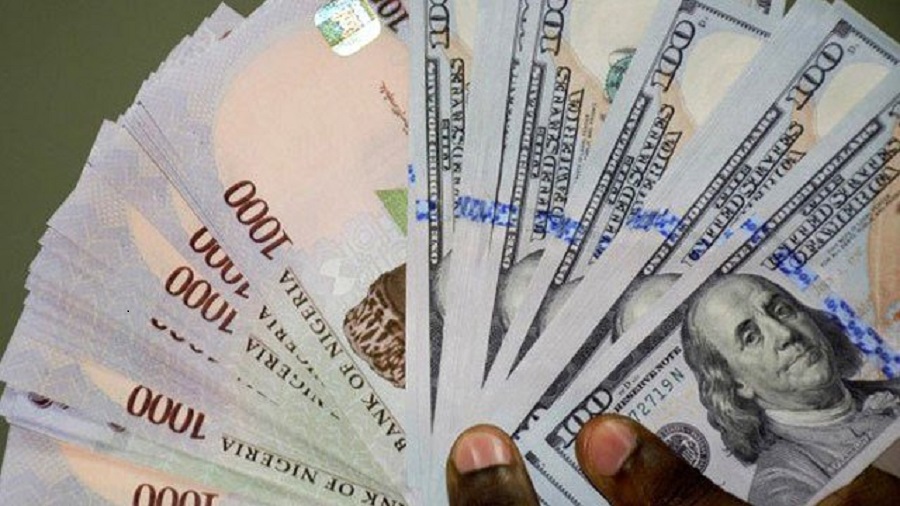
Naira exchanges for 480/$ at parallel market
Published

on

The naira exchanged to the dollar at the rate of 480/$ at the parallel market on Friday according to the Bureau de Change operators.

At the Importer & Exporter forex window, it reached a high of 435/$ before closing at 410/$.

The Central Bank of Nigeria recently disclosed that the naira depreciated at the official market to 410 against the dollar.

“In order to adjust for the decrease in supply of foreign exchange, the naira depreciated at the official window from 305/$ to 360/$ and now hovers around 410/$,” it stated.

Recently, the Association of Bureaux De Change Operators of Nigeria called on the CBN to introduce measures that would counter the advantages of cryptocurrency exchanges as a channel for diaspora remittances.

In its quarterly economic review report for the first quarter of 2021, ABCON said such measures were necessary to redirect diaspora remittance inflow away from cryptocurrency exchanges to official channels.

Though  the association  commended the CBN for the N5/$ rebate scheme introduced to encourage diaspora Nigerians to use official channels for remittance transfer, it noted that the apex bank needed to address other issues driving the patronage of cryptocurrency exchanges for remittance transfer.

It stated, “It is noteworthy that public acceptability for cryptocurrency exchanges is rising which could be quite accountable for the wide drop in diaspora inflows to Nigeria.

“Insecurity in the country is giving it greater prominence as investors and citizens are finding cryptocurrency a safe haven for their wealth in case of any eventuality.

“In most emerging markets, Bitcoin transfers surged last year, as the pandemic exposed the cheaper and more efficient digital remittance services.

“Migrants sending money across borders to their families prefer the minimal transaction costs of cryptocurrency exchanges against the exorbitant costs of traditional money transfer companies like Western Union.”

The report added that cryptocurrency transactions were faster than the conventional transfers, which required passing through banks reliant SWIFT, the sluggish, half-century-old interbank messaging system that handles cross-border payments.

-Saturday PUNCH

Loading

Railway

Rail transformation on Abuja–Kaduna route excites NIPR delegates 

Published

on

L-R: Chairman, NIPR Akwa Ibom State Chapter, Dr Manasseh Umortte; Lagos State Chairman, Dr Samuel Ayetutu; Vice Chairman, Cross River Chapter, Amb. Deborah Grace Awatte (representing Dr Austin Mboso); Edo State Chairman, Dr James Wisdom Abholimen; Bayelsa State Chairman, Dr. Ebowari Wariowei, and Dr Mohammed Kudu Abubakar, Fellow, NIPR and Chairman Planning Committee, World Public Relations Conference, holding at Kaduna State, inside the NRC coach…on Monday.

Rail transformation on Abuja–Kaduna route excites NIPR delegates 


Members of the Nigerian Institute of Public Relations (NIPR) have applauded the ongoing transformation of Nigeria’s rail system, describing it as a clear sign of renewed confidence in public transport under the leadership of Dr. Kayode Opeifa at the Nigerian Railway Corporation (NRC).

The commendation came on Monday as hundreds of NIPR members travelled aboard the Abuja–Kaduna train to attend the Institute’s Annual General Meeting in Kaduna.

The journey itself became a moving testament to the rail sector’s resurgence, with fully booked coaches buzzing with networking, reunions and professional camaraderie.

Delegates from across the country, particularly from the southern states, converged on Abuja before boarding the train alongside their counterparts from the Federal Capital Territory.

For many, the decision to travel by rail was both practical and symbolic—a vote of confidence in the improving fortunes of the NRC.

Inside the coaches, the atmosphere was said to be lively. Old colleagues reconnected, new relationships were forged, and passengers commended the professionalism and efficiency of NRC staff.

Many described the experience as seamless and refreshing, noting that with the right leadership, public institutions can deliver quality service.

While praising the progress recorded so far, the NIPR members called on the Federal Government to deepen investment in rail infrastructure.

They stressed that sustained funding is critical, given the capital-intensive nature of railway operations, and expressed confidence that such investments would yield strong economic returns.

Among dignitaries on board were the Olumobi of Imobi-Ijesha, Oba Dr. Jacob Adetayo Haastrup; President of the Broadcasting Organisations of Nigeria, Chief Tony Akiotu; and media veteran, Dr. Mohammed Kudur Abubakar.

Oba Haastrup particularly commended President Bola Tinubu for appointing Opeifa as NRC Managing Director, noting that his performance within a year highlights the corporation’s potential as a driver of economic growth.

Lagos NIPR Chairman, Dr. Samuel Ayetutu, said the coordinated rail trip was also influenced by safety considerations and served as a deliberate endorsement of the NRC’s ongoing reforms.

He urged the government to extend rail connectivity to more parts of the country, providing Nigerians with reliable alternatives to road travel.

The NRC delegation to the conference was led by its Chief Public Relations Officer, Mr. Callistus Unyimadu, alongside the MD’s Special Assistant on Media and Communication, Mr. Yinka Aderibigbe.

The Kaduna conference, which runs until April 24, is expected to equip communication professionals with fresh insights and innovations in public relations practice.

It also serves as a precursor to the World Public Relations Conference scheduled to hold in Abuja later this year, where global stakeholders will converge to address emerging challenges in the profession.

Loading

Continue Reading

Business

Middle East Crisis: Nigeria Records $4bn Oil Windfall

Published

on

crude oil price

Middle East Crisis: Nigeria Records $4bn Oil Windfall

Nigeria and oil companies operating in the country have recorded an estimated $4 billion windfall following a sharp rise in global crude oil prices triggered by the ongoing US–Israel–Iran conflict, which has now lasted about seven weeks and continues to destabilize global energy markets.

The geopolitical tension, which reportedly began on February 28, has pushed oil prices higher amid fears of supply disruptions from the Middle East, a key global energy hub. As a result, Nigeria—one of Africa’s largest crude exporters—has benefited significantly from the rally in international oil markets.

The Central Bank of Nigeria data shows that before the conflict, Nigeria’s benchmark Bonny Light crude oil averaged $70.14 per barrel year-to-date. However, during the 52-day conflict period, the average price surged to $116.84 per barrel, representing a 66.6% increase in crude value.

This sharp rise coincided with improved production levels. Figures from the Nigerian Upstream Petroleum Regulatory Commission indicate that output increased from 1.483 million barrels per day in February to 1.546 million barrels per day in March, boosting Nigeria’s export earnings during the period.

Based on these figures, analysts estimate that at pre-crisis prices, Nigeria would have earned about $5.64 billion in 52 days, while post-crisis pricing pushed revenue to approximately $9.39 billion, resulting in an estimated $4 billion windfall for the government and oil companies.

READ ALSO:

Despite the gains, crude oil markets remain highly volatile. Bonny Light crude recently traded around $98 per barrel, rising from about $95 after diplomatic talks between the United States and Iran collapsed over the weekend. Earlier, prices had briefly dropped to around $90 per barrel after peaking near $100, as markets reacted to speculation of a potential breakthrough in negotiations.

Energy analysts say the market is being driven by geopolitical uncertainty, supply concerns, and speculative trading, with further volatility expected in the coming weeks.

According to energy expert and CEO of Petroleumprice.ng, Olatide Jeremiah, oil prices are likely to remain elevated due to ongoing instability.

He noted that the global oil market remains highly sensitive to geopolitical tensions, warning that rising crude prices could also impact Nigeria’s domestic economy. He explained that higher oil prices are likely to spill into the downstream sector, leading to increases in petrol (PMS) prices, transportation costs, and inflationary pressures on goods and services.

Similarly, the National President of the Oil and Gas Services Providers Association of Nigeria (OGSPAN), Mazi Colman Obasi, acknowledged that rising global energy costs could affect Nigeria’s economy. However, he noted that the impact may be moderated by domestic refining capacity, particularly the operations of the Dangote Petroleum Refinery (650,000 barrels per day), which is expected to reduce reliance on imported refined products.

Economists say the current windfall highlights both the opportunities and risks associated with Nigeria’s dependence on crude oil exports. While higher prices strengthen foreign exchange earnings, external reserves, and government revenue, they also expose the economy to global shocks that can quickly reverse gains.

Looking ahead, analysts warn that Nigeria’s oil earnings will remain closely tied to developments in the Middle East. If tensions persist, crude prices could remain elevated, further boosting revenue. However, any resolution to the conflict could lead to a rapid price correction.

For now, Nigeria stands among the key beneficiaries of the global energy shock, as the oil price surge continues to deliver unexpected fiscal gains amid ongoing geopolitical uncertainty.

Middle East Crisis: Nigeria Records $4bn Oil Windfall

Loading

Continue Reading

Business

Naira Holds Steady in Official Market, Slides in Black Market

Published

on

Naira-dollar

Naira Holds Steady in Official Market, Slides in Black Market

The Nigerian Naira continues to show mixed performance across the country’s foreign exchange segments on Wednesday, April 22, 2026, as traders monitor movements in the Nigerian Foreign Exchange Market (NFEM) and the parallel market for clearer direction.

In the official window, early data indicates that the Naira is trading around ₦1,348.77 per $1, reflecting mild intraday volatility. The currency briefly strengthened to about ₦1,346.30/$ before settling in the mid-₦1,340 range. This trend suggests a phase of relative stability, supported by ongoing liquidity management efforts from the Central Bank of Nigeria.

The NFEM remains the primary channel for formal foreign exchange transactions, including import financing, corporate obligations, and government-backed allocations. Analysts note that the apex bank’s interventions—alongside improved FX inflows from oil receipts and remittances—have helped prevent sharper depreciation in recent sessions.

However, pressures persist beneath the surface. Market participants report that dollar demand continues to outpace supply in certain segments, particularly for invisible transactions, which has limited the Naira’s ability to record significant gains in the official market.

In contrast, the parallel market reflects stronger depreciation, highlighting sustained retail demand for foreign currency. Across major trading hubs in Lagos, Abuja, and Kano, the Dollar is currently exchanged between ₦1,450 and ₦1,470, depending on location and transaction size.

READ ALSO:

This widening gap between official and parallel market rates underscores structural challenges in Nigeria’s FX system. Many individuals and small businesses continue to rely on the informal market due to documentation requirements, access constraints, and delays associated with official channels.

Currency dealers attribute the elevated parallel market rates to:

  • Persistent demand for travel allowances and school fees abroad
  • Import-related pressures from small and medium-scale traders
  • Speculative hoarding amid uncertainty about future FX supply

Economic observers also point to broader macroeconomic factors influencing the Naira’s trajectory. These include fluctuations in global crude oil prices—Nigeria’s primary source of foreign exchange earnings—as well as movements in external reserves and capital inflows.

While the official market shows signs of short-term consolidation, the parallel market remains highly sensitive to sentiment and liquidity shocks. Analysts warn that without a significant boost in dollar supply or structural reforms, the spread between both markets may persist.

Attention is now shifting to end-of-day data expected from the FMDQ Securities Exchange, which will provide a clearer picture of closing rates and trading volumes. These figures are likely to shape expectations for the Naira’s performance for the rest of the week.

For now, the outlook remains cautiously balanced. The Naira is holding relatively steady in the official window but continues to face underlying pressure in the parallel market, reflecting the ongoing tug-of-war between policy support and real demand dynamics.

Naira Holds Steady in Official Market, Slides in Black Market

Loading

Continue Reading
HostArmada Affordable Cloud SSD Shared Hosting
HostArmada - Affordable Cloud SSD Web Hosting

Trending