
News
Nigeria is at war, seek external help, Soyinka tells FG

- ‘Don’t use youths as sacrificial offering’
Nobel laureate, Wole Soyinka, has asked the Federal Government to seek foreign assistance to tackle insecurity in the country.
He said this in a statement he issued on Sunday.
Referring to the killing of three students abducted from Greenfield University in Kaduna by gunmen on Friday, Soyinka said youths should not be allowed to “serve as ritual offering on the altar of a failing state”.
Soyinka said the government should not “continue to pretend” that the rising insecurity in the country was “mere birth-pangs of a glorious entity”.
He added, “Abukakar Atiku has summed up the nation’s feeling – this most recent savagery against our youth is heartbreaking.”
Part of the statement read, “More than the heart is broken however; more than millions of individual hearts that still lay claim to bonds in a common humanity.
“The already over-stretched sinews of moral restraint have been snapped off the casing of nation being, and nothing is left but the collective wails of impotence.
“Not for the first time, what many hoped was a Natural Law of Limitations has been contemptuously, defiantly breached.
“We need to remind ourselves of hideous precedents. We must remember Chibok. And Dapchi. And numerous antecedents and after, unpublicised, or soon relegated to the sump of collective amnesia. The wages of impunity never diminish; on the contrary, they distend.
“One’s greatest fear, with this latest feat of cowardly savagery is that the nation must brace itself for a Beslan scenario, yet strive to avoid Nigeria become Africa’s Cherchnya.
“Those who have been proven weak and incapable must learn to swallow their vain pride and seek help. Again, this is no new counselling, but of course the dog that will get lost no longer heeds the hunter’s whistle.
“I envy no one the task ahead, terminating the toxic harvest of past derelictions. Blame laying is for later. Right now is the question of – what needs to be done, and done urgently.
“We keep avoiding the inevitable, but that very unthinkable now hammers brutishly on our gates, the blood ransom arrogantly insatiable.
“This nation is at war, yet we continue to pretend that these are mere birth-pangs of a glorious entity. They are death throes. Vultures and undertakers hover patiently but with full confidence.
“The dogs of war stopped merely baying years ago. Again and again, they have sunk their fangs into the jugular of this nation. The plague called COVID has met its match on the earth of some nation space once known as Nigeria.
“I grieve with the bereaved, but mourn even more for our youth so routinely sacrificed, burdened with uncertainty and traumatised beyond youth’s capacity to cope. To this government we repeat the public cry.
“Seek help. Stop improvising with human lives. Youth – that is, the future – should not serve as ritual offering on the altar of a failing state.”








News
Afenifere Calls for Immediate Take-Off of State Police as Terror Threats Rise in Yorubaland

Afenifere Calls for Immediate Take-Off of State Police as Terror Threats Rise in Yorubaland
The pan‑Yoruba socio-political group Afenifere has warned that escalating terrorist attacks in states bordering the South-West are heightening fears of a full-scale incursion into Yorubaland, calling on governors to urgently implement robust security measures and push for the take-off of state police.
In a statement by its National Publicity Secretary, Jare Ajayi, Afenifere expressed deep concern over repeated attacks in Kwara, Kogi, and Niger states, as well as kidnappings in Ondo, Ekiti, and Oyo states. The group cited the recent Woro and Nuku attacks in Kwara State, where nearly 200 people were reportedly killed and several others abducted, as a warning of the growing threat.
“This is a very disturbing development as cases of abduction seem to be on the increase in Yorubaland. Terror acts are no longer confined to rural areas; even cities like Ibadan have witnessed incidents,” the statement read. Afenifere highlighted the broad-daylight abduction of a schoolgirl in Ibadan’s Challenge area as a chilling example of the insecurity affecting urban centres.
Ajayi urged governors of the six South-West states — Oyo, Ogun, Osun, Ekiti, Ondo, and Lagos — as well as neighbouring states including Kwara, Kogi, Edo, and Delta, to implement practical security arrangements that will allow residents to “sleep with their two eyes closed.”
READ ALSO:
- CAF Confirms 2027 AFCON Dates, Reveals Host Cities, Stadiums Across East Africa
- Ronaldo Returns From Absence to Score in Al‑Nassr’s 2‑0 Win Over Al‑Fateh
- One Dead as Hausa, Benue Communities Clash at Port Harcourt Market
The group recalled that during a November 24, 2025, meeting in Ibadan, the South-West governors had agreed to strengthen regional security through measures such as the South-West Security Fund and the creation of monitoring centres to track potential terrorist activity. Afenifere noted that recent steps, such as Ogun State’s inauguration of CCTV monitoring centres, are commendable but insufficient.
Ajayi stressed that the persistence of banditry and terrorism is not due to a lack of intelligence, but rather the failure to effectively utilize available information. He insisted that state police should take off immediately, while communities must be empowered to develop local security arrangements, including support for the Amotekun Corps and other regional security initiatives.
“It is high time governors in Yorubaland went beyond sermonisation and swung into decisive actions that will make the region truly secure,” Ajayi said.
Afenifere’s warning comes amid growing concerns over security across southern Nigeria, where the spread of banditry, kidnappings, and terrorist attacks is increasingly threatening both rural and urban communities. The group’s call reinforces longstanding advocacy for state-level policing as a critical measure to combat rising insecurity.
Afenifere Calls for Immediate Take-Off of State Police as Terror Threats Rise in Yorubaland
News
UN Chief Calls Africa’s Security Council Exclusion Unfair, Outdated
UN Chief Calls Africa’s Security Council Exclusion Unfair, Outdated
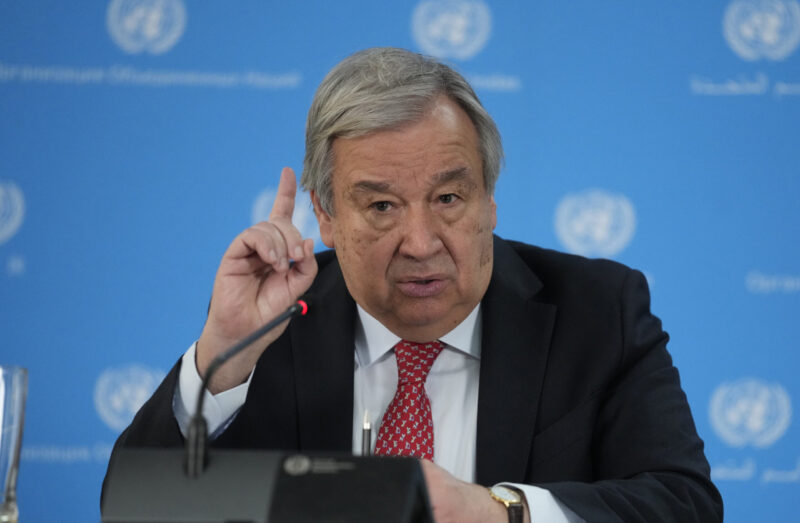
The Secretary-General of the United Nations, António Guterres, has described Africa’s continued exclusion from permanent membership of the UN Security Council as “indefensible”, calling for urgent reforms to reflect today’s global realities.
Guterres made the remarks while addressing world leaders, stressing that Africa—home to more than 1.4 billion people and a major focus of the Council’s peace and security agenda—remains without a single permanent seat in the UN’s most powerful decision-making body.
According to him, the current structure of the Security Council no longer reflects geopolitical realities of the 21st century and undermines the credibility and legitimacy of the United Nations.
“Africa is dramatically under-represented. This is not only unfair, it is indefensible,” Guterres said.
READ ALSO:
- Tragedy on Enugu–Port Harcourt Highway as 11 Die in Road Accident
- Kwara Govt, Security Agencies Analyse Terrorists’ Video to Identify Kidnap Victims
- 26 Killed as Bandits Attack Niger Communities, Burn Police Station, Homes
He noted that while Africa accounts for a significant proportion of issues discussed by the Council—including peacekeeping operations, sanctions, and conflict resolution—it remains excluded from permanent decision-making power, including the veto.
The UN chief reiterated his support for long-standing African demands for at least two permanent seats and additional non-permanent seats on the Council, in line with the African Union’s Common African Position on UN reform.
Guterres also warned that failure to reform the Security Council risks eroding trust in multilateral institutions at a time when global cooperation is most needed to address conflicts, climate change, terrorism, and humanitarian crises.
Calls for reform of the Security Council have intensified in recent years, with African leaders, alongside countries from Latin America and Asia, arguing that the current structure—largely unchanged since 1945—reflects post-World War II power dynamics rather than present-day global realities.
Despite widespread agreement on the need for reform, progress has been slow due to disagreements among UN member states, particularly the five permanent members who hold veto power.
UN Chief Calls Africa’s Security Council Exclusion Unfair, Outdated
News
INEC May Adjust 2027 Election Dates Over Ramadan Concerns
INEC May Adjust 2027 Election Dates Over Ramadan Concerns
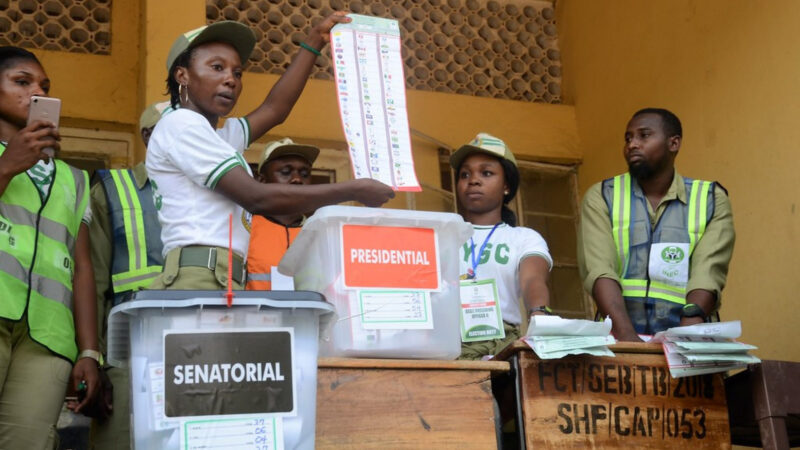
The Independent National Electoral Commission (INEC) has acknowledged growing concerns over the timing of the 2027 general elections, which currently coincide with the holy month of Ramadan, and said it may seek legislative intervention if necessary to ensure full electoral participation.
In a statement released on Friday, INEC National Commissioner and Chairman of the Information and Voter Education Committee, Mohammed Kudu Haruna, said the commission is sensitive to public concerns and is consulting with stakeholders on possible adjustments to the election timetable.
The commission explained that the current schedule, developed in strict compliance with the Constitution of the Federal Republic of Nigeria, 1999 (as amended), the Electoral Act, 2022, and INEC’s own Guidelines and Regulations for the Conduct of Elections, 2022, sets Saturday, February 20, 2027, for the presidential and National Assembly elections, and Saturday, March 6, 2027, for the governorship and State Houses of Assembly elections. Party primaries are slated for May 22 to June 20, 2026.
READ ALSO:
- Man Allegedly Kills Brother in Rivers Over Witchcraft Accusation
- Regina Daniels Gifts Mother Two Luxury SUVs in Emotional Surprise
- El-Rufai Alleges Ribadu Ordered Arrest, Says Intercepted Calls Exposed Plot
However, INEC noted that these dates overlap with Ramadan, a period of fasting, prayer, and religious observances for Muslims, which could affect voter turnout and participation, particularly in predominantly Muslim areas. The commission emphasized that any adjustment to the timetable will remain consistent with constitutional and statutory requirements.
“The commission wishes to assure the public that it remains sensitive to all legitimate concerns that may impact electoral participation and the overall conduct of elections. In view of these representations, INEC is currently undertaking consultations and may, where necessary, seek appropriate legislative intervention,” the statement read.
Several political figures have already expressed concerns. Former Vice President Atiku Abubakar called on INEC to reconsider the February 20 date, citing potential disruption of voting during Ramadan. Former presidential aide Bashir Ahmad also urged the commission to review the schedule to avoid disenfranchisement of Muslim voters.
The commission reaffirmed its commitment to conducting transparent, credible, and inclusive elections. It promised to keep the public informed of any adjustments to the election timetable arising from consultations with political parties, civil society, and religious stakeholders.
The debate over the 2027 election schedule highlights the challenges of balancing constitutional timelines with religious and cultural sensitivities, underscoring the importance of ensuring accessible and fair elections for all Nigerians.
INEC May Adjust 2027 Election Dates Over Ramadan Concerns

-
 Education7 hours ago
Check Your Name: UNILORIN Releases Updated NELFUND Refund List for 2024/2025 Students
-

 News2 days ago
Aso Rock Goes Solar as Tinubu Orders National Grid Disconnection
-

 metro2 days ago
Lagos Police Launch Manhunt for Suspect in Brutal Ajah Murder
-

 Sports2 days ago
Lookman Shines as Atlético Madrid Hammer Barcelona 4-0
-

 metro1 day ago
Boko Haram Terrorists Release Video of 176 Abducted Kwara Residents
-
 metro2 days ago
Court Orders DIA to Produce Cleric Accused of Coup Plot by February 18
-
 metro3 days ago
El-Rufai to Appear Before EFCC After Alleged Airport Arrest Attempt
-

 News3 days ago
MPAC Hails Supreme Court Verdict Affirming Muslim Students’ Right to Worship at RSU