

metro
SERAP gives Tinubu 48 hours to reverse ban on Vanguard, Galaxy TV, 23 others

SERAP gives Tinubu 48 hours to reverse ban on Vanguard, Galaxy TV, 23 others
Socio-Economic Rights and Accountability Project (SERAP) has urged President Bola Tinubu to immediately reverse the ban on 25 journalists and media houses from covering the presidential villa and restore the accreditation of those affected.
SERAP urged him “to publicly instruct the officials in the presidential villa to allow journalists and media houses to freely do their job and discharge their constitutional duty of holding those in power to account.”
The Federal Government recently withdrew the accreditations of some 25 journalists from covering activities at the Presidential Villa, Abuja.
The banned journalists include those from the Vanguard, Galaxy TV, Ben TV, MITV, ITV Abuja; PromptNews, ONTV and Liberty.
In the letter dated August 26, 2023 and signed by SERAP Deputy Director Kolawole Oluwadare, the organisation said, “Barring these journalists and media houses from covering the presidential villa is to prevent them from carrying out their legitimate constitutional responsibility.”
SERAP also said, “Your administration cannot with one broad stroke ban journalists from covering public functions. Citizens’ access to information and participation would mean little if journalists and media houses are denied access to the seat of government.”
It added, “Media freedom is a cornerstone of Nigeria’s democracy and journalists must be able to hold the government to account. This is a matter of public interest. The government cannot cherry-pick journalists to cover its activities.”
READ ALSO:
- Navy SEAL, Robert O’Neill, who killed Bin Laden arrested in Texas
-
Teacher accused of threatening to shoot Trump, his son, Barron
-
FG debunks report of expulsion of Nigerian ambassador from Niger
The letter read in part, “We would be grateful if the recommended measures are taken within 48 hours of the receipt and/or publication of this letter. If we have not heard from you by then, SERAP shall consider appropriate legal actions to compel your government to comply with our request in the public interest.”
“Nigerians may consider the expulsion of the journalists from the presidential villa as your government’s ambivalence towards media freedom, and citizens’ rights of access to information and participation in their own government.
“The legal obligations imposed on your government to ensure and uphold media freedom and human rights, and facilitate public access to the presidential villa as a public trust outweigh any purported ‘security concerns and overcrowding of the press gallery area.’m
“Media freedom, access to information and citizens’ participation in the affairs of their own government are the sine qua non of a democratic and rule of law-based society.
“The withdrawal of the accreditation tags of these journalists directly violates media freedom and human rights including access to information and the right to participation. It would have a significant chilling effect on newsgathering and reporting functions, and may lead to self-censorship.
“The withdrawal of the accreditations of the journalists would construct barriers between Nigerians and certain information about the operations of their government, something which they have a constitutional right to receive.
“Media freedom, access to information and the right to participation are necessary for the maintenance of an open and accountable government. These freedoms are so fundamental in a democracy that they trump any vague grounds of ‘security concerns and overcrowding of the press gallery area.
READ ALSO:
- Tinubu seeks US support for economy, accepts Biden’s UNGA invitation
-
Awoniyi equals Salah, Adebayor’s Premier League scoring run
-
Mbappe shines on home return as PSG outclass Lens
“The effective exercise of media freedom, access to information and citizens’ right to participation in their government would preserve and contribute to a free and democratic society, something which is consistent with your constitutional oath of office to defend the Nigerian Constitution 1999 [as amended].
“Allowing the media to cover the presidential villa would improve the reliability of information available to the public and serve the public interest.
“Your government reportedly justified this grave constitutional infraction on the pretext of ‘an internal attempt to reduce bloated number of print photographers and overcrowding in the State House.
“Your government also cited alleged security concerns raised by State House officials and visiting dignitaries concerning the overcrowding of the press gallery area that blocks the walking path to the President’s Office.
“According to our information, your administration on 18 August 2023 withdrew the accreditation tags of some 25 journalists and media houses from covering activities at the Presidential Villa, Abuja.
“The banned journalists reportedly include those from Vanguard newspaper; Galaxy TV; Ben TV; MITV; ITV Abuja; PromptNews, ONTV, and Liberty. Other media personnel affected by the withdrawal are mostly reporters and cameramen from broadcast, print, and online media outlets.
“The affected journalists were simply told at the main gate of the presidential villa to submit their accreditation tags.
“SERAP is concerned that the withdrawal of the accreditations of 25 journalists covering the presidential villa is a grave violation of the Nigerian Constitution and the country’s international human rights obligations.
READ ALSO:
-
Former military operation spokesperson, General Bernard Onyeuko dies
-
Arsenal held to 2-2 draw by 10-man Fulham
-
Coup: Niger Junta orders troops to go on ‘maximum alert’
“Our requests are brought in the public interest, and in keeping with the requirements of the Nigerian Constitution 1999 [as amended]; and the country’s international obligations including under the International Covenant on Civil and Political Rights and the African Charter on Human and Peoples’ Rights to which Nigeria is a state party.”
“Under section 22 of the Nigerian Constitution, the mass media including ‘the press, radio, television and other agencies of the mass media shall at all times be free to uphold the fundamental objectives contained in this Chapter and uphold the responsibility and accountability of the Government to the people.’”
“Section 14(2)(c) of the Constitution provides that ‘the participation by the people in their government shall be ensured in accordance with the provisions of this Constitution.’”
“Similarly, Article 9 of the African Charter on Human and Peoples’ Rights provides that, ‘Every individual shall have the right to receive information. Every individual shall have the right to express and disseminate his opinions.’”
“Article 13 of the Charter also provides that, ‘Every citizen shall have the right to participate freely in the government of his country. Every citizen shall have the right of equal access to the public service of his country. Every individual shall have the right of access to public property and services.’”
“Articles 19 and 25 of the International Covenant on Civil and Political Rights contain similar provisions.”
“SERAP also urges you to take meaningful and effective steps to ensure respect for the rights to media freedom, access to information and citizens’ right to participate in their own government.”
SERAP gives Tinubu 48 hours to reverse ban on Vanguard, Galaxy TV, 23 others











metro
How I Sold My Twins for N300,000, Stole 13 Other Children — Suspect
How I Sold My Twins for N300,000, Stole 13 Other Children — Suspect
A 50-year-old suspected child trafficker, Adejoke Popoola, has confessed to selling a newborn boy and a set of twins she gave birth to before stealing at least 13 other children for onward sale, in a case that has uncovered an interstate trafficking syndicate operating across Oyo, Ogun and Delta States.
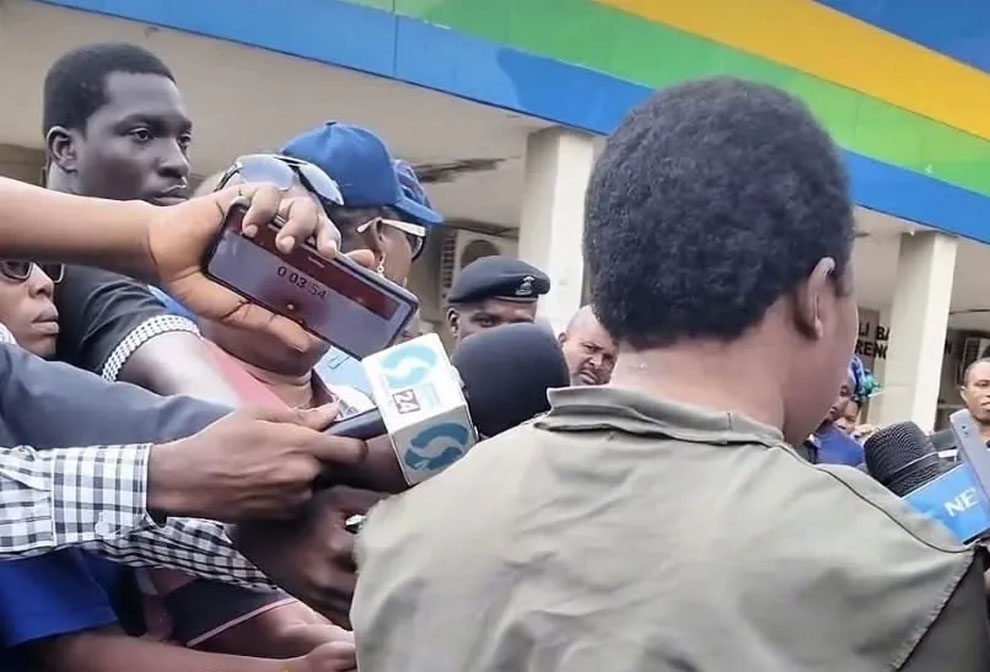
Popoola, also known as Orente Alagbo, made the startling disclosure on Monday while speaking with journalists at the Oyo State Police Command headquarters in Ibadan, following her arrest on August 4. She claimed she had been involved in the alleged activities since October 2024, after her herb-selling business was gutted by fire, which she said pushed her into the illicit trade as a means of survival.
Popoola stated that she sold a newborn baby boy and a set of male twins, with the twins sold to a clinic in Ogeere for ₦300,000. She said she sometimes received between N80,000 and N120,000 for other children, and up to N900,000 for some victims, depending on the age and gender of the child. “God blessed me with the gift of pregnancy. Anytime a man has sex with me twice, I get pregnant, and it is always difficult to abort,” she said. “I have sold two sets of children, a newborn boy and twins as well, last year. I sold the twins to … clinic; she also resells them to her customers in Lagos. She has a baby industry. When the owner of the pregnancy rejects the pregnancy, that is when I sell.” Popoola, who said she has seven children of her own aged between six and 34, added that she became involved in the alleged operation after meeting a woman she identified as Oluwakemi, who she said operated a “baby industry” and supplied children to buyers in Lagos, revealing the existence of a well-organized trafficking network.
The suspect also admitted to stealing children through various deceptive methods. She explained that she would sometimes disguise herself as a prospective tenant to gain access to homes before taking children when their parents were not around. “I steal babies. I will go to their place and say I want to rent a house. Then, if I do not see anyone, if I see their children, I will just steal their children,” she said. Popoola claimed that a woman she worked with at Ogeere Market taught her how to steal children, providing her with the skills and confidence to carry out the abductions. She further alleged that she sometimes posed as a spiritualist, targeting parents with children living with disabilities, preying on their desperation for healing. “Parents bring their disabled children to me because they cannot talk, sit, or walk. So, I will promise them that I can help them to heal, then I will go and pick another person’s child for them,” she said, revealing a particularly cruel method of operation.
READ ALSO:
- No More Embassy Visits: Step-by-Step Guide to Nigeria’s Contactless Passport Renewal
- Lagos police arrest four suspected robbers, recover 25 phones in Mushin
- Benue Govt Blasts Obi Over ‘Unapproved’ Visit: ‘He Is Looking For Our Trouble’
One of the most chilling incidents she recounted involved the abduction of three-year-old Ifakunle Ifagbenro during an Egungun festival in Oyo Town on June 29. She said she travelled to the festival two days earlier, joined the family during prayers and even contributed money to gain their trust before volunteering to carry the boy during the procession. “When the Egungun left, the boy told his mother that he did not want to stay at home and wanted to join the procession. So, I volunteered to help hold the boy,” she said. “I joined them for the procession and, in the evening, I picked up the boy, laid him on my back and ran away with him.” She claimed she received N900,000 for selling Ifagbenlo, making him one of her most lucrative targets.
Popoola claimed that of the children she allegedly kidnapped, six had died while 17 were rescued by police. The deceased children were identified as Musharaf Lawal Tajudeen, two; Greatness Adeagbo, five; Sainat Amoo, two; Taiwo Usman, two; Daniel Solomon Olayinka, seven; and Miracle Olaniyi, four. She explained that some of the children died due to illness or neglect while in custody, while others reportedly succumbed to the harsh conditions in which they were kept.
The Oyo State Commissioner of Police, Abimbola Olugbenga, said the investigation began with a petition dated July 29, 2026, submitted by Popoola herself over allegations including conspiracy, cyberbullying, threat to life and defamation. Detectives later linked the case to the disappearance of Ifakunle during the masquerade festival, as video footage from the event showed Popoola carrying the child moments before he vanished. Popoola was arrested on August 4, and her statement provided the first major breakthrough in dismantling the syndicate. She allegedly named Adekanbi Janet, also known as Hosanna, as her accomplice. Janet was arrested in Mowe, Ogun State, where four children and two pregnant young women were rescued from her custody, revealing the scale of the operation.
READ ALSO:
- Yamal Fires Back at Mbappé: “I’m Not Going to Beg” for Ballon d’Or
- Osun Police Arrest Woman After Vigilante Member Dies During Sexual Encounter in Ile-Ife
- Igbo Group Rejects Tinubu Endorsement, Pledges Grassroots Support for Peter Obi in 2027
The investigation later extended to Agbor, Delta State, where four children allegedly stolen from Oyo State were rescued from persons suspected to have bought them. Two suspects, Christopher Joy, 48, and Rosemary Jesse, 53, were arrested and allegedly confessed to involvement in the trafficking network, confirming the interstate dimension of the criminal enterprise. The investigation also uncovered an alleged ritual dimension, with suspects confessing that children who died in custody were sold to ritualists. This led to the arrest of Muritala Fasasi, an Islamic cleric, and Yakubu Azeez, a herbalist, who were allegedly involved in purchasing the bodies of deceased children for ritual purposes.
The police said it has so far rescued 17 children and arrested seven suspects in connection with the investigation. The rescued children include Ifakunle Ifagbenro, 3; Musibau Olasupo, 5; Sulaimon Osamo, 7; Murina Fidaus, 3; Aminat Yusuf, 3; Taiwo Olamilekan, 3; an infant aged nine days; Rafiat Waheed Babalola, 2; Quwiyat Alade, 5; Rejoice Divine, 3; Alhaji Divine, 5; Eniolorunda, 3; Victoria, 3; Isoma Prince, 3; Roqeeba, 4; Boluwatife Odedeyi, 3; and Ireoluwa Elizabeth Olapade, 7. The CP urged parents and guardians whose children recently went missing to visit the command headquarters in Eleyele, Ibadan, to identify the rescued children and facilitate their reunification with their families, as some of the children have yet to be claimed.
How I Sold My Twins for N300,000, Stole 13 Other Children — Suspect
metro
No More Embassy Visits: Step-by-Step Guide to Nigeria’s Contactless Passport Renewal

No More Embassy Visits: Step-by-Step Guide to Nigeria’s Contactless Passport Renewal
metro
Lagos police arrest four suspected robbers, recover 25 phones in Mushin
Lagos police arrest four suspected robbers, recover 25 phones in Mushin
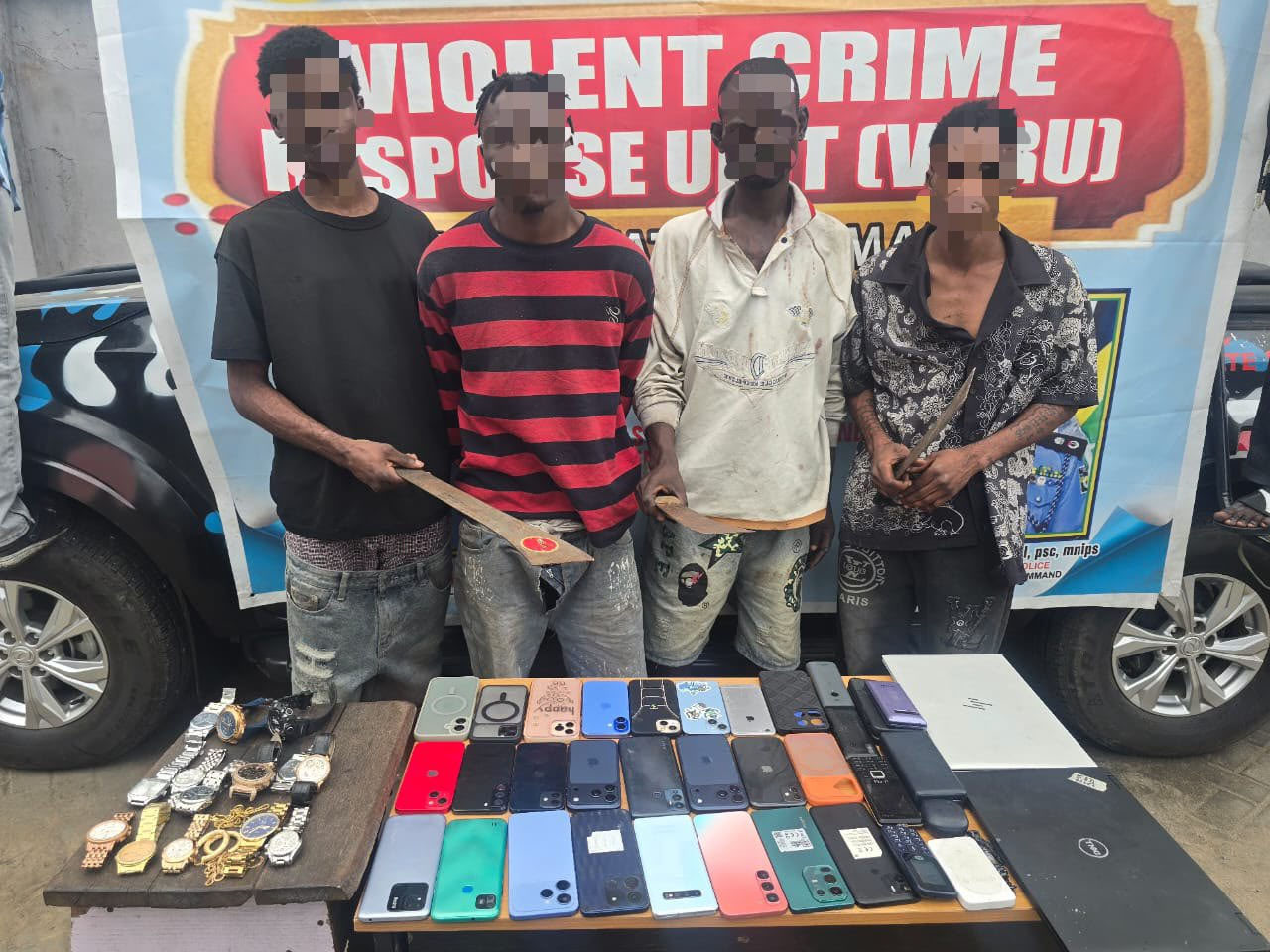
The Lagos State Police Command has arrested four suspected members of an alleged armed robbery syndicate operating around the Iju-Ishaga and Oke-Aro areas of Lagos State, recovering 25 mobile phones and other items during a raid on their hideout.
The suspects were arrested at their alleged hideout in Idi-Oro, Mushin, following what the police described as credible intelligence and sustained surveillance by operatives of the Command’s Violent Crime Response Unit (VCRU).
The suspects were identified as Damilare Oluwatobi, 28; Lekan Adenuga, 30; Haruna Sheriff, 22; and David Balogun, 24.
According to the police, the operation followed intelligence gathered on the activities of the alleged robbery syndicate, which was reportedly linked to criminal operations in parts of Lagos.
During a search of the hideout, VCRU operatives recovered 25 mobile phones, two laptop computers, gold jewellery, including a necklace and earrings, and three cutlasses.
The police described the arrests as a significant development in efforts to tackle armed robbery and violent crime in Lagos, while investigations continue to establish the circumstances surrounding the recovered items and identify their owners.
READ ALSO:
- Benue Govt Blasts Obi Over ‘Unapproved’ Visit: ‘He Is Looking For Our Trouble’
- Yamal Fires Back at Mbappé: “I’m Not Going to Beg” for Ballon d’Or
- Osun Police Arrest Woman After Vigilante Member Dies During Sexual Encounter in Ile-Ife
The suspects are currently in police custody and are assisting investigators with the ongoing investigation. The Command also said efforts were being intensified to apprehend other suspected members of the alleged syndicate who may be connected to the criminal activities.
The development was confirmed by the Lagos State Police spokesperson, SP Abimbola Adebisi, who said the suspects were arrested by operatives of the VCRU following sustained intelligence gathering.
The Lagos State Commissioner of Police, CP Tijani Fatai, commended the VCRU operatives for their swift response and intelligence-led approach, describing the operation as part of the Command’s broader efforts to dismantle criminal networks across the state.
Fatai reaffirmed the police commitment to protecting residents and tackling criminal activities, particularly armed robbery and other violent crimes.
He also urged residents to remain vigilant and promptly report suspicious activities to the police through the Command’s emergency lines.
The police listed the emergency contacts as 07061019374, 08065154338, 08063299264, 08039344870, 08080193432 (Marine), and 09168630929.
The latest arrests come as the Lagos Police Command continues to rely on intelligence-led operations to identify and disrupt criminal groups operating across the state.
The four suspects remain in custody while the investigation continues, with the police expected to determine the extent of their alleged involvement and pursue other individuals suspected to be connected to the syndicate.
Lagos police arrest four suspected robbers, recover 25 phones in Mushin
-

 metro3 days ago
APC rally: Suspected thugs attack journalists, smash Radio Nigeria vehicle in Kano
-
 Education3 days ago
FG Opens N2.5bn Grant Window For 50 Student Innovators Under “Next Moonshot Initiative”
-
 Politics2 days ago
Peter Obi, Others Challenging Tinubu Cannot Transform Nigeria — Datti Baba-Ahmed
-
 Politics3 days ago
Kano Political Earthquake: Kwankwaso Loyalists Dump NDC, Defect to APC in Major 2027 Blow
-

 Entertainment3 days ago
Wizkid Mocks Davido’s Family Wealth: “Rich and Empty” — Afrobeats Feud Escalates
-

 metro2 days ago
Socialite Igho ‘Tiny’ Ubiribo Dies After Penis Enlargement Surgery
-

 Auto2 days ago
Kaduna to Lead Govt Patronage of Local Vehicles as Sani Unveils Peugeot 5008
-
 Politics2 days ago
Demystifying the Political Monolith: Wike’s ‘See Finish’ Doctrine and Nigeria’s New Political Calculus