
International
Seven European nations urge Israel to reverse policy on Gaza

Seven European nations urge Israel to reverse policy on Gaza
A group of seven European nations has called for an end to Israel’s military assault and blockade of Gaza, as the United Nations aid chief says time should not be wasted on an alternative United States-backed proposal to deliver aid to the Palestinian territory.
In a joint statement late on Friday, the leaders of Iceland, Ireland, Luxembourg, Malta, Slovenia, Spain and Norway said they “will not be silent in front of the man-made humanitarian catastrophe that is taking place before our eyes in Gaza” as Israel’s blockade has prevented the delivery of humanitarian aid for two and a half months.
“We call upon the government of Israel to immediately reverse its current policy, refrain from further military operations and fully lift the blockade, ensuring safe, rapid and unimpeded humanitarian aid to be distributed throughout the Gaza strip by international humanitarian actors,” the statement read.
“More than 50,000 men, women, and children have lost their lives. Many more could starve to death in the coming days and weeks unless immediate action is taken,” it said.
Meanwhile, the Council of Europe, a body that works to safeguard human rights and democracy, also noted that Gaza was suffering from a “deliberate starvation” and warned that Israel was sowing “the seeds for the next Hamas” in the territory, referring to the Palestinian armed group.
“The time for a moral reckoning over the treatment of Palestinians has come – and it is long overdue,” said Dora Bakoyannis, rapporteur for the Middle East at the Parliamentary Assembly of the Council of Europe.
READ ALSO:
- 21 dead after storms hit US states of Missouri, Kentucky
- Tragedy hits Kwara community again as 21 die in boat accident
- FG launches new citizenship, business processing digital platform
The European calls came hours after UN aid chief Tom Fletcher said 160,000 pallets of relief and 9,000 trucks were ready to enter Gaza.
“To those proposing an alternative modality for aid distribution, let’s not waste time. We already have a plan,” he said in a statement.
“We have the people. We have the distribution networks. We have the trust of the communities on the ground. And we have the aid itself – 160,000 pallets of it – ready to move. Now,” he said.
“We demand rapid, safe, and unimpeded aid delivery for civilians in need. Let us work.”
Israel has halted the entry of food, medication and all other essentials into Gaza since March 2. UN agencies and other humanitarian groups have warned of shrinking food, fuel and medicine supplies to the territory of 2.4 million Palestinians facing acute starvation.
Earlier, the US and Israel said they were preparing a plan that would allow the resumption of aid by an NGO, while keeping supplies out of Hamas’s hands.
Under the heavily criticised alternative aid plan, the US-backed Gaza Humanitarian Foundation aims to start work in Gaza by the end of May.
It intends to work with private US security and logistics firms to transport aid into Gaza to so-called secure hubs where it will then be distributed by aid groups, a source familiar with the plan told the Reuters news agency. It is unclear how the foundation will be funded.
The Gaza Humanitarian Foundation has also asked Israel to allow humanitarian deliveries by the UN and aid groups to resume now until its infrastructure is fully operational, saying this is essential to “alleviate the ongoing humanitarian pressure”.
The UN, however, said it would not work with the foundation because the distribution plan is not impartial, neutral or independent. Israel says the blockade, alongside “military pressure”, is intended to force Hamas to free the remaining captives.
On Thursday, senior Hamas official Basem Naim reiterated the group’s position that the entry of aid into Gaza is a prerequisite for any truce talks with Israel.
“Access to food, water and medicine is a fundamental human right – not a subject for negotiation,” he said.
Seven European nations urge Israel to reverse policy on Gaza








International
Trump Claims US Has ‘Virtually Destroyed Iran’ After 11 Days of War

Trump Claims US Has ‘Virtually Destroyed Iran’ After 11 Days of War
President of the United States Donald Trump has declared that the ongoing U.S.-Iran war has significantly weakened Tehran’s military capabilities, claiming American forces have “virtually destroyed Iran” during nearly two weeks of intense fighting.
Speaking at a campaign-style rally in Kentucky, Trump told supporters that the U.S. military operations against Iran had already achieved major success, but stressed that the mission was not yet complete.
“Over the past 11 days, our military has virtually destroyed Iran. Tough country,” Trump said. “We don’t want to leave early, do we? We’ve got to finish the job.”
The US president said the sustained U.S. air and naval strikes on Iran had severely damaged the country’s military infrastructure, including its missile systems, air defence network and naval fleet. According to him, Iranian military assets were rapidly degraded during the early phase of the conflict.
Trump claimed that American forces destroyed numerous Iranian naval vessels in the Persian Gulf and disabled key radar installations and air bases, significantly reducing Tehran’s ability to project military power in the region.
The conflict, which began in late February, has involved sustained military strikes by the United States and allied forces targeting Iranian missile bases, military facilities and naval infrastructure.
READ ALSO:
- Ikeja Electric Apologises to Customers Over Power Disruptions
- Iran’s Revolutionary Guard Fires at ‘Israeli-Owned’ Vessel, Strikes Thai Cargo Ship
- Iran Rules Out Participation in 2026 FIFA World Cup
Washington has said the campaign aims to weaken Iran’s ability to threaten regional security and disrupt international shipping routes.
Despite declaring what he described as a major victory, Trump warned that the United States would not withdraw prematurely from the Iran conflict, arguing that doing so could allow Tehran to rebuild its military strength.
“You never like to say too early you won. We won,” Trump said, adding that American forces would remain engaged until the objectives of the operation were fully achieved.
He also suggested the war could end sooner than expected, claiming that many strategic targets inside Iran had already been destroyed.
The conflict has already affected global oil markets, with prices rising amid concerns that escalating hostilities in the Middle East could threaten shipments through the Strait of Hormuz, a critical global energy corridor through which roughly 20 percent of the world’s oil supply passes.
In response to the tensions, international energy authorities have reportedly discussed the possible release of strategic oil reserves to stabilise markets if disruptions intensify.
Iranian authorities, however, have rejected US claims of victory and have continued launching missile and drone attacks targeting US military assets and allied positions in the region, insisting they will defend the country against foreign aggression.
Military analysts caution that while US strikes on Iran may have significantly degraded some of Tehran’s military infrastructure, claims that the country has been “virtually destroyed” remain political statements rather than verified battlefield assessments.
Security experts warn the conflict remains fluid and could still escalate, with potential long-term consequences for Middle East stability, global energy supplies and international trade.
Governments and international organisations continue to monitor the situation closely while urging restraint to prevent a broader regional war.
Trump’s latest remarks signal that the United States intends to maintain military pressure on Iran while presenting the operation to domestic audiences as a rapid and largely successful campaign.
Trump Claims US Has ‘Virtually Destroyed Iran’ After 11 Days of War
International
Iran’s Revolutionary Guard Fires at ‘Israeli-Owned’ Vessel, Strikes Thai Cargo Ship

Iran’s Revolutionary Guard Fires at ‘Israeli-Owned’ Vessel, Strikes Thai Cargo Ship
Iran’s Islamic Revolutionary Guard Corps (IRGC) has confirmed that it fired on two commercial vessels transiting the Strait of Hormuz, escalating tensions in one of the world’s most strategically important shipping routes.
In a statement, Iranian authorities said the vessels ignored repeated warnings from Iranian naval forces and failed to obtain the required permission before entering waters Tehran considers under its jurisdiction.
Iran identified one of the ships as the Liberia-flagged container vessel Express Rome, which the IRGC described as an “Israeli-owned vessel.” The second vessel was the Thailand-flagged bulk carrier Mayuree Naree.
According to Iranian officials, both ships allegedly disregarded several radio warnings and attempted to proceed through the strait despite instructions from Iranian maritime authorities.
The Mayuree Naree was reportedly struck by at least two projectiles while sailing approximately 11 nautical miles north of Oman, causing heavy damage to the ship’s engine room and stern and igniting a large fire onboard.
Maritime safety agencies said the fire forced emergency evacuation procedures as rescue teams and nearby vessels responded to distress calls from the ship’s crew. Regional maritime authorities later assisted in rescue efforts and damage control operations.
READ ALSO:
- Oil prices rise again after Dangote reduces petrol by N100/litre
- Four Reps Members Defect from PDP, LP to APC
- DR Congo FA president gets life jail over corruption scandal
Most crew members aboard the Thai vessel were reported rescued, although initial reports indicated that some seafarers were temporarily unaccounted for before search operations were launched.
The second vessel, Express Rome, was reportedly targeted after Iranian forces claimed it had links to Israel and had also failed to comply with instructions to halt or change course while passing through the area.
Iranian naval authorities said the action was justified because the vessels “disregarded warnings” and attempted to navigate the Strait of Hormuz without complying with Iranian directives.
Tehran has repeatedly maintained that ships passing close to its territorial waters must follow navigation protocols and respond to communications from Iranian naval units operating in the region.
The Strait of Hormuz is a narrow but crucial maritime corridor connecting the Persian Gulf to the Gulf of Oman and the Arabian Sea. Around 20 percent of global oil and liquefied natural gas exports transit through the route each day, making it one of the most vital chokepoints in the global energy supply chain.
The latest incident comes amid rising tensions involving Iran, Israel and the United States, with military forces and intelligence agencies from multiple countries closely monitoring maritime activity across the Gulf.
In recent days, maritime security agencies have also reported that several other commercial ships were struck by projectiles or damaged while navigating the Strait of Hormuz, forcing emergency evacuations and raising concerns about the safety of international shipping.
Some vessels reportedly suffered fires and structural damage, prompting rescue missions by regional naval forces and international maritime safety organisations.
Shipping companies and global maritime authorities are now closely monitoring the situation, with some operators considering alternative routes or delaying voyages due to growing security concerns.
Energy analysts warn that any sustained disruption in the Strait of Hormuz shipping route could have serious implications for global oil prices, energy markets and international trade, given the massive volume of oil and gas shipments that pass through the waterway daily.
The incident highlights the growing geopolitical tensions in the Middle East, with Iran asserting control over strategic waterways while regional and global powers weigh their responses in an effort to prevent a wider conflict that could threaten global shipping and energy supplies.
Iran’s Revolutionary Guard Fires at ‘Israeli-Owned’ Vessel, Strikes Thai Cargo Ship
International
Saudi Arabia Intercepts Multiple Ballistic Missiles, Drones in Major Defence Operation
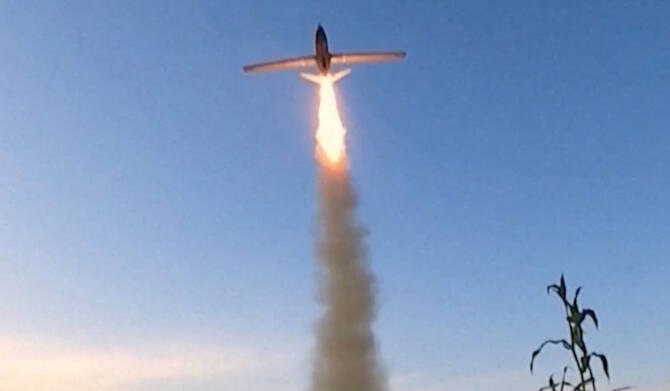
Saudi Arabia Intercepts Multiple Ballistic Missiles, Drones in Major Defence Operation
Saudi Arabia’s air defence forces have shot down a wave of ballistic missiles and drones fired toward the kingdom as the Middle East conflict escalates, officials said on Wednesday, highlighting rising regional instability and ongoing threats to critical infrastructure. (Arab News)
According to the Saudi Ministry of Defense, at least seven ballistic missiles were intercepted and destroyed, including six aimed at Prince Sultan Air Base — a major military installation in Al‑Kharj — and one that was heading toward the Eastern Province. Additionally, Saudi air defences knocked down more than 20 attack drones targeting key locations including the Shaybah oil field in the Empty Quarter, Al‑Kharj, Hafar Al‑Batin, and other parts of the Eastern Province. (Arab News)
READ ALSO:
- Nigerian Midfielder Daniel Daga Jailed in Norway for Sexual Assault
- Quack Doctor Sentenced to Death for Murder in Ekiti
- Galatasaray Beat Liverpool 1–0 in Champions League Last‑16 First Leg
Prince Sultan Air Base, used by both Saudi and allied forces, has been a repeated target in recent days as Iran and allied factions intensify cross‑border attacks in retaliation against US‑Israeli military operations in Iran that began in late February. These strikes are part of a broader barrage of missile and drone attacks across the Gulf region, complicating security and defence efforts for Gulf Cooperation Council (GCC) states. (Al Jazeera)
The Saudi government has vowed to protect its sovereignty and security, with the cabinet condemning the attacks on the kingdom and neighbouring states. In a recent session chaired by Crown Prince Mohammed bin Salman, officials reaffirmed Saudi Arabia’s right to take “all necessary measures” to safeguard its territory and citizens from external threats. (Arab News PK)
The ongoing barrage has also threatened energy infrastructure and global oil markets. Brent crude prices surged earlier in the week — hitting historic highs before stabilising — as oil supplies from the Gulf region face disruption due to hostilities and shipping risks through the Strait of Hormuz, through which a significant portion of the world’s oil and LNG normally flows. (The Guardian)
Amin Nasser, CEO of Saudi Aramco, warned that continued disruptions could have “catastrophic consequences for the world’s oil markets,” stressing that prolonged instability would worsen the impact on global energy supply chains. (Arab News PK)
The conflict, which shows no immediate sign of abating despite statements from US President Donald Trump suggesting it could be drawing to a close, is expected to persist for months. Tehran’s Islamic Revolutionary Guard Corps has made clear that any end to hostilities will be decided on its terms. (Arab News PK)
Saudi Arabia Intercepts Multiple Ballistic Missiles, Drones in Major Defence Operation

-

 metro3 days ago
Viral Video Shows Man Disarming Robbers After Minna Bank Heist, ₦10m Stolen
-

 metro3 days ago
Tragedy in Ibadan as Woman, 26, Dies at Boyfriend’s Residence
-

 metro11 hours ago
Ikeja Electric Apologises to Customers Over Power Disruptions
-

 Business2 days ago
JUST IN: Dangote Refinery Cuts Petrol, Diesel Ex-Depot Prices Amid Market Relief
-

 metro3 days ago
Students Escape as Four-Storey School Building Collapses in Lagos
-

 News24 hours ago
India, Other Countries Reject Tinubu’s Ambassadorial Nominees
-

 Politics3 days ago
BREAKING: Zamfara Governor Dauda Lawal Defects from PDP to APC
-

 News3 days ago
OYOSUBEB Chairman Adeniran Joins 2027 Oyo Governorship Race