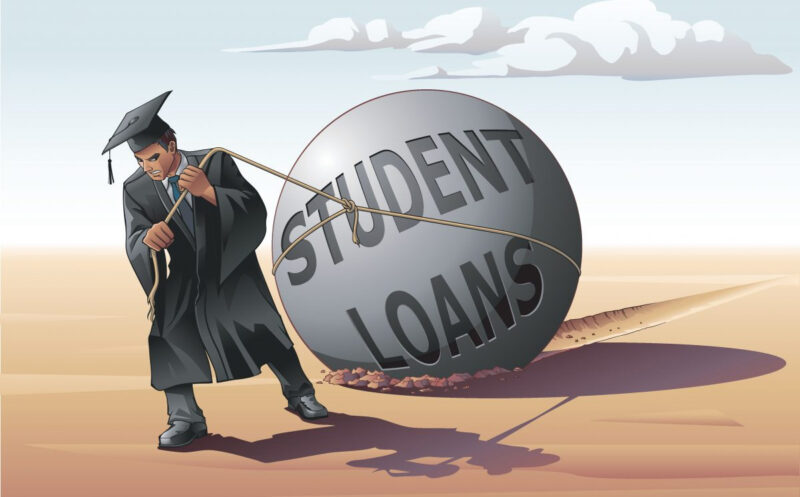
The lecturers also expressed doubt about the workability of the loan scheme given the condition that the beneficiaries should start repayment two years after completing the National Youth Service Scheme, NYSC, in the face of the difficulties by graduates in securing jobs after graduation.
Defaulting in the repayment of the loan or aiding to default attracts a fine of N500,000 or two years imprisonment or both.
The scheme starts in September, this year, according to the Federal Government.
No to hike in fees
Speaking on the workability of the law, especially given the high unemployment rate in Nigeria, the Academic Staff Union of Universities, ASUU, and the Academic Staff Union of Polytechnics, ASUP, said the foundation for the scheme to fail has been laid already. They opined that when repayment becomes impossible, the fund would simply dry up.
The National President of ASUU, Prof. Emmanuel Osodeke, noted, “It is a subtle hike in tuition fees in tertiary institutions. If a student says he cannot afford the fee, he would be asked to go and take the loan. We are not talking about how the children of the poor will be able to access it. We know that in Nigeria, things meant for the masses are always hijacked by the rich. After graduation, the children of the rich will get jobs and those of the poor, who may benefit from the scheme, will have no job from which to repay. We are not in support of any move to hike fees.
READ ALSO:
- Physically challenged, four others kidnap three-year-old boy in Delta
- ‘Aregbesola should explain why he didn’t vote for Tinubu, Oyetola’ – Ajibola Basiru
- Breaking: Tinubu suspends EFCC Chairman Bawa
“The union will react appropriately soon, but Nigerians know our stance on the scheme. It may not ultimately benefit children of the poor and even if it does, it will just put debt burden on them. Let the cost of governance be reduced and frivolous contracts and spendings be done away with and we will have more funds for social services like education and others.”
For the National President of ASUP, Dr Anderson Ezeibe, “the law does not take cognisance of the economic realities and situation in the country. The foundation for the scheme to fail has been laid. The unemployment rate in Nigeria, which I learnt is over 30% is one of the highest and under such condition, the scheme won’t be sustainable. It is a funny way of introducing tuition fee and take away education from the children of the poor that they claim to support.
“It is like the proponents of the law don’t live in Nigeria. Let them take a look at the situation on ground and do something that will reflect the realities on ground. Who is deceiving whom? If beneficiaries don’t secure employment after graduation and you expect them to begin repayment, the scheme will crash. Officially, tuition is free, but institutions have hike service charges like Acceptance Fes, ID card Fees, Hostel Fees among others. A student who complaints of inability to pay would just be asked to go to seek students loan. Government should just convene a meeting of stakeholders and experts and people will chip in ideas on how to fund education and even free funds from frivolous sectors.”
Commendable but….
The National President of the National Association of Parent Teacher Association of Nigeria, NAPTAN, Alhaji Haruna Danjuma, said the scheme is a good idea, but some areas must be tidied up. “It is not all students who have the grace of being sponsored by rich parents. Poor students will have access to education if the scheme is properly managed and the Nigerian factor not allowed to creep in. My concern is about the guidelines. From what one can see, students in public institutions may be the major beneficiaries, as those in private schools usually have privileged backgrounds.
“The issue is about repayment. When they say repayment should start after two years of graduation, will they help beneficiaries secure jobs? If a beneficiary is unable to secure job after graduation and unable to pay back, he is going to be jailed, what kind of trouble is that? If my income is over N500,000 annually and I have three children in school like I do now, does it mean none of my children is entitled to go for the loan?.
READ ALSO:
- FG sets up students loan committee, to start disbursement Sept
- Gbajabiamila finally resigns from House of Reps
- Many pregnant women sneaked into Saudi, Hajj commission laments
“The fear of government introducing tuition fee is being expressed in various circles, government should not do that at all. They should rather bring down the fees, as parents are groaning under harsh economic condition already.”
For the Congress of University Academics, CONUA, it is one of the ways of solving the problems in the sector. “For us and from the little we can read on the pages of newspapers, it is a positive development that would grant equal opportunity to students to access higher education. However, CONUA sees this as one of the ways of solving the problem of funding as well as one of the best international practices. All stakeholders have duties of monitoring to ensure credibility in implementation. By all stakeholders, I mean all certified tertiary institutions unions, parents, students, tertiary institutions, etc.
“As I said, more perspectives could be offered once we are able to access the signed copy of the Act. Once we have access to the act, we would be able to talk more,” the National President of CONUA, Dr Niyi Sunmonu, said in a message to our correspondent.
Also, the National Association of Nigerian Students, NANS, while commenting on the initiative, expressed reservations about the repayment conditions. “But as good as this is, there are some questions that need to be answered by the government. The ultimatum for repayment is not feasible. As we all know that there is no work anywhere and most graduates don’t get work immediately, how will they pay back? How will it work when most of our graduates do not get jobs. Is there any plan or opportunity for those that have no work two years after NYSC?”, the Southwest Coordinator, Comrade Adejuwon Emmanuel Olatunji, said in a statement.
Hike in service charges
Meanwhile, many tertiary institutions in the country have hiked service charges such as Acceptance Fee, Hostel Fee among others. Investigation by our correspondent has shown.
For instance, at the University of Ibadan, UI, the Acceptance Fee has been jerked up from N37,000 to N50,000. The same at the Federal University of Technology, Akure, FUTA, where the fee has been raised to N50,000 from N20,000. While new students are to pay N108,000 up from about N50,000.
At the University of Maiduguri, new students are to pay N252, 000, instead of N131,500. The University of Uyo is asking students to pay N107,750. Even at The Polytechnic, Ibadan, students who are not staying in the hostels even have Hostel Fee to pay, it has been increased from N5,000 to N15,000.
Facts about the scheme
Students who want to enjoy the benefit must apply to the Chairman of the Education Bank through their respective institutions upon satisfaction of the following conditions:
(i) Student must have secured admission into any public Nigerian University,Polytechnic, COE or TVET school.
Applicant income or family income must be less than N500,000 per annum. Applicant must provide at least two civil servants as guarantors: of not less than 12 years in service; or a lawyer with at least 10 years post-call experience; a judicial officer; or a Justice of Peace.
Students who have defaulted in previous loans; found guilty of exam malpractices, felony, drug offenses will not be considered.
READ ALSO:
- Police confirm abduction of seven UNIJOS students
- Dollar sells for N755 as FG unifies exchange rates
- Kylian Mbappe ‘belongs at Man Utd’, says Sheikh Jassim
Students with parents who have defaulted in respect of previous loans will not be considered. All Applications will be submitted through the Students Affairs Office of each Institution via a list of all qualified applicants from the institution accompanied by a cover letter signed by the Vice Chancellor or Rector or the head of the institution and the student affairs.
Disbursement of loans: The new Act establishes the Nigerian Education Loan Fund. The fund will shall be domiciled with, managed and administered by the Central Bank of Nigeria (CBN) through the money deposit banks in Nigeria for the purpose set out under section 6 of this Act.The governor of the CBN shall set up a special committee to perform the functions of the fund set out under Section 6 of this Act. The chairman of the committee shall be the governor of the CBN who shall appoint the secretary of the committee. Also, the applicant’s application and disbursements are made within 30 days of the application reaching the chairman of the committee.
Academic records of beneficiaries are to be monitored through the student affairs office of each institution via a list of all qualified applicants from the institution, accompanied by a cover letter signed by the vice-chancellor, rector, or the head of the institution and the student affairs.
Loan repayment method: According to the law, the employers of successful applicants must deduct the loan from their salaries after they must have completed their National Youth Service Corps (NYSC) programme.
Make it easy for us to secure Forex
Meanwhile, Nigerians studying abroad, under the aegis of the National Association of Nigerian Students, NANS, in the Diaspora, have appealed to President Bola Tinubu, to make it easy for them to get Form M through which they get foreign exchange to pay their school fees.
The students made this known in a statement by the President, Comrade Abdulrazak Abubakar, made available to our correspondent on Wednesday. “The leadership of the National Association of Nigerian Students in Diaspora led by Comrade Abdulrazak Abubakar is deeply appreciating Mr. President, His Excellency, Asiwaju Bola Tinubu for his commitment towards the Nigerian Students Community. The signing of the student loan bill marks the beginning of a new dawn for Nigerian students.
“Mr. President, the Nigerian students in the Diaspora hope that the new educational system would also cover the Nigerian students in the Diaspora because, in the real sense, the Nigerian Students in Diaspora are not living in paradise. For instance, one of the challenges that we are confronted with is the challenge of tuition funds remittance through Form A.”
Scheme begins September
Meanwhile, the federal government on Wednesday said it had begun putting all necessary measures in place to ensure students loan begin between September and October, 2023.
The Permanent Secretary, Federal Ministry of Education, Andrew David Adejo, who revealed this while speaking to newsmen in Abuja, said already President Bola Tinubu has approved a committee made up of ministries and agencies to see to the realization of the scheme
Adejo said “The bill is to make sure that every Nigerian has access to higher education through what we called the Higher Education Nigerian Bank.
“Learning from past mistakes, the bank is not going to be the type that will sit down and be collecting application loans, it will also perform normal banking functions and make sure loans are given because we had cases of loan recovery in the past.
“The Act as it is tells us the process, but as I speak with you today, the President has approved the committee made up of ministries and agencies and their meeting will be coming up 20th of June.
“The President has also directed that by September to October this 2023/2024 academic session, he wants to see recipients of these loans. So it is a very serious march for us so between now and then we have to phantom the process for people to get the loan,” he added.
“Form A is a medium through which foreign students access foreign exchange at the official rate rather than sourcing extra finances in other to get the same from the parallel market on order to settle all their academic bills and expenses. The unbearable hiccups, therefore, remain the challenge of responsiveness and delay from the Nigerian banks in remitting the funds to the students’ respective institutions and accounts.
“It is in view of this, we join forces with our sister association in Nigeria NANS to suggest that the government solves the Form A issues as a viable solution to the challenge of funds remittance to the students’ international accounts and institutions. With this stride, our hope is renewed that we have a government that really cares for Nigerian students,” the statement read.