
Opinion
The exit of Arakunrin Oluwarotimi Odunayo Akeredolu, by Bolanle Bolawole
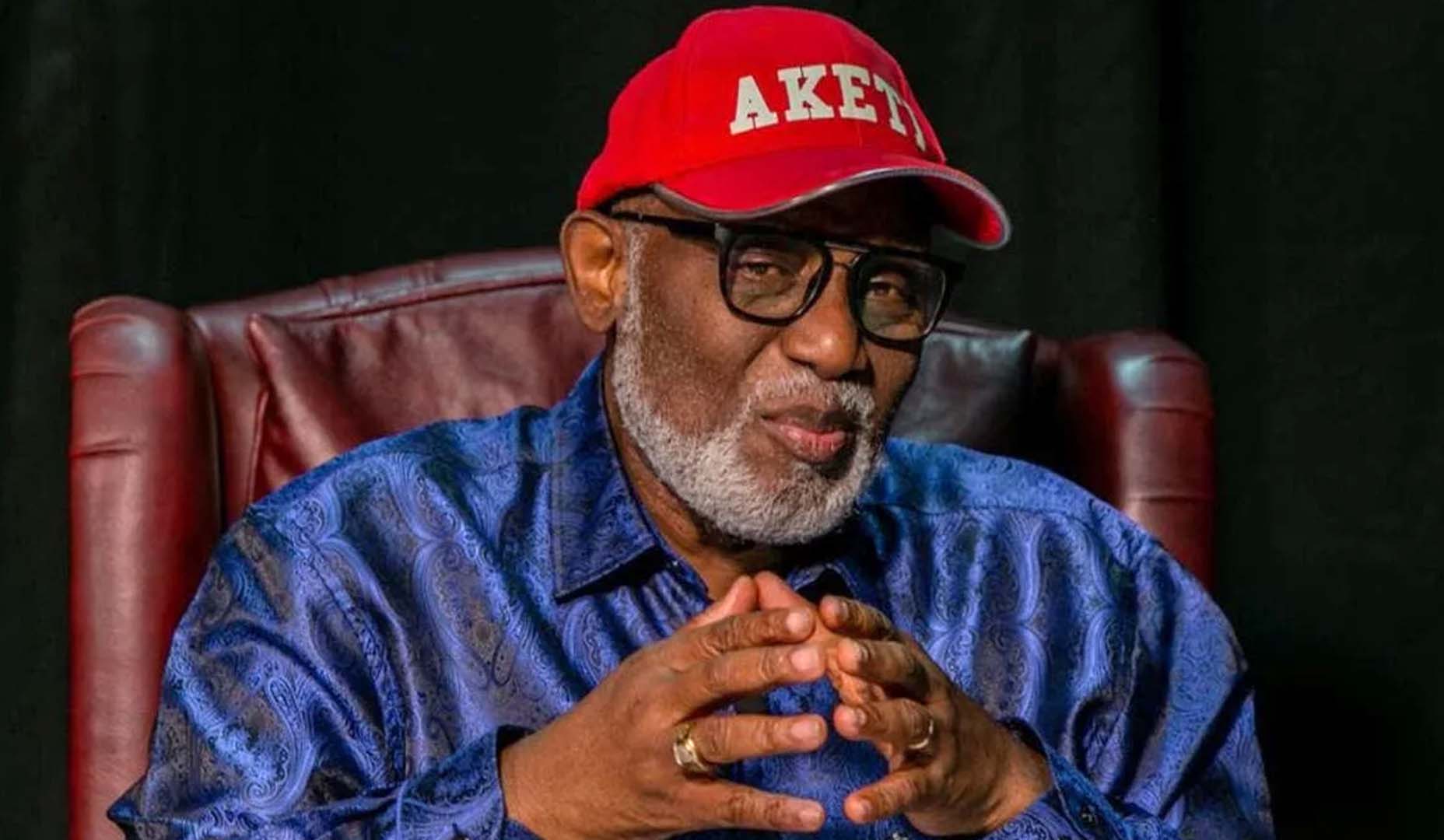
The exit of Arakunrin Oluwarotimi Odunayo Akeredolu
By Bolanle Bolawole
turnpot@gmail.com 0705 263 1058
My phone rang, rousing me up from sleep, and the words rang out: “Bola, has that boy called you?” I hesitated! Who is the person speaking? And who is “that boy”. To ask “who is speaking” will be discourteous. The masculine voice on the line sounded familiar and did not hesitate to call my name – and he did so with confidence and authority. The voice, too, was that of an elderly person. So, I asked: “What boy, Sir?” “Your governor, Arakunrin Akeredolu”
By this time the voice was damn decipherable. I have sat in the same room and around the same conference table too many times with one of the doyens of the journalism profession not to recognize his voice. We had rubbed minds while I was at The Westerner newsmagazine, when it was adding The Nigerian Compass to its stable; we also, together with other patriots, had plotted the way forward for the Yoruba Nation at the Yoruba World Congress before it scattered. Aba Saheed of the Nigerian Tribune fame in those politically turbulent days of the Chief Obafemi Awolowo-led Unity Party of Nigeria versus the National Party of Nigeria needs no introduction – a one-man riot squad that was an unrelenting thorn in the flesh of President Shehu Shagari.
“No sir, he has not called me”. “He will call you. I shared your piece with him and told him to call you” “Yes sir. Thank you, sir” The next day Aba Saheed called me again. “Has he called you?” “No, sir!” “Aaha? What is wrong with this boy? He will call you” “Yes, sir!” After one or two more “Has he called you?”, which received the same “No, sir” response, Aba Saheed muttered some words and gave up. Till date, I wouldn’t know what they discussed and why Arakunrin was meant to have called me.
But Aba Saheed was not the only respected Yoruba leader or doyen of the journalism profession that wanted or felt that Akeredolu should call me. Many who called to ask me for his phone number expressed shock whenever I told them I did not have it. “Are you not from the same town?” Yes, we are from the same Owo!” Many felt I should have been one of his unofficial media aides! I wasn’t – and couldn’t have been. I never met or spoke with Aketi, as he is famously called. The closest I ever got to him was during the 8th Day Fidau for my late friend, Taiye Haruna, as Aketi and his team walked off the field at the end of proceedings.
That is not to say, however, that I did not impact his administration in some ways. While he had newly won his election and was yet to be sworn in, I warned the people of Ondo State to watch it; that the bad side of Akeredolu had to be tamed if Ondo State was to enjoy his good side. I was viciously attacked by the elites of Owo! What kind of an Owo son are you, they asked! One even threatened to report me to Olowo! I was at a media function when one of the reporters, a lady, gave a low down on governor-elect Akeredolu’s lack of human relations.
To be forewarned is to be forearmed; so, I decided to sound a note of warning, not because I had anything against the man but just that his tenure as governor might bode well for the state. Weeks later, and Aketi was yet to be inaugurated, an ardent reader of my column, and an Aketi acquaintance, called to complain about what he suffered trying to access the governor-elect. “Aketi’s human relations are bad, his wife’s are worse” he lamented. Again, I wrote and warned. Again, I was bashed by some Owo elites.
However, many of the people around Aketi – commissioners, special advisers, etc – secretly applauded things that I wrote, which they dared not say themselves. I learnt from them that some of my writeups swayed him. Good! Like the one on the Alabi family house at Igboroko, Owo that he had planned to demolish to make way for his cenotaph of controversy but which he later spared after my advocacy.
Playing God is not peculiar to Aketi or Ondo state. Our big men play God and many of their aides are damn too cowardly to stand up to them. Those who dare are unceremoniously shown the door, like Aketi did to my senior at Owo High School, Kola Olawoye SAN, who was Aketi’s Commissioner for Justice and Attorney-General. Two stubborn men met in Akeredolu and Olawoye. While Aketi advanced his family interests, Olawoye, supported by the then Chief Judge of the state, Hon. Justice (Mrs.) O. O. Akeredolu (nee Fagboyegun), advanced Ondo state’s interests but Aketi eventually had his way.
Remember that “Abe Nazet Olooni” advert of yore? The razor-blade tongue of aketi was double-edged and spared no one, cutting friends and foes alike. He was blunt, up to the point of being called irascible. Yet, some tact and diplomacy were expected of anyone in high office.
Some of Aketi’s family members did not help matters. Aketi also did not – could not? – help himself. Friends who could tell him the bitter truth, he cast away – or he was made to cast away. Those who were the source of his rise to power he discountenanced. It will interest you to know that many of the Owo elites who shouted me down at the beginning virtually all fell out, one after the other, with Aketi. Olawoye was said to have been the man who opened Aketi’s eyes to the Ondo State governorship tussle.
As Aketi’s wife, several years his senior in age, got a foothold in her husband’s government, an Igbo mafia emerged. A cabal of political associates with eyes fixed on the next governorship tussle in 2014 also grouped themselves. Some also talked of the Owo mafia. Akeredolu’s illness helped; just like that of former President Umaru Yar’Adua and Muhammadu Buhari’s helped the formation of cabals that took hold of the reins of power. This should interest political researchers.
One theory says Akeredolu’s family members were aware of his health conditions and prepared themselves for any eventualities. That was why his son, Babajide, was promoted to a position of relevance. During COVID-19, Babajide was in the engine room of the State’s response to the virus. Afterwards, Aketi tested the waters when he boasted that he could make his son his Chief of Staff and nothing would happen. Of course, he has a precedence in former Gov. Segun Agagu who made his younger brother, Femi, his Chief of Staff.
Maybe the uproar that attended his boast made Aketi to change the nomenclature but he still installed his son, Babajide, as the most powerful person in his administration. Conflict of interest is the reason why many, who vouch for Babajide’s competence, disagree with the arrangement. But it would appear that Aketi was a man who, like Nostradamus, saw the future. He needed someone he could trust; and there was no one better than his own blood and flesh.
If, then, Aketi and his family knew of his failing health, and prepared for any eventualities, can we still ascribe his health challenges to “Irunmoles” and Ondo State traditional rulers said to be angry with some of his decisions? Or can we still say that it was the cenotaph erected as a memorial to those slain by terrorists at Owo, right in the precincts of the Owo palace and to the alleged dismay of the traditionalists, that triggered the anger of the “Irunmoles” against Aketi?
Sheer coincidence or what? But many people who are not as privileged as a governor survived cancer, why not Aketi who had the money to spend? Aketi’s wife is a cancer survivor; why not Aketi? Aketi – and God — must have been instrumental to Betty surviving cancer; what role did Betty play in her own husband’s battle with cancer?
Aketi is gone; nothing can bring him back again. As Marc Antony said of Caesar in Shakespeare’s Julius Caesar, “The evil that men do lives after them, the good is oft interred with their bones” But before the good deeds of Aketi are interred with his bones, let us recount a few of them here. As president of the Nigerian Bar Association, he kept alive the radical tradition birthed by Alao Aka-Bashorun. His role in the formation of Amotekun will never be forgotten. But for his courageous stand that led to the formation of Amotekun, the South-west today might have become similar killing fields like the Middle Belt. Aketi doggedly and resolutely fought for the presidency to rotate to the South. He spoke vehemently against back-to-back Fulani/Northern presidency. He trod where even angels feared to – and that was massive; really, really massive. While many others were compromising or eating their words, Aketi stood firm like the rock of Gilbraltar, insisting without mincing words that the presidency must rotate to the South. And it did! Again, that was massive! Aketi’s efforts at developing his Owo hometown has given the ancient town a face-lift that many could never have thought possible. Although there are complaints that the development was not evenly spread within the town and that the suburbs were not factored into it, Owo will not forget Akeredolu in a hurry.
Aketi’s shenanigans were many: His and some of his family’s alleged greed and avarice; his lack of tact, civility and gentility; some of his family members were no less obtuse; and together, they lacked finesse and human relations. Still, Aketi managed to leave indelible imprints on the sands of time. May his soul RIP!
LAST WORD: Lucky Aiyedatiwa is the new governor of Ondo State! Congratulations, Your Excellency! I don’t know if I can extend similar congratulations to the in-coming First Lady but let me warn: No battery, no bashing in Ondo State Government House, please! But how I wish the child had been allowed to die from its mother’s hands! Some will now say that our brand new governor was disloyal to his boss! That he broke Aketi’s heart! That in Aketi’s moment of anguish, Aiyedatiwa’s blow – like Brutus did to Julius Caesar – was the unkindest cut of all! That Aiyedatiwa was one of those who couldn’t exercise some patience but harried Aketi to his untimely grave!
Haba! You conveniently forgot that he was not obliged to make you deputy governor. Wouldn’t your predecessor, Agboola Ajayi, now say it served Aketi right? There were others even more deserving – but he chose you. The other side of the argument, though, is that if Aiyedatiwa hadn’t fought for his political life, he wouldn’t be where he is today! I take no sides! But now that the world or stage, as William Shakespeare called it, has become yours, as Aketi himself inadvertently prophesied, the whole world waits to see to what use you will put it. All eyes are on you. The ball is now in your court. The buck now stops on your table!
You declared a 3-day mourning period for your boss; great! But you couldn’t wait out those days of mourning before making important appointments! Incongruous! Now, some will ask if you were truly mourning! But now that you are shopping for a deputy, the criteria you listed amuse me! Did I hear you say you are searching for a loyal, trusted, and supportive deputy? Karma must not hear that from you! What goes around comes around! Did not the scripture say whatsoever a man soweth…
Oorun ni n gba t’owo omode/Iku ni n bo bata l’ese Rago/Ko sohun t’o ni’bere ti kii l’opin/Bee si ni ko si ohun ti a n je l’enu ti kii tan/Afi ola Olorun Eleduwa/Igba o lo bi orere/Aiye o lo bi opa ibon/Bi oni ti ri, ola o ri be/L’o mu Babalawo d’Ifa ojoojumo/Toto, o se bi owe/O tun se bi ayajo/O si le f’ara jo ogede/Sugbon ase ti Eleduwa fi da ile aiye niyen/ Enikan o si le yii pada/Yala Oba ni, tabi Ijoye/Yala olowo, tabi talaka/Ogbo-oogba ni gbogbo Ise Ojo Kefa/Ni’waju Aseda, Ameda! Oro ree, e gbee yewo!
“When sleep beckons, a child is forced to release what he had staunchly held on to/It takes death to remove the hooves of a horse/There is nothing that has a beginning that will not have an end/So also there is nothing, no matter how sweet, that we can savour forever/Only the grace of God is everlasting/No condition is permanent/What is today, may not be tomorrow/Which is why Babalawos consult their Ifa oracle on a daily basis/ This may sound proverbial/It may even appear like incantation or divination/But it is the way the Creator has arranged the things He created/And no one can change it/Be you king or chief/ Be you rich or poor/ Equal before God are the Man He created on the sixth day/This is food for thought/Consider it!
* Former Editor of PUNCH newspapers, Chairman of its Editorial Board and Deputy Editor-in-Chief, BOLAWOLE was also Managing Director/Editor-in-Chisf of THE WESTERNER newsmagazine. He writes the ON THE LORD’S DAY column in the SUNDAY TRIBUNE and TREASURES column in the NEW TELEGRAPH newspapers on Wednesdays. He is also a public affairs analyst on radio and television.






Opinion
El Rufai’s Arise News mind game with Ribadu, By Farooq Kperogi

El Rufai’s Arise News mind game with Ribadu, By Farooq Kperogi
El Rufai’s Arise News mind game with Ribadu, By Farooq Kperogi
Opinion
Oshiomhole: Behold the 13th disciple of Christ
Oshiomhole: Behold the 13th disciple of Christ
Opinion
AFCON 2025: Flipping Content Creation From Coverage to Strategy

AFCON 2025: Flipping Content Creation From Coverage to Strategy
By Toluwalope Shodunke
The beautiful and enchanting butterfly called the Africa Cup of Nations (AFCON) emerged from its chrysalis in Khartoum, Sudan, under the presidency of Abdelaziz Abdallah Salem, an Egyptian, with three countries—Egypt, Sudan, and Ethiopia—participating, and Egypt emerging as the eventual winner.
The reason for this limited participation is not far-fetched. At the time, only nine African countries were independent. The remaining 45 countries that now make up CAF’s 54 member nations were either pushing Queen Elizabeth’s dogsled made unique with the Union Jack, making supplications at the Eiffel Tower, or knocking at the doors of the Palácio de Belém, the Quirinal Palace, and the Royal Palace of Brussels—seeking the mercies of their colonial masters who, without regard for cultures, sub-cultures, or primordial affinities, divided Africa among the colonial gods.
From then until now, CAF has had seven presidents, including Patrice Motsepe, who was elected as the seventh president in 2021. With more countries gaining independence and under various CAF leaderships, AFCON has undergone several reforms—transforming from a “backyard event” involving only three nations into competitions featuring 8, 16, and now 24 teams. It has evolved into a global spectacle consumed by millions worldwide.
Looking back, I can trace my personal connection to AFCON to table soccer, which I played alone on concrete in our balcony at Olafimihan Street—between Mushin and Ilasamaja—adjacent to Alafia Oluwa Primary School, close to Alfa Nda and Akanro Street, all in Lagos State.
Zygmunt Bauman, the Polish-British sociologist who developed the concept of “liquid modernity,” argues that the world is in constant flux rather than static, among other themes in his revelatory works.
For the benefit of Millennials (Generation Y) and Generation Z—who are accustomed to high-tech pads, iPhones, AI technologies, and chat boxes—table soccer is a replica of football played with bottle corks (often from carbonated drinks or beer) as players, cassette hubs as the ball, and “Bic” biro covers for engagement. The game can be played by two people, each controlling eleven players.
I, however, enjoyed playing alone in a secluded area, running my own commentary like the great Ernest Okonkwo, Yinka Craig, and Fabio Lanipekun, who are all late. At the time, I knew next to nothing about the Africa Cup of Nations. Yet, I named my cork players after Nigerian legends such as Segun Odegbami, Godwin Odiye, Aloysius Atuegbu, Tunji Banjo, Muda Lawal, Felix Owolabi, and Adokiye Amiesimaka, among others, as I must have taken to heart their names from commentary and utterances of my uncles resulting from sporadic and wild celebrations of Nigeria winning the Cup of Nations on home soil for the first time.
While my connection to AFCON remained somewhat ephemeral until Libya 1982, my AFCON anecdotes became deeply rooted in Abidjan 1984, where Cameroon defeated Nigeria 3–1. The name Théophile Abéga was etched into my youthful memory.
Even as I write this, I remember the silence that enveloped our compound after the final whistle.
It felt similar to how Ukrainians experienced the Battle of Mariupol against Russia—where resolute resistance eventually succumbed to overwhelming force.
The Indomitable Lions were better and superior in every aspect. The lion not only caged the Eagles, they cooked pepper soup with the Green Eagles.
In Maroc ’88, I again tasted defeat with the Green Eagles (now Super Eagles), coached by the German Manfred Höner. Players like Henry Nwosu, Stephen Keshi, Sunday Eboigbe, Bright Omolara, Rashidi Yekini, Austin Eguavoen, Peter Rufai, Folorunsho Okenla, Ademola Adeshina, Yisa Sofoluwe, and others featured prominently. A beautiful goal by Henry Nwosu—then a diminutive ACB Lagos player—was controversially disallowed.
This sparked outrage among Nigerians, many of whom believed the referee acted under the influence of Issa Hayatou, the Cameroonian who served as CAF president from 1988 to 2017.
This stroll down memory lane illustrates that controversy and allegations of biased officiating have long been part of AFCON’s history.
The 2025 Africa Cup of Nations in Morocco, held from December 21, 2025, to January 18, 2026, will be discussed for a long time by football historians, raconteurs, and aficionados—for both positive and negative reasons.
These include Morocco’s world-class facilities, the ravenous hunger of ball boys and players (superstars included) for the towels of opposing goalkeepers—popularly dubbed TowelGate—allegations of biased officiating, strained relations among Arab African nations (Egypt, Algeria, Tunisia, and Morocco), CAF President Patrice Motsepe’s curt “keep quiet” response to veteran journalist Osasu Obayiuwana regarding the proposed four-year AFCON cycle post-2028, and the “Oga Patapata” incident, where Senegalese players walked off the pitch after a legitimate goal was chalked off and a penalty awarded against them by DR Congo referee Jean-Jacques Ndala.
While these narratives dominated global discourse, another critical issue—less prominent but equally important—emerged within Nigeria’s media and content-creation landscape.
Following Nigeria’s qualification from the group stage, the Super Eagles were scheduled to face Mozambique in the Round of 16. Between January 1 and January 3, Coach Eric Chelle instituted closed-door training sessions, denying journalists and content creators access, with media interaction limited to pre-match press conferences.
According to Chelle, the knockout stage demanded “maximum concentration,” and privacy was necessary to protect players from distractions.
This decision sparked mixed reactions on social media.
Twitter user @QualityQuadry wrote:
“What Eric Chelle is doing to journalists is bad.
Journalists were subjected to a media parley under cold weather in an open field for the first time in Super Eagles history.
Journalists were beaten by rain because Chelle doesn’t want journalists around the camp.
Locking down training sessions for three days is unprofessional.
I wish him well against Mozambique.”
Another user, @PoojaMedia, stated:
“Again, Eric Chelle has closed the Super Eagles’ training today.
That means journalists in Morocco won’t have access to the team for three straight days ahead of the Round of 16.
This is serious and sad for journalists who spent millions to get content around the team.
We move.”
Conversely, @sportsdokitor wrote:
“I’m not Eric Chelle’s biggest supporter, but on this issue, I support him 110%.
There’s a time to speak and a time to train.
Let the boys focus on why they’re in Morocco—they’re not here for your content creation.”
From these three tweets, one can see accessibility being clothed in beautiful garments. Two of the tweets suggest that there is only one way to get to the zenith of Mount Kilimanjaro, when indeed there are many routes—if we think within the box, not outside the box as we’ve not exhausted the content inside the box.
In the past, when the economy was buoyant, media organisations sponsored reporters to cover the World Cup, Olympics, Commonwealth Games, and other international competitions.
Today, with financial pressures mounting, many journalists and content creators seek collaborations and sponsorships from corporations and tech startups to cover sporting events, who in turn get awareness, brand visibility, and other intangibles.
As Gary Vaynerchuk famously said, “Every company is a media company.” Yet most creators covering AFCON 2025 followed the same playbook.
At AFCON 2025, most Nigerian journalists and content creators pitched similar offerings: on-the-ground coverage, press conferences, team updates, behind-the-scenes footage, analysis, cuisine, fan interactions, and Moroccan cultural experiences.
If they were not interviewing Victor Osimhen, they were showcasing the stand-up comedy talents of Samuel Chukwueze and other forms of entertainment.
What was missing was differentiation. No clear Unique Selling Proposition (USP). The result was generic, repetitive content with little strategic distinction. Everyone appeared to be deploying the same “Jab, Jab, Jab, Hook” formula—throwing multiple jabs of access-driven content in the hope that one hook would land.
The lesson is simple: when everyone is jabbing the same way, the hook becomes predictable and loses its power.
As J. P. Clark wrote in the poem “The Casualties”, “We are all casualties,” casualties of sameness—content without differentiation. The audience consumes shallow content, sponsors lose return on investment, and creators return home bearing the “weight of paper” from disappointed benefactors.
On November 23, 1963, a shining light was dimmed in America when President John F. Kennedy was assassinated.
As with AFCON today, media organisations sent their best hands to cover the funeral, as the who’s who of the planet—and if possible, the stratosphere—would attend. Unconfirmed reports suggested that over 220 VVIPs were expected.
While every newspaper, radio, and television station covered the spectacle and grandeur of the event, one man, Jimmy Breslin, swam against the tide. He chose instead to interview Clifton Pollard, the foreman of gravediggers at Arlington National Cemetery—the man who dug John F. Kennedy’s grave.
This act of upended thinking differentiated Jimmy Breslin from the odds and sods, and he went on to win the Pulitzer Prize in 1986.
Until journalists and content creators stop following the motley and begin swimming against the tide, access will continue to be treated as king—when in reality, differentiation, aided by strategy, is king.
When every journalist and content creator is using Gary Vaynerchuk’s “Jab, Jab, Jab, Hook” template while covering major sporting events, thinkers among them must learn to replace one jab with a counterpunch—and a bit of head movement—to stay ahead of the herd.
Toluwalope Shodunke can be reached via tolushodunke@yahoo.com

-

 metro2 days ago
IKEDC Sets Feb 20 Deadline for Customers to Submit Valid IDs or Face Disconnection
-

 Education2 days ago
Supreme Court Affirms Muslim Students’ Right to Worship at Rivers State University
-

 metro1 day ago
Lagos Police Launch Manhunt for Suspect in Brutal Ajah Murder
-

 News1 day ago
Aso Rock Goes Solar as Tinubu Orders National Grid Disconnection
-

 Business2 days ago
Naira Could Trade Below ₦1,000/$ With Dangote Refinery at Full Capacity — Otedola
-
 metro3 days ago
Kwara, Katsina Bloodshed: TMC Condemns Attacks, Dismisses ‘Jihadist Preacher’ Claims
-

 metro2 days ago
Army University Professor Dies in Boko Haram Captivity After Nearly One Year
-

 International2 days ago
Trump Halts Minnesota Immigration Crackdown After Fatal Shootings, Protests