

Opinion
When couples are partners in crime
When couples are partners in crime
By Emmanuel Onwubiko
ON 4th of January 2024, yours faithfully woke up from the wrong side of my bed, feeling like I don’t want to go to work today even when as the head of the HUMAN
RIGHTS WRITERS ASSOCIATION OF NIGERIA (HURIWA), I had scheduled a major media conference which is the first in the new year 2024.
What came to my mind was a particular popular song by some European singers few years back who were actually singing that they don’t want to do anything on a particular day and that they will simply sleep, wake up, have their bath, eat and go back to sleep.
I really can’t figure out the identity of those musical team members but I can remember graphically that they were each mimicking in a video recording, series of decorated monkeys who were just lazying joyfully around the room.
The rhythm of that award winning song promoting relaxation dominated my thinking faculty except for one necessary distraction: my daily reading of news copies from Nigeria and globally.
That necessary distraction not withstanding, the nostalgia of the just ended Yuletide period which I spent in my hometown of Arondizuogu, was hanging all over me like a sweetened bunch of banana fruits falling on top of me from a very well cultivated farmland somewhere in Arondizuogu.
So, I decided to just relax some more hours on my bed before heading out to carry out my mandatory press briefing which we had long scheduled at our non-governmental organisation.
It was whilst I was in a relaxation mood, browsing through the Internet for local news about Nigeria that I ran into a particularly intriguing news copy from the Economic and Financial Crimes Commission (EFCC).
READ ALSO:
- Amotekun shot, whisked Ibadan Poly student away 370 days ago
- Traffic infraction: Govs lack power to nab military man – Soldier blasts Sanwo-Olu
- Three notorious ‘one chance’ armed robbers arrested in Lagos
Mind you, the EFCC has recently become the cynosure of all eyes from curious Nigerians who are simply imagining if this government anti-graft institution has become a new body that will say and mean what they say regarding the crusade against growing trend of corruption and economic crimes involving top government officials. If truth be told, the majority of Federal government ministries, agencies and parastatals, have become cesspool of corruption.
Recently, the EFCC tweeted a so-called interview granted by the erstwhile Petroleum minister Mrs. Deziani-Alluson Maduekwe which purports to state that she made confessional statements which a section of the British media carried in which the current governor of Zamfara was implicated in alleged money laundering. But the EFCC quickly deleted that post from their social media account. Predictably, nobody in Nigeria is concerned about such a mind-blowing revelation for whatever it is worth.
But this story isn’t just about the routine news copies about the EFCC parading some youngsters over suspected cases of been involved in advanced fees fraud. It is not about the fallacy made by the EFCC’s head in which he accused seven out of every higher institution’s students of doing ‘yahooyahoo’ or advanced fees fraud.
The story was of a deeper genre which have both the social and cultural dimensions which I think the scholars of social studies or sociology ought to go into broader research to ascertain the trigger for such a social trend.
The story is about the observation made by the EFCC that couples in Nigeria are increasingly getting entangled in criminal cases of frauds and advanced fees fraud.
Also, the EFCC did something particularly impressive: they proffered the fundamentals behind the unprecedented scale of couples in Nigeria getting involved in such crimes as aforementioned.
The head, Cybercrime of the Economic and Financial Crimes Commission (EFCC), Nura Buhari, attributed the increase in the number of couples committing crimes to greed and loss of traditional values.
“It’s just the 21st century generation where people believe they can make money through the internet by identifying a glitch or system weakness and committing fraud,” Buhari said in an interview with one of the nation’s fast growing online newspapers.
The EFCC official was reacting to the rising number of couples caught by the agency for their involvement in internet fraud.
READ ALSO:
- Police arrest ‘notorious cult leader’ in Rivers
- 2 police inspectors dismissed over alleged robbery
- Emefiele: EFCC operatives storm Dangote head office
On 28th November 2023, the Commission arraigned a couple, Oriyomi Idowu and Ruth Idowu, before Justice Mojisola Dada of the Special Offences Court sitting in Ikeja, Lagos over false pretence, money laundering, stealing, retention of stolen property and forgery to the tune of N2,757,188,000.00.
The couple were arraigned alongside Food Commodity Processing Enterprise, Bonway Food Processing Company Limited, Samee Idowu Company Limited and Farmex Integrated Companies Limited, which all belong to Ruth Idowu.
According to EFCC, sometime in 2023 in Lagos, Ruth converted the sum of N10,000,000 to purchase a GLK Benz, purchase sum derived from converting the sum of N500,000,000 belonging to Creditpro Business Support Services with the aim of disguising the illegal origin of the funds.
The accused also dishonestly retained the sum of N936,619,876 in UBA account, property of Creditpro Business Support services, knowing same to be funds fraudulently obtained from Creditpro Business Support Services but the defendants pleaded “not guilty” to the charges.
EFCC also arraigned another couple, Aisha Malkohi (a.k.a Ummitah, Arab Money) and her husband, Abubakar Sadiq Mahmoud (at large), over alleged fraud involving the sum of N410,518,000 meant for the purchase of cars from Saudi Arabia.
They were arraigned on 8th December 2023, before Justice Aisha Mahmud at Kano State High Court after they obtained the sum of N225,259,000 belonging to Farida Ibrahim between 6th January to 16th December, 2022.
The said money was reportedly paid into a Zenith Bank account bearing Abubakar Sadiq Mahmoud for the purchase and supply of 64 cars, from Saudi Arabia.
But Malkohi pleaded not guilty to all the five counts read to her.
Malkohi was arrested by EFCC investigators in Kano following a petition from two people–Farida Ibrahim and Ibrahim Mohammed Abdulrahman–alleging that she conspired with her husband and defrauded them under the guise of supplying them with cars, gold, electronics and kitchen utensils from Saudi Arabia.
EFCC carried out an investigation that revealed the defendant had collected a total sum of N410,518,000 through bank accounts belonging to her company–Golden Grass Hill International Ltd– and her husband’s Zenith Bank account.
Further investigation also revealed that the defendant, alongside her husband, who is still at large, diverted the monies into several bank accounts.
On 19th December 2023, the Enugu Zonal Command of the EFCC arraigned another couple, Mr. Udeani Sunday and his wife, Udeani Amaka, before Justice M.G. Umar of the Federal High Court sitting in Enugu.
READ ALSO:
- Lagos to partially close Third Mainland Bridge again from Tuesday Jan 09
- Zack Orji left National Hospital against medical advice – CMD
- Ex-minister appeals court judgement barring her from holding public office
They were arraigned on three-count charges bordering on obtaining the sum of N2,750,000.00 by false pretence in an alleged land fraud.
According to EFCC, between 10th July 2019 to 19th December 2019 in Enugu, the couple lured one Onugu Chinyere to deliver N2,750,000.00 to them under the pretence that they’d sell a plot of land behind Ebenezer Anglican Church, Ala-Uguaji along Enugu/Port Harcourt Road to her, but like the other couples they also pleaded not guilty and the case was adjourned till February 6, 2024.
Looking at these cases and the established harmonious pattern of couples increasingly becoming partners in the crime of fraud from a deeper philosophical point of view, is actually left for philosophers and free thinkers like us to weigh in. So why are couples who ought to behave as embodiment of good behaviour and the supposed teachers of morality and ethics to their children, now turning around to become undesirable social elements?
The EFCC has actually done us the philosophers the favour of pointing towards a very disquieting development in the underworld which should and must be further researched upon to reach a far-reaching understanding of the various underlying dimensions.
This is exactly what I set out in this essay to achieve and first, my initial point of call was a researched document done for the Pontifical commission by some scholars who I believe are Nigerians given the background of the information they shared concerning the genesis, essence and texture of what family means especially in the African milieu.
These Pontifical scholars saw the family as the smallest and oldest institution in society is important for the growth and development of society. It is the building block of society. The family takes a central role in the survival of the society as a whole, both for biological and social reproductions (Olutayo & Omobowale, 2006).
These scholars argued that in Nigeria, marriage is a pathway for the existence of the family. The family is considered a primary aspect of an individual’s life. There is a high value placed on marriage and the family, and most individuals will identify their families as the most important thing in their lives.
However, in their understanding, with modernization, industrialization, urbanization, and globalization, there is a shift in how marriage and family are now viewed. This is so true. Marriage in the 21st century is even beginning to take certain unpalatable shapes which is diametrically opposed to the entrenched traditional implications of marriage especially from the angle of what exactly constitutes marriage as it were.
Nevertheless, these scholars aforementioned stated that marriage and family have experienced fundamental changes, and this has major consequences to individuals and the society. Therefore, this presentation will focus on the changing patterns of African marriage and family in Nigeria and will discuss the historical analysis of marriage and family systems in the pre-colonial, colonial and post-colonial era; the delimiting factors affecting marriage and family systems; visible areas of changes in marriage and family; the future of marriage and family; the importance of family in the present generation; and practical ways to improve marriage and family systems.
On the definition of marriage and family (the philosophical, social, and economic viewpoint of marriage), the social scientists stated that marriage and family are crucial systems in society. They are always linked together. They have a historical background and are as old as man on earth. The present definition of marriage is different from what it was several years ago. Marriage was defined as the union of a man and a woman for reproduction reasons. However, the definition has changed globally. Today, marriage can be defined with different viewpoints, as an institution, a partnership, and as a responsibility. Generally, marriage can be defined as the legally recognized union between two persons that is based on a sexual relationship. The philosophical basis for this union is that man should not be alone, but rather have a union that is completely legal and long-lasting; a legal union that is socially and religiously acceptable for sex and procreation. Socially, marriage forms the base of a family that helps in the transmission of cultural values from one generation to another. Economically, marriage is regarded as a legal union between two people that creates room for mutual gainful interdependence.
Similarly, there are various meanings people give to what constitutes a family. The conservatives will define the family as a social group made up of the father, mother, children, and other extended family members. Sociologically, what constitutes a family is much more complex. A family is defined as a social group that is joined by either blood, marriage, and adoption that serves as the economic unit of the society. Because the family is the bedrock of a society, the state must protect families. The Nigerian marriage and family systems have undergone several changes in society and these changes keep defining whether marriage and family are really functional or necessary in modern society (https:/www.pass.va/en/events/2021/family_ecology/eghafona.html).
There are actually a formidable body of scholarly works on the renowned African cultural values, one of which states that in Africa, the sense of family unit, ethics and etiquette are fundamental to understanding who the African is at all times.
Interestingly, a reputable philosopher and theologian, Reverend father Oliver Onwubiko one of our professors during my years as a Philosophy student in Nekede Owerri under the Claretians Institute of Philosophy, has done a body of scholarship on African cultural values. He listed the following African cultural values: sense of community life; sense of good human relations; sense of sacredness of life; sense of hospitality; sense of the sacred and religion.
From the above, it is unambiguous to assert that the cause of the degeneration that we see happening within the family system in Nigeria, has to do with what Anthropologists identified as social change theory. When the media of mass communication including the social are now dominating their platforms with contents that are poorly produced with the central them of justifying the pursuit of money by all means as the contemporary culture universally.
We will look at a publication of the journal of anthropology that was done in 2012 to understand in broader perspective why couples are increasingly committing crimes which are antithetical to the respected African tradional and cultural values of a sense of respect for honesty and the good name of the family units.
The Anthropologists stated as follows: “Odetola [6] see “social change as primary change in social relation.” Succinctly put, social change means change in social structure, within the framework of such structural changes, in social institutions.”
READ ALSO:
- AFCON 2024: CAF increases winner’s prize money to $7m
- Man arrested for attacking Lagos building control officials with charms (picture)
- N40bn probe: EFCC may declare ex-minister wanted, traces N30bn to private accounts
“Basic institutions perform function for the society, thus these basic institutions are dynamic and adaptive to changes. It should be noted that the environment of social structure requires certain amount of persistence in some of their features in order to perform that expected function. But observations portray that society and indeed components of social structure change continuously though often imperceptibly. Social change could either bring about progress for the members of a society or visit them with retrogression. As human beings collectively adapt themselves to their environment, they bring about changes to their ways of life.”
“But for the purpose of the status quo, we are concerned about the changes that transform the fabric of our culture occasion our forgotten values day in day out. The applicability of this theory is that it has strongly affected the ways of doing things in all societies. The urbanization and industrialization have altered the totality of our social institutions, not living the political and economic systems unaffected. The Nuclearization of the family has also negatively touched the socialization and internalization processes.”
“In a nutshell, the factors responsible for social change have brought about major changes in the traditional-to-modern society. Since change is inevitable, cultural dynamics of any society cannot be foreclosed be it in form of cultural accumulation, that is, addition of new traits to the already existing ones or cultural reduction, or cultural diffusion which is infusion of new cultural traits. All this can still be in a way checkmated,” (www.hindawi.com).
The lesson is that families in Nigeria should and must return back to the days of yore and embrace a revisiting of the renowned African cultural value systems especially as it relates to the family, hard work, and the sense of honesty.
I remember vividly that my late father Mazi Osonduagwuike Okorieocha Onwubiko once asked me, as a 14 year old Senior Secondary school student, how I got the resources to buy a brand new set of shoes which at that time wasn’t even more than N10,000 but was actually the reigning fashion of that epoch.
But as far as my father was concerned, accountability and transparency were his hallmarks and he made it mandatory that his children will never be permitted to bring in materials or items of suspicious sources or origin.
Recently too, a story in the media was about a mother in Delta State who turned down an offer of a brand new Mercedes benz automobile bought by her undergraduate son in his late tens. The mother refused to accept the car gift because the son is just a student and has no validly traceable source of incomes.
It turned out that the boy was into ‘yahoo yahoo’ or advanced fees fraud.
The contemporary society as it were, has their work cut out and it is imperative that we once more accept and embrace those authentic African cultural values that promote honesty, hard work, and the sense of the sacred and religion.
If this done, couples wouldn’t want to stain their reputation by going into crime because as the popular saying in Africa says that “good name is better than dirty money” and this should be our national mantra rather than the current madness about chasing money and making money by all means.
***Emmanuel Onwubiko is the head of the HUMAN RIGHTS WRITERS ASSOCIATION OF NIGERIA (HURIWA) And was NATIONAL COMMISSIONER OF THE NATIONAL HUMAN RIGHTS COMMISSION OF NIGERIA.











Opinion
2027: Competence, Not Zoning, Should Decide Nigeria’s Next President — Imasuagbon

Nigerians should look beyond ethnicity, region and the longstanding debate over rotational presidency when choosing the country’s next leader, according to a chieftain of the African Democratic Congress (ADC), Kenneth Imasuagbon.
The former Edo State governorship aspirant said the priority ahead of the 2027 election should be finding a president with the ability to confront Nigeria’s economic, security and infrastructure challenges.
Speaking to journalists in Benin, Imasuagbon argued that presidential rotation is not a requirement of the Nigerian Constitution and should therefore not outweigh the question of competence.
He said voters should be more concerned about replacing poor schools with better ones, improving healthcare and addressing hardship than debating where the next president comes from.
Imasuagbon specifically appealed to voters in the South to support former Vice President Atiku Abubakar, who is contesting the 2027 presidency on the ADC platform.
According to him, Atiku has demonstrated the experience and determination needed to improve the country, describing the former vice president as someone capable of promoting national unity and fairness.
He also accused the Bola Tinubu administration of worsening economic pressure through policies including the removal of fuel subsidy, while expressing concern about the condition of roads, electricity and other infrastructure.
Imasuagbon argued that the next administration must focus on practical improvements in areas such as power, transportation, employment, security and public services.
The ADC chieftain also dismissed the idea that the ruling All Progressives Congress (APC) would automatically benefit from its incumbency advantage in 2027.
He maintained that the electorate ultimately determines the outcome of an election, arguing that voters could change the political direction of the country if they were determined to do so.
Imasuagbon further criticised what he described as regional and ethnic considerations in the distribution of political appointments and opportunities, insisting that the next president should give Nigerians across different parts of the country a sense of belonging.
His comments come as political parties and their candidates intensify preparations for the 2027 presidential election.
Opinion
Lesson from Dotun Oladipo’s Brave Daughters, by Bamidele Johnson
Lesson from Dotun Oladipo’s Brave Daughters, by Bamidele Johnson
I hope to grow old. I want to see my kids become real adults, find their own feet, make mistakes, recover from them, and perhaps one day complain that their own children are giving them grey hairs. I want that plainly stated before anything else, as everything that follows might read as a man agreeing to an early exit rather than a man simply being honest about the odds.
I want the decades. I want to become the grandfather who repeats the same stories until nobody bothers correcting him anymore. But wanting a thing and being granted are different things. The last year has made that difference harder to ignore than I would like. I have lost many friends recently to keep thinking that optimism is my natural resting state. Some of these men had better blood pressure than mine, better habits, better everything that is supposed to count. It did not save them.
There is no formula I know that reliably separates the men who make it to 70 from those who do not. Anyone who says he knows one is selling something. So, I do not assume that old age is an already booked destination. Even if I once did, which I doubt, the last three years have cured me of such an illusion. As such, I treat it as a hope rather than an expectation, and I have found that a more honest way to live.
It is exactly why I want something placed on record now, while I am still able to place things on record, rather than leave it for people to guess what my wishes were in the fog of a funeral week. If I do not make old bones, my children are not to be asked to read tributes at my funeral. Not one line, however short, however lovingly written.
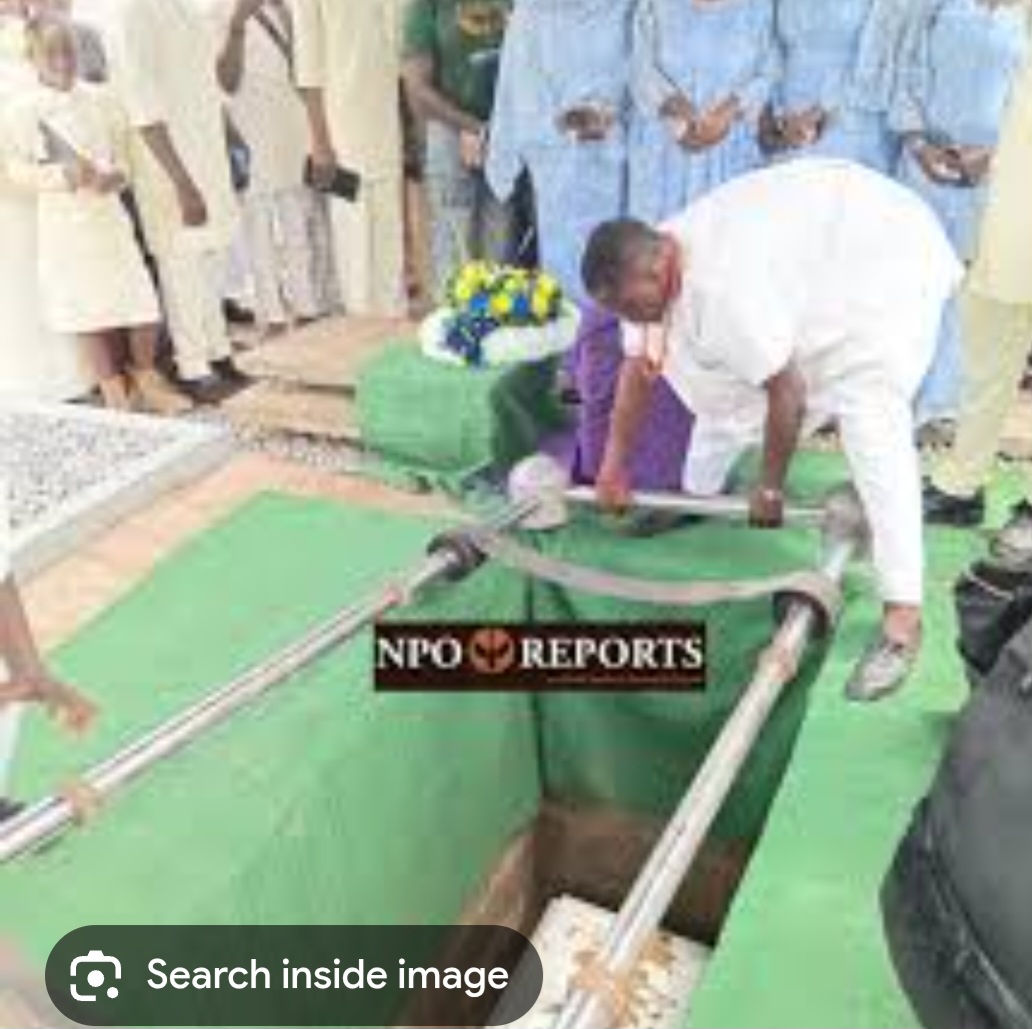
This, for me, was settled today rather than re-opened. At Dotun Oladipo’s funeral service, his three daughters took turns to read their tributes to their dad, and I found myself watching them with awe. There was a kind of strength in them that I do not possess. It is the strength needed to stand in front of a hall brimming with grieving adults and speak about a man they have just lost. Forever. Strength, however, is not the same as ease. I could see plainly what that strength was costing them as they read. Their voices caught. Their composure held and then did not hold and then held again through sheer will.
In front of them, in the pews, men and women considerably older than them came undone in ways the girls themselves were somehow managing to resist. I went mightily close. Some of the sobbing was quiet, the type people try to fold into a handkerchief. Some of it was not quiet at all, the kind that announces itself whether or not you want it.
Those young women honoured their father with a grace that is beyond me. What they did was astonishing. So, what I am attempting is an observation of a custom I have now watched wound people. This was not the first time I had watched this particular ritual extract more than it should from people already running on fumes. I saw an earlier and harder version of it at a friend’s wake back in 2015.
The first son was called forward to read his father’s tribute, and he could not do it. He tried, but the words would not come, and he stood there in front of a crowd of mourners, with his grief simply refusing to organise itself into sentences. The officiating minister, rather than releasing him from the task, urged him to continue. I sat fizzing with sorrow and ire. He could not go on and, eventually, the minister accepted, but not before insisting a while longer than it should have reasonably taken. His younger brother was called up next, presumably on the theory that if one grieving son could not manage it, maybe another one could. He flunked it in the same way. Grief does not distribute itself more conveniently among siblings just because a programme has been printed and needs to be followed.
I have turned that memory over many times since, trying to work out why this part of the rites is treated as mandatory in the first place. I have not found a satisfying answer. Maybe it comes from a belief that a child’s words carry more weight than anyone else’s, which may even be true, but weight is exactly the problem when those carrying it are struggling to hold themselves together with nothing but adrenaline and the fear of dissolving in public.
Maybe it is simply inertia, the reason we still do a hundred things at funerals that nobody can explain the original purpose of. Either way, I have stopped looking for the justification. I no longer think one exists that is good enough to weigh against what I watched happen to that boy in 2015.
So, let this stand as my instruction rather than my preference, the kind of thing I would rather state plainly now than leave for my children to infer later from how uncertain I sound when the subject comes up in passing. If I do not get the old age I am hoping for, my children will not be asked to read a single word over my body. Someone else can speak for me. A friend, a stranger with a steadier voice and a smaller stake in the loss, anyone whose grief will not be quite so total that standing upright becomes almost impossible.
My children, of course, will sit in front and fall apart if that is what the day requires of them, but without the microphone. That, at least, is one small mercy I intend to arrange for them while I am still here to arrange it.
Dotun deserved every bit of the send-off his daughters gave him today, and I suspect he would have been the first to tell them to sit down and let someone else carry the weight for a while. He did not get a say in that, as none of us ever do once we are the ones being spoken of rather than the ones speaking. Rest well, Dotun. You raised three young women whose strength I will not soon forget. That alone says everything worth saying about the man you were.
Opinion
‘Tinubu Will Win Again in 2027’ — Charismatic Bishops’ Secretary

‘Tinubu Will Win Again in 2027’ — Charismatic Bishops’ Secretary
A senior Nigerian cleric, Archbishop Chivir Chianson, has declared that President Bola Tinubu will retain the presidency after the 2027 general election, attributing the prediction to a message he said came from God.
Chianson, who serves as Secretary General of the Charismatic Bishops’ Conference of Nigeria, made the statement while appearing on Arise Television on Saturday.
Rather than basing his prediction on political calculations, the archbishop said his confidence came from what he described as the prophetic role of bishops.
He maintained that the conference had previously spoken about Tinubu’s political future based on what he said was divine revelation and that the President would return for another term.
Chianson also predicted that Tinubu’s performance would improve if he wins the 2027 election.
READ ALSO:
- DSS warns Osun churches, mosques, markets over alleged terrorist attack plot ahead of 2027
- ‘Tinubu Will Win Again in 2027’ — Charismatic Bishops’ Secretary
- Fake miracles, bogus grants: How clerics allegedly fleece Nigerians of millions
Addressing the political opposition, the cleric said the bishops could not be blamed if rival parties failed to unite or organise themselves effectively ahead of the election.
He also sought to clarify the position of the bishops when dealing with government, saying their role in speaking truth to power did not mean they should approach political leaders with hostility or disrespect.
According to him, the Constitution, alongside their religious convictions, should guide how they engage the President and the country.
Chianson said he was sufficiently confident in his prediction to promise that he would return to the Arise TV studio after the 2027 election, when he expects the result to demonstrate that the bishops’ prophecy was correct.
His comments add a religious dimension to the increasingly active political conversation surrounding the 2027 presidential race.
‘Tinubu Will Win Again in 2027’ — Charismatic Bishops’ Secretary
-

 Politics2 days ago
2027: Northern Lecturers Back Tinubu, ASUU Disowns Endorsement
-

 metro3 days ago
Police Arrest Mother Over Alleged Brutal Abuse of 7-Year-Old Girl in Anambra
-

 Sports2 days ago
‘I Was Never the Chosen One’ — Dembele Responds to Mbappe
-

 News3 days ago
Nwifuru Dismisses Cubana Chief Priest as ‘Attention-Seeker’
-
 Politics3 days ago
2027: Sowore Promises ₦500,000 Minimum Wage, Free Education, 24-Hour Electricity
-
 metro3 days ago
Grand Chief Imam calls for professional communication structure for Rabitoh 1964
-

 Education2 days ago
JAMB Moves 2027 UTME Time — Here’s What Candidates Need To Know
-
 Politics2 days ago
2027: APC Governors Reject Wike’s Rainbow Coalition, Insist on Party Loyalty