

metro
Tinubu promises to look into FG N4tn debt to GENCOS

Tinubu promises to look into FG N4tn debt to GENCOS
President Bola Tinubu on Friday appealed to power generation companies (GENCOs) to give the federal government more time to complete the verification and validation of longstanding debts owed to them.
During a meeting with members of the Association of Power Generation Companies, led by Col. Sani Bello (rtd), at the Presidential Villa in Abuja, the President assured them of his administration’s commitment to resolving the liquidity challenges in the power sector.
The Special Adviser to the President on Energy, Mrs. Olu Verheijen, disclosed that a ¦ 4 trillion bond programme has received anticipatory approval from President Tinubu to address the liquidity shortfall in the sector.
President Tinubu acknowledged the historic liabilities inherited from previous administrations and pledged transparency and fairness in addressing them:
“I accept the assets and liabilities of my predecessors, and there is no question about that. But that acceptance must be on credible grounds. I need to wear the audit cap of verifiability, authenticity, and the fact that this inheritance is not a mere deodorant but a support structure for critical economic and industrial promotion.”
The President emphasised the need for patience from GENCOs and financial institutions, noting that government agencies are actively engaging audit and legal firms to scrutinise the claims.
READ ALSO:
- WAFCON 2024: Ghana defeat South Africa on penalties to win bronze
- SDP crisis worsens, Gabam, Agunloye factions lose out as Modibo emerges new chair
- Tinubu govt executing 40 major projects in North – Presidency
“We are here. So market it to your other colleagues. Give us time to do verification and validation of the numbers,” he said.
While reaffirming his belief in a market-driven electricity sector, the President said the industry’s long-neglected legacy issues are now receiving the attention they deserve.
“This is a longstanding issue that is now being dealt with. I know how much we have been able to save on fuel subsidies. We introduced the alternative, CNG, to bring relief back to the people.”
President Tinubu also emphasised the government’s commitment to creating a stable investment environment and avoiding extreme measures, such as bank asset foreclosures, against the generation companies.
“Your Excellency, your presence at this meeting is a clear testament to your unwavering commitment to the sustainability, stability, and long-term development of Nigeria’s power sector. Under your leadership, we have recorded critical milestones in less than two years,” the Minister said.
Adelabu said the Tinubu administration signed into law the Electricity Act, 2023, which decentralises and liberalises the electricity market. This was the first legislation signed by the President upon assuming office.
He noted that the administration has launched Nigeria’s first Integrated National Electricity Policy in 24 years to drive coherence in sector planning and delivery.
He disclosed that over $2 billion in new private capital has been attracted to expand electricity access nationwide. At the same time, the sector’s annual revenue has grown by 70 per cent—from ¦ 1 trillion in 2023 to ¦ 1.7 trillion in 2024—resulting in a reduction of government subsidy obligations by over ¦ 700 billion.
He added that installed generation capacity has grown from 13,000 MW to 14,000 MW, with an all-time peak generation of 5,801 MW and a record maximum daily energy delivery of 120,370 MWh, achieved on March 4, 2025.
According to him, there has been no national grid collapse in 2025, a direct result of interventions under the Presidential Power Initiative, which has added over 700MW of transmission capacity.
He reported significant progress in narrowing Nigeria’s metering gap through the ¦ 700 billion Presidential Metering Initiative, funded via FAAC, and the World Bank-supported Distribution Sector Recovery Programme (DISREP), which has already delivered 300,000 smart meters out of 3.45 million procured.
- Plateau: 27 victims of bandits’ attack set for mass burial
- UNILAG to commence post-UTME online registration July 28
- Lady arrested in Lagos for mixing harmful agents with spoiled yam flour (video)
While acknowledging these strides, Adelabu cautioned that the sector is grappling with an urgent liquidity crisis that could undermine the sustainability of ongoing reforms and investments.
“Mr. President, given the grave implications of this debt overhang, including the risk of a nationwide shutdown of generation assets, I humbly seek your immediate support for defraying these obligations, even if partially, over a defined period,” the Minister appealed.
He urged the President to continue supporting structural reforms to ensure a resilient and financially viable power market.
In separate remarks, business leaders Tony Elumelu and Kola Adesina appealed for urgent intervention to preserve operations and encourage further investment in the sector.
“Mr. President, we’ve come to you as a last hope. The generating companies are heavily indebted to banks, and foreclosure threats are real, not because we’re not doing our jobs, but because the system owes us trillions,” Elumelu said.
He commended the Tinubu administration for restoring the integrity of oil production and banking stability.
“Before you took office in 2023, we lost 97% of our daily oil production. Today, we are retaining 98%. That’s transformation. Investors are seeing greater stability and predictability,” he said.
On electricity, Elumelu added: “We don’t need power to complete your transformation, we need power to enable it. Power is critical to unlocking Nigeria’s full potential. We urge you to help solve this debt problem.”
Adesina reiterated the need for immediate liquidity support while raising concerns over gas supply shortfalls.
“Liquidity is the oxygen of our business. Without urgent intervention, generation capacity will stall, and Nigeria’s industrial and economic ambitions will be jeopardised.
“The plants in the Afam axis are underperforming because we have not paid gas suppliers. We propose unlocking 800 million cubic feet of gas through NLNG to boost supply to these power plants,” he said.
The meeting was attended by the Chief of Staff to the President, Femi Gbajabiamila; the Coordinating Minister of the Economy and Minister of Finance, Mr. Wale Edun; the Minister of Information and National Orientation, Alhaji Mohammed Idris; and other senior government officials, regulators, and stakeholders in Nigeria’s electricity industry.
Tinubu promises to look into FG N4tn debt to GENCOS







metro
MURIC petitions Oyo police over 2019 murder of Muslim cleric in Fiditi

MURIC petitions Oyo police over 2019 murder of Muslim cleric in Fiditi
The Muslim Rights Concern (MURIC), Oyo State Chapter, has petitioned the state Commissioner of Police, demanding a thorough investigation into the alleged murder of Pa Biliaminu Taiwo in Fiditi, Afijio Local Government Area of Oyo State, in November 2019.
The organisation also called for appropriate legal action against Ojo Akinlabi, following his reported arrest in connection with the killing.
In a press release dated October 23, 2026, MURIC said the petition was submitted to the Commissioner of Police on October 22 and acknowledged by the commissioner and the Deputy Commissioner of Police in charge of the State Criminal Investigation Department (SCID), Iyaganku, Ibadan.
According to the organisation, Pa Taiwo was allegedly hacked to death inside a mosque in Fiditi in November 2019.
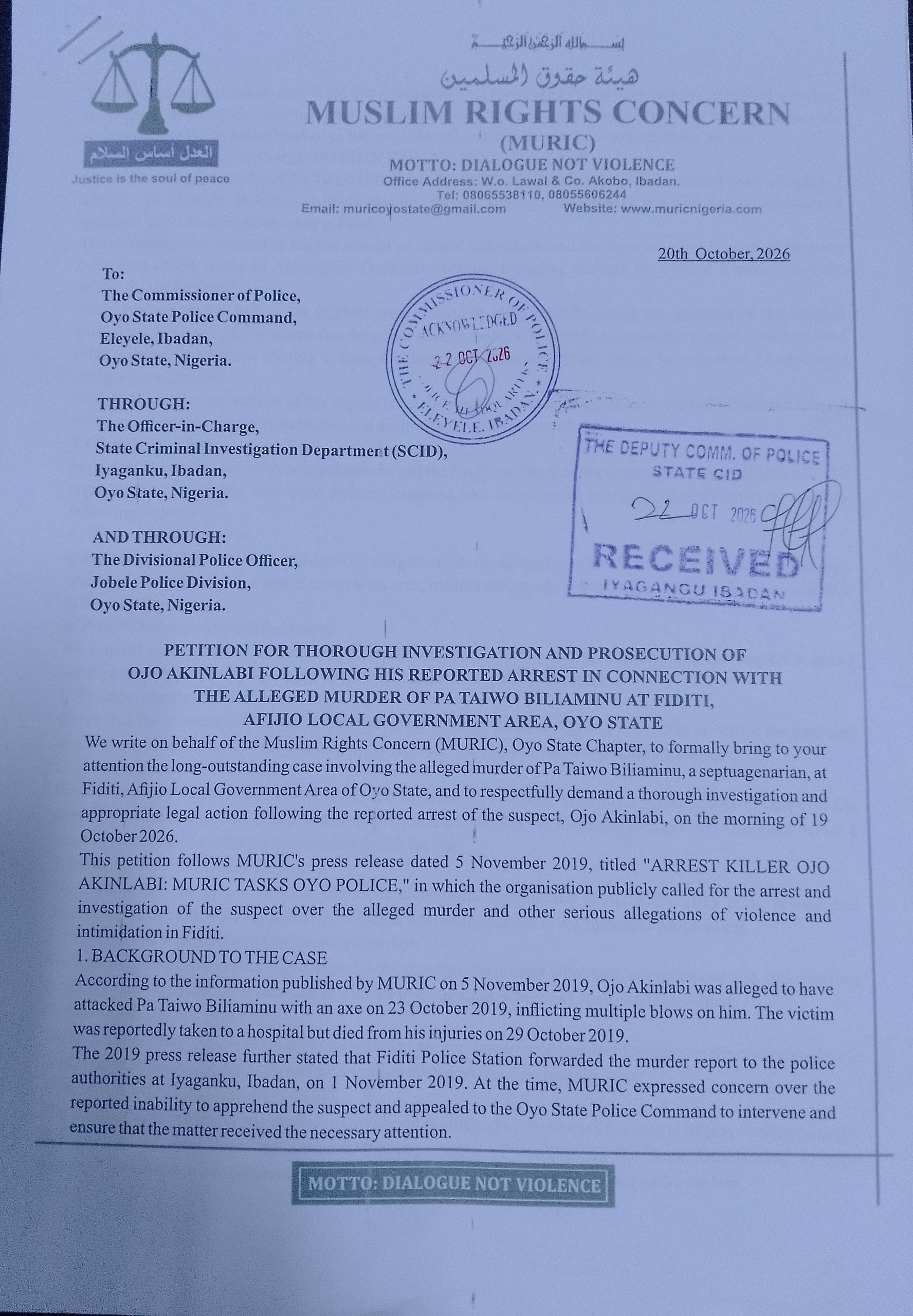
MURIC urged the police to conduct a comprehensive investigation into the case and ensure that anyone found culpable was prosecuted in accordance with the law.
The group also called on the authorities to ensure that the case was handled in a manner that would prevent justice from being frustrated.
“Murder is not a bailable offence,” the organisation said, urging the police to ensure that the suspect was brought before a court of competent jurisdiction and that any decision concerning his custody or release complied with the law.
MURIC further alleged that Akinlabi had a history of violent attacks, including incidents involving the use of knives allegedly coated with poison. However, the organisation did not provide supporting details of the alleged incidents in the statement.
The group described the allegations as a matter of concern and called for appropriate action by the relevant authorities.
Reaffirming its commitment to the protection of human rights and the rule of law, MURIC said allegations of criminal conduct should receive the attention of law enforcement agencies and be subjected to due process.
The statement was signed by Mallam Ibrahim Agunbiade, Secretary of MURIC in Oyo State.
The organisation concluded its appeal with the declaration: “Justice delayed must not become justice denied.”
As of the time of the statement, MURIC had not provided further details about the circumstances surrounding the reported arrest or the current status of the police investigation. The allegations against Akinlabi have not been independently verified, and any determination of criminal responsibility remains a matter for the courts.
MURIC petitions Oyo police over 2019 murder of Muslim cleric in Fiditi
metro
Police Arrest Man Over Fake Presidency Number Plate in Abuja
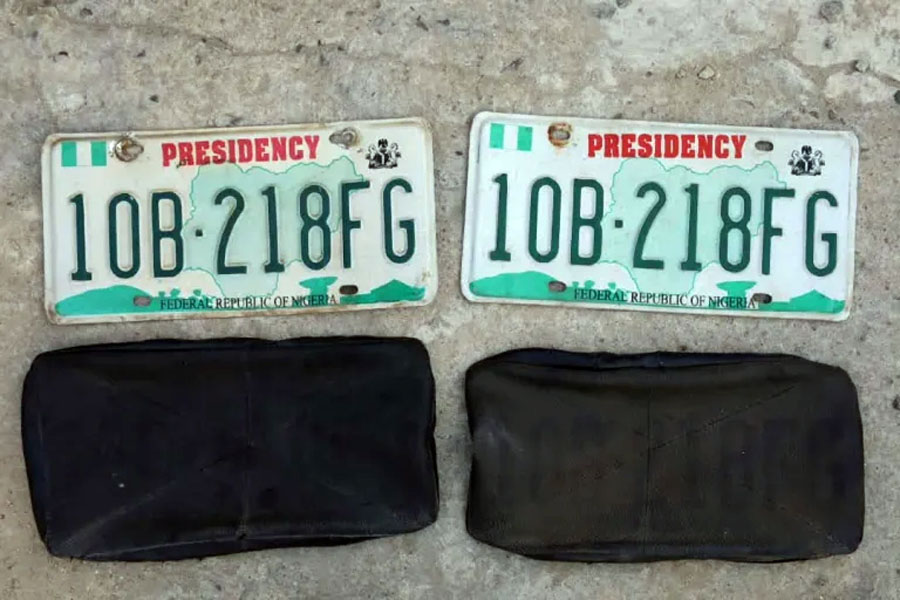
ABUJA — The Federal Capital Territory (FCT) Police Command has arrested a man accused of impersonating a permanent secretary in the Office of the Secretary to the Government of the Federation (SGF) after he was allegedly caught using a forged number plate bearing the inscription “PRESIDENCY”.
The suspect was arrested on October 20, 2026, after police operatives intercepted a Lexus LX570 sports utility vehicle (SUV) in Maitama District, Abuja, at about 8pm.
According to the police, the concealed number plate carried the registration number 10B218 FG.
The command’s spokesperson, SP Josephine Adeh, disclosed that preliminary investigations revealed that the documents presented to support the registration were allegedly forged.
READ ALSO:
- Shettima Blasts States Over Power Woes, Says Govs Must Stop Waiting for Abuja
- Fourth Gas Leak in Six Months: Over 100 Ogun Pupils Hospitalised, Schools Shut as Parents Panic
- Nigerian Journalist Sentenced to 4 Years Over Facebook Post Criticising Police
Adeh said the suspect had claimed to be the legitimate holder of the number plate, prompting further investigations that reportedly uncovered the alleged fraud and impersonation.
“The vehicle and its occupant were promptly arrested for investigation and subsequent prosecution,” the police said.
The command added that investigations were ongoing and that the suspect would be charged to court upon their conclusion.
The police urged residents to remain law-abiding, cooperate with security operatives and report suspicious activities to the nearest police station.
The arrest comes amid concerns over the unauthorised use of official government and diplomatic number plates in the FCT. Police authorities have previously raised concerns that such plates could be used by unauthorised individuals to evade scrutiny or facilitate criminal activities.
The suspect’s identity has not been publicly disclosed, and the allegations remain subject to the outcome of the police investigation and any subsequent court proceedings.
Police Arrest Man Over Fake Presidency Number Plate in Abuja
metro
Woman Arrested for Torching Ex-Boyfriend’s Home in Fit of Jealous Rage

Woman Arrested for Torching Ex-Boyfriend’s Home in Fit of Jealous Rage
Accra, Ghana — A routine breakup escalated into a catastrophic act of arson this week, leaving a young man homeless and his former girlfriend in police custody. The Ghana Police Service has arrested a young woman accused of deliberately setting her boyfriend’s rented apartment on fire after he ended their relationship. The shocking trigger for the split? The woman had answered a phone call on his mobile device without his permission.
According to preliminary police investigations, the couple became embroiled in a volatile and heated argument over the breach of privacy. The confrontation spiraled rapidly out of control when the boyfriend, reportedly furious that she had answered his phone, decided to end the relationship on the spot. Rather than accepting the breakup, the woman’s anger reportedly boiled over into a dangerous and premeditated rage.
In the aftermath of the breakup, authorities allege that the woman intentionally ignited a fire inside the man’s rented home in an act of vengeance. Eyewitnesses described a scene of sheer chaos as flames rapidly consumed the residence, forcing neighbors to flee and local fire services to be summoned to battle the inferno. Dramatic images from the scene reveal a landscape of utter devastation, with the apartment reduced to a pile of charred debris and twisted metal. While no casualties have been reported, the property damage is extensive, and the young man has effectively lost his home and belongings.
The Ghana Police Service acted swiftly following the incident, apprehending the young woman who is now in police custody facing potential charges of arson and destruction of property. Local neighbors have expressed profound shock at the severity of the attack, with one bewildered resident telling reporters, “It is just a phone call. To burn down a whole apartment because you were broken up with? It is a very sad day for us here.” The suspect is expected to be arraigned in court in the coming days as the police finalize their case, serving as a chilling reminder of the dangerous consequences of unchecked anger.
Woman Arrested for Torching Ex-Boyfriend’s Home in Fit of Jealous Rage
-
 metro3 days ago
Atiku: US Lobbying Firm Raises Alarm Over Alleged Assassination Plot
-

 metro3 days ago
‘We Don’t Know What Else to Do’ — Mother Begs for Release of Abducted Children
-

 metro2 days ago
Five Arraigned Over Kidnapping of 20 Prospective NYSC Members in Imo
-

 Auto3 days ago
Beyond the Showroom: Why After-Sales Service Will Define Auto Industry Winners
-

 Auto2 days ago
Hyundai Unveils Mufasa, Grand Creta SUVs to Strengthen Nigeria Line-up (Updated)
-

 Auto2 days ago
Happening now: Hyundai unveiling of Mufasa and Grand Creta
-

 Education2 days ago
NELFUND Warns Schools: Student Loans Are Voluntary, Not Compulsory
-

 Auto2 days ago
No 5% Petrol Tax Plan, Oyedele Says, Amid Public Concerns