

metro
Flood destroys houses, schools, farms in Plateau, Bauchi, Niger
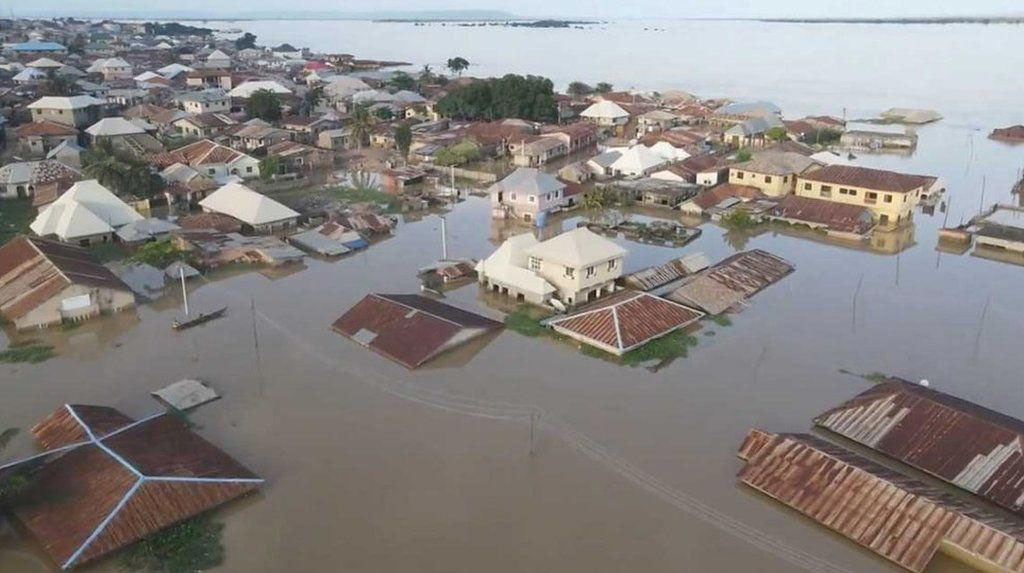
Flood destroys houses, schools, farms in Plateau, Bauchi, Niger
A torrential downpour on Sunday wreaked widespread destruction across communities in Plateau and Bauchi states, leaving scores of houses destroyed, farmlands submerged, and hundreds of residents displaced.
In the Menkaat community, Shimankar district, Shendam Local Government Area of Plateau State, over 50 houses, including schools and a worship centre, were destroyed.
Residents said the rainstorm, which began in the early hours, was accompanied by strong winds that uprooted trees, knocked down electric poles, and blew off rooftops, causing several buildings to collapse.
Mazawaje Daniel Danjuma, the councillor representing Shimankar, confirmed the extensive damage, saying that rice farms were especially affected as floodwaters with sand overwhelmed the fields.
“Many residential buildings have collapsed. The intensity of the rainfall also destroyed farms. People have lost a lot,” he said.
Another resident, Mr. Lawrence Longwalk, appealed for urgent government intervention, noting that two primary schools and a worship centre were destroyed.
“From the level of damage, the people need urgent help,” he said.
Bauchi
Meanwhile, a rainstorm also displaced over 40 households and swept away farmlands in Dass Local Government Area of Bauchi State.
Adamu Nayola, Director of Relief and Rehabilitation at the Bauchi State Emergency Management Agency (SEMA), said that although no lives were lost, many victims, especially women and children, are now in urgent need of humanitarian assistance.
Nayola blamed the severity of the flooding on a poorly constructed culvert by a road construction company, which failed to handle the heavy volume of water.
READ ALSO:
- Lookman presents transfer request to Atalanta
- Families trapped in Sudan city face starvation – UN
- Leverage UN recognition to equip Amotekun, Afenifere tells S’West govs
He assured that SEMA had begun assessments and would provide relief materials to affected communities.
Niger
Also, flood submerged several farmlands in parts of Niger State following an early morning rainfall on Sunday in Kafin Koro, Paikoro Local Government Area.
The flooding also affected 18 communities in Lapai Local Government Area, where some farmlands were damaged, and many others remain at risk of being washed away.
Some of the affected communities include Dere, Eshi, Apataku, Tsakanabi, Kuchi Kakanda, Arah, Achiba, Rebba, Ebwa, Pele, Edda, Rigido, Gbami, Yawa, Baka, and Muye.
The state government on Sunday urged riverine communities to relocate to higher grounds, citing intensified rainfall across the state.
In a statement, the Special Adviser to the Governor on Communication, Media and Strategy, Jonathan Vatsa, acknowledged the emotional ties residents have to their ancestral homes but emphasised the need to comply with the government’s relocation advisory until the rains subside.
“As a government, we will continue to be proactive by appealing to the people, especially those in flood-prone areas, to immediately move upland to avoid another disaster like that of Mokwa,” Vatsa said.
“We understand the strong connection people have to their ancestral lands, but given the current flood alerts and the realities we are already witnessing, it is crucial that they heed this warning.”
“The Mokwa experience is still fresh in our minds, and we cannot afford a repeat. That is why we are urging the people to move to higher ground,” he added.
Vatsa revealed that the Nigerian Meteorological Agency (NiMet) had earlier identified 15 out of the state’s 25 local government areas as highly vulnerable to flooding during the rainy season.
FG’s flood warning
The federal government also recently issued a red alert for imminent flooding in 11 states.
The alert, which predicts possible flood events, came from the National Flood Early Warning Centre under the Federal Ministry of Environment.
READ ALSO:
- 2027: PDP reportedly wooing Jonathan for presidential comeback
- Abuja Chief Imam’s son shot dead over land dispute
- Lasaco Assurance strengthens collaboration, service delivery at 2025 S’West Customers Forum
Similarly, during the April unveiling of the 2025 Annual Flood Outlook, the Minister of Water Resources and Sanitation, Prof. Joseph Utsev, listed several high-risk flood zones.
These include Abia, Adamawa, Akwa Ibom, Anambra, Bauchi, Bayelsa, Benue, Borno, Cross River, Delta, Ebonyi, Edo, Gombe, Imo, Jigawa, Kebbi, Kogi, Kwara, Lagos, Nasarawa, Niger, Ogun, Ondo, Osun, Oyo, Rivers, Sokoto, Taraba, Yobe, Zamfara, and the Federal Capital Territory (FCT).
Between March and July 2025, over 250 people were killed and thousands displaced due to a series of floods, windstorms, and rainstorms across states including Sokoto, Niger, Kaduna, Taraba, Ekiti, Ogun, and Imo.
The deadliest incident occurred on June 11 in Mokwa, Niger State, where more than 200 people died and dozens went missing after a massive flood submerged large portions of the town.
Just last week, heavy rainfall triggered severe flooding in various parts of Maiduguri, the Borno State capital, displacing hundreds of residents.
According to the police, eight buildings collapsed as a result of the flood, though no casualties were recorded.
The affected areas include Bulunkutu, Pompomari Bypass, Damboa Road, Gamboru area, Baga Road, Gwange, Moduganari, Dala, Moranti, and Jiddari Polo.
Many residents expressed fear, recalling the devastation caused by the September 10, 2024, flood.
Meanwhile, in Adamawa State, five people lost their lives and over 50 others were injured following a devastating flood that swept through several communities in Yola North and Yola South Local Government Areas in late July.
The heavy rainfall caused widespread destruction in the affected areas.
The worst-hit communities include Yola Bypass, Sabon Pegi, Yolde Pate, and Modire, where houses were submerged, farmlands destroyed, and roads washed away, hindering both human and vehicular movement.
Flood destroys houses, schools, farms in Plateau, Bauchi, Niger









metro
How I Sold My Twins for N300,000, Stole 13 Other Children — Suspect
How I Sold My Twins for N300,000, Stole 13 Other Children — Suspect
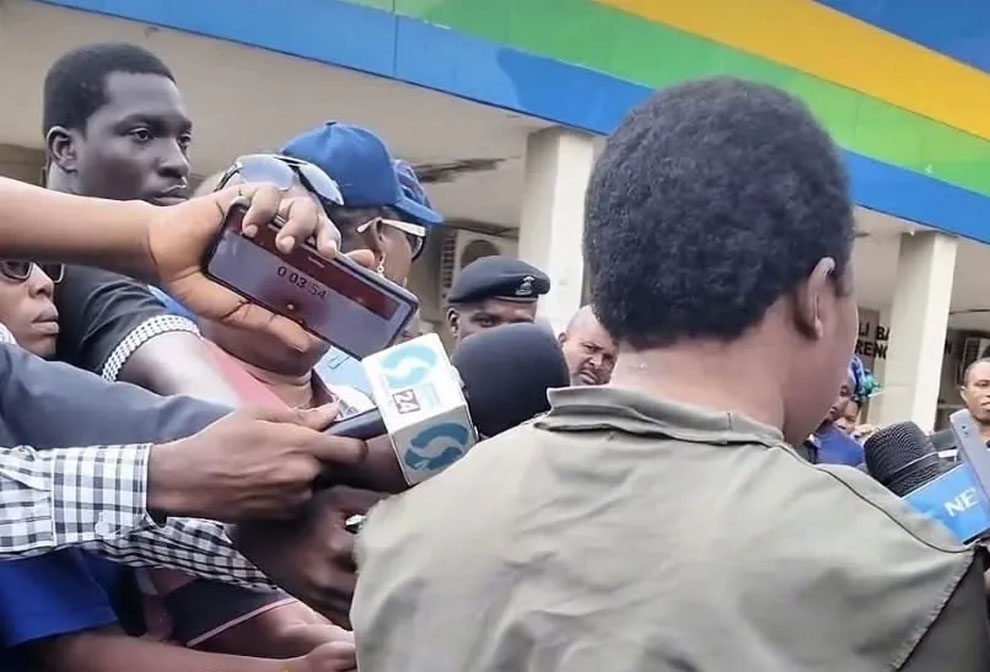
A 50-year-old suspected child trafficker, Adejoke Popoola, has confessed to selling a newborn boy and a set of twins she gave birth to before stealing at least 13 other children for onward sale, in a case that has uncovered an interstate trafficking syndicate operating across Oyo, Ogun and Delta States.
Popoola, also known as Orente Alagbo, made the startling disclosure on Monday while speaking with journalists at the Oyo State Police Command headquarters in Ibadan, following her arrest on August 4. She claimed she had been involved in the alleged activities since October 2024, after her herb-selling business was gutted by fire, which she said pushed her into the illicit trade as a means of survival.
Popoola stated that she sold a newborn baby boy and a set of male twins, with the twins sold to a clinic in Ogeere for ₦300,000. She said she sometimes received between N80,000 and N120,000 for other children, and up to N900,000 for some victims, depending on the age and gender of the child. “God blessed me with the gift of pregnancy. Anytime a man has sex with me twice, I get pregnant, and it is always difficult to abort,” she said. “I have sold two sets of children, a newborn boy and twins as well, last year. I sold the twins to … clinic; she also resells them to her customers in Lagos. She has a baby industry. When the owner of the pregnancy rejects the pregnancy, that is when I sell.” Popoola, who said she has seven children of her own aged between six and 34, added that she became involved in the alleged operation after meeting a woman she identified as Oluwakemi, who she said operated a “baby industry” and supplied children to buyers in Lagos, revealing the existence of a well-organized trafficking network.
The suspect also admitted to stealing children through various deceptive methods. She explained that she would sometimes disguise herself as a prospective tenant to gain access to homes before taking children when their parents were not around. “I steal babies. I will go to their place and say I want to rent a house. Then, if I do not see anyone, if I see their children, I will just steal their children,” she said. Popoola claimed that a woman she worked with at Ogeere Market taught her how to steal children, providing her with the skills and confidence to carry out the abductions. She further alleged that she sometimes posed as a spiritualist, targeting parents with children living with disabilities, preying on their desperation for healing. “Parents bring their disabled children to me because they cannot talk, sit, or walk. So, I will promise them that I can help them to heal, then I will go and pick another person’s child for them,” she said, revealing a particularly cruel method of operation.
READ ALSO:
- No More Embassy Visits: Step-by-Step Guide to Nigeria’s Contactless Passport Renewal
- Lagos police arrest four suspected robbers, recover 25 phones in Mushin
- Benue Govt Blasts Obi Over ‘Unapproved’ Visit: ‘He Is Looking For Our Trouble’
One of the most chilling incidents she recounted involved the abduction of three-year-old Ifakunle Ifagbenro during an Egungun festival in Oyo Town on June 29. She said she travelled to the festival two days earlier, joined the family during prayers and even contributed money to gain their trust before volunteering to carry the boy during the procession. “When the Egungun left, the boy told his mother that he did not want to stay at home and wanted to join the procession. So, I volunteered to help hold the boy,” she said. “I joined them for the procession and, in the evening, I picked up the boy, laid him on my back and ran away with him.” She claimed she received N900,000 for selling Ifagbenlo, making him one of her most lucrative targets.
Popoola claimed that of the children she allegedly kidnapped, six had died while 17 were rescued by police. The deceased children were identified as Musharaf Lawal Tajudeen, two; Greatness Adeagbo, five; Sainat Amoo, two; Taiwo Usman, two; Daniel Solomon Olayinka, seven; and Miracle Olaniyi, four. She explained that some of the children died due to illness or neglect while in custody, while others reportedly succumbed to the harsh conditions in which they were kept.
The Oyo State Commissioner of Police, Abimbola Olugbenga, said the investigation began with a petition dated July 29, 2026, submitted by Popoola herself over allegations including conspiracy, cyberbullying, threat to life and defamation. Detectives later linked the case to the disappearance of Ifakunle during the masquerade festival, as video footage from the event showed Popoola carrying the child moments before he vanished. Popoola was arrested on August 4, and her statement provided the first major breakthrough in dismantling the syndicate. She allegedly named Adekanbi Janet, also known as Hosanna, as her accomplice. Janet was arrested in Mowe, Ogun State, where four children and two pregnant young women were rescued from her custody, revealing the scale of the operation.
READ ALSO:
- Yamal Fires Back at Mbappé: “I’m Not Going to Beg” for Ballon d’Or
- Osun Police Arrest Woman After Vigilante Member Dies During Sexual Encounter in Ile-Ife
- Igbo Group Rejects Tinubu Endorsement, Pledges Grassroots Support for Peter Obi in 2027
The investigation later extended to Agbor, Delta State, where four children allegedly stolen from Oyo State were rescued from persons suspected to have bought them. Two suspects, Christopher Joy, 48, and Rosemary Jesse, 53, were arrested and allegedly confessed to involvement in the trafficking network, confirming the interstate dimension of the criminal enterprise. The investigation also uncovered an alleged ritual dimension, with suspects confessing that children who died in custody were sold to ritualists. This led to the arrest of Muritala Fasasi, an Islamic cleric, and Yakubu Azeez, a herbalist, who were allegedly involved in purchasing the bodies of deceased children for ritual purposes.
The police said it has so far rescued 17 children and arrested seven suspects in connection with the investigation. The rescued children include Ifakunle Ifagbenro, 3; Musibau Olasupo, 5; Sulaimon Osamo, 7; Murina Fidaus, 3; Aminat Yusuf, 3; Taiwo Olamilekan, 3; an infant aged nine days; Rafiat Waheed Babalola, 2; Quwiyat Alade, 5; Rejoice Divine, 3; Alhaji Divine, 5; Eniolorunda, 3; Victoria, 3; Isoma Prince, 3; Roqeeba, 4; Boluwatife Odedeyi, 3; and Ireoluwa Elizabeth Olapade, 7. The CP urged parents and guardians whose children recently went missing to visit the command headquarters in Eleyele, Ibadan, to identify the rescued children and facilitate their reunification with their families, as some of the children have yet to be claimed.
How I Sold My Twins for N300,000, Stole 13 Other Children — Suspect
metro
No More Embassy Visits: Step-by-Step Guide to Nigeria’s Contactless Passport Renewal

No More Embassy Visits: Step-by-Step Guide to Nigeria’s Contactless Passport Renewal
metro
Lagos police arrest four suspected robbers, recover 25 phones in Mushin

Lagos police arrest four suspected robbers, recover 25 phones in Mushin
The Lagos State Police Command has arrested four suspected members of an alleged armed robbery syndicate operating around the Iju-Ishaga and Oke-Aro areas of Lagos State, recovering 25 mobile phones and other items during a raid on their hideout.
The suspects were arrested at their alleged hideout in Idi-Oro, Mushin, following what the police described as credible intelligence and sustained surveillance by operatives of the Command’s Violent Crime Response Unit (VCRU).
The suspects were identified as Damilare Oluwatobi, 28; Lekan Adenuga, 30; Haruna Sheriff, 22; and David Balogun, 24.
According to the police, the operation followed intelligence gathered on the activities of the alleged robbery syndicate, which was reportedly linked to criminal operations in parts of Lagos.
During a search of the hideout, VCRU operatives recovered 25 mobile phones, two laptop computers, gold jewellery, including a necklace and earrings, and three cutlasses.
The police described the arrests as a significant development in efforts to tackle armed robbery and violent crime in Lagos, while investigations continue to establish the circumstances surrounding the recovered items and identify their owners.
READ ALSO:
- Benue Govt Blasts Obi Over ‘Unapproved’ Visit: ‘He Is Looking For Our Trouble’
- Yamal Fires Back at Mbappé: “I’m Not Going to Beg” for Ballon d’Or
- Osun Police Arrest Woman After Vigilante Member Dies During Sexual Encounter in Ile-Ife
The suspects are currently in police custody and are assisting investigators with the ongoing investigation. The Command also said efforts were being intensified to apprehend other suspected members of the alleged syndicate who may be connected to the criminal activities.
The development was confirmed by the Lagos State Police spokesperson, SP Abimbola Adebisi, who said the suspects were arrested by operatives of the VCRU following sustained intelligence gathering.
The Lagos State Commissioner of Police, CP Tijani Fatai, commended the VCRU operatives for their swift response and intelligence-led approach, describing the operation as part of the Command’s broader efforts to dismantle criminal networks across the state.
Fatai reaffirmed the police commitment to protecting residents and tackling criminal activities, particularly armed robbery and other violent crimes.
He also urged residents to remain vigilant and promptly report suspicious activities to the police through the Command’s emergency lines.
The police listed the emergency contacts as 07061019374, 08065154338, 08063299264, 08039344870, 08080193432 (Marine), and 09168630929.
The latest arrests come as the Lagos Police Command continues to rely on intelligence-led operations to identify and disrupt criminal groups operating across the state.
The four suspects remain in custody while the investigation continues, with the police expected to determine the extent of their alleged involvement and pursue other individuals suspected to be connected to the syndicate.
Lagos police arrest four suspected robbers, recover 25 phones in Mushin
-
 metro3 days ago
APC rally: Suspected thugs attack journalists, smash Radio Nigeria vehicle in Kano
-

 Education3 days ago
FG Opens N2.5bn Grant Window For 50 Student Innovators Under “Next Moonshot Initiative”
-
 Politics2 days ago
Peter Obi, Others Challenging Tinubu Cannot Transform Nigeria — Datti Baba-Ahmed
-
 Politics3 days ago
Kano Political Earthquake: Kwankwaso Loyalists Dump NDC, Defect to APC in Major 2027 Blow
-

 Entertainment3 days ago
Wizkid Mocks Davido’s Family Wealth: “Rich and Empty” — Afrobeats Feud Escalates
-

 metro2 days ago
Socialite Igho ‘Tiny’ Ubiribo Dies After Penis Enlargement Surgery
-

 Auto2 days ago
Kaduna to Lead Govt Patronage of Local Vehicles as Sani Unveils Peugeot 5008
-

 Entertainment3 days ago
Kneeling to Propose Is Why Western Marriages Fail — Pete Edochie Sparks Fresh Debate