

News
Shot by Bandits, Saved by Soldiers: Dramatic Rescue of General’s Wife in Katsina
Shot by Bandits, Saved by Soldiers: Dramatic Rescue of General’s Wife in Katsina
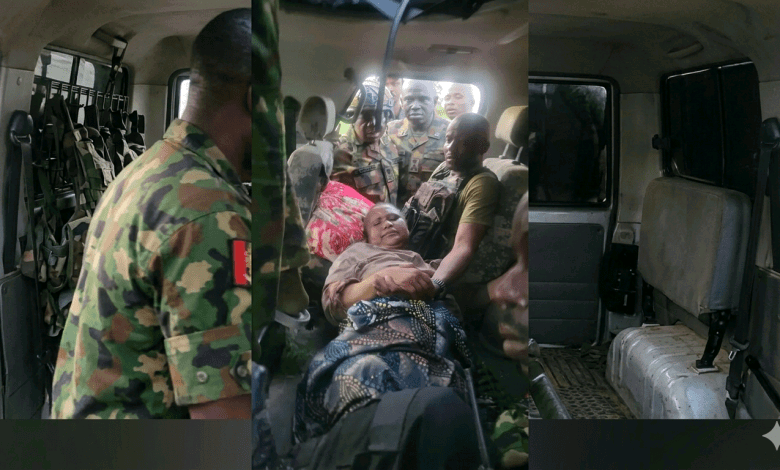
Nigerian Army troops have rescued the wife of retired Major General Rabe Abubakar, a former Director of Defence Information, following a fierce gun battle with armed bandits in Katsina State.
The dramatic rescue came days after the woman was abducted by gunmen in Matazu Local Government Area, one of several communities in Katsina that have come under repeated attacks by bandits involved in kidnapping, cattle rustling and other violent crimes.
The operation, conducted by troops of Operation FANSAN YANMA under the military’s ongoing Operation CLEAN SWEEP III, was launched after intelligence reports pinpointed the movement of the kidnappers and their victim.
Security analyst Zagazola Makama disclosed the development in a report posted on his verified X account on Monday night, citing military sources.
According to the sources, troops tracked the kidnappers to Tunga village, where they engaged the criminals during a search-and-rescue mission. Overwhelmed by the military offensive, the bandits reportedly fled the area, abandoning their captive.
READ ALSO:
- If Nigeria Is Not Divided, We Will Never Have Any Sense in the North
- Trump Says Iran Deal ‘All Signed’ As Strait Of Hormuz Partially Reopens
- UK Announces Social Media Ban for Children Under 16
“The bandits shot her and fled when we made contact at Tunga village. We have rescued Mrs. Abubakar. She is bleeding. We have given her first aid and are moving her for urgent medical attention,” a military source was quoted as saying.
Although injured during the encounter, Mrs. Abubakar was stabilised by military personnel and evacuated for urgent medical treatment.
The rescue is being viewed as a significant breakthrough in the fight against banditry in the North-West, particularly in Katsina State, which has remained one of the epicentres of the security crisis despite sustained military operations.
Maj.-Gen. Abubakar, who served as Director of Defence Information between 2015 and 2018, was the military’s chief spokesman during some of Nigeria’s most challenging security operations. His wife’s abduction had heightened concerns about the growing audacity of criminal gangs operating across the region.
In recent months, troops of Operation FANSAN YANMA have intensified offensives against bandit enclaves in Katsina, Zamfara, Sokoto and parts of Kebbi States, leading to the rescue of several kidnapped victims and the neutralisation of scores of armed criminals.
Military authorities have yet to issue an official statement on the latest operation, but security sources described the rescue as a major success in ongoing efforts to restore security across the North-West.
Shot by Bandits, Saved by Soldiers: Dramatic Rescue of General’s Wife in Katsina








News
Peter Obi Rejects Anambra Debt Claims, Challenges Soludo Govt to Produce Evidence
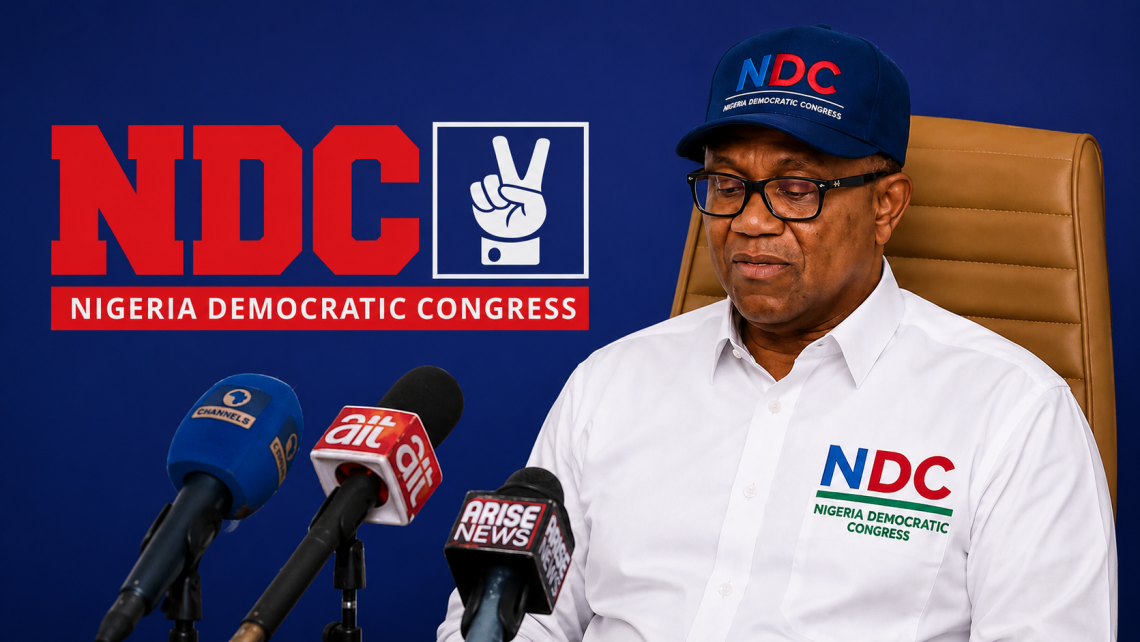
Peter Obi Rejects Anambra Debt Claims, Challenges Soludo Government to Produce Evidence
Former Anambra State Governor and 2027 presidential candidate Peter Obi has rejected claims that he left the state with unpaid financial obligations when he handed over power in 2014, challenging the Anambra State Government to identify any contractor, supplier, worker or pensioner who was owed money by his administration at the time.
Obi made the statement in response to renewed claims by the administration of Governor Chukwuma Soludo that the state is still servicing loans and other financial obligations inherited from previous administrations.
The dispute has opened a fresh political debate over Anambra’s debt profile, the financial obligations inherited by successive governments and the management of the state’s resources before and after Obi left office.
Obi, who governed Anambra between 2006 and 2013 before handing over to his successor in 2014, said he paid what was due during his tenure and left the state in a financially stable position.
He challenged the Soludo administration to provide evidence of any unpaid obligation incurred by his government that remained outstanding when he left office.
According to Obi, if the state government can identify any contractor, supplier, employee, pensioner or other beneficiary who was owed money by his administration at the time of the handover, he would be prepared to address the matter.
The former governor also said his administration left funds in government accounts, including an alleged ₦2.14 billion ecological fund balance, when he handed over power.
However, the claim regarding the ecological fund is from Obi’s camp and would require confirmation from the relevant official financial records.
READ ALSO:
- Peter Obi: Release My UNN Academic Records, I Have Nothing to Hide
- A Son Wouldn’t Have Done Better — Dangote Speaks on Daughters, Succession
- 2027: APC Governors Reject Wike’s Rainbow Coalition, Insist on Party Loyalty
The response followed comments by the Anambra Commissioner for Finance, Izuchukwu Okafor, who said the state was still repaying loans inherited from previous administrations.
Okafor said the Soludo administration had not obtained any commercial bank loan since it came into office in 2022, arguing that the government’s focus had been on reducing the state’s inherited financial obligations.
He said the state’s debt burden had been substantially reduced under Soludo and that the administration had also cleared inherited liabilities relating to contracts, gratuities and pensions.
The commissioner said some loans taken by previous administrations remain subject to repayment and deductions from the state’s federal allocations.
This distinction is at the centre of the current disagreement.
The Soludo administration is not necessarily claiming that Obi personally left unpaid bills to contractors or workers. Rather, the government is pointing to loans and other financial commitments inherited from successive administrations, some of which continue to be serviced.
Obi, on the other hand, is arguing that his administration settled the obligations that were due and payable when he left office and should not be held responsible for liabilities incurred by subsequent governments.
The issue has therefore raised questions about the difference between a state’s overall outstanding debt and debts that were specifically incurred by an individual administration.
Available public debt records have shown that Anambra had outstanding formal obligations around the period Obi left office. However, the political dispute centres on when particular obligations were incurred, which administration contracted them, when repayment became due and whether they should be described as unpaid debts inherited from Obi’s administration.
The Soludo administration has maintained that it inherited financial commitments from previous governments and has been working to reduce them.
The finance commissioner reportedly said the state’s domestic debt was now close to zero and that the government had reduced its overall debt burden significantly.
He also said the Soludo administration had not resorted to commercial bank borrowing since assuming office, presenting the reduction in liabilities as evidence of improved fiscal management.
The government has simultaneously highlighted investments in infrastructure and other projects while maintaining that debt reduction remains an important part of its financial strategy.
READ ALSO:
- Sanwo-Olu Joins Dangote as Historic N2.15tn Refinery IPO Opens on Nigerian Exchange
- Shehu Buba Submits Himself To DSS Over Banditry Allegations
- No Lives Lost as Responders Contain Dual Fire Outbreaks Across Lagos
Obi’s camp, however, has questioned the basis for attributing current financial obligations to his administration.
The former governor has repeatedly presented his tenure as one characterised by fiscal discipline, savings and investment in infrastructure, education, healthcare and other sectors.
His supporters have pointed to the savings and financial reserves accumulated during his tenure as evidence that the state was handed over in relatively strong financial condition.
Critics of the former governor, however, argue that the financial position of a state cannot be assessed solely by looking at cash balances or the absence of unpaid bills because governments can inherit long-term obligations whose repayment extends beyond the tenure of the administration that contracted them.
That distinction is particularly relevant in Anambra, where governments have succeeded one another while continuing to service financial commitments made over several administrations.
The latest exchange has consequently shifted the political conversation from whether Anambra has debt to the more specific question of which administration incurred particular liabilities and whether those obligations were outstanding at the time of each handover.
The dispute also comes at a politically sensitive period, with Obi preparing for the 2027 presidential election under the Nigerian Democratic Congress (NDC).
Questions about his record as Anambra governor are likely to remain part of the political debate as the election approaches, particularly because his administration’s economic management has been a central part of his political narrative.
For Soludo, who is serving as Anambra governor, the emphasis has been on the state’s current fiscal position and the steps his administration says it has taken to reduce inherited liabilities while funding development projects.
For Obi, the priority is to establish that he did not leave unpaid obligations to contractors, workers, pensioners or other beneficiaries when he left office.
The former governor has therefore challenged the state government to publish specific records showing any outstanding obligation attributable to his administration at the point of handover.
The competing claims have yet to be resolved by an independent audit or judicial determination.
What remains clear is that Anambra’s debt debate involves more than a simple disagreement over whether the state owes money. It encompasses loans contracted by successive administrations, repayment schedules, inherited liabilities, outstanding contracts and the question of how political leaders should be held accountable for financial commitments made during their tenure.
As the exchange continues, official debt records, audited financial statements and handover documents could provide the clearest basis for determining the extent of liabilities inherited by each administration.
Until such records are independently reviewed, claims that Obi either left the state completely debt-free or was solely responsible for all of its inherited obligations should be treated with caution.
The latest dispute therefore leaves two competing narratives: Obi’s insistence that he paid what was due before leaving office, and the Soludo administration’s position that Anambra continues to service financial obligations inherited from previous governments, including loans dating back to earlier administrations.
With the 2027 election approaching, the controversy is likely to remain part of the wider political contest over Obi’s record in Anambra and his claims of fiscal discipline in government.
Peter Obi Rejects Anambra Debt Claims, Challenges Soludo Government to Produce Evidence
News
We Must Build Beyond the Next Elections’ — Shettima

We Must Build Beyond the Next Elections’ — Shettima
Vice-President Kashim Shettima has called on political leaders to look beyond election cycles and leave behind institutions that can continue to benefit Nigerians.
His remarks came at the Abuja presentation of Brigadier Musa Usman (1940–1991): Service and Impact, a book documenting the life and public service of the late military governor of the former North-Eastern State.
Represented by Aliyu Modibbo Umar, Shettima said leadership should be measured by the value that remains after an administration has left office.
“We must recover the spirit of selflessness in public service,” he said, urging leaders to “build beyond the next elections and think beyond political boundaries.”
He listed reconstruction, agriculture, education, transport, energy, industrialisation, jobs, environmental restoration, peace and security among areas where leaders must take a long-term approach.
The Vice-President pointed to Musa Usman’s administration as an example of how development can outlive a political tenure. Usman governed the former North-Eastern State from 1967 to 1975, and the region he once administered now covers six states in the North-East.
Shettima said Usman played a major role in developing Maiduguri and establishing infrastructure and institutions that later administrations were able to build upon.
Governor Babagana Zulum, who spoke at the event, described Usman as a leader who combined effective governance with integrity, discipline and humility.
Zulum said the late governor’s contributions included investments in education, healthcare and infrastructure, as well as efforts to strengthen the region’s economy.
The book, written by journalists Mahmud Jega and Theophilus Abbah, also traces Usman’s military career and his rise to leadership at a young age. It was published to preserve his record and the history of the former North-Eastern State.
Shettima said preserving such history could help younger Nigerians understand that lasting public service is about strengthening institutions and improving lives, rather than simply holding office.
News
I Wanted to Disgrace Tinubu — Omokri Reveals What He Discovered at Chicago Varsity
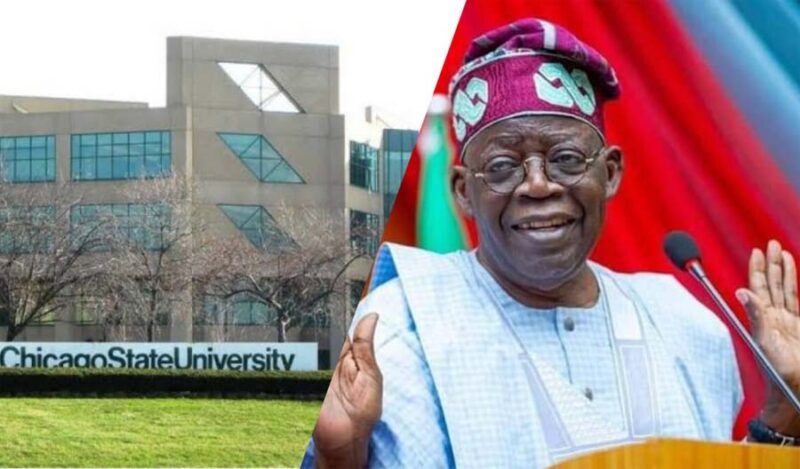
I Wanted to Disgrace Tinubu — Omokri Reveals What He Discovered at Chicago Varsity
Nigeria’s ambassador-designate to Mexico, Reno Omokri, has recounted what he described as an unexpected twist during his visit to Chicago State University (CSU) in the United States, saying he initially travelled there with the intention of scrutinising President Bola Ahmed Tinubu’s academic history.
Omokri, a former aide to ex-President Goodluck Jonathan and now a diplomatic appointee of the Tinubu administration, reportedly made the disclosure while recounting his earlier position on the controversy surrounding the President’s academic credentials.
According to the account circulating online, Omokri said his original objective was to find information that could be used to discredit Tinubu, particularly amid years of controversy over the President’s educational background.
However, he said what he encountered at the university changed his understanding of the matter.
Omokri was quoted as saying that he went to Chicago State University with a predetermined objective—to investigate Tinubu and, if possible, expose inconsistencies that could damage the President politically.
But, according to his account, the findings did not produce the outcome he expected.
Instead, he said he became convinced that Tinubu had genuinely been admitted to and attended Chicago State University.
The development is significant because Tinubu’s educational history has remained one of the most contentious issues surrounding his political career, particularly since the 2023 presidential election.
READ ALSO:
- ‘I Was Never the Chosen One’ — Dembele Responds to Mbappe
- Plateau Attacks: Gunmen Kill Passengers, 13 Dead Across Three LGAs
- 2027: Northern Lecturers Back Tinubu, ASUU Disowns Endorsement
The controversy intensified in 2023 when former Vice-President Atiku Abubakar obtained a United States court order compelling Chicago State University to release documents relating to Tinubu’s academic records.
The records were subsequently released following the order of a US federal judge. Reports at the time said the university’s records confirmed that Tinubu attended the institution and graduated in 1979.
CSU Registrar Caleb Westberg also testified under oath that Tinubu had attended and graduated from the university.
However, the controversy did not completely disappear because questions were raised about the specific diploma submitted by Tinubu to Nigeria’s electoral authorities.
Reports of the US proceedings indicated that the university had Tinubu’s academic record but could not authenticate a particular diploma presented to Nigerian authorities because that exact document was not in the university’s possession.
Against that background, Omokri’s reported admission represents a striking change in tone, considering his earlier opposition to Tinubu.
His account suggests that his visit to Chicago State University was initially motivated by political scepticism but ultimately left him convinced that there was indeed a genuine academic connection between Tinubu and the institution.
The development has generated reactions on social media, with supporters of the President viewing Omokri’s account as further vindication of Tinubu’s claim that he attended the Chicago university.
Critics, however, are likely to maintain that the issue was never simply whether Tinubu attended Chicago State University, but also concerned questions surrounding documents, identity details and the certificate submitted to the Independent National Electoral Commission (INEC).
The available reporting from the 2023 legal proceedings provides an important distinction. There is substantial documentary evidence that Tinubu attended Chicago State University and graduated in 1979. CSU’s registrar testified to his attendance and graduation, while the university released academic records pursuant to a US court order.
At the same time, the controversy over the particular diploma submitted to INEC was not identical to the question of whether Tinubu attended the university.
That distinction has continued to fuel political arguments between supporters and opponents of the President.
Tinubu’s education has remained a recurring political issue since the 2023 election, with opponents repeatedly questioning aspects of his academic credentials, while his supporters argue that the available university records establish his attendance and graduation.
The latest account attributed to Omokri therefore adds another dramatic chapter to a controversy that has survived the election, court battles and the release of university records.
For Omokri, the story appears to have taken an unexpected turn: he said he went looking for ammunition against Tinubu but returned convinced that the President was, in fact, admitted to Chicago State University.
I Wanted to Disgrace Tinubu — Omokri Reveals What He Discovered at Chicago Varsity
-
 News2 days ago
SERAP Threatens Legal Action Over ₦126bn INEC Electoral Funds
-
 Politics2 days ago
Five Islamic Clerics Abducted After Tinubu Re-Election Prayer At Yari’s Zamfara Residence
-
 Opinion2 days ago
‘Tinubu Will Win Again in 2027’ — Charismatic Bishops’ Secretary
-

 metro2 days ago
Mother ‘sold daughter’s abuse videos for $300’: Nigeria child pornography case shocks nation
-
 Politics21 hours ago
2027: Northern Lecturers Back Tinubu, ASUU Disowns Endorsement
-

 Sports2 days ago
‘Unacceptable’ — Arteta Furious Over Sunderland Penalty in Arsenal Win
-
 News1 day ago
Nwifuru Dismisses Cubana Chief Priest as ‘Attention-Seeker’
-
 Education2 days ago
JAMB Takes Over HND Admissions in Polytechnics, Health Institutions Nationwide