

International
Israeli Settlers Torch, Deface West Bank Mosque During Ramadan
Israeli Settlers Torch, Deface West Bank Mosque During Ramadan
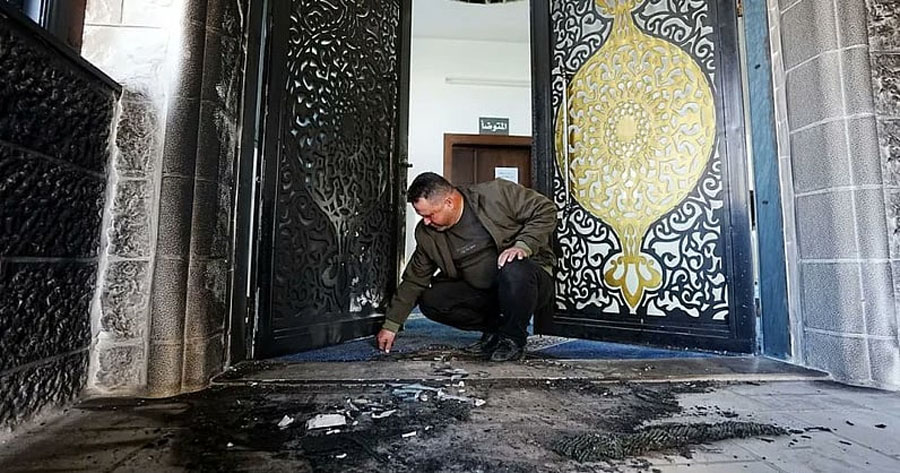
TELL, West Bank — Israeli settlers have vandalized and set fire to the Abu Bakr al-Siddiq Mosque in the Israeli-occupied West Bank, authorities confirmed, marking the latest in a series of attacks on Palestinian religious sites amid a surge in settler violence. The attack occurred early Monday during the Muslim holy month of Ramadan.
Worshippers arriving for morning prayers discovered the mosque’s entrance smoldering, with black smoke staining the doorway and broken glass scattered across the area. According to the Palestinian Authority Ministry of Religious Affairs, settlers spray-painted offensive graffiti, including derogatory references to Islam and slogans linked to extremist “price tag” operations.
Local resident Munir Ramdan described the scene: “I was shocked when I opened the door. The fire had been burning here, the glass was broken, and the door was damaged.” Security footage reportedly shows two individuals carrying gasoline and spray paint approaching the mosque before fleeing the scene.
READ ALSO:
- Iranian Army Helicopter Crashes Into Market, Four Killed
- Mother of Three Dies by Suicide After Fiance’s Family Rejects Marriage in Ijebu-Ode
- RCCG Pastor Peter Akpe Confirmed as Bayelsa Deputy Governor
The incident is part of a broader pattern of attacks on mosques in the West Bank, with the Palestinian Ministry of Religious Affairs reporting that 45 mosques were vandalized or attacked last year. Residents said the assault was a deliberate provocation during Ramadan, targeting both the religious sanctity of the mosque and the spiritual practice of fasting.
The Israeli military and police responded to reports of the incident and are actively searching for suspects. While the military condemned harm to religious institutions, Palestinian officials and rights groups say Israeli authorities often fail to hold settlers accountable for violence.
The attack comes amid a recent rise in settler violence, including last week’s killing of a 19-year-old Palestinian-American, Nasrallah Abu Siyam, highlighting ongoing tensions between settlers and Palestinian communities in the occupied territories.
Israeli Settlers Torch, Deface West Bank Mosque During Ramadan







International
Iran Denies US Talks After Trump Announces Negotiations as War Enters Sixth Month
Iran Denies US Talks After Trump Announces Negotiations as War Enters Sixth Month
Tehran rejects Washington’s claim of imminent talks, says discussions with Oman over Strait of Hormuz are separate and ongoing
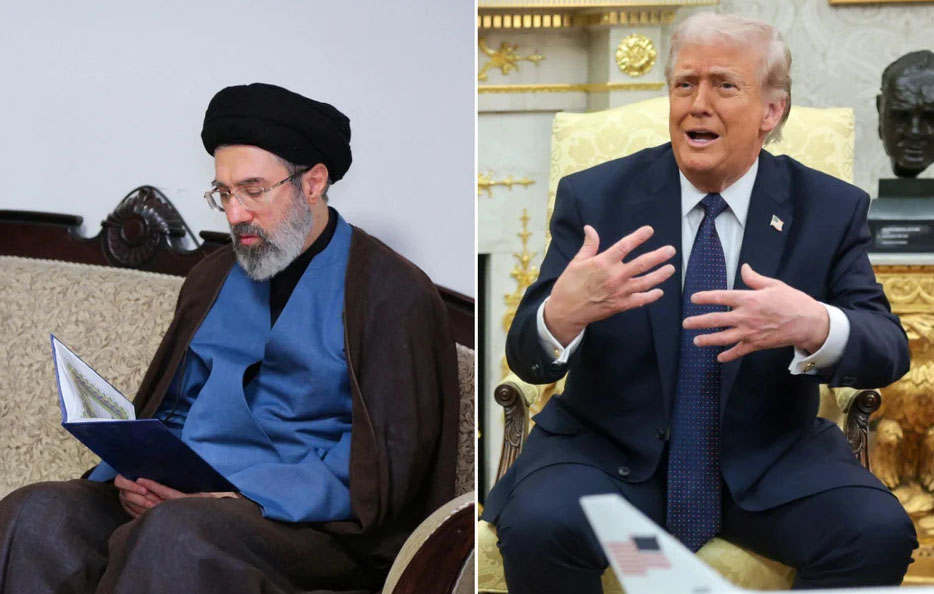
Iran has firmly denied that it is currently holding negotiations with the United States, contradicting President Donald Trump’s announcement that talks would begin on Monday afternoon. The conflicting claims come amid heightened tensions over the Strait of Hormuz and Iran’s nuclear program, with the war between the two countries now in its sixth month. The war began on February 28, 2026, when the United States and Israel launched surprise strikes against Iran, targeting key leadership, air defence capabilities, missile sites, and the Islamic Revolutionary Guard Corps (IRGC) Navy. The opening salvo included an attack on a leadership meeting in Tehran that killed Supreme Leader Sayyid Ali Khamenei, Iran’s defence minister, the chief of staff of the armed forces, and the commander of the IRGC. Since then, months of on-off diplomacy have led to periods of relative calm, though fighting has continued to flare.
Iranian Foreign Ministry spokesman Esmaeil Baqaei stated during a televised press conference on Monday that “Iran is not currently holding talks with the United States”. He elaborated that Tehran has no plans to host or send delegations, and members of Iran’s negotiating delegation remain inside the country. Baqaei clarified that Iran’s current discussions are focused exclusively on Oman regarding a temporary safe route through the Strait of Hormuz. He emphasized that reaching an agreement with Oman would not mean the reopening of the strait, as the situation would remain unchanged while US “aggression” continued. “So long as the United States continues to violate its commitments, the situation in the Strait of Hormuz will not change,” Baqaei told his weekly press conference. The spokesman also warned Gulf states against allowing the United States to use their territory for attacks on Iran, urging countries in the region not to facilitate US military action.
READ ALSO:
- NiDCOM confirms release of Nigerian girls detained in Mauritius
- Power Struggle Threatens Peter Obi-Kwankwaso Alliance Ahead of 2027 Polls
- Gumi: Clerics who join politics are better than those praying for politicians
On Sunday, President Trump told reporters aboard Air Force One that negotiations with Iran would begin Monday afternoon. He claimed that the talks would cover the Strait of Hormuz and ultimately the denuclearisation of Iran. “The deal is imminent, having to do with the Hormuz Strait and also, ultimately, the denuclearization of Iran,” Trump said. Trump stated that he had been asked by Iran as well as US partners Saudi Arabia, the United Arab Emirates, and Qatar to hold off on strikes, which he claimed would have been “the biggest attack since World War II”. In a post on Truth Social, Trump wrote: “Based on this request, I have agreed, for the future benefit of the WORLD and, likewise, the survival of a successful and prosperous Iran, to cancel the attack, subject to being able to rapidly make a DEAL”. However, Iranian media has denied that Tehran asked Trump not to strike. Trump has repeatedly predicted that a negotiated settlement is within reach, although previous diplomatic efforts have been followed by renewed exchanges of military strikes.
While denying US talks, Iranian officials confirmed progress in discussions with Oman over a new shipping route through the Strait of Hormuz. Iranian Foreign Minister Abbas Araghchi said negotiations with Oman on a mechanism for ships to transit the waterway were “nearing completion and in their final stages,” according to Iranian state media. The talks have been ongoing for months between Tehran and Muscat, the two littoral states bordering the strait, with discussions continuing at both the technical and political levels. Baqaei told state television that a deal was close with Oman over a new route through the strait, describing it as “one path with entry and exit lanes” that would respect the sovereign rights of both sides. The route under discussion will be temporary, he said, and through it, Iran will ensure safe navigation. Baqaei emphasized that Iran and Oman, as coastal states of the strait, are required to cooperate to ensure the safe passage of vessels through the waterway and reach a defined mechanism. He noted that Tehran needs to ensure that the Strait of Hormuz would not be exploited by the parties that have carried out aggression against Iran, adding that “this requires us to adopt a mechanism in which Iran’s sovereign rights are fully respected”.
The conflicting claims come against the backdrop of a war that has significantly disrupted global energy markets. Before the war, the Strait of Hormuz served as a conduit for approximately 20% of the world’s oil and liquefied natural gas. Iran has largely closed the strait, causing energy prices to rise and stoking broader inflation. On June 18, Iran and the United States signed a memorandum of understanding (MoU) on ending the conflict, under which the two countries were scheduled to hold negotiations within a 60-day period to reach a final agreement. Under the understanding, Iran agreed to allow fee-free maritime transit through the Strait of Hormuz for a period of 60 days. However, the talks’ fate has been uncertain due to recent military escalation. The US attempted to undermine Iran’s sovereignty by establishing an unsafe corridor near Omani shores, prompting Iran’s firm response to re-impose restrictions on the strait.
Iranian President Masoud Pezeshkian posted on X that “We must strive to compel the enemy to remain committed to what it has signed”. He expressed belief that the MoU would be the focal point of Iran’s foreign relations in the future. Baqaei also revealed that over the past 24 hours, “we have received numerous calls from the United Kingdom, Bulgaria, and Ukraine stating that they will not be part of the war against Iran”. Iranian lawmaker Hassan Ghashghavi, spokesman for the parliament’s national security commission, said on Sunday that mediators were trying to revive the US-Iran memorandum of understanding that was agreed in June. That agreement was not intended as a final peace deal, but as a stepping stone to negotiations on a comprehensive agreement, though it did include provisions on Hormuz. “They know that the main issue and, in fact, the key to the matter right now is the issue of the Strait of Hormuz, so yes, there is an exchange of views,” Ghashghavi said.
Trump’s announcement had immediate market effects, with oil prices falling at the opening of Asian trade. The president said he had been asked by Iran as well as US partners Saudi Arabia, the United Arab Emirates, and Qatar to hold off on further strikes. Eli Cohen, Israel’s energy minister and a member of Prime Minister Benjamin Netanyahu’s security cabinet, said there was close security and intelligence coordination between Israel and the US on everything happening in the region. However, he added: “With or without an agreement, and regardless of any external commitments, if Iran attempts to renew its nuclear programme or advance its ballistic missile industries, we will be there. We will take action, and we will strike”. In his call with Trump, Saudi Crown Prince Mohammed bin Salman stressed the “necessity of prioritising dialogue to de-escalate tensions” in the Middle East, according to Saudi Arabia’s state news agency. Many observers have expressed skepticism about the latest diplomatic push. Vali Nasr, an Iran expert at Johns Hopkins University, stated there was “no clear path” for Trump to achieve his goals, noting that “He is trying his hand now at a diplomatic solution to avoid military escalation. But there’s no clear path, either diplomatically or militarily, to get Trump to a place where he can declare victory”.
Iran Denies US Talks After Trump Announces Negotiations as War Enters Sixth Month
Additional reporting by Reuters, AFP, Ynetnews, and The New Arab
International
Oil Prices Slide as Trump Announces Fresh Iran Talks, Easing Supply Fears

Oil Prices Slide as Trump Announces Fresh Iran Talks, Easing Supply Fears
Global oil prices fell sharply in early Asian trading on Monday after United States President Donald Trump announced fresh negotiations with Iran, raising hopes of easing tensions in the Middle East and restoring normal shipping through the strategically vital Strait of Hormuz.
Brent crude, the international oil benchmark for September delivery, dropped 4.69 per cent to $83.81 a barrel as of 2250 GMT on Sunday, while the US benchmark, West Texas Intermediate (WTI), declined 4.67 per cent to $80.72.
The decline followed Trump’s announcement on Sunday that Washington would resume diplomatic engagement with Tehran instead of pressing ahead with major military strikes against the Islamic Republic.
READ ALSO:
- Political Realignments: Kwankwaso Receives APC Defectors into NDC in Kano
- DSS, Vigilantes Ambush, Kill Notorious Bandit Kingpin Idi Abasu Aiki, Over 60 Fighters in Katsina
- Nigeria Shines in Commonwealth Games, Tops Africa with 10 Gold Medals
“Now what we’re doing is we’re talking to them in the form of a negotiation. It begins tomorrow afternoon,” Trump said, without disclosing the venue or those expected to participate in the talks.
Oil markets have remained highly volatile since the conflict between the United States, Israel and Iran escalated in late February, disrupting traffic through the Strait of Hormuz—a critical maritime corridor for global crude oil and liquefied natural gas exports.
The renewed diplomatic push has fuelled optimism that the waterway could soon reopen fully, reducing the risk of prolonged disruptions to global energy supplies.
Adding to the positive sentiment, Iran said on Sunday that it was close to reaching an agreement with Oman on establishing a new shipping arrangement through the Strait of Hormuz, a development that could further stabilise oil exports from the region.
Oil Prices Slide as Trump Announces Fresh Iran Talks, Easing Supply Fears
International
Hamas Accepts US-Backed Disarmament Plan as Trump Unveils Gaza Peace Roadmap
Hamas Accepts US-Backed Disarmament Plan as Trump Unveils Gaza Peace Roadmap
- A landmark agreement could reshape the future of Gaza, but Israel’s official response remains pending as key details hang in the balance.
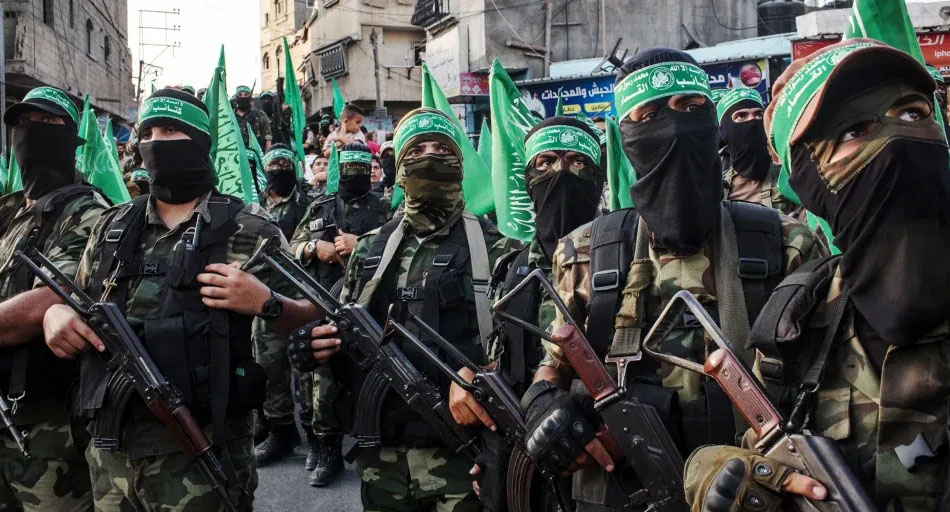
In a significant diplomatic breakthrough, the Palestinian group Hamas has formally accepted a United States-backed proposal aimed at ending the 10-month-long war in the Gaza Strip. The agreement, unveiled by U.S. President Donald Trump, outlines a phased roadmap that includes the group’s complete disarmament and a gradual withdrawal of Israeli troops from the territory. The announcement, made on Friday, marks one of the most substantial developments since the October ceasefire. However, the deal remains conditional, and Israel has not yet issued an official response, leaving the international community in a state of cautious optimism.
Under the proposed framework, Hamas has agreed to surrender its weapons to the National Committee for the Administration of Gaza (NCAG) , a Palestinian governing body established under the Trump-administration-led Board of Peace initiative. The disarmament process is designed to be phased and verifiable, beginning with an initial phase where Hamas police forces are expected to hand over light weapons to the NCAG within the first two weeks. This would be followed by a second, more extensive phase lasting between 200 and 350 days, during which the full decommissioning of heavy weapons, tunnels, depots, and weapons production facilities would take place under strict international oversight. The roadmap follows a “zero trust” model, meaning each phase of disarmament must be independently verified before the next step of Israeli military withdrawal can proceed. Echoing this cautious approach, Nickolay Mladenov, the Board of Peace’s High Representative for Gaza, emphasized that “withdrawal must move in lockstep with decommissioning,” underscoring the need for synchronized and carefully monitored implementation.
For Hamas, the decision represents a difficult but necessary concession aimed at alleviating the suffering of Palestinian civilians. Ghazi Hamad, a member of the group’s negotiating team, described the move as a sacrifice made for the sake of the people in Gaza, to save them from continued killing and displacement. He further clarified that Israel will not intervene in the disarmament process, which will be solely managed by the NCAG. However, a senior Hamas official stressed that full implementation of the agreement depends on Israel fulfilling its prior commitments under the initial ceasefire, which include ending all military attacks, withdrawing forces to October 2025 positions, and significantly increasing humanitarian aid deliveries into the besieged territory.
READ ALSO:
- FG to phase out electricity subsidy from 2027 as power sector debts rise
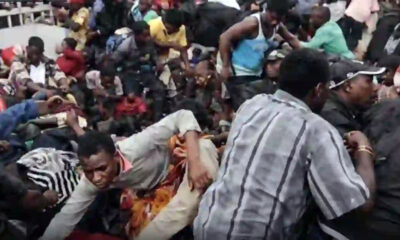
- At least 43 migrants die as 49,000 cross into Spain’s Ceuta enclave
- Segun Aina assumes office as JAMB registrar, vows to protect examination integrity
As of this report, Israel’s government has not formally responded to the proposal, and its position remains a critical unknown. An Israeli political source indicated that the current framework does not “satisfactorily” address Israel’s core demand for the complete demilitarisation of the Gaza Strip. The source also reiterated that Prime Minister Benjamin Netanyahu’s recent meeting with President Trump in Washington did not include discussions on the Gaza conflict, casting doubt on the level of Israeli engagement with the plan. Another major sticking point is the so-called “Yellow Line” buffer zone, with an Israeli official insisting there would be no withdrawal from this area before Hamas is fully disarmed. Despite these reservations, the U.S. has expressed confidence that Israel will ultimately adhere to the 20-point plan, with one official noting that President Trump would be “very, very disappointed” if it did not.
The agreement was brokered by a coalition of international mediators, including Egypt, Qatar, and Turkey, who have been engaged in months of difficult negotiations. Egypt’s state-linked Al-Qahera News reported that Cairo is expected to host another meeting to advance discussions on the second phase of the truce, signaling continued diplomatic momentum. A diplomatic source familiar with the negotiations emphasized the roadmap’s commitment to unity and order, stating that “there will be no exceptions for certain weapons or certain people,” and that the goal is to establish “one authority, one law, one weapon.” The roadmap also includes a verification mechanism designed to monitor compliance by both parties, ensuring accountability and transparency throughout the entire process.
Despite the diplomatic progress, hostilities have persisted on the ground, underscoring the fragility of the current situation. Gaza’s health authorities reported that Israeli airstrikes on Thursday killed at least four people, including two children, even as negotiations advanced. The humanitarian situation in Gaza remains dire, with widespread displacement, acute food insecurity, and a collapsing healthcare system that has left thousands without access to basic medical care. The success of the agreement hinges not only on political will from all parties but also on tangible, on-the-ground improvements in the daily lives of Palestinian civilians, many of whom have been displaced multiple times since the conflict began.
The focus now shifts from negotiation to implementation, with the Board of Peace confirming in a post on X (formerly Twitter) that the NCAG will “soon begin a phased transition toward full authority.” Key milestones to watch include Israel’s official response to the proposal, which could shape the entire trajectory of the deal; the actual start of the weapons handover process; the deployment of an International Stabilization Force to work alongside a new Palestinian police force; and meaningful progress on humanitarian aid and reconstruction efforts that could help stabilize the region. Each of these steps carries significant weight and will be closely monitored by the international community.
This agreement represents a rare moment of compromise in a conflict marked by decades of violence and deep-seated mistrust. However, the path forward is fraught with challenges, and the “zero trust” approach reflects the profound suspicions that persist on both sides. Any misstep, whether a delay in weapons handover or a disagreement over troop withdrawal, could unravel the entire framework and plunge the region back into conflict. For now, the world watches and waits, with hopes pinned on a process that remains as fragile as it is historic. As Mladenov aptly put it, “What happens next matters even more. Implementation and verification have to be real.”
Hamas Accepts US-Backed Disarmament Plan as Trump Unveils Gaza Peace Roadmap
-
 News2 days ago
Oloyede clears air on JAMB’s ₦36m ‘snake swallowed money’ controversy
-

 News2 days ago
475 Police Officers Recalled After Controversial Retirement, Ordered for Mandatory Induction
-

 metro2 days ago
MURIC Hails Oloyede as ‘Game Changer,’ Says He Proved Muslims Can Excel in Public Office
-

 Auto2 days ago
Lanre Shittu Motors Leads Drive to Steer Lagos Students Away from Crime, Donates books to public Schools
-

 Sports2 days ago
Nigeria Shines in Commonwealth Games, Tops Africa with 10 Gold Medals
-

 Auto2 days ago
FRSC Boss: Tinubu’s CNG, EV Drive Creating Jobs, Attracting Investment
-

 metro2 days ago
DSS, Vigilantes Ambush, Kill Notorious Bandit Kingpin Idi Abasu Aiki, Over 60 Fighters in Katsina
-

 metro3 days ago
Peller, Jarvis’ Glamorous Lagos Wedding: N400m Mansion, $20,000 Gift, Over 50,000 Virtual Guests