30 Nigerians on US Deportation Portal Linked to N87bn Fraud - Newstrends
Connect with us

International

30 Nigerians on US Deportation Portal Linked to N87bn Fraud
Published

on

30 Nigerians on US Deportation Portal Linked to N87bn Fraud

30 Nigerians on US Deportation Portal Linked to N87bn Fraud

At least 30 Nigerian nationals listed on the United States Department of Homeland Security (DHS) “Worst of the Worst” deportation portal have been linked to more than N86.8 billion ($62 million) in confirmed fraud losses, restitution orders, and intended losses, according to U.S. Department of Justice publications analyzed by THE WHISTLER.

The 30 individuals are part of a larger group of 124 Nigerians currently featured on the DHS portal at wow.dhs.gov – a public database of foreign nationals flagged for deportation. Financial crimes account for 77 of the 124 entries, representing 62% of all charges against Nigerians on the list. New court records and enforcement actions from the first half of 2026 have since added more cases, pushing the total fraud exposure linked to this group well beyond the original $62 million estimate.

Top Fraud Cases on the DHS Portal

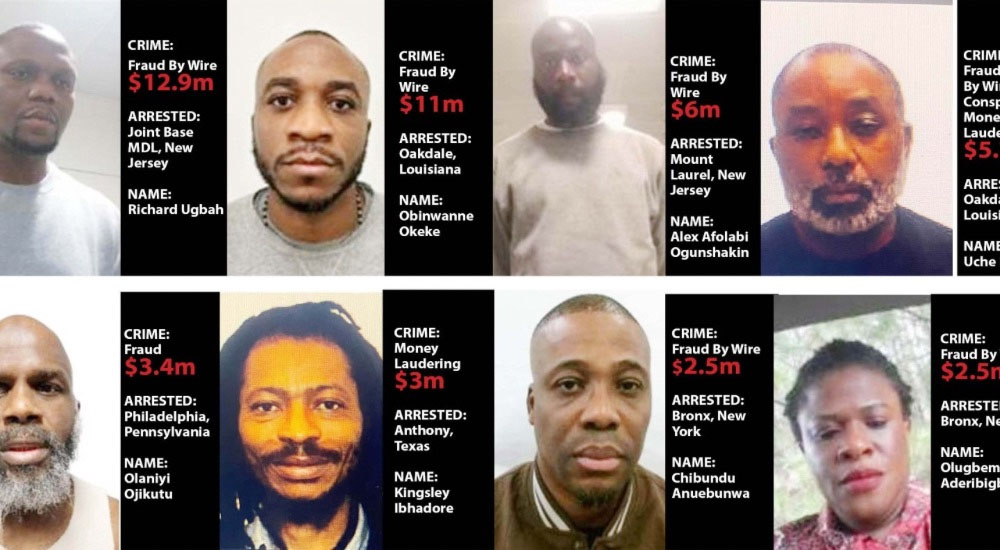
Richard Ugbah was sentenced to 12 years in November 2017 for a romance fraud and business email compromise (BEC) scheme, with intended losses of $12.9 million. The presiding judge noted the figure was likely understated. Ugbah was arrested at Joint Base MDL in New Jersey.

Obinwanne Okeke received a 10-year sentence for an $11 million BEC scheme and is held at Oakdale FCI in Louisiana. His case remains one of the largest single cyber fraud convictions involving a Nigerian national.

Alex Ogunshakin was extradited from Nigeria and sentenced in October 2024 after spending more than three years on the FBI Cyber Most Wanted list. Federal prosecutors documented $6 million in confirmed losses and over $30 million in attempted fraud. These three cases alone account for nearly **$30 million** of the confirmed $62 million fraud total.

Other Significant Convictions

Uche Diuno was convicted in May 2024 for a $5.7 million advance-fee fraud scheme and described himself as the “chairman” of a fraud ring that operated across more than 20 countries over four years. He was sentenced to 60 months.

Oludayo Adeagbo was jailed for seven years for a business email compromise scheme causing more than $5 million in losses.

Olaniyi Ojikutu opened approximately 25 bank accounts through which $3.4 million in romance scam proceeds were laundered. He fled to Canada after indictment, was apprehended seven months later, extradited, and is now serving 88 months.

Chibundu Anuebunwa was sentenced to 66 months for a $2.5 million **BEC scheme**, while **Benjamin Ifebajo** received 10 years for $2.1 million in email fraud. Sakiru Ambali received 42 months after $2.4 million passed through his accounts.

Yusuf Bakare and Quazeem Adeyinka were convicted in a COVID-19 unemployment insurance fraud conspiracy after obtaining $2.27 million. Bakare was sentenced to four years and nine months, while Adeyinka received 26 months.

READ ALSO:

Oluwole Odunowo was sentenced to 54 months as part of an IRS fraud scheme that caused $11.6 million in total losses, with his individual restitution order set at $402,846.

Toluwani Adebakin was a collegiate track and field athlete at William Carey University in Mississippi when he and a teammate were convicted of laundering proceeds from romance, military, and money scams. More than 100 victims sent over $820,000 to the athletes, who transferred the funds to fraudsters in Nigeria. He was sentenced to 36 months in April 2024.

Bameyi Omale is serving 135 months for his role in a romance and investment fraud laundering ring in the Western District of Texas, the longest confirmed sentence among the money laundering entries on the list.

Okechukwu Amadi, serving 11 years and three months, was convicted in connection with the Black Axe criminal organization and ordered to forfeit $833,625 in laundered proceeds and pay $1.35 million in restitution. Oriyomi Aloba was sentenced to 145 months after hacking into the Los Angeles Superior Court computer system and using it to send approximately two million malicious phishing emails, with a restitution order of $47,479.

New Developments: March – June 2026

In April 2026, the U.S. Department of Justice convicted 25 defendants in an international email hacking and fraud scheme that caused over $215 million in losses to more than 1,000 victims. Several Nigerians were among those who pleaded guilty to wire fraud and money laundering conspiracy charges in this separate but significant case.

Under the DHS West Africa Operations Watch initiative launched in June 2026, an additional 110 Nigerians were added to the removal queue as part of a 355-person regional enforcement action. Nigeria topped the West Africa breakdown, ahead of Liberia with 94, Ghana with 30, and Senegal with 19.

Fresh extraditions and indictments emerged in May 2026. Samuel Ugberaese was extradited from Nigeria to face charges in North Carolina for wire fraud and money laundering conspiracy related to cross-border romance scams. Meanwhile, Oluwadamilare Kolaogunbule, a naturalized U.S. citizen, was indicted alongside Ugberaese for allegedly using his network of bank accounts to launder illicit proceeds from romance fraud schemes.

Recent sentences from March to April 2026 include Saheed Sunday Owolabi, who was sentenced to 15 years in federal prison for defrauding victims and laundering over $1.5 million to Nigeria, with the DOJ noting that Owolabi used a female identity to build online relationships with male victims. **Ayobami Omoniyi** was sentenced to 32 months for a $202,000 money laundering scheme linked to business email compromise scams and is scheduled for deportation upon completion of his sentence.

Common Charges and Criminal Methods

Analysis of court records shows that wire fraud was the most common single offense, appearing in 27 charge entries. Money laundering appeared 18 times, identity theft 13 times, forgery or counterfeiting eight times, and mail fraud seven times. Wire fraud and money laundering frequently appeared together, consistent with organized financial crime where proceeds from fraudulent transfers are moved through layered transactions to obscure their origin.

The primary fraud schemes identified include Business Email Compromise (BEC) , where hackers compromise legitimate business email accounts to send fraudulent payment requests; romance scams, where fake online identities are used to manipulate victims into sending money; advance-fee fraud, where victims pay upfront fees for promised goods, services, or inheritances that never materialize; and COVID-19 relief fraud, involving fraudulent applications for unemployment insurance and pandemic relief funds.

Beyond Financial Crimes: Other Charges on the Portal

While financial crimes dominate the list, 28 Nigerians face violent offense charges, including aggravated assault, robbery, and kidnapping. Donald EhieAdeyinka Ademokunla, and Ifeanyi Okoro each faced kidnapping charges, with Okoro also facing sexual assault and robbery charges. Olayinka A. Jones, arrested in Fairfax, South Carolina, was the only individual with a manslaughter-level charge.

READ ALSO:

Fifteen individuals face sexual offense charges, with five involving alleged crimes against minors. Abayomi Daramola, arrested in Portland, Oregon, is listed for enticement of a minor via telecommunications – a charge carrying a mandatory minimum of 10 years upon conviction. Cletus Onyali, arrested in Jessup, Maryland, has five separate charge entries, including assault, rape, sex offense against a child, cruelty toward a child, and a general sex offense.

Nine individuals were arrested for drug-related crimesSuraj Tairu in Washington, D.C., faced both heroin sale and heroin smuggling charges. Adewale Aladekoba in Baltimore faced heroin distribution charges, while Aderemi Akefe, arrested in Detroit, faced cocaine smuggling and customs evasion charges.

Geographic Breakdown Within the U.S.

The 124 Nigerians were arrested across at least 26 states and Washington, D.C. Texas recorded the most arrests at 29, followed by Maryland with 14, Pennsylvania and California with eight each, Georgia with eight, Louisiana with seven, Illinois with six, and Florida with five. Texas’s high number is likely driven by the large Nigerian and West African diaspora in Dallas-Fort Worth and Houston, and by the ICE Dallas Field Office, one of the agency’s largest operational centers.

Several individuals were arrested at federal Bureau of Prisons facilities, meaning they were already serving federal sentences when ICE processed them for removal. Oakdale FCI in Louisiana appeared eight times as an arrest location despite the state’s relatively small Nigerian diaspora, while Yazoo City FCI accounted for the majority of Mississippi’s entries.

Nigeria’s Official Response

The former Minister of Foreign Affairs, Yusuf Tuggar, said in a BBC interview that the Nigerian government welcomes the return of nationals who have violated U.S. law but insisted such returns must be conducted with dignity. In a separate Channels TV interview, Tuggar stated that Nigeria, with a population exceeding 230 million, already faces huge domestic challenges and would not accept nationals of other countries under a proposed regional deportation arrangement.

In May 2026, the U.S. finalized a third-country deportation agreement with Sierra Leone, paying the country $1.5 million to accept up to 300 West Africans annually whose home countries are slow to process returns. Some Nigerians on the DHS list have already been removed under this arrangement.

Portal Glitch Acknowledged by DHS

In February 2026, CNN reported that the DHS acknowledged a glitch affecting approximately 5% of entries across the portal, with some individuals listed as violent criminals despite having only minor offenses on record. Two Nigerians illustrate this discrepancy: Adetunji Olofinlade, arrested in Belcamp, Maryland, was listed solely for driving under the influence, while Olamide Jolayemi, arrested in Oklahoma City, was listed for computer crimes and a DUI.

Broader Context: Nigerians Under Final Deportation Orders

The 124 Nigerians on the “Worst of the Worst” portal represent a specific category of prioritized deportees with criminal convictions. For broader context, as of November 2024, ICE records indicated that 3,690 Nigerians were on the agency’s non-detained docket with final orders of removal.

30 Nigerians on US Deportation Portal Linked to N87bn Fraud

Loading

International

Iran Halts Military Operation Against Israel, Warns of Stronger Response if Attacks Continue

Published

on

Iran Halts Military Operation Against Israel, Warns of Stronger Response if Attacks Continue

Iran Halts Military Operation Against Israel, Warns of Stronger Response if Attacks Continue

Iran’s military command on Monday announced the suspension of its operation against Israel after the two countries exchanged missile and air strikes for the first time since an April ceasefire.

In a statement broadcast on Iranian state television, the Khatam al-Anbiya Central Headquarters said Iran had delivered what it described as a “painful response” to Israeli actions and was therefore ending its current military operations against Israel.

“Accordingly, the cessation of armed forces operations is hereby announced,” the statement said.

However, the command warned that the halt was conditional and could be reversed if Israel continued what Tehran described as acts of aggression, particularly in southern Lebanon.

“It is emphasised that should acts of aggression and hostility continue, including in southern Lebanon, much more severe and crushing measures than before will follow,” the statement added.

The announcement came after a sharp escalation in regional tensions over the weekend. Iran launched multiple waves of missiles at Israeli targets after Israel carried out strikes linked to Hezbollah positions and other targets in Lebanon. Israel responded with air strikes on sites inside Iran, marking the most serious direct exchange between the two sides since the truce that took effect in April.

READ ALSO:

The latest flare-up raised fears that the ceasefire brokered earlier this year could collapse entirely and trigger a broader regional conflict involving Lebanon’s Hezbollah movement and other Iran-backed groups.

Meanwhile, U.S. President Donald Trump urged both sides to stop military action and preserve ongoing diplomatic efforts aimed at securing a broader peace arrangement in the region. Following the exchange of strikes, both Tehran and Jerusalem indicated that they were pausing further attacks for the time being, although neither side ruled out renewed military action if provoked.

The confrontation also rattled global energy markets, with oil prices surging amid concerns that a prolonged conflict could threaten shipping routes and energy supplies in the Middle East before retreating after Iran announced the end of its current operation.

Despite the announcement, analysts cautioned that the situation remains highly fragile, with tensions over Lebanon, regional security, and Iran’s broader dispute with Israel and its allies continuing to pose a risk of renewed hostilities.

Iran Halts Military Operation Against Israel, Warns of Stronger Response if Attacks Continue

Loading

Continue Reading

International

Israel Strikes Iranian Military Targets in Retaliation for Missile Attack

Published

on

Israel Strikes Iranian Military Targets in Retaliation for Missile Attack
Smoke rising over Tehran, Iran, following airstrikes on military targets.

Israel Strikes Iranian Military Targets in Retaliation for Missile Attack

Jerusalem/Tehran – The Israel Defense Forces (IDF) launched airstrikes on military targets in western and central Iran early Monday, hours after Iran fired ballistic missiles at northern Israel in the first direct attack between the two nations since a fragile ceasefire took effect in early April.

The IDF said its aircraft struck military sites belonging to the “Iranian terror regime,” including areas near Tehran, Tabriz, and Isfahan. Iranian state media reported multiple explosions in those cities. The strikes also hit the Karun Mahshahr Petrochemical Company in Khuzestan Province, marking the first reported attack on an Iranian energy-related site since the April 8 ceasefire.

Israel’s ambassador to the United States, Yechiel Leiter, defended the strikes, stating that “no self-respecting country” would accept missile attacks on its territory. He added that Israel was targeting Iranian surface-to-surface missile launch sites and infrastructure not related to the energy sector.

Iran’s Islamic Revolutionary Guard Corps (IRGC) confirmed that Israel used air-launched ballistic missiles in the strikes and warned that if Israel expands its attacks on southern Lebanon or responds further, it will face more “crushing and regretful blows.”

The Iranian missile barrage on Sunday targeted Israel’s Ramat David Air Base in northern Israel, according to the IRGC. The attack was in response to recent Israeli strikes on Hezbollah positions in Beirut’s southern suburbs. The IDF said it intercepted the incoming projectiles, with no immediate reports of casualties or significant damage in Israel.

The IRGC claimed its forces struck two Israeli air bases—Nevatim and Tel Nof—during the operation it codenamed “Victory” (Nasr). Meanwhile, Iranian media reported that the Mahshahr special petrochemical economic zone was being evacuated following the Israeli strikes. The Tehran fire department confirmed that no urban areas in the capital had been targeted, with explosions limited to military sites. Iran temporarily closed the airspace around Tehran’s main international airport following the attacks.

READ ALSO:

President Donald Trump reportedly urged Israeli Prime Minister Benjamin Netanyahu to exercise restraint and avoid retaliatory action to preserve de-escalation efforts, telling Axios, “Hopefully Israel is not going to retaliate… Each of them had their fun. We don’t need another one.” However, Israel proceeded with the strikes despite the president’s appeal. Trump told the Financial Times that Netanyahu “doesn’t call the shots” and would have “no choice” but to accept a deal with Iran, signaling a widening rift between the two allies as the administration seeks to wind down the conflict.

The exchanges mark the latest breach of the fragile ceasefire arrangements that followed the wider U.S.-Israeli military campaign against Iran, which began in late February 2026. A senior U.S. official described Israel’s strikes as “relatively limited” in scope. The escalation threatens to derail sensitive talks to end the wider conflict and cast the region back into chaos. Iran has demanded a ceasefire in Lebanon before an accord can be reached with the U.S., while Hezbollah last week rejected a U.S.-brokered ceasefire between Israel and Lebanon.

No immediate casualty figures were available from the Iranian side. Both countries have issued warnings of further escalation as the situation continues to develop, with the IDF calling up reserve battalions and reinforcing fronts, including forces continuing operations in southern Lebanon.

Israel Strikes Iranian Military Targets in Retaliation for Missile Attack

Loading

Continue Reading

International

Grammy-Winning Nigerian-British Singer Stabbed to Death in UK

Published

on

Grammy-Winning Nigerian-British Singer Stabbed to Death in UK
Mark Yinka Orabiyi, professionally known as Talay Riley

Grammy-Winning Nigerian-British Singer Stabbed to Death in UK

London, United Kingdom – The music world is in mourning following the tragic death of Grammy-winning Nigerian-British singer and songwriter Mark Yinka Orabiyi, professionally known as Talay Riley, who was stabbed to death in east London on Friday morning. He was 35 years old.

The incident occurred around 9 a.m. on Friday, June 5, 2026, on Rayleigh Road in Silvertown, east London. Police responded to reports of a stabbing and discovered Riley in the garden of a property suffering from multiple stab wounds. Despite emergency services’ efforts, he was pronounced dead at the scene.

A second victim, a man in his 20s, was also found with multiple stab wounds and was transported to a hospital. As of Sunday evening, he remained receiving treatment, but his injuries are not believed to be life-threatening or life-changing.

The Metropolitan Police confirmed that homicide detectives from the Specialist Crime Command have launched a murder investigation. Three suspects were initially arrested on suspicion of murder: a 27-year-old man, a 24-year-old man, and a 25-year-old woman.

According to police statements, the 27-year-old suspect has been released on bail pending further enquiries, while the 24-year-old man and 25-year-old woman have been released with no further action.

In a heartbreaking statement released through police, Riley’s family described their loss with overwhelming sadness.

“It is with overwhelming sadness that we confirm that Mark ‘Yinka’ Orabiyi, professionally known as Talay Riley, passed away yesterday morning,” the family statement read.

They continued: “Talay will fondly be remembered by those who knew him publicly for his incredible talent as a Grammy Award-winning, multi-platinum-selling songwriter and artist. For those that knew and loved him personally, it is his humour, generous spirit and unmistakable presence that will be missed the most.”

The family also described Riley as “a beloved son, brother, uncle, and friend. He brought love, light, and joy to our family and to all who knew him. We will always cherish his kindness, beautiful spirit, and remarkable talent. His presence touched many lives, and his memory will remain in our hearts forever. May his soul rest in perfect peace.”

Riley’s younger brother, Michael Orabiyi Riley, known professionally as Scribz Riley—a successful music producer and songwriter in his own right—shared an emotional tribute on Instagram that revealed the heartbreaking details of their final conversation.

“I never thought the day would come where I’d be writing this, but unfortunately I can confirm that in the morning of Friday 5th June my big brother YINKA (Talay Riley) passed away,” he wrote.

“My heart is shattered! This doesn’t feel real. It feels like a bad dream. Just before he went to sleep we spoke about the future, staying positive and about everything we still had left to do. I never imagined that would be our last conversation.”

READ ALSO:

He continued: “Yinka wasn’t just my brother. He was my mother’s son, a friend to many, a mentor, an inspiration, and a light in so many people’s lives. Even with everything you accomplished this was far too soon. I love you brother. Thank you for everything. Rest in paradise Yinka. Until we meet again.”

Born Mark Yinka Orabiyi in London in 1990, Talay Riley had Nigerian heritage and grew up in East London in a family where music played a central role. He entered the music industry at the young age of 18 after securing a publishing deal with Global Publishing.

His career gained wider recognition following a feature on Chip’s 2009 single ‘Look For Me,’ after which he signed with Jive/Sony Records. Over the years, he toured across the United Kingdom and the United States, sharing stages with major artists including Skepta, Usher, and Trey Songz.

However, it was behind the scenes that Riley made some of his most significant marks. He built an impressive songwriting portfolio that included credits on tracks for some of the biggest names in pop and R&B. His songwriting credits include Chip’s UK No.1 hit ‘Oopsy Daisy,’ Khalid’s global smash ‘Young Dumb & Broke,’ Dua Lipa’s ‘Last Dance,’ as well as work with H.E.R., Chris Brown, Usher, Britney Spears, Kehlani, Craig David, Ella Mai, Nick Jonas, Zendaya, Tinie Tempah, and The Chainsmokers. At the time of his death, he had 76,000 monthly listeners on Spotify.

News of Riley’s death prompted an outpouring of grief from across the music industry, with fellow artists and collaborators sharing their shock and condolences on social media.

Craig David, who worked with Riley, commented: “Sending so much love to you & the family. His beautiful energy will continue to be felt & shown from the other side.”

Kehlani shared: “Big hugs scribz i’m so sorry.”

R&B superstar Khalid wrote: “I’m so sorry bro… im sending you so much love.”

Riley’s longtime friend and collaborator, rapper Chip, delivered an emotional tribute on Instagram: “You aint deserve to go out like that fam. Fly high bro. Your pen will live forever. What a day man. What a life. RIP Talay Riley. I’ll cherish the memories forever fam. Prayers and thoughts go out to your family.”

Stormzy was also among the famous artists to pay tribute to the singer. This Morning presenter Rochelle Humes commented: “May he rest in peace. I will always remember how kind he was to everyone and his friendly smile.”

Detective Chief Inspector Joanna Yorke, who is leading the investigation, appealed to the public for assistance.

“This is a tragic incident and my thoughts remain with Mark’s family and loved ones,” she said.

“We are particularly interested in hearing from anyone who might have CCTV or other footage from the morning of the incident that could assist our investigation.”

Specialist officers are providing support to Riley’s family during this difficult time. Anyone with information is asked to call police on 101 quoting CAD 1868/5JUN, or contact Crimestoppers anonymously on 0800 555 111.

Grammy-Winning Nigerian-British Singer Stabbed to Death in UK

Loading

Continue Reading

Trending