

News
PFIPC Probe: ICPC Indicts Civil Servants Over ₦1.3bn Fake Agency Scandal






News
Fake Drugs: NAFDAC Plans Wholesale Centres in Lagos, Anambra
Fake Drugs: NAFDAC Plans Wholesale Centres in Lagos, Anambra
The National Agency for Food and Drug Administration and Control (NAFDAC) has announced plans to establish Coordinated Wholesale Centres (CWCs) in Lagos and Anambra states as part of efforts to strengthen pharmaceutical distribution and curb the circulation of fake and substandard medicines.
The initiative is aimed at relocating open drug markets to designated facilities where pharmaceutical products can be properly monitored, stored and traced across the supply chain.
Musa Godiya, a member of NAFDAC‘s Federal Taskforce and Investigation, Enforcement Directorate, disclosed the plan on Thursday at the 10th annual conference of the Association of Nigerian Health Journalists in Abuja.
Godiya said the centres would improve regulatory oversight and help the agency trace the sources of falsified and substandard medicines entering the distribution network.
“With the CWC, we will be able to trace where the bad products are coming from and have strong regulatory oversight over the distribution of these products in our supply chain,” he said.
He explained that the proposed centres would build on the pilot Coordinated Wholesale Centre unveiled in Kano State in February 2023.
According to him, NAFDAC had already shut down major open drug markets, including Idumota Market in Lagos, Bridge Head Market in Onitsha, Anambra State, and a market in Aba, Abia State, as part of its crackdown on unsafe pharmaceutical distribution.
Godiya said traders in the affected markets had signed irrevocable undertakings to relocate to designated wholesale centres once the facilities were ready.
READ ALSO:
- Niger Communal Violence: Bago Pledges ₦148m as 74 People Die in Kambari-Fulani Clash
- ‘Useful Errand Boy’ — Imo APC Rejects Wike’s Bid To Lead Tinubu Campaign
- Kenyan Pastor Serving 200 Years For Murder Convicted Of Terrorism-Related Charges
The Coordinated Wholesale Centres are designed to replace open drug markets with regulated environments that would improve storage conditions, product authentication, monitoring and accountability in the pharmaceutical supply chain.
The initiative is expected to reduce the circulation of counterfeit medicines, expired drugs and improperly stored pharmaceutical products, which pose serious health risks to consumers.
NAFDAC intensifies enforcement against sachet alcohol
Godiya also announced the commencement of the second phase of enforcement against sachet alcohol and alcoholic beverages packaged in containers below 200 millilitres.
He said the agency had concluded the first phase, which involved inspections of manufacturing facilities, and had now moved to market and street-level enforcement.
“We have concluded the first phase of the ban, which involved visiting manufacturing factories.
“We are now going to markets and streets for a total mop-up and enforcement action on sachet alcohol,” he said.
He disclosed that enforcement activities had commenced in markets, including a raid on Zuba International Market on Thursday.
NAFDAC‘s latest initiatives form part of wider efforts to strengthen public health regulation, improve medicine safety and address the proliferation of unregistered, falsified and substandard products in Nigeria.
Fake Drugs: NAFDAC Plans Wholesale Centres in Lagos, Anambra

News
Tinubu Offers Abuja Homes, N100m each to Families of Air Force Crash Victims
Tinubu Offers Abuja Homes, N100m each to Families of Air Force Crash Victims
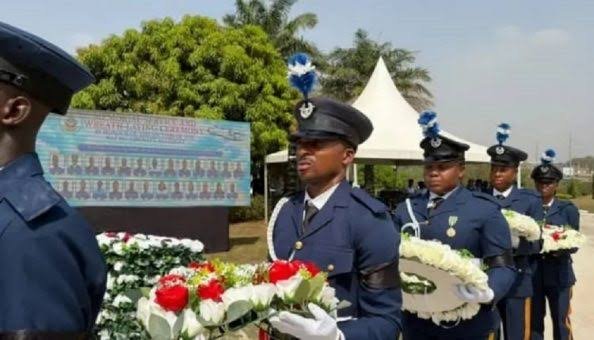
President Bola Tinubu has approved three-bedroom flats in Abuja and N100m compensation for the bereaved families of Nigerian Air Force personnel who died in the October 5 aircraft crash in Igbokoda, Ondo State.
The President announced the package on Thursday at a memorial service and wreath-laying ceremony held at the Military Cemetery in Abuja in honour of the 25 victims of the tragedy.
The houses, located in the Federal Government’s Renewed Hope Housing Project in Abuja, will be allocated to the immediate families of the deceased military personnel and civilians who were aboard the ill-fated aircraft.
Tinubu described the intervention as a demonstration of the nation’s gratitude to those who lost their lives in service to the country, assuring their families that the government would not abandon them.
“As a tangible expression of the nation’s gratitude, I approve the allocation of three-bedroom flats in the Renewed Hope Housing Project in Abuja to the family of each of the military personnel who lost their lives in this accident.
“No home can ever replace the one you have lost, but they gave their lives for Nigeria, and Nigeria will give their family a home,” he said.
In addition to the housing allocation, the President announced an approval of N100m for each of the 19 deceased military personnel’s families.
He, however, extended the housing gesture to the immediate families of the civilians who also died in the crash.
Tinubu said the government’s responsibility to the bereaved families would go beyond the memorial ceremony, stressing that sustained support would be necessary to honour the sacrifices of the deceased.
“Long after the wreaths have faded, our commitment to these families must remain evergreen,” he said.
The President also promised a thorough investigation into the October 5 crash, assuring Nigerians that the findings would guide measures to strengthen aviation safety and prevent a recurrence.
“I assure the grieving nation that this accident will be thoroughly investigated. We will seek answers. We will learn the lessons. We will strengthen our military and civilian aviation safety standards.
“Our operational procedures and our institutional accountability will be strengthened. We owe them the truth, and we will honour that debt,” he stated.
The Nigerian Air Force aircraft, marked NAF ATR 42, crashed in a marshy area of Igbokoda, Ondo State, on October 5, 2026, killing 25 people, comprising military personnel and civilians.
Tinubu also reaffirmed his administration’s commitment to improving the welfare, safety and operational capacity of the Armed Forces through modernisation, improved training and the provision of better equipment.
“A nation that asks its sons and daughters to fly into danger must give them the best wings it can build,” he added.
He urged the bereaved families to take solace in the contributions of their loved ones to national service, assuring them that the country would continue to remember their sacrifices.
News
Senate Meeting Turns Bloody As Rivers Senator’s Aide Allegedly Beaten, Struck With Gun Butt
Senate Meeting Turns Bloody As Rivers Senator’s Aide Allegedly Beaten, Struck With Gun Butt
A meeting of the Senate Committee on Appropriations at the National Assembly complex in Abuja descended into violence on Wednesday after security operatives allegedly assaulted two aides to Senator Allwell Onyesoh, representing Rivers East Senatorial District, leaving one of them with serious head injuries.
The injured aide, identified as Barrister Kingsley Wali, was reportedly pushed down a staircase and repeatedly struck on the head with the butt of a gun during the confrontation with security personnel stationed at the entrance of the committee room.
Wali was subsequently rushed to the National Assembly Clinic for medical attention after he was found bleeding and lying in a pool of blood.
The incident occurred during a closed-door meeting of the Senate Committee on Appropriations, chaired by Senator Olamilekan Adeola, popularly known as Yayi, who represents Ogun West Senatorial District.
According to accounts provided by Wali, he and another aide, identified as Dr Kingsley, had accompanied Senator Onyesoh to the committee meeting.
He alleged that after their principal entered the committee room, he attempted to follow but was prevented from doing so by security operatives who were trying to shut the entrance.
Wali reportedly explained that the senator had already gained access to the meeting and that he was not attempting to force his way into the room.
However, he alleged that the situation escalated when the security personnel grabbed his colleague by the neck and began assaulting him.
Wali said he intervened and pleaded with the operatives to stop beating his colleague, explaining that the individual was the senator’s personal assistant.
He further alleged that the security personnel subsequently turned on him because of his intervention.
According to his account, one of the operatives grabbed him and pushed him down a staircase. He claimed that after falling, three security personnel cornered him and repeatedly hit his head with the butt of a gun until he slumped.
Wali said the operatives left him after he collapsed.
His colleague reportedly took photographs of his condition and forwarded them to Senator Onyesoh through WhatsApp while the lawmaker was still attending the committee meeting.
On receiving the photographs, Onyesoh reportedly stepped out and discovered his aide lying in a pool of blood.
The senator subsequently took Wali into the committee room, where other lawmakers reportedly expressed shock at the extent of his injuries and directed that he receive immediate medical attention.
He was later taken to the National Assembly Clinic, where he received treatment and was discharged.
However, the chairman’s media adviser, Chief Kayode Odunaro, presented a different account of how the confrontation started.
In a statement, Odunaro described the incident as a misunderstanding between legislative aides attempting to gain access to a closed-door committee meeting and security personnel stationed at the entrance.
He maintained that the confrontation occurred without the knowledge of Senator Adeola, who was already presiding over the meeting when the incident happened.
According to him, the committee chairman only became aware of the development after Senator Onyesoh briefly stepped out and discovered that his aide had sustained injuries.
Odunaro also confirmed that the injured aide was taken to the National Assembly Clinic, where he received treatment before being discharged.
He disclosed that the management of the National Assembly had commenced an investigation to establish the circumstances surrounding the incident and determine what led to the confrontation.
The development has raised concerns about the conduct of security personnel within the National Assembly, particularly regarding the treatment of legislative aides and other officials accompanying elected representatives.
It also raises questions about the security arrangements governing access to committee meetings and the appropriate handling of disagreements involving lawmakers’ aides and security operatives.
As of the time of filing this report, the National Assembly management had yet to release the findings of its investigation, while the allegations made by the injured aide had not been independently established.
The outcome of the investigation is expected to clarify the circumstances that led to the violence and establish whether the security personnel involved acted within the limits of their responsibilities.
Senate Meeting Turns Bloody As Rivers Senator’s Aide Allegedly Beaten, Struck With Gun Butt
-
 metro2 days ago
Oyoland Grand Chief Imam Moves to End Feud, Seeks Reconciliation Among Markaziyya, Adabiyyah, Mahdul ‘Arabi
-
 metro1 day ago
Phone-Tapping Claim: I Lied to Unsettle Tinubu Government – El-Rufai
-

 metro1 day ago
Nigerian Health Worker, 26, Found Dead in Canada After Returning From Work
-

 News3 days ago
Omokri Arrives in Mexico to Assume Duty as Nigerian Ambassador, Thanks Govt for Ministerial Reception
-

 metro1 day ago
‘I Came to Nigeria for Love, Now I’m Stranded, Begging for Rent’ — American Woman Married to Enugu Man Cries Out
-
 Politics24 hours ago
BREAKING: Makinde Reportedly Agrees to Back Atiku’s Presidential Bid
-

 Politics1 day ago
2027 Presidency: ‘Atiku Should Forget His Ambition, Wait Until 2031’ – Bode George
-

 International2 days ago
Iran Flogs Singer, Four Others 74 Times Over Hijab-Free Performance