

News
Buhari warned ex-Power Minister Mamman of imminent sack

The recently sacked Minister of Power, Engineer Sale Mamman, was aware of the fate awaiting him 24 hours before he was fired, The Nation gathered on Friday.
President Muhammadu Buhari was said to have personally informed Mamman of his imminent sack on Tuesday after inviting him to the Presidential Villa.
Buhari, according to Mamman’s Special Adviser on Media, Mr. Aaron Artimas, even gave the ex-minister the option attending the Federal Executive Council (FEC) meeting on Wednesday where news of the sack was broken.
Mamman, however, chose to stay away from the meeting.
Artimas said there was a mutual relationship between the President and the ex-minister which made Buhari personally pick him without lobbying from anyone and which also led to the President telling him why he had to be dropped.
Artimas was said to have been dropped to pave the way for the strengthening of the cabinet and alleged tension in the ministry.
Asked to confirm whether the ex-minister collapsed as reported in some newspapers (not The Nation), Artimas dismissed the reports as fake.
He noted that his principal had over stressed himself on his return from Chad and did not sleep for up to eight hours.
Mamman’s blood pressure, according to his aide, rose and he became a bit ill but never collapsed.
His words: “It is the wicked fake news as usual because Nigerians are becoming vindictive and making conditions extreme for people we don’t like having issues with.
“The true story is that on Tuesday evening, the President himself called the minister to the Villa and informed him personally of his intention to make changes and that he (Mamman) would be affected by the changes for the reasons they discussed between them.
“And the minister accepted in good faith and thanked the President for giving him the opportunity.
“And the President told him that he was doing it because he wanted to strengthen the government and reduce some tension within the ministry.
“The President had singlehandedly appointed him because nobody lobbied for Sale to become minister.
“So, he felt that as his own son, if there is anything, he can have a mutual discussion.
“When he got home, he was tensed because when he went to Chad and he came back, he had been ailing a little bit, he had not rested.
“So, he took drugs and went to bed.
“When he woke up, his body was ailing. His sugar level had gone up. Maybe it had been long he had eight hours sleep.
“And the doctor yesterday had to bring down the sugar level.
“So, if you go to his house now in Maitama, you will see him there.
“Yesterday, I insisted he should grant interview, he granted Hausa service interview.
“So there was nothing like collapse. He heard about his removal before everyone else. At least, the President honoured him with that prior information.
“The President even gave him the option whether he would attend the Federal Executive Council meeting that day or not so that he would make the announcement after the meeting. He said he would not attend. These are the facts.”

News
Nigerian Pastor, 68, Dies Mid-Air While Returning From US Vacation

Nigerian Pastor, 68, Dies Mid-Air While Returning From US Vacation
A Nigerian pastor, Dr Mrs Asabe Toye, has reportedly died aboard an aircraft while returning to Nigeria from a vacation in the United States.
The 68-year-old cleric reportedly suffered a medical emergency on October 16, 2026, while travelling with her husband on a flight from the United States to Frankfurt, Germany.
According to reports, the incident occurred during the journey when she suddenly developed a medical complication, prompting efforts by fellow passengers and other occupants of the aircraft to save her life.
Despite attempts to provide medical assistance and prayers offered on board, the pastor reportedly could not survive the emergency.
READ ALSO:
- Osun Lawmaker Drags Fadahunsi to Court, Seeks Ban From 2027 Election Over Alleged Incitement
- Iran Accuses US of Threatening Nuclear Scientists With $20m Reward
- Troops Arrest Father, Son Over Terrorism Suspicions, Recover AK-47 in Sokoto
Her death has reportedly thrown her family, loved ones and members of her religious community into mourning.
Family appreciates Nigerian Embassy, Customs Service
Following her death, the family expressed appreciation to the Nigerian Embassy in Germany and the Nigeria Customs Service for their assistance in facilitating the necessary clearances and arrangements for the return of her remains to Nigeria.
The family reportedly acknowledged the support of both institutions during the difficult process.
Dr Mrs Asabe Toye has since been laid to rest, according to reports published on Wednesday, November 11.
Her death has also triggered emotional reactions on social media, with Nigerians expressing sympathy and offering prayers for her husband, children and other family members.
Nigerian Pastor, 68, Dies Mid-Air While Returning From US Vacation
News
Tinubu’s Chicago Varsity Certificate Row: Omokri Challenges Journalists to Verify Fresh Allegations
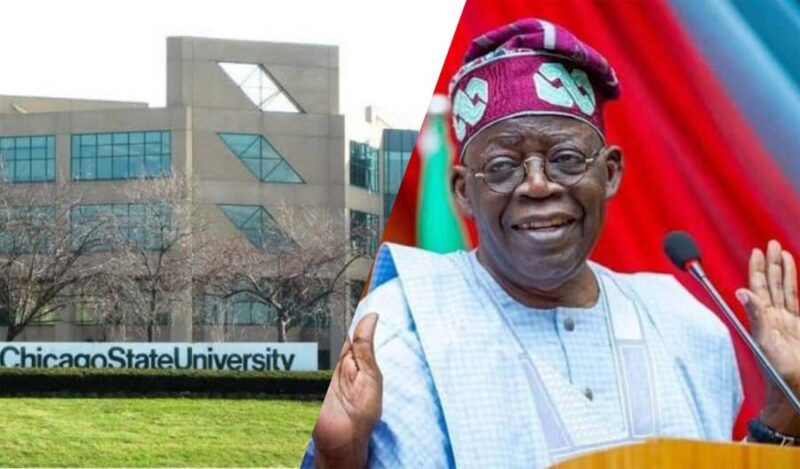
Tinubu’s Chicago Varsity Certificate Row: Omokri Challenges Journalists to Verify Fresh Allegations
Nigeria’s Ambassador to Mexico, Reno Omokri, has challenged Nigerian journalists to independently investigate fresh allegations surrounding President Bola Ahmed Tinubu’s academic records at Chicago State University (CSU), insisting that the American institution confirmed the President’s admission, attendance and graduation.
Omokri’s challenge comes amid renewed controversy over Tinubu’s educational background following claims by Dr Pearse Adetokunbo, a former lecturer at Chicago State University, who reportedly questioned whether the Nigerian leader attended or graduated from the institution.
Adetokunbo, who said he worked at the university between 1985 and 1990, reportedly claimed during an interview on News Central Television that he found no evidence of Tinubu’s attendance or graduation. He also raised questions about the identity associated with the President’s academic records and the authenticity of documents attributed to the university.
However, Omokri rejected the allegations, saying he had personally visited Chicago State University and established that Tinubu was admitted, attended classes and graduated.
In a post on his official X account on Monday, November 9, Omokri urged journalists not to rely solely on claims made during television interviews but to travel to the United States and examine the university’s records independently.
READ ALSO:
- Agunbiade Celebrates Oyo Grand Chief Imam Akeugberu at One, Says His Impact Equals a Decade
- Fuel Prices: FCCPC Warns Marketers Against Denying Nigerians Relief
- US Lawmakers to Hold Fresh Hearing on Nigeria’s Insecurity, Christian Killings
He wrote: “I went to @ChicagoState University and proved that President Tinubu was admitted, attended, and graduated from there.
“I urge Nigerian journalists not to sit in studios peddling gossip, but to also go to Chicago, as I did, and verify.”
Omokri’s response has brought renewed attention to a controversy that has featured prominently in Nigerian political and legal debates, particularly since the 2023 presidential election.
In September 2023, Chicago State University confirmed that Tinubu attended the institution and graduated in 1979 with a Bachelor of Science degree in Business Administration, with a concentration in Accounting.
Documents released during the legal proceedings in the United States showed that the university’s records placed Tinubu’s attendance between August 1977 and June 1979.
The university’s confirmation of his graduation, however, became a subject of further scrutiny during proceedings connected to a case brought by former presidential candidate Atiku Abubakar, who sought access to Tinubu’s academic records.
During a deposition, CSU Registrar Caleb Westberg confirmed that Tinubu graduated from the institution but said he could not authenticate the particular diploma submitted by the President to the Independent National Electoral Commission (INEC), as the university did not have that document in its possession.
The distinction between confirmation of Tinubu’s graduation and authentication of the specific certificate submitted to INEC became a central issue in the legal dispute.
The latest claims by Adetokunbo have therefore reopened public debate over the President’s academic history, while Omokri has maintained that the allegations should be tested against the university’s records rather than accepted without independent verification.
The renewed debate is unfolding against the background of growing political activity ahead of the 2027 general elections, with Tinubu’s opponents and supporters continuing to scrutinise issues relating to his eligibility, background and record in office.
Tinubu’s Chicago Varsity Certificate Row: Omokri Challenges Journalists to Verify Fresh Allegations
News
Fuel Prices: FCCPC Warns Marketers Against Denying Nigerians Relief

Fuel Prices: FCCPC Warns Marketers Against Denying Nigerians Relief
The Federal Competition and Consumer Protection Commission (FCCPC) has warned petroleum refiners and marketers against maintaining high petrol and diesel prices despite the recent decline in international crude oil prices.
The Commission said Nigerians should begin to benefit from the reduction in global oil prices, insisting that refiners and marketers have no justification for keeping petroleum product prices elevated if their operating costs have declined.
The Executive Vice Chairman and Chief Executive Officer of the FCCPC, Tunji Bello, gave the warning in a statement issued on Tuesday, November 10, 2026, by the Commission’s Director of Corporate Affairs, Ondaje Ijagwu.
Bello said the Commission was closely monitoring developments in the international oil market to ensure that reductions in crude oil prices translate into lower wholesale and retail prices of petroleum products in Nigeria.
According to the FCCPC, Brent crude, the international oil benchmark, which rose to about $115 per barrel in September, has fallen below $90 per barrel this week.
Despite the decline, petrol prices remain high across major Nigerian cities.
The Commission disclosed that petrol currently sells for between N1,405 and N1,420 per litre in Abuja, while consumers in Lagos pay between N1,325 and N1,370 per litre.
It compared the current prices with those recorded on February 27, before the outbreak of the conflict involving the United States, Israel and Iran, when Brent crude futures closed at $72.48 per barrel.
At the time, petrol sold for between N839 and N925 per litre in Lagos and Abuja.
READ ALSO:
- US Lawmakers to Hold Fresh Hearing on Nigeria’s Insecurity, Christian Killings
- ‘Her Death Must Not Be in Vain’: Lagos Mother Demands Justice for Toddler Killed by Police Bullet
- DR Congo Sentences 66 Soldiers to Death for Cowardice, Mutiny
Petroleum marketers have attributed the sharp increase in fuel prices over the past eight months to fluctuations in international crude oil prices following the conflict in the Middle East and disruptions to shipments through the Strait of Hormuz, a major global oil transportation route.
However, Bello insisted that sustained reductions in crude oil prices should lead to corresponding decreases in the cost of refined petroleum products.
“If the decline in crude prices is sustained, there is no justification for refiners and marketers to continue to keep petrol and diesel prices relatively high. We expect easing in wholesale petrol costs and for the resulting savings to reach consumers at the pump without undue delay,” he said.
The FCCPC chief acknowledged the financial difficulties Nigerians had experienced because of elevated fuel prices, noting that the Commission was determined to ensure that consumers were not denied the benefits of favourable movements in the international oil market.
He said the Commission would continue working with the Nigerian Midstream and Downstream Petroleum Regulatory Authority (NMDPRA) and other relevant government agencies to monitor wholesale and retail prices across the petroleum supply chain.
Bello also warned that the FCCPC would take appropriate action against operators found engaging in anti-competitive practices or unfair market behaviour that prevented consumers from benefiting from lower production and supply costs.
“Where there is evidence of anti-competitive conduct or unfair practices that prevent consumers from benefiting from lower costs, we will take appropriate action within our mandate,” he added.
The Commission’s intervention comes amid growing concerns over the impact of high petrol prices on transportation, food prices, manufacturing, household spending and the operating costs of businesses.
Although crude oil prices influence the cost of petroleum products, other factors, including refining expenses, foreign exchange rates, transportation, distribution, financing and inventory costs, also affect domestic pump prices.
The FCCPC’s position is that any sustained reduction in costs should be reflected in the market and that consumers should not be subjected to unfair pricing practices.
For millions of Nigerians struggling with high living costs, the major expectation is whether the latest decline in international crude oil prices will translate into meaningful reductions at filling stations.
Fuel Prices: FCCPC Warns Marketers Against Denying Nigerians Relief
-

 metro1 day ago
Fayose Petitions IGP, Threatens Lawsuit Over Rape, Torture Allegations
-

 metro2 days ago
‘Miracle’ Turns Sour as Visiting Pastor Vanishes with Congregants’ Phones During Crusade in Edo
-
 News1 day ago
Despite Tegbe’s 72-Hour Promise, Nigerians Still Battle Power Outages
-

 Auto2 days ago
Four-day Abuja International Motor Fair begins tomorrow Nov 10
-
 Politics2 days ago
ADC Raises Alarm as Court Delays Release of Lifu’s Judgment Despite Payment
-

 Politics3 days ago
ADC Crisis: Aregbesola Heads to Appeal Court, Challenges Judgment Nullifying Mark-Led Leadership
-

 Railway2 days ago
Tinubu Targets December 3 Inauguration for Kaduna-Kano Rail Project as Construction Hits 90%
-

 Auto2 days ago
Seven Drivers Emerge for Todays Naija Driver Challenge Grand Finale in Lagos