

metro
Abba Kyari: PSC gives IGP new orders, sets deadline for fresh report

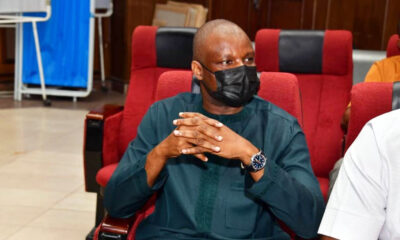
The Police Service Commission has deferred decision on the case involving the suspended Head of the Inspector General of Police Intelligence Response Team, Deputy Commissioner of Police Abba A. Kyari.
The position of the Commission was contained in a statement by its Head of Press and Public Relations, Ikechukwu Ani, on Friday.
Kyari had earlier been indicted by a report of the Federal Bureau of Investigation of the United States of America and was also investigated by a Special Panel set up by the Inspector General of Police, Usman Baba.
The report had earlier been forwarded to the Attorney General of the Federation and Minister of Justice, Abubakar Malami, for legal advice by the Inspector General of Police.
The Commission in the statement on Friday directed that further necessary investigation should take half the time it took the Police to conduct the original investigation and that it should be carried out by a different panel.
The Commission took the decision at the continuation of its14th Plenary Meeting, which ended in Abuja on February 11, 2022, chaired by Alhaji Musiliu Smith, a retired Inspector General of Police and its Chairman.
The Commission at the Plenary Meeting also considered 20 Pending Disciplinary Matters and five appeals and petitions from the Inspector General of Police and aggrieved serving and ex-Police Officers.
READ ALSO:
- North Can’t Afford To Let Tinubu Down – Sen Shettima
- One killed as thugs attack Igboho’s house, supporters in Ibadan
- Emir of Kano, others urge BUK alumni to assist in alma mater development
It also considered five promotion appeals.
The Commission reaffirmed its earlier decision to exonerate SP Shaaba Adamu Gboyako, a former Chief Security Officer to former Inspector General of Police, taken at its I9th Plenary Meeting of September 28 and 29, 2020.
Ani said in the statement: “The Commission was mindful of the need to safeguard its corporate image and defend its institutional integrity.
“It directed the Inspector General of Police to implement its decision as its affects the Officer without delay.”
The Commission also directed that the judgment of a Kano State High Court in an application for enforcement of the fundamental right to life brought by the father of one Abdulkadir Nasiru, now deceased, be forwarded to the Inspector General of Police for implementation of the orders of the court.
The appellant was seeking justice for the alleged torture of his son to death by the Police.
The appeal for accelerated/notional promotion based on merit from CSP Ita Lazarus Udom was also considered and approved by the Plenary.
The Commission approved the adjustments of promotion dates of the Officer from the rank of Superintendent of Police to a Deputy Commissioner of Police in line with his course mates.
The Commission also considered and promoted 89 staff of the Commission with a promise to ensure that staff promotion will continue to receive priority attention, while they should ensure they, at all times, put in their best.
The Eagle











metro
₦50,000 Relief Fund: FG Reveals Criteria for Selecting Beneficiaries

₦50,000 Relief Fund: FG Reveals Criteria for Selecting Beneficiaries
The Federal Government has explained how beneficiaries will be selected for its ₦50,000 cash relief programme, clarifying that the intervention is targeted at poor and vulnerable households identified through verified national identity records and the National Social Register (NSR).
The programme, known as the National Emergency Relief and Stabilisation Intervention (NERSI), is being implemented by the Federal Ministry of Humanitarian Affairs and Poverty Reduction to provide financial support to households struggling with rising living costs.
Under the initiative, selected beneficiaries will receive a one-off grant of ₦50,000 directly into mobile wallets operated by approved payment providers.
According to the government, the selection process involves screening information from verified national identity records and the National Social Register to identify households that meet the programme’s vulnerability requirements.
The National Social Register is a database of poor and vulnerable households across the country, while national identity records are used to verify the identities of prospective beneficiaries.
The government said the exercise is based on need and is designed to cover Nigerians across the six geopolitical zones, irrespective of their religion, ethnicity or political affiliation.
READ ALSO:
- Iran Unveils ‘We Will Kill Trump’ Billboard in Tehran Amid Rising Tensions With US
- Tinubu’s Re-election: Osun APC Leaders Reject Oyebamiji-Led Campaign Council
- Tragedy: Spanish Footballer Jesús de Miguel Dies at 30 After On-Field Collision
However, it stressed that inclusion in the relevant databases does not automatically mean that everyone will receive the payment in the first phase, as disbursement will be carried out in batches.
The government also clarified that there is no public application process for the ₦50,000 grant. Individuals cannot independently register or pay to be included in the beneficiary list, and no official or intermediary is authorised to sell access to the programme.
How selected beneficiaries will receive the ₦50,000
The Federal Government outlined a four-step process through which selected Nigerians will access the financial support.
First, beneficiaries will receive an SMS notification from one of the five approved payment providers: ALAT by Wema Bank, MoMo PSB, NairaGram, OPay or Moniepoint.
Recipients will then be required to confirm their willingness to participate by following the instructions in the message. The government said payment will not be made without the beneficiary’s consent.
After confirmation, a mobile wallet will be opened and linked to the beneficiary’s phone number and National Identification Number (NIN).
The sum of ₦50,000 will subsequently be credited to the wallet, after which the recipient can withdraw the money through a Point of Sale (POS) agent, access it at a bank where applicable, or spend it directly from the wallet.
The government said beneficiaries do not need a smartphone or internet connection to access the funds, as the approved providers have USSD options that work on basic mobile phones.
The designated codes include 94523# for ALAT, 6710# for MoMo PSB, 72600# for NairaGram, 95520# for OPay and 557327# for Moniepoint.
Beneficiaries are expected to follow the instructions sent by their respective providers.
FG warns Nigerians against fraud
The government has warned Nigerians to be wary of fraudsters seeking to exploit the relief programme by demanding money or sensitive personal information.
It emphasised that participation in the programme, acceptance of the grant and receipt of the ₦50,000 payment are free.
According to the official guidelines, genuine notifications will come from the approved payment providers and will not ask recipients to pay a fee, disclose their Personal Identification Number (PIN), share a One-Time Password (OTP), or click suspicious links.
The government urged Nigerians never to disclose their PINs, OTPs or passwords to anyone, including payment agents or individuals claiming to be programme officials.
It also warned that anyone offering to add a person to the beneficiary list, speed up payment or release the grant in exchange for money is attempting to defraud them.
Beneficiaries who are unsure about the authenticity of a message have been advised to contact the programme’s official helpline on 0700-022-2222.
Why some Nigerians may not have received the money
The government explained that the payments are being made in phases, meaning selected beneficiaries will not necessarily receive their notifications at the same time.
It also clarified that the programme is supporting a limited number of households in each phase, so not everyone will be selected immediately.
Those who have not received an SMS should therefore not automatically conclude that they have been excluded from every future phase.
The Federal Government said the full ₦50,000 grant would be credited to selected beneficiaries without deductions. The money is a grant, not a loan, and recipients are not required to repay it.
The intervention is part of the government’s efforts to provide direct financial assistance to vulnerable households amid continuing economic pressures.
₦50,000 Relief Fund: FG Reveals Criteria for Selecting Beneficiaries
metro
Bandits Demand Over ₦100m Ransom for 15 Abducted Islamiya Students in Niger

Bandits Demand Over ₦100m Ransom for 15 Abducted Islamiya Students in Niger
Suspected bandits who abducted 15 students of an Islamiya school in Niger State have reportedly demanded more than ₦100 million for their release, heightening fears over the safety of the children and prompting fresh calls for urgent government intervention.
The victims were reportedly kidnapped while assisting their teacher, Malam Aminu Bako, in harvesting maize on his farm in Tungan-Bako village, Rafi Local Government Area of Niger State, during the weekend.
The teacher disclosed that the armed men had contacted community leaders to communicate their ransom demand, leaving parents and residents increasingly worried about the fate of the abducted children.
According to reports, the kidnappers initially believed the victims were students of government-owned schools. However, a parent, identified as Malam Adamu, said community representatives informed the abductors that the children attended an Islamiya school.
Adamu explained that the bandits had demanded more than ₦100 million before being informed about the actual identity of the school.
The teacher, who confirmed the ransom demand, also appealed to the Federal Government and Niger State Government to urgently intervene and ensure the safe return of the students.
Bako expressed concern that the children might be facing harsh conditions in captivity, revealing that information gathered through local vigilantes suggested they were still being held somewhere within Niger State.
According to him, the students were reportedly locked inside an isolated building guarded by heavily armed men.
“We heard that they were still within Niger State, locked in a building, probably without food. We are worried; we want the authorities to come to our aid to rescue them,” he said.
The teacher maintained that the situation required urgent intervention by the military and other security agencies, warning that community vigilantes might not have the capacity to confront the heavily armed kidnappers.
He also expressed dissatisfaction with what he described as the limited government presence since the incident, saying the affected families and school management had largely been left to depend on local vigilantes for information and assistance.
Bako disclosed that the acting chairman of Rafi Local Government Area and the Divisional Police Officer were the only government officials who had visited the community following the abduction.
He said the absence of further engagement from the state government had increased anxiety among parents, who had continued to approach him for updates on their children’s whereabouts and safety.
“We are also worried that nobody has visited us from the state government, at least to give us hope that something is being done to ensure their release,” he added.
The teacher consequently appealed to the authorities to demonstrate greater commitment towards securing the students’ freedom, stressing that the community needed more than assurances.
Meanwhile, the Niger State Police Command has confirmed the abduction, although its preliminary account differed slightly from the number of victims identified by the teacher.
The Police Public Relations Officer, SP Wasiu Abiodun, said suspected bandits invaded Tungan-Bako village and abducted some people working on a farm.
According to him, preliminary police information indicated that about 14 of the victims were Islamiya school students who had accompanied their instructor to harvest maize.
Abiodun, however, assured that joint security operations were ongoing to rescue the abducted persons.
The police assurance came amid concerns from residents, who maintained that local vigilantes were the only security personnel visibly involved in efforts to trace the abductors.
The Commissioner for Homeland Security in Niger State, Justin Maurice Magaji, was reportedly unavailable for comments when contacted, as he was attending a State Executive Council meeting.
The teacher subsequently released the names of the 15 students reportedly taken away by the bandits.
They are Hassana Isah, Aliya Ahmad, Hajara Musa, Hauwa’u Abubakar, Halima Yahaya, Asma’u Jamilu, Radiya Salisu, Aminatu Salisu, Aisha Bello, Rahinatu Sani, Aminatu Alhassan, Nafisa Ayuba, Bilkisu Adamu, Salaha Abdullahi and Hajara Salisu.
The reported discrepancy between the 15 names released by the teacher and the 14 Islamiya students mentioned in the police account has also raised questions about the exact number of victims.
The latest development has renewed concerns over the persistent activities of armed bandits in parts of Niger State, particularly attacks targeting rural communities and vulnerable residents.
For the families of the abducted students, however, the immediate priority remains the safe return of their children.
They are calling on the Federal Government, Niger State Government and security agencies to intensify rescue operations and ensure that the children are reunited with their families without further delay.
Bandits Demand Over ₦100m Ransom for 15 Abducted Islamiya Students in Niger
metro
FG’s N50,000 Relief: OPay Details Eligibility Check Process, Issues Strong Warning Against Scams
FG’s N50,000 Relief: OPay Details Eligibility Check Process, Issues Strong Warning Against Scams
Lagos, Nigeria — Following the Federal Government’s introduction of the N50,000 relief package, leading financial technology platform, OPay, has released comprehensive guidelines on how customers can verify their eligibility for the funds. The company has simultaneously issued a stern warning to users regarding the rise of fraudulent schemes targeting beneficiaries.
In a statement released on Tuesday, November 3, 2026, and reported by Punch, OPay clarified the procedural steps for Nigerians to determine if they qualify for the government’s financial intervention. The move comes as millions of citizens seek clarity on accessing the relief aimed at cushioning economic hardship.
How to Check Eligibility
According to OPay, the verification process is designed to be seamless and accessible directly through the OPay mobile application. Customers are advised to log into their updated OPay app to access the dedicated section for the Federal Government’s relief program.
The fintech giant explained that users will be required to provide specific details to verify their status. Once logged in, customers can navigate to the designated “Government Relief” or notification tab where the eligibility checker is situated. The system cross-references the user’s verified identity (such as their Bank Verification Number, BVN, and National Identification Number, NIN) with government databases to confirm qualification.
Strict Warning Against Fraudsters
In a critical advisory, OPay warned customers to remain vigilant against scammers who are leveraging the news of the N50,000 relief to defraud unsuspecting citizens. The company emphasized that it will never ask customers to pay a fee or provide sensitive information over the phone to claim the relief.
“OPay urges all Nigerians to be cautious. The N50,000 relief is a government initiative, and no fee is required to check eligibility or receive funds,” a representative stated. “We will never ask for your OPay PIN, passwords, or OTPs via phone calls, text messages, or social media. Beware of fake links claiming to be from OPay or the government.”
Security Tips for Users
To ensure safety, OPay advised users to follow these guidelines:
· Use Only the App: Only check your eligibility through the official OPay mobile application.
· Protect Your Data: Never share your ATM card details, OPay PIN, or One-Time Passwords (OTPs) with anyone.
· Ignore Suspicious Links: Do not click on links received via SMS or WhatsApp claiming to offer the N50,000 relief.
· Verify Information: Always confirm information through OPay’s official customer service channels or verified social media pages.
The company reaffirmed its commitment to the financial security of its customers and stated that it is working closely with relevant government agencies to ensure a smooth and transparent disbursement process for eligible beneficiaries.
For those who may face difficulties checking their eligibility, OPay has encouraged customers to contact their customer care team through the in-app support feature.
FG’s N50,000 Relief: OPay Details Eligibility Check Process, Issues Strong Warning Against Scams
About Newstrends.ng:
Newstrends.ng is your premier source for breaking news, business, and technology updates in Nigeria and across the globe.
-

 Sports2 days ago
Super Falcons Receive $100,000 Each as Tinubu Finally Fulfils WAFCON Pledge
-
 Politics2 days ago
APC Dumps Adeleke’s Campaign Structure, Unveils Separate 168-Member Council in Osun
-

 metro2 days ago
Three Homeless Men Shot Dead in Midnight Attack at Lagos Bus Stop
-

 metro3 days ago
Court Orders 18-Year-Old Fraudster To Pay ₦1.2m Over $800 Lottery Scam
-

 metro3 days ago
Contempt: Court Orders Arrest, Remands Lagos NURTW Chairman Sego, Secretary in Kirikiri
-

 metro3 days ago
Gunmen Intercept Family Car, Abduct Woman, Two Children, Release Husband in Abuja
-

 News3 days ago
I Believe God Has Answered My Prayer, Says Tinubu After Entering Holy Ka’abah
-

 metro3 days ago
Dino Melaye Challenges Tinubu to Quranic Recitation Contest After Umrah Trip