

metro
2022 Budget: Research Institute’s Bid To Execute N80bn Constituency Projects Raises Eyebrows

An advertisement placed by the Nigerian Building and Road Research Institute (NBRRI) in some Nigerian newspapers on Monday April 18, 2022, calling for bids for ‘2020 direct line capital and zonal intervention projects worth about N80 billion has raised eyebrows, Daily Trust on Sunday can report.
While observers have said it was an aberration for NBRRI to delve into capital projects which are outside their core mandate, the agency said they cannot reject constituency projects brought to them for execution by federal lawmakers.
Daily Trust on Sunday reports that apart from NBRRI, many government MDAs have been running newspaper adverts calling for bids to execute contracts considered to be outside their core mandates.
In the advertisement under reference, the research institute (NBRRI) expressed its desire to execute some capital projects under the 2022 Budget Appropriation.
The scope of work, as contained in the advert, involves the construction of classroom blocks, skills centres/town halls, construction of earth roads, with hydraulic structures, asphalt overlay, solar street lights, motorized boreholes, and supply of goods, among other projects.
This has, however, raised questions as to why an agency of government with the core mandate of conducting research would be involved in executing capital projects.
NBRRI’s mandate
NBRRI is a parastatal under the Federal Ministry of Science and Technology.
Established in 1978 to carry out research and development activities into the many aspects of the industries in charge of building and construction of roads, its statutory function, according to our findings, is to conduct coordinated applied research and development into the many sections of the building and construction sectors of the economy.
READ ALSO:
- PENCOM alleges blackmail over N3m monthly salary claim
- NAF Bombs Bandits Attending Naming Ceremony At Turji’s Home
- We don’t kill known enemies let alone an Igbo man, IPOB replies FG
Some of the areas in which NBRRI is mandated to conduct research, according to our findings, are the following: Local building and construction materials to determine the most effective and economic methods of their utilization; architectural design of buildings to suit Nigerian climatic conditions with respect to lighting, ventilation, thermal comfort, and humidity; the design and performance of functional units in buildings including electrical installations, plumbing, painting, drainage, ventilation, and air-conditioning system; local construction, foundation and earth-works for buildings and bridges, especially on problem soils.
In 1993, the mandate of the institute was said to have been further expanded to include Research and Development (R&D) into all possible aspects of materials of engineering which are used in relation to the construction industry, our findings reveal.
Questions trail bid for over 500 constituency projects
However, a scrutiny of the advertisement indicates that NBRRI invited bidding for over 500 projects in different parts of the country which were categorized into A, B, C, D and E.
While category ‘A’ sought pre-qualification for 48 projects, including works, goods, and services, category ‘B’ invited bids for 263 projects.
In the same vein, category C invited tenders for 12 projects while categories D and E sought to bid for 6 and 30 projects respectively.
Questions are being raised over the inclusion of 80 per cent of the projects which are constituency related and considered to be outside the mandate of the organization.
For instance, under category A, the research institute plans to execute projects believed to be outside its jurisdiction, among which is the erection of high-intensity solar street lights for surveillance in selected areas of Surulere, Lagos.
Besides calling for bidding to undertake a project for the development of a 150kw solar mini-grid for the off-national grid at Kwalita village, Dobi, Gwagwalada in the FCT, it also sought to undertake the provision of high-efficiency solar street lights within and around some schools and rural communities in North-Central, North-West, and South-West for security surveillance.
Other ‘strange’ projects NBRRI has called for bid to undertake include the procurement of freezers, fridges, generators, grinding machines, vulcanizing machines for youth empowerment in Anambra State, the provision of educational materials in Gindiri, Plateau State, as well as the supply of classroom furniture at Ojokoro, Ashafa, Irepodun communities.
Also, the agency plans to undertake projects for the supply of classroom furniture in the Aiyetoro-Ajeromi and Badagry communities, equipping of the Central Auditorium and Multi-Purpose Hall in Naki Gori and Yola Wakat in the North-Central zone, and the supply of empowerment as well as provision of empowerment items to women at Danmaje and other LGAs.
Similarly, NBRRI is being questioned over its bid to undertake a project for capacity building and empowerment of indigents on cassava value-chain by-products in Anambra North.
READ ALSO:
- I’m out to win 2023 election, Kola Abiola declares
- Four-storey building collapses in Uyo, many trapped, four rescued
- Osinbajo away to London for Queen Elizabeth’s funeral on Monday
Under category ‘B’ as contained in the advert, which is tagged ‘technical and financial bid’, NBRRI invited bid to undertake a project for the installation of its (NBRRI) fabricated solar streetlight in Gombe Sought LGA, provision and installation of NBRRI fabricated integrated solar streetlights to communities in Awe, Doma, Keana Federal Constituency of Nasarawa State, as well as a contract for what it tagged ‘using NBRRI finished products on rural road construction technology in Ikenne LGA of Ogun State.’
While calling for a bid to undertake a project for the provision of health treatment, supply of drugs, and health insurance for the people of Ibadan, the NBRRI advert also sought to supply and install all-in-one solar street lights in all the six geopolitical zones, according to the tender.
This is in addition to seeking bids for the provision of health treatment, supply of drugs, and health insurance for the people of Ibadan, Oyo State, as well as the construction of solar-powered boreholes and solar-powered streetlights in Idemili North and South Federal Constituency of Anambra State.
Also advertised for bidding by NBRRI is a contract for the provision and installation of streetlights at Aiyetoro, Gbede, in Kogi West Senatorial District, and another for the supply and installation of 3-in-1 solar streetlights at various locations in Nasarawa South.
It’s an aberration – Rafsanjani
Auwal Musa Rafsanjani, the Executive Director of Civil Society Legislative Advocacy Centre (CISLAC), said it was an aberration for a research-based organisation like NBRRI to be undertaking constituency projects.
“Aside from being a negation of the mandate given to them, it is also a clear case of non-adherence to the Public Procurement law. If the National Assembly lawmakers are asking them to do a wrong thing as in this case, they should reject that and stay within their mandate.
“They (NBRRI) should remain within their research-based mandate and stop aiding corruption while the National Assembly should understand that there is a need for a legal framework to avoid diversion,” Rafsanjani said.
However, another source said the fact that the projects were advertised in the national dailies, meant the due process was followed. “Many government agencies go beyond their mandates to solve problems. I am not saying the NBRRI has the mandate to go into constructing roads or providing boreholes. I am also not saying they don’t have the mandate,” said the source who wished to remain unnamed.
We can’t stop lawmakers from domiciling constituency projects with us – NBRRI
The management of NBRRI said it cannot stop the National Assembly lawmakers from allocating their projects to them.
READ ALSO:
- Two survive as car tumbled off Otedola bridge
- Just in: Tension in Ebonyi as police teargas Obi supporters, disperse rally
- Blame FRSC, states, not motorists, for faded number plates – NAJA
NBRRI’s Chief Information Officer, Peter Mashem, said: “We have tried several times in the NASS to tell them that this is not within our mandate but they still tell you ‘look, it has been signed already; it is an appropriation.”
He explained that the lawmakers started bringing constituency projects to them when they started promoting some of their technologies by building skills acquisition centres in order to create awareness and promote their activities for people to know what they were doing.
“That promotion of these skills acquisition centres was what these lawmakers began to see and say we can take these to our constituencies; that was how we got involved in all these. So, technically, it is our mandate because we were doing promotion which is good for us also.
“But I can assure you that we do a lot of checking to ensure that the money is utilized and the projects reach conclusion; it is not as if they (lawmakers) use us here. We ensure that the projects get to 100 percent conclusion.
“We supervise and issue out the money; if you come and get the bid, we give you part of the money to start with and when you come back with pictures, we give you the second batch,” Mashem said.
‘NASS not in a position to react’
When contacted, the Director of Information to the National Assembly, Agada Rawlings Emmanuel, said the matter falls within the purview of the political leadership who passed the bill to law.
“Accordingly, you can reach out to the spokesperson of the Senate for further necessary insights or at best, get to read through the Act, which is now a public document, and have a proper understanding of their mandates to draw necessary conclusions on the issues of your concerns.”
However, a senior official in the National Assembly, who preferred not to be named, said there was no relationship between the federal parliament and the execution of capital projects by government agencies except the constitutional role of oversight.
“The National Assembly has no business with any government agency’s capital projects other than oversight to ensure that Nigerians are not short-changed in whatever they do,” the official said.








metro
Osun: Family Questions Police Suicide Claim After Man Dies in Cell

The family of a 40-year-old man, Taofeek Azeez, has demanded a thorough investigation into his death in police custody in Agbeye, Odo-Otin Local Government Area of Osun State, questioning the police account that he died by suicide.
Azeez reportedly died hours after being detained over an allegation of stealing cocoa seeds. His death has raised concerns about the circumstances of his arrest, his treatment before being handed over to the police and the events inside the detention cell.
According to reports, local vigilantes apprehended Azeez over the alleged theft and took him to the palace of the Alagbeye of Agbeye before he was handed over to the police at the community’s police outpost.
A video reportedly seen by the newspaper showed Azeez being subjected to corporal punishment and paraded half-naked while being taken to the palace.
His brother, Fatai Alimi, expressed disbelief over reports that Azeez had taken his own life in detention, describing the circumstances of his death as suspicious and calling on the Osun State Commissioner of Police and the state government to intervene.
Alimi alleged that Azeez had been beaten and stripped before he was handed over to the police. He also questioned the circumstances in which his brother was reportedly found hanging in the cell.
READ ALSO:
- ‘You Copied My Idea Poorly, Like a Dull Student’ – Atiku Fires at Tinubu Over Petrol Discount
- Mary Ugwoma’s Death: Husband Denies Abuse, Cites Brain Haemorrhage Report
- ‘Lunatic Can’t Preside Over Nigeria’: Wike Fires Back at Amaechi
“It was surprising to hear that he had killed himself inside the cell; his death looks suspicious,” Alimi said, urging the authorities to establish what happened and ensure justice for the family.
Azeez was a father of six children, had three wives and left behind an aged mother, according to his brother.
Confirming the incident, the Osun State Police Command said Azeez had been arrested by community members over the alleged theft of cocoa seeds and subsequently handed over to the police.
The command’s Public Relations Officer, Abiodun Ojelabi, said the suspect was questioned and detained at the Agbeye police outpost. An officer later discovered him dead while checking the cell.
Ojelabi said preliminary findings indicated that Azeez had died by suicide while in custody. He added that the officer in charge of the outpost would be questioned as part of the investigation.
The police spokesperson also said the command was unaware of reports that Azeez had been humiliated or paraded around the community before his transfer to the police.
The family’s account and the police explanation have left questions about the events preceding Azeez’s death, including the alleged treatment he received before detention and the supervision of the cell. These matters require independent verification through a thorough investigation.
No arrest had been announced in connection with the death in the earlier police account, although the officer in charge was to be questioned. The police said the family had been contacted to discuss arrangements concerning the deceased.
The case has renewed calls for accountability when suspects die in custody. Azeez had been accused of stealing cocoa seeds, but the allegation had not been established in court before his death.
The family is seeking answers about how he died and wants the authorities to determine whether any person or officer should be held responsible. The outcome of the investigation will be crucial in establishing the circumstances of his death.
Osun: Family Questions Police Suicide Claim After Man Dies in Cell
metro
Oyo: Police Officer’s Son Held Over Alleged Rape of Five-Year-Old Girl

Oyo: Police Officer’s Son Held Over Alleged Rape of Five-Year-Old Girl
A 19-year-old man identified as Bayo has been arrested over the alleged rape of a five-year-old girl in Oyo town, Oyo State, while a human rights organisation has called for an independent investigation amid allegations of possible interference in the case.
The incident reportedly occurred on Monday in the Durbar area of Oyo town, when the child was sent by her mother to buy a recharge card. The suspect is said to be the son of a serving police officer in Ibadan.
The victim’s father, Afeez Tiamiyu, told Saturday PUNCH that he was at work when his wife called to inform him of the incident. He said he rushed home and, after speaking with his daughter, accompanied the family in identifying the alleged suspect.
According to Tiamiyu, the family took the child to the scene, where she reportedly identified the young man. Bayo was subsequently arrested and taken to the Police Area Command in Durbar, Oyo.
Tiamiyu alleged that the family became concerned after arriving at the police station and discovering that the suspect’s father was a serving police officer. He claimed that some officers on duty attempted to persuade the family to drop the complaint.
The father said the family refused to abandon the case and sought the assistance of human rights advocates. His allegations about the conduct of officers have not been independently established.
READ ALSO:
- ‘You Copied My Idea Poorly, Like a Dull Student’ – Atiku Fires at Tinubu Over Petrol Discount
- Mary Ugwoma’s Death: Husband Denies Abuse, Cites Brain Haemorrhage Report
- ‘Lunatic Can’t Preside Over Nigeria’: Wike Fires Back at Amaechi
A medical examination was reportedly conducted on the child at the State Hospital in Oyo. According to a medical report dated October 5, 2026, and signed by a doctor identified as Dr Adeniyi, the child sustained injuries to her vulva and labia minora, accompanied by severe pain. The report was described by Saturday PUNCH as indicating injuries consistent with sexual assault.
The Oyo State Police Command confirmed that the incident had been reported and that an investigation was underway. The Police Public Relations Officer, DSP Olayinka Ayanlade, said the case had been transferred to the State Criminal Investigation Department (SCID) for further investigation.
The transfer places the case under the state-level investigative unit as the authorities work to establish the circumstances surrounding the allegation and determine the appropriate next steps.
Meanwhile, the Ta’awunu Human Rights Initiative (THURIST) has petitioned the Inspector-General of Police, Tunji Disu, and the Oyo State Commissioner of Police, demanding an independent and transparent investigation.
In a petition dated October 6, 2026, and signed by its Director-General, Sulaimon Tadese, the organisation raised concerns about alleged attempts to resolve the matter privately because of the suspect’s reported family connection to a police officer.
The group argued that allegations of sexual abuse involving a five-year-old child should not be treated as a private family dispute. It called for the protection of the child and her family, the preservation of medical and forensic evidence, and the prosecution of the suspect if investigators establish sufficient evidence.
THURIST also urged the Police Service Commission to investigate any officer found to have attempted to suppress the complaint, intimidate the family or interfere with the investigation.
The allegations of police interference have not been independently verified, and no finding of misconduct against any officer has been established in the information publicly available. The authorities’ investigation will be critical in determining whether the complaint was handled appropriately.
The case has renewed concerns about child protection, access to justice and the need for allegations involving minors to be handled without intimidation or undue influence. The child’s identity has been withheld to protect her privacy.
Bayo remains a suspect, and the allegation against him has not been determined by a court. The investigation is expected to establish the facts and whether there is sufficient evidence to proceed with prosecution.
Oyo: Police Officer’s Son Held Over Alleged Rape of Five-Year-Old Girl
metro
Police Bust Counterfeit Currency Hideout In Abia, Arrest 40-Year-Old Suspect
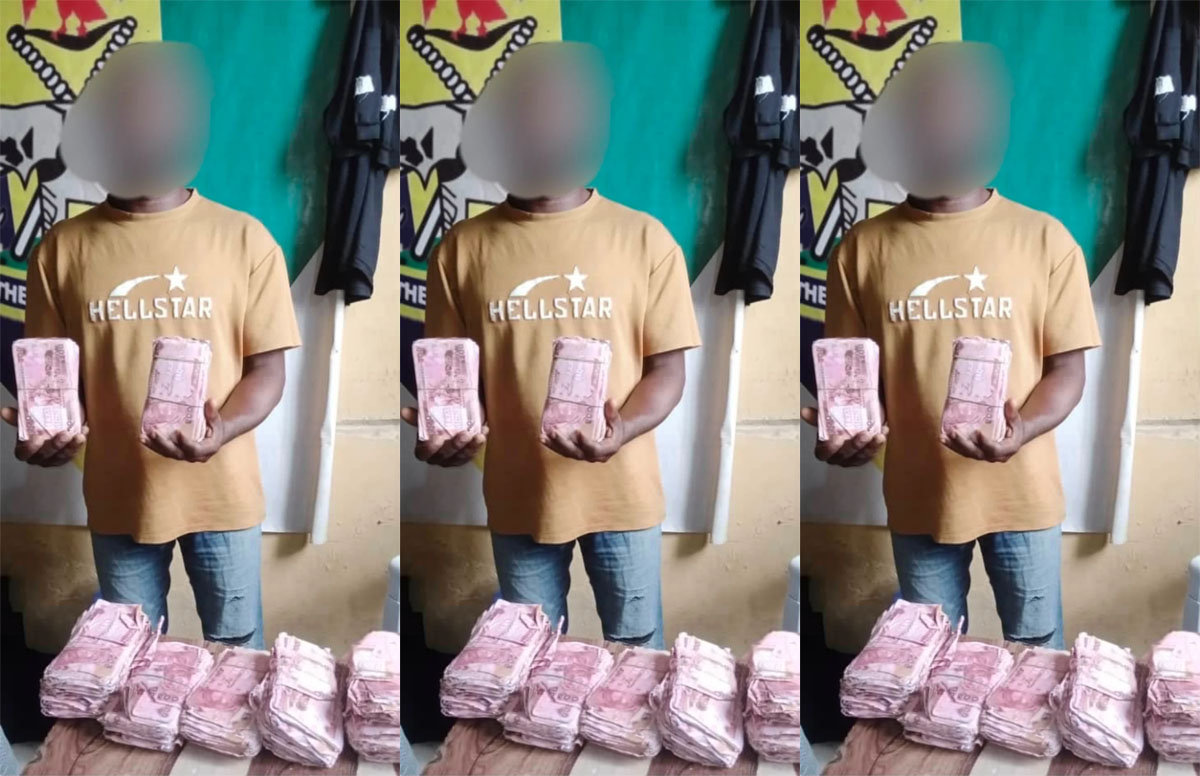
The Abia State Police Command has arrested a 40-year-old man, identified as John Paul, after operatives allegedly uncovered a hideout used for producing counterfeit Nigerian currency in Obikabia community, Aba.
The operation led to the recovery of seven bundles of suspected counterfeit ₦200 notes, which police said had been taken into custody as exhibits. Investigators are also working to track down other suspected members of the alleged counterfeiting syndicate who fled.
The Police Public Relations Officer, DSP Maureen Chioma Chinaka, disclosed the development in a statement issued on behalf of the Commissioner of Police, CP Wilfred Olutokunbo Afolabi, on October 9, 2026.
According to the command, operatives of its Anti-Kidnapping Unit raided the suspected hideout after receiving actionable intelligence that some individuals were allegedly involved in producing counterfeit Nigerian currency.
READ ALSO:
- ‘You Copied My Idea Poorly, Like a Dull Student’ – Atiku Fires at Tinubu Over Petrol Discount
- Mary Ugwoma’s Death: Husband Denies Abuse, Cites Brain Haemorrhage Report
- ‘Lunatic Can’t Preside Over Nigeria’: Wike Fires Back at Amaechi
The police said the intelligence-led operation resulted in the arrest of John Paul and the recovery of the suspected fake notes. However, the command did not disclose whether currency-printing equipment or other materials used in the alleged operation were recovered.
The investigation is ongoing, with officers seeking to establish the full scope of the suspected operation and identify other people allegedly involved. The police have not disclosed the estimated value of the recovered notes or how long the hideout had been in use.
The Commissioner of Police, Afolabi, reaffirmed the command’s commitment to combating criminal activities and protecting lives and property across Abia State. He warned that the state would not be allowed to serve as a base for criminal operations.
The command also encouraged residents to provide useful information to security agencies to support efforts to identify and dismantle criminal networks.
The arrest comes amid ongoing police operations targeting suspected criminal activities in the state. However, John Paul remains a suspect, and the allegations against him have not been established in court.
Police Bust Counterfeit Currency Hideout In Abia, Arrest 40-Year-Old Suspect
-
 metro2 days ago
[UPDATED] 20 NYSC Prospective Corps Members Freed After Seven Days in Captivity
-

 Africa2 days ago
FBI Raids Ghana Scam Centre, Detains Over 130 in $10m Fraud Probe
-

 metro3 days ago
Yayi, Adebule, Muslim Leaders, Others for Imodi-Ijebu Turbaning, ₦1bn Fundraiser
-
 metro2 days ago
EFCC Re-Arraigns Two Over Alleged £110,000 Money Laundering, ₦500m Fraud
-
metro1 day ago
How Parents Raised Millions to Free 20 Abducted NYSC Members
-

 News2 days ago
World Bank Raises Nigeria Growth Forecast, Demands More Jobs, Poverty Reduction
-
 metro2 days ago
NAF Crash: NYSC-Bound Graduate, Only Son, Among 25 Victims
-

 Sports2 days ago
Ronaldo Pays Emotional Tribute to Messi After Argentina Farewell