

The convener of the summit, Alhazan Abiodun, said the reason for the gathering was to access the minds of the various stakeholders on the causes and solutions to the recent rise in cases of kidnapping in Iseyin and other areas in the Oke-Ogun region.Sun
metro
2023: Nigerians may elect kidnappers if care is not taken – criminologist

A criminologist, Dr. Oludayo Tade, has warned Nigerians wary of some personalities contesting for elective political positions during the 2023 general elections, saying some of them might be kidnappers that have amassed wealth from collecting ransoms.
Trade, who is a university lecturer, gave the warning in the lecture, entitled: ‘Rising Cases of Kidnapping: Beyond Ethnic Stereotype, Mirroring Local Causes and Solutions’, at a security summit held at the SAF Group of Schools’ Hall, Iseyin, Iseyin Local Government Area of Oyo State at the weekend. The summit was convened by a journalist and community newspaper publisher, Mr. Alhazan Abiodun.
Critical stakeholders, including the Nigeria Police Force (NPF), Department of State Services (DSS), Nigeria Security and Civil Defence Corps (NSCDC), Nigeria Customs Service (NCS), Nigerian Immigration Service (NIS), Federal Road Safety Corps (FRSC), Amotekun Corps, and non-state actors that comprised Iseyin community leaders and leadership of Fulani/Hausa community, attended the security summit and proffered solutions to the crimes and criminalities in Iseyin, especially recent upsurge in kidnapping cases on the town.
READ ALSO:
- Ronaldo Expresses Displeasure With Manchester United, Says Nothing Changed Since Ferguson Left
- SSS watching #BBNaija instead of collecting intelligence – Sowore
- Nigeria Offers Concession On $1.3bn China-Funded Hydro Power Plant
Four farm hands were kidnapped in a farm settlement some weeks ago, in which one of the victims was killed, while three regained their freedom after payment of N10million ransom. The development as gathered, has made some farmers to abandon their farms over tne insecurity.
According to Tade: “As things are going, we may elect kidnappers in 2023, with the successes they record from their operations around the country. We all should know that they now have so much money for them to do whatever they like, and as you know about Nigerians, they may even vie for political posts.
“The onus is on us residents to localise our approach to curbing criminalities, especially kidnapping, knowing fully well that our state actors are performing their roles but are limited by insufficient logistics, inappropriate weaponry, mobility and other inputs. It is important that we give them our support.”
The Chairman of the occasion, Alhaji Ahmed Raji (SAN), who was represented by a former Chairman of Iseyin local government, Alhaji Saheed Alaran, who appreciated the convener of the summit, saying the meeting came at the right time. He noted that kidnapping cases have permeated the whole nation and have caused so much negative effects on the local economy.
He enjoined the people to make haste in reporting suspicious people and activities to the security personnel or the traditional head in the particular area, in the case of fear of leakage of identity.
The representative of the traditional rulers, who is the Baale of Alokongbo community in Iseyin, Chief Adesokan Olaniyi, called on the leadership of the Fulani herders in Iseyin community to have the data and other information of migrating herders so as to be able to monitor them and dissuade them from perpetrating crime.











metro
Edo Court Sentences Four to Death Over Kidnapping, Armed Robbery
Edo Court Sentences Four to Death Over Kidnapping, Armed Robbery
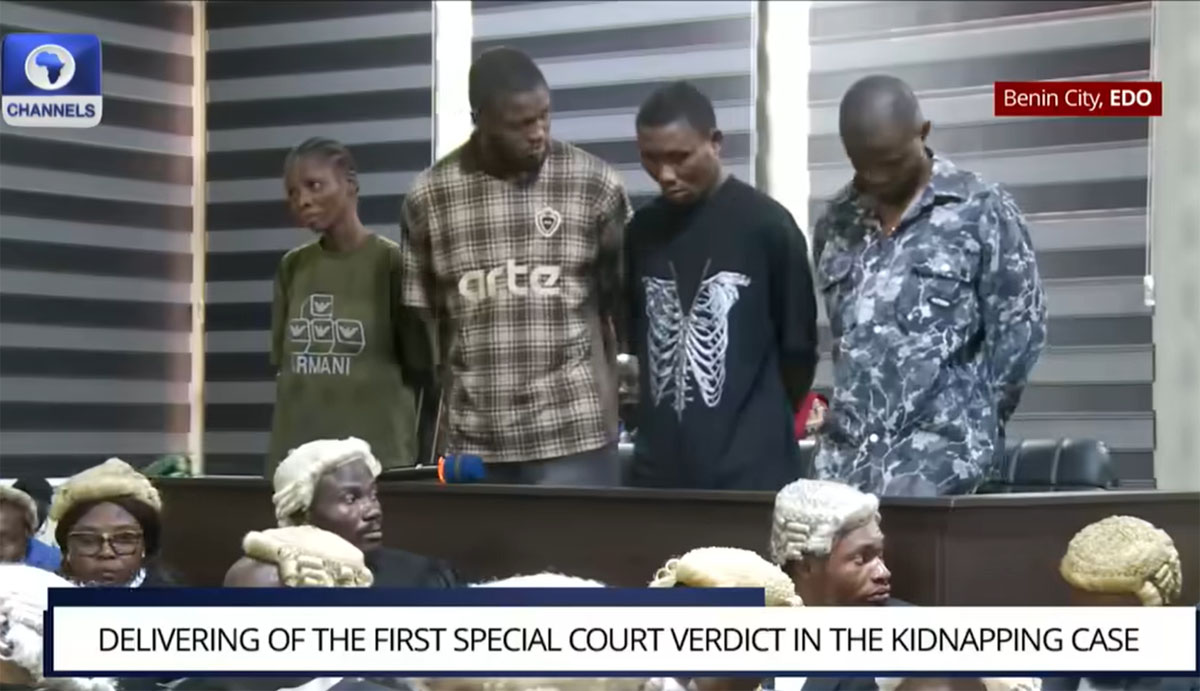
Four men have been sentenced to death by the Edo State Special Criminal Court after being convicted on multiple charges arising from a kidnapping, armed robbery, cultism and firearms case in Benin City.
Justice Aigbona Momodu delivered the judgment on Tuesday, September 29, 2026, in what was the court’s first reported judgment in a kidnapping case since it became operational.
The convicts were identified as Marvellous Isaac, 32; Wisdom Michael, 36; Rufus Emete Michael, 30; and Gift Raphael, 27.
The case arose from the June 14, 2026 abduction of a woman at the Vegetable Market area along Airport Road in Benin City.
The victim was reportedly at the market with her husband and children when armed men abducted her. She was later released unharmed.
The incident prompted a police investigation that led to the arrest and prosecution of the four men.
Police reportedly recovered a Lexus RX 350, which investigators linked to the abduction, as well as a pump-action firearm, ammunition, a motorcycle and cash.
One alleged member of the group, identified as Precious, was reportedly killed during a security operation, while Marvellous Isaac was arrested on June 18 following an alleged exchange of gunfire with police operatives.
The defendants had pleaded not guilty during the trial.
After considering evidence presented by the prosecution and defence, the court convicted the defendants on the relevant counts.
According to the reported judgment, Marvellous Isaac received seven years’ imprisonment on Count 1, death sentences on Counts 2 to 9, 10 years’ imprisonment on Count 10 and life imprisonment on Count 11.
READ ALSO:
- Bauchi Woman Arrested After Co-Wife Dies in Alleged Pestle Attack
- Breaking: Tinubu Ends Extended European Vacation, Departs Paris for Nigeria
- Troops Rescue 41 Travellers as Bandits Attack Senegal-to-Kano Vehicle in Zamfara
Wisdom Michael was sentenced to seven years on Count 1 and death sentences on Counts 2 to 9.
Rufus Emete Michael received seven years on Count 1 and death sentences on Counts 2, 3, 4, 6 and 7.
Gift Raphael was sentenced to seven years on Count 1 and death sentences on Counts 2, 4, 6 and 8.
Earlier reports on the case had described the defendants as facing a 10-count charge, while the judgment reports refer to an additional Count 11. The available reports do not provide sufficient detail to independently assign every offence to each of the 11 counts, so the sentencing breakdown above follows the counts specifically reported in the judgment.
Justice Momodu said the court had no discretion over the punishment prescribed by law for the offences attracting the death penalty.
The court also ordered the confiscation of a JoJef pump-action firearm and four cartridges tendered as exhibits during the trial.
The firearm and ammunition were ordered to be handed over to the Edo State Police Armourer at the State Criminal Investigation Department (CID) for destruction within 30 days.
The judgment marked the first kidnapping-related judgment delivered by the Edo State Special Criminal Court, a specialised court established to handle kidnapping, cultism and other serious violent-crime cases.
The court became operational on July 1, 2026, as part of efforts to accelerate the prosecution of serious criminal cases in Edo State.
The sentencing concludes the trial at the Special Criminal Court, but available reports do not indicate whether the four convicts have filed appeals against their convictions or sentences.
The death sentences are therefore sentences imposed by the trial court and should not be presented as final or carried out unless subsequent legal proceedings establish that position.
Edo Court Sentences Four to Death Over Kidnapping, Armed Robbery
metro
Chimamanda Adichie: Hospital Seeks to Stop Inquest Into Son’s Death

Chimamanda Adichie: Hospital Seeks to Stop Inquest Into Son’s Death
A Lagos State High Court has fixed October 12, 2026, to rule on an application by Eurapharma Care Services Nigeria Limited, operators of Euracare Multi-Specialist Hospital, seeking to halt the coroner’s inquest into the death of Chimamanda Adichie’s son, Nkanu Adichie-Esege.
Justice Aishat Opesanwo fixed the date after hearing arguments from the hospital, Nkanu’s parents and other parties involved in the legal dispute.
The hospital is challenging the continuation of the coroner’s inquest, which is examining the circumstances surrounding the death of the 21-month-old child at Euracare Multi-Specialist Hospital in Lagos on January 7, 2026.
Eurapharma is seeking judicial review orders, including certiorari, to quash decisions already made by the coroner and prohibition, to restrain the coroner, Magistrate Atinuke Adetunji, from continuing with the proceedings.
One of the hospital’s key arguments concerns the fact that Nkanu’s remains were cremated, which it argues prevents a post-mortem examination and affects the coroner’s ability to proceed with the inquest.
The hospital has also challenged the procedure adopted by the coroner regarding the presentation of evidence, particularly a direction requiring Euracare to present its case before the family of the deceased.
Eurapharma’s counsel, Taiwo Osipitan, SAN, argued that the hospital should not be required to open its case before the family, which has raised allegations concerning the medical care provided to Nkanu, first presents its evidence.
READ ALSO:
- Bauchi Woman Arrested After Co-Wife Dies in Alleged Pestle Attack
- Breaking: Tinubu Ends Extended European Vacation, Departs Paris for Nigeria
- Troops Rescue 41 Travellers as Bandits Attack Senegal-to-Kano Vehicle in Zamfara
However, lawyers representing Chimamanda Adichie and her husband, Dr Ivara Esege, urged the High Court to dismiss the hospital’s application.
Their counsel, Kemi Pinheiro, SAN, argued that the application was premature because the coroner had not made any substantive decision capable of being challenged through judicial review.
Pinheiro also disputed the argument that the cremation of Nkanu’s remains deprived the coroner of jurisdiction.
He relied on provisions of the Lagos State Coroners System Law, including Sections 21 and 31, arguing that an inquest could proceed even where a body was unavailable for inspection.
The lawyer described the inquest as a fact-finding process rather than a criminal trial, stressing that the coroner’s proceedings do not determine criminal guilt or impose criminal liability.
He argued that the coroner’s eventual findings would be submitted to the appropriate authorities, including the Lagos State Attorney-General and the Director of Public Prosecutions, for any further action considered necessary.
The Lagos State Attorney-General and Commissioner for Justice, Lawal Pedro, SAN, also urged the court to dismiss the hospital’s application.
Counsel representing Atlantis Paediatric Hospital Limited similarly opposed the application and argued that the issue concerning the order of evidence had already been addressed during proceedings before the coroner.
According to the arguments presented in court, parties had previously agreed that the family would lead evidence first, although the hospital had earlier agreed to commence its case because it was the party that initially sought the inquest.
The dispute is not the first time the Chimamanda Adichie son death inquest has faced a legal challenge.
In June, the Lagos State High Court granted Eurapharma leave to commence judicial review proceedings and temporarily stayed further proceedings before the coroner pending determination of the substantive application.
The hospital had argued that the coroner acted without jurisdiction and had also challenged procedural decisions made during the inquest.
The coroner’s proceedings began after Nkanu died at Euracare in January following medical treatment. His parents subsequently raised concerns about the circumstances surrounding his treatment and alleged breaches of the duty of care.
The family has alleged possible medical negligence, while Euracare has denied wrongdoing and described the allegations as inaccurate and unfounded.
Earlier reports on the case said the child had been referred to Euracare for diagnostic procedures and that arrangements were being made for further treatment abroad.
The family has maintained that it wants the inquest to establish the circumstances surrounding Nkanu’s death and provide answers about the medical care he received.
The current court proceedings, however, are focused on whether the coroner can lawfully continue with the inquest and whether the hospital’s complaints about the procedure and the cremation of the remains provide grounds for judicial intervention.
Justice Opesanwo is expected to determine the hospital’s application on October 12, 2026.
The ruling will determine the immediate legal direction of the coroner’s inquest into Nkanu Adichie-Esege’s death, while the underlying allegations of medical negligence remain unresolved.
Chimamanda Adichie: Hospital Seeks to Stop Inquest Into Son’s Death
metro
Bauchi Woman Arrested After Co-Wife Dies in Alleged Pestle Attack
Bauchi Woman Arrested After Co-Wife Dies in Alleged Pestle Attack
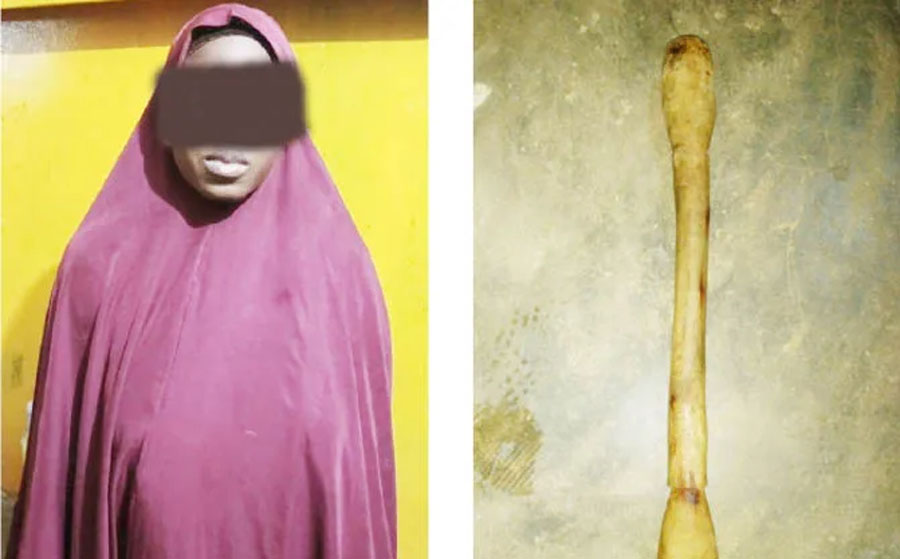
A 33-year-old woman, Hauwa’u Haruna, has been arrested by the police in Bauchi State after her co-wife, identified as 43-year-old Jamila Adamu, died following an alleged attack with a pestle.
The incident occurred at about 4:05pm on Sunday, September 27, 2026, at Tafawa Balewa Housing Estate in Bauchi metropolis, where the two women reportedly lived in the same household with their husband.
According to the Bauchi State Police Command, Haruna allegedly picked up a pestle during a confrontation and struck Adamu on the forehead.
The victim reportedly lost consciousness after the alleged assault.
Police said officers from C-Division, Bauchi, were alerted to the incident and responded to the residence. Adamu was subsequently taken to Specialist Hospital, Bauchi, where a medical doctor reportedly confirmed her death.
Her remains were deposited at the hospital mortuary pending an autopsy, while the police commenced investigation into the circumstances surrounding her death.
The police said the alleged pestle used in the attack was recovered and retained as an exhibit. Haruna was also arrested and taken into custody for questioning.
READ ALSO:
- Lagos Driver Arrested After Police Sergeant Dies During Stop-and-Search
- FG Releases 2026–2028 Approved Textbooks, Introduces QR Codes for Tracking
- 24 Hours in Darkness: Iju Ishaga Residents, Businesses Count Losses as Ikeja Electric Fails to Restore Power
The police spokesperson, SP Nafiu Habib, said preliminary findings indicated that the suspect was allegedly acting under what the command described as hallucinations when the incident occurred.
However, the police description does not by itself establish a medical diagnosis or explain the cause of the alleged behaviour. Further investigation, including the circumstances surrounding the incident and any relevant medical assessment, would be required to establish the facts.
The Bauchi State Commissioner of Police, Sani-Omolori Aliyu, directed that the case be transferred to the State Criminal Investigation Department (SCID) for discreet investigation and prosecution.
The commissioner also expressed condolences to the family of the deceased and urged members of the public to seek timely medical and psychosocial assistance for people experiencing serious behavioural or psychological difficulties.
Police have not disclosed a specific motive for the alleged attack or provided details of what triggered the confrontation between the two women.
The incident has consequently remained under investigation as authorities work to establish the circumstances that preceded the alleged assault and the events that led to Adamu’s death.
The case is expected to be subjected to further investigation before any criminal liability is determined through the appropriate legal process.
Bauchi Woman Arrested After Co-Wife Dies in Alleged Pestle Attack
-

 News2 days ago
Fake Agency Scandal: Gbajabiamila Says He Never Betrayed Tinubu’s Trust
-

 metro2 days ago
Woman Busted With Alleged Alcohol Hidden in Water Pack at Ogun Prison
-

 International2 days ago
Iran Claims Capture of Second US Underwater Drone in Strait of Hormuz
-

 News2 days ago
Anambra Govt Demands Unreserved Apology From Peter Obi Over Debt Claims
-

 metro21 hours ago
24 Hours in Darkness: Iju Ishaga Residents, Businesses Count Losses as Ikeja Electric Fails to Restore Power
-

 Politics2 days ago
2027: NDC State Chairmen Reject Obi-Kwankwaso Movement’s Parallel Structures
-

 Sports3 days ago
Man City Chairman Breaks Silence After Club Found Guilty Of 114 Charges
-

 Politics3 days ago
2027: Lawal Challenges Wike To Clarify Allegiance Over Rainbow Coalition