metro
Catholic Bishop condemns commercialization of Churches
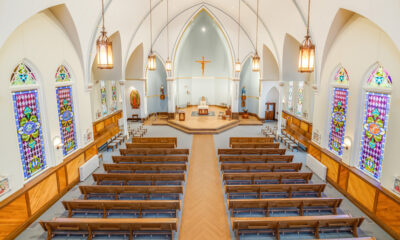
During a special Mass in Yola, Bishop Mamza, also the immediate Adamawa State Chairman of the Christian Association of Nigeria (CAN), lamented the growing trend of churches being established solely for commercial gain. He highlighted the pervasive desire among individuals to become general overseers and acquire private jets, attributing it to the rampant establishment of profit-driven churches.
In a candid revelation, Bishop Mamza recounted a personal encounter where a general overseer solicited him to purchase their church due to financial struggles, emphasizing the prevalent focus on material wealth rather than spiritual nourishment.
The Bishop’s remarks were made during a Mass held at St. Augustine’s Catholic Church, Bekaji, Yola, to commemorate this year’s World Communications Sunday of the Catholic Church. Addressing the theme of the day, ‘Artificial Intelligence and the Wisdom of the Heart Towards a Fully Human Communication,’ Bishop Mamza emphasized the irreplaceable value of human empathy and passion in communication, asserting that artificial intelligence cannot replicate the depth of human connection.
READ ALSO:
- Man given pig kidney transplant dies
- 14 abducted Kogi varsity students regain freedom
- NDLEA intercepts drug consignments in three-trailer load
While acknowledging the opportunities presented by communication platforms, Bishop Mamza cautioned against the dehumanizing effects of technology, urging for a balanced approach that prioritizes genuine human interaction. He emphasized the importance of maintaining empathy and compassion in communication, essential elements that artificial intelligence cannot replicate.
In conclusion, Bishop Mamza called for a renewed focus on strengthening human communication, rooted in empathy and compassion, amidst the rapid advancement of technology. He urged individuals to prioritize authentic connections and relationships, emphasizing the intrinsic value of human touch and empathy in fostering meaningful interactions.
Catholic Bishop condemns commercialization of Churches
![]()
metro
Nigeria, UK Strengthen Defence Ties as Senior British Military Officer Visits Maiduguri
The United Kingdom’s Deputy Chief of the Defence Staff (Military Strategy and Operations), Lieutenant General Sir Charlie Collins, has arrived in Maiduguri, Borno State, in a strategic visit aimed at deepening Nigeria-UK defence cooperation and reinforcing joint efforts to tackle terrorism, insurgency and other security threats in West Africa.
The visit, announced by the British Defence Staff West Africa on its official X account on Tuesday, highlights the UK’s continued commitment to supporting Nigeria-led security operations and promoting regional stability amid persistent threats posed by terrorist groups operating in the North-East and the wider Sahel region.
According to the British military mission, Sir Charlie Collins is meeting with senior officers of the Nigerian Army and other military leaders to assess ongoing defence collaboration, exchange operational insights and explore new areas of partnership designed to strengthen the capacity of both countries in addressing evolving security challenges.
“Welcome to Nigeria, Lt Gen Sir Charlie Collins KBE DSO, UK Deputy CDS (MSO). In Maiduguri with Nigerian Army colleagues, seeing UK-Nigeria defence cooperation first-hand and supporting Nigeria-led efforts to strengthen security and regional stability,” the British Defence Staff West Africa said in a statement.
Images released from the visit showed the senior British military officer receiving a ceremonial guard of honour before holding high-level discussions with Nigerian military commanders at strategic locations in Maiduguri, the epicentre of Nigeria’s counter-insurgency campaign.
READ ALSO:
- Kwara Poly Suspends Lecturer for Flogging IJMB Exam Candidates
- US Mission Nigeria Opens 2026 Opportunity Fund for Nigerian Students – Apply Now
- Insecurity: Senate Holds Emergency Session to Consider State Police Bill
The visit comes at a critical period as Nigerian security forces intensify operations against Boko Haram and the Islamic State West Africa Province (ISWAP), which have continued to launch attacks in parts of Borno State despite sustained military offensives.
Maiduguri serves as the headquarters of Operation HADIN KAI, the Nigerian military’s flagship counter-terrorism operation responsible for combating insurgency across the North-East. The city remains the operational nerve centre for efforts to restore peace and facilitate the return of displaced communities affected by years of conflict.
The United Kingdom and Nigeria defence partnership has expanded significantly in recent years, covering intelligence sharing, military training, strategic planning, logistics support and capacity building. British military advisers have consistently worked alongside Nigerian counterparts to improve operational effectiveness while supporting broader regional security initiatives.
The latest engagement follows a series of high-level interactions between both countries aimed at strengthening collaboration against terrorism and violent extremism. British officials have repeatedly reaffirmed their support for Nigeria’s security architecture and emphasized the importance of international partnerships in addressing transnational threats affecting West Africa.
Military authorities believe Sir Charlie Collins’ visit will further consolidate bilateral defence relations, enhance intelligence cooperation and strengthen joint strategies to improve security, protect civilian populations and promote lasting peace across Nigeria and the region.
With insecurity remaining a major challenge, the visit underscores the shared commitment of both nations to building resilient security institutions and sustaining collaborative efforts against terrorism, insurgency and organized criminal networks.
Nigeria, UK Strengthen Defence Ties as Senior British Military Officer Visits Maiduguri
![]()
metro
Insecurity: Senate Holds Emergency Session to Consider State Police Bill
The Nigerian Senate has convened an emergency plenary session today to consider the proposed State Police Bill, a landmark constitutional reform that would allow states to establish their own police forces. The emergency sitting, scheduled for 11:00 a.m. at the National Assembly Complex in Abuja, was called by Senate President Godswill Akpabio to address urgent national security concerns. The Senate had adjourned for its recess on June 11 and was scheduled to resume on July 7, but the leadership recalled lawmakers to address what it described as “matters of urgent national importance, particularly issues relating to national security and other critical concerns that require immediate legislative attention.” According to a memo issued on June 15 by the Clerk of the Senate, Emmanuel Odo, the session was convened at the instance of Senate President Akpabio. The decision to cut short the recess underscores growing anxiety over Nigeria’s worsening security situation, including persistent attacks by terrorists, bandits, kidnappers and other criminal groups across several parts of the country.
Senate spokesman, Senator Yemi Adaramodu (Ekiti South), confirmed that national security concerns and the State Police Bill will dominate deliberations. “The Senate will be considering matters of public interest, especially national security. The State Police legislation will undoubtedly be a priority issue,” Adaramodu said. According to him, lawmakers are expected to review reports from the committee currently handling the bill as part of efforts to move the proposal forward. “The Senate is desirous of partnering with other arms of government in curbing the undesirable activities of bandits, terrorists and other peace-threatening marauders,” he added.
The emergency session follows concerns over delays in the constitutional amendment process after the Senate went on a three-week recess without concluding work on the bill. According to a senior Senate official who spoke on condition of anonymity, the proposal could not be concluded earlier because the chamber failed to secure the constitutionally required two-thirds majority of the 109 senators needed to amend the Constitution. “The leadership has spoken with members and there is optimism that the required number will be present,” the source told THISDAY. Determined to avoid further delays, the Senate leadership has intensified consultations across party lines and appealed to lawmakers to ensure full attendance at today’s emergency sitting.
READ ALSO:
- ‘Britain Is Not Ungovernable’ — Badenoch Attacks Starmer Following Resignation
- “We No Go Gree” — Nigerians in South Africa Demand Evacuation as June 30 Deadline Nears
- ‘He Died in My Arms’ — General Rabe’s Wife Contradicts Official Death Account
The bill, which has already passed second reading in the Senate and was passed by the House of Representatives, seeks to transfer policing from the Exclusive Legislative List to the Concurrent Legislative List, allowing state governments to establish their own police formations alongside the federal police. Sponsored by Senate Leader Opeyemi Bamidele, the proposed legislation would amend Sections 197, 214 and 215 of the Constitution, among other provisions. The bill proposes the creation of both Federal and State Police structures, defining their responsibilities and establishing State Police Service Commissions with robust oversight mechanisms. It also proposes amendments to Section 214 of the Constitution to formally establish both Federal Police and State Police formations. Under the proposed framework, the National Assembly would retain authority to prescribe the structure, organization, administration, and powers of the Federal Police while also setting minimum standards and legal requirements for the establishment and operation of state police services nationwide. The bill stipulates that no state police formation can commence operations unless it is created through legislation enacted by the relevant State House of Assembly and certified as meeting nationally prescribed minimum standards. It further provides that until any state police force becomes operational, the Federal Police shall continue to exercise policing responsibilities within that state.
Addressing concerns about potential political abuse by state governments, the bill contains several built-in safeguards. The proposed legislation includes the creation of State Police Service Commissions, federal oversight by the Federal Police Service Commission, uniform national policing standards, legislative confirmation of senior appointments, and strengthened constitutional procedures for removal of State Commissioners of Police. Furthermore, provisions are included for federal intervention in cases of breakdown of law and order. Bamidele also noted that under the proposed changes to Section 215 of the Constitution, State Commissioners of Police would be appointed by governors on the advice of the Nigeria Police Council from among serving officers of the respective state police formations and confirmed by their State Houses of Assembly. The bill empowers governors to issue lawful directives to State Commissioners of Police on matters relating to public safety and maintenance of law and order. However, where a commissioner believes such directives are unlawful or inconsistent with established policing standards, the matter may be referred to the Nigeria Police Council, whose decision would be final.
READ ALSO:
- Kaduna Mob Killing: Family Recounts Last Moments of Teacher Burnt Over False Child Theft Claim
- US Exposes ISIS Funding Network Linking Nigeria to Syria, Sanctions Lagos BDCs
- MSSN Demands Special Courts, Death Penalty for Kidnappers, Terrorists
Supporters argue that decentralising policing powers would improve intelligence gathering, strengthen community-based security operations and enable state governments to respond more effectively to local security threats. Nigeria currently operates a centralised policing system under the control of the Federal Government through the Nigeria Police Force, which advocates say has struggled to respond effectively to localised threats. Leading the debate on the bill during second reading, Senate Leader Opeyemi Bamidele noted that Nigeria continues to face terrorism, violent extremism, banditry, mass abductions, farmer-herder clashes, cultism, armed robbery, pipeline vandalism, communal conflicts and cyber-enabled crimes. He argued that local police officers would be better positioned to gather intelligence because of their familiarity with local languages, customs and community dynamics. Drawing comparisons with other federations, Bamidele noted that the United States, Canada, Australia and Germany operate multi-layered policing systems that combine federal and subnational law enforcement agencies. “As such, Nigeria should not remain an exception among federal systems,” he argued. Several lawmakers across party lines, including senators from Northern Nigeria, have openly backed the proposal, insisting that the current centralised policing structure is no longer sufficient to tackle security threats effectively. Senate Chief Whip Tahir Monguno also noted that the legislation could help provide proper legal regulation for vigilante groups currently operating in several communities across the country.
If the bill successfully passes the Senate today, the upper chamber and the House of Representatives will constitute a joint conference committee to harmonise differences in their respective versions of the legislation before transmitting it to the 36 State Houses of Assembly for approval, as required for constitutional amendments. The House of Representatives had earlier passed the bill with overwhelming bipartisan support—289 lawmakers voted in favour, one abstained, while no lawmaker voted against it. This reflects growing consensus among federal lawmakers, state governors, and security stakeholders that Nigeria’s current centrally controlled policing system requires reforms to meet contemporary security realities.
The emergency session comes amid renewed pressure on the Federal Government to adopt more effective strategies to combat insecurity nationwide. During his Democracy Day broadcast earlier this month, President Bola Tinubu vowed that terrorists, bandits and their sponsors would face the full weight of the law, insisting that no mercy would be shown to enemies of the state. The President disclosed that more than 13,000 terrorists had been neutralised within the last year, though he acknowledged that the continued captivity of schoolchildren abducted in Oyo and Borno states remained a painful reminder of the country’s security challenges.
Insecurity: Senate Holds Emergency Session to Consider State Police Bill
![]()
metro
“We No Go Gree” — Nigerians in South Africa Demand Evacuation as June 30 Deadline Nears
Some stranded Nigerians in South Africa on Monday staged a peaceful protest at the Nigerian High Commission in Pretoria over delays in repatriation flights and the slow processing of their return to Nigeria amid ongoing xenophobic attacks and anti-immigration tensions in the country. The protesting Nigerians were seen outside the Nigeria House Commission chanting “We no go gree o, we wan go” while demanding urgent action from the federal government over their situation. The demonstration came as a June 30 deadline set by anti-migrant groups for undocumented foreigners to leave South Africa draws near, heightening anxiety among affected citizens.
One of the affected Nigerians, in a video during the protest, expressed deep frustration over the delay, lamenting that women and children were stranded without shelter and food in harsh winter conditions. “I didn’t really support what the ambassador was saying because it didn’t specify the specific date when the flight could have come. This is because the federal government from our information released five aircrafts from which one came and took people, remaining four aircrafts,” he said. “The question is why the delay because there are stranded women and children hoping to come only to hear that the flight is cancelled. Today, these women in this weather sleep outside. There is no food, shelter and blanket,” he added.
The protester further queried the sudden cancellation of flights, insisting they were ready to return home amid escalating tensions in the country. “We want to know what is going on because from what we’re told the relief is not there. Only one flight is not enough. They said five. We have only seen one. Where is the remaining four?” he asked. “We are ready to go home. Our people are ready to go home because of these tension going on in South Africa. Most of us might look stranded but we have a home. We are here not because we are desperate but because we love South Africa,” he added.
Speaking during the protest, Smart Nwobu, president of the Nigerian community in South Africa, appealed to the Federal Government and relevant authorities to expedite the evacuation of stranded Nigerians. “As you know, only one flight left. The question is, when is the second batch? When is the third batch? When is the fourth batch?” Nwobu asked. “We were promised that the second batch will be here on the 15th of June. The 15th has come and left. People were made destitute and their conditions worsened. Nigerians are now sleeping on the street, and their documents have been cancelled as a result of that registration,” he stated. He said the protesters gathered at the high commission to express their dissatisfaction with the situation and urge the government to complete the evacuation process before the end of June.
READ ALSO:
- ‘He Died in My Arms’ — General Rabe’s Wife Contradicts Official Death Account
- Kaduna Mob Killing: Family Recounts Last Moments of Teacher Burnt Over False Child Theft Claim
- US Exposes ISIS Funding Network Linking Nigeria to Syria, Sanctions Lagos BDCs
Nigeria’s Acting High Commissioner to South Africa, Alexander Ajayi, who addressed the protesters, clarified that the repatriation was temporarily suspended due to operational reasons, assuring affected Nigerians they would be evacuated before the June 30 deadline. “Contrary to insinuations that are going on that the repatriation has been cancelled, it has not been cancelled. It was only temporarily suspended due to operational reasons,” Mr Ajayi stated. The non-violent demonstration came amid ongoing efforts by the government to repatriate Nigerians seeking to leave South Africa following renewed anti-immigration tensions and concerns in the country.
The Federal Government had earlier announced plans for five repatriation flights to evacuate Nigerians willing to return home following rising anti-immigration tensions in South Africa. The first batch of 258 Nigerians arrived in Lagos on June 11, but the second flight, initially scheduled for June 15, was postponed, deepening frustration among affected citizens. Available figures indicate that while 258 Nigerians have been successfully evacuated from South Africa, more than 742 registered citizens reportedly remain stranded across different provinces, facing hunger and homelessness due to flight logistics delays. Scores of Nigerians awaiting repatriation earlier underwent screening at the Nigerian High Commission in Pretoria as part of the evacuation exercise amid efforts by officials to finalise flight arrangements for registered returnees.
The Nigerian Citizens Association South Africa (NICASA) has raised the alarm over the worsening humanitarian situation facing stranded Nigerians. National President Rev. Frank Onyekwelu revealed that many families, including women and children, are stranded without shelter, food, transportation, or financial means to sustain themselves. “Today, numerous families, including women and children, are stranded without shelter, food, transportation or financial means to sustain themselves,” Onyekwelu said in a statement. “Our citizens are not merely statistics. They are fathers, mothers, children, students, workers and entrepreneurs who have found themselves in desperate circumstances. Their cries for help must not go unanswered,” he added. The association further alleged that some Nigerians experienced humiliation, insensitive treatment, and poor communication from certain officials during the registration and screening exercise.
The Ohanaeze Ndigbo South Africa has called on the Federal Government to urgently resume the repatriation exercise, lamenting that the delay has compounded the hardship faced by affected Nigerians and allegedly led to the death of a Nigerian woman. In a letter addressed to the Minister of Foreign Affairs, Ambassador Bianca Odumegwu-Ojukwu, the group’s President, Dr. ABC Okokoh, stated that the woman reportedly collapsed after learning that the repatriation flight had been suspended. “Just last week, one of our compatriots reportedly collapsed and died on hearing that the flight had been cancelled. Her children have been rendered motherless because of her dashed hope arising from the unfortunate development,” Dr. Okokoh stated. He stressed that the organisation was not criticising the Federal Government’s intervention but was appealing for urgent measures to address the plight of stranded Nigerians, particularly those sleeping in open spaces around the Nigerian High Commission in Pretoria under harsh winter conditions.
The Federal Government has assured Nigerians residing in South Africa that all citizens who have indicated interest in returning home amid ongoing anti-migrant attacks will be evacuated before the June 30 deadline. The Minister of Foreign Affairs, Ambassador Bianca Odumegwu-Ojukwu, had earlier stated that President Bola Tinubu approved the evacuation exercise following reports of harassment, intimidation, and attacks against Nigerians and other African migrants living in South Africa. On June 18, the minister had assured Nigerians in South Africa that no citizen willing to return home would be abandoned, following the first government-led evacuation flight. She disclosed that nearly 1,000 Nigerians had registered for evacuation, leaving more than 742 awaiting transportation back to Nigeria. The South African Police Service has also announced that it would strengthen deployments nationwide ahead of the June 30 deadline set by fringe anti-illegal immigration groups for undocumented foreigners to leave. Acting Police Minister Firoz Cachalia said the police had elevated operational readiness across all provinces, with comprehensive deployment plans in place to protect communities and critical infrastructure.
“We No Go Gree” — Nigerians in South Africa Demand Evacuation as June 30 Deadline Nears
![]()
-
metro2 days agoVIDEO: Jubilation as Kidnapped Family Is Freed After Sunday Igboho’s Two-Hour Ultimatum
-
metro2 days agoPolice Deny Sunday Igboho’s Role in Oyo Kidnap Victims Release
-
metro20 hours agoJUST IN: One Injured As Bomb Explosion Rocks Lagos Market
-
Politics2 days agoINEC Declares Oyebanji Winner of Ekiti Governorship Election, Sweeps All 16 LGAs (Full Results)
-
metro21 hours agoFG Orders Immediate Halt of Ibadan-Ife-Ilesa Road Work – Here’s Why
-
metro1 day agoOyo School Kidnapping: Troops Tighten Siege as Abductors Drop Key Demands
-
Politics3 days agoEkiti 2026: EU Observers Hail Peaceful Poll, 96% BVAS Performance
-
metro3 days agoAbia Police Arrests Man Captured Assaulting Woman In Viral Video