

metro
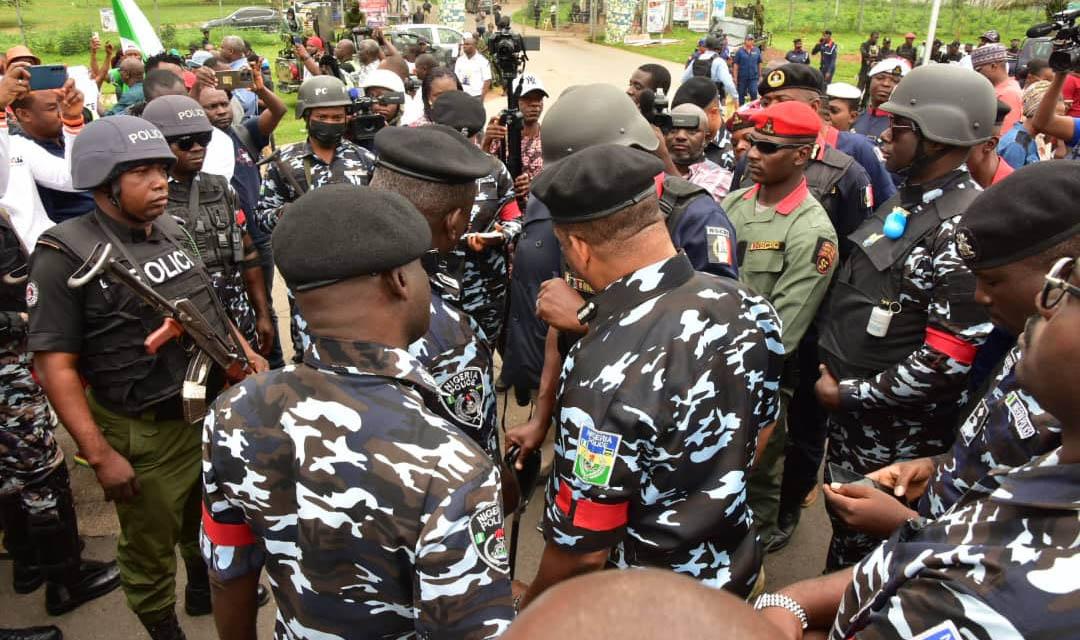
Insecurity: Three govs vow to implement state police
Insecurity: Three govs vow to implement state police
LAGOS — The governors of Ondo, Rivers and Jigawa states, yesterday, reiterated their commitment to forming state police, as part of key measures to tackle insecurity in their domain.
The three governors committed while speaking at a breakout section on state policing at the ongoing Nigerian Bar Association, NBA, Annual General Conference in Lagos.
In his remarks at the section, Governor Lucky Aiyedatiwa of Ondo State expressed optimism that creating state police would address security challenges bedeviling the country.
He also stated that the state’s security outfit, which had successfully helped to check insecurity in all parts of Ondo, reflected that state policing remained the best option to tackle insecurity in the country.
He said: “I am proud to say that Amotekun has delivered. It has brought a measure of peace and security to our people, a peace that had long been elusive.
‘’This home-grown initiative has demonstrated that when we trust in our communities, when we empower them when we give them the responsibility and the resources to secure their lives and property, they can achieve remarkable results. ‘’The synergy between Amotekun and other security agencies has placed Ondo State as one of the most peaceful and secure states in Nigeria today.
“This is but a glimpse of what state policing can truly accomplish. Imagine a Nigeria where every state is empowered to tailor its security approaches to the unique needs of its people.
READ ALSO:
- Saudi Arabia condemns Israeli minister remarks on building synagogue at Al-Aqsa mosque
- Six killed in West Bank attacks, says Palestinian health ministry
- 7 dangerous spots you should never charge your phone
‘’A country where swift response times, targeted interventions and community-driven initiatives become the norm, rather than the exception. This is the future we must fight for – a future where the safety and well-being of our citizens are paramount, protected by the very foundations of our constitution.
“We must, however, acknowledge the concerns that have been raised in some quarters – issues of abuse, training, funding and political interference. But I firmly believe that with the right safeguards and governance structures in place, state policing can be the transformative solution we so desperately need.
“We must learn from the shining example of the Amotekun Corps and forge a path forward that enshrines accountability, transparency and unwavering commitment to the people.
He reiterated that while Amotekun may not be a cure to all the deep-seated issues that plague our nation, it is a good starting point, a bold experiment, and a step in the right direction.
“It provides an elixir to some inadequacies of our centralized policing structure – its slow response times, its lack of cultural sensitivity, and its inability to address the unique needs of our diverse communities,” he added.
Also speaking, Governor Siminalayi Fubara of Rivers State reiterated his support for state policing, saying it was the best way to check rising insecurity in the country.
READ ALSO:
- Patients flee Gaza hospital after latest evacuation order from Israel
- Egypt rejects Israeli force on its Gaza border
- Osun confirms 2 cases of Monkeypox in Ilesa West
The governor, who was represented by the Attorney-General and Commissioner for Justice, Dagogo Eborama, highlighted the inefficiency of the current Nigerian Police in tackling crime across Nigeria, especially in states facing frequent kidnappings and other violent crimes.
Fubara said: “Constitutionally, Nigeria is a federation. Can a central police, from top to bottom, effectively tackle crime in Nigeria? It cannot.”
Speaking on fears that state policing could be abused by governors, he said: “Is there any situation in Nigeria that is not abused? The fear of abuse of state police cannot be used to deny its establishment.”
On his part, Governor Umar Namadi of Jigawa State threw his weight behind state police, adding that a federal Police would also be needed to operate on federal matters.
Namadi, who was represented by the Attorney-General of Jigawa State, Mr Bello Fanini, said: “A multi-layered police system that would allow state-level policing to complement the federal police is what we need as a country.
‘’The federal police are still needed. Why? Because of the dynamics of crime and the importance of synergy between state and federal forces.”
Also speaking at the section, former Attorney General and Commissioner of Justice for Oyo State, Prof. Oyelowo Oyewo, SAN, challenged long-held myths surrounding the country’s centralized police system.
He stated that there was a real urgency for the adoption of state policing to tackle rising insecurity across the country, noting that Amotekun had proven that state policing could make a difference in tackling insecurity in the country.
Insecurity: Three govs vow to implement state police






metro
Lagos pensioners tear-gassed during protest as Sowore demands justice
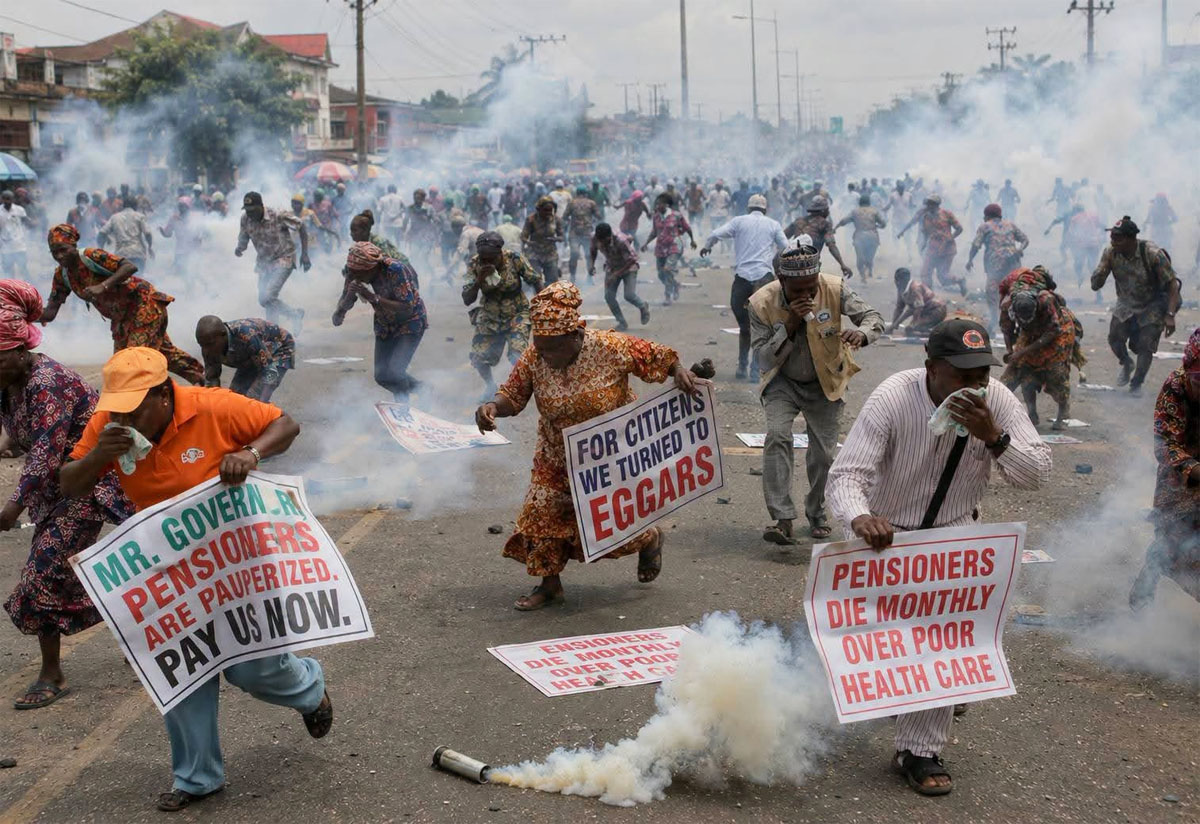
Lagos pensioners tear-gassed during protest as Sowore demands justice
Police officers in Lagos State reportedly deployed tear gas on Monday to disperse pensioners who gathered at the Lagos House in Ikeja to protest over unpaid pension increases, wage awards and arrears.
The retirees, drawn from the Nigeria Union of Pensioners (NUP) and the Contributory Pension Scheme (CPS), had converged on the Lagos State Government premises to demand the implementation of pension increases they said had been approved and the payment of accumulated benefits.
The protest followed an earlier demonstration by the pensioners, who had accused the Lagos State Government and the Lagos State Pension Commission (LASPEC) of delaying the implementation of outstanding pension adjustments.
The retirees had subsequently set August 31, 2026, as a deadline for the government to address their grievances, warning that they would embark on further action if their demands were not met.
The Monday protest reportedly became tense after police officers fired tear gas to disperse the pensioners, forcing some of the elderly protesters away from the government premises.
The incident has generated criticism from activists and political figures, with concerns raised over the use of force against elderly citizens during a demonstration over their welfare.
The pensioners have alleged that several approved pension adjustments and wage awards remain outstanding.
Chairman of the Lagos State chapter of the Nigeria Union of Pensioners, Olarewaju Caleb, said the retirees were demanding payment of 57 months of arrears of the 2019 consequential adjustment, alongside arrears relating to the 20 per cent and 28 per cent pension increases approved in 2024.
They are also demanding payment of the N32,000 wage award for state pensioners, which they said should have commenced in January 2024.
READ ALSO:
- 2027: Donald Duke warns divided opposition could hand Tinubu victory
- Security Forces Rescue 10 NYSC Members from Kogi Forest
- Messi Retires from Argentina National Team for Second Time at 39
Retirees under the Contributory Pension Scheme have similarly demanded outstanding increases dating back several years, including the 15 per cent pension increase of 2010, the 33 per cent increase associated with the 2019 consequential adjustment and the 20 per cent and 28 per cent increases approved in 2024.
The pensioners have argued that the failure to implement the adjustments has worsened the financial pressure faced by retirees, particularly amid rising living costs.
They have also called on Lagos State Governor Babajide Sanwo-Olu to meet with them directly and address their concerns.
Some of the retirees reportedly receive monthly pensions that they consider inadequate to meet their basic needs, with their representatives citing payments ranging from about N10,000 to N70,000 for some pensioners.
The protest came shortly after the Lagos State Government defended its record on pension payments.
The government said the Lagos State Pension Commission had paid N168.2 billion to more than 48,000 retirees since 2007.
It further stated that between May 2019 and August 2026, the state disbursed about N92 billion in accrued rights to more than 25,000 retirees.
The government described the figures as evidence of its commitment to pensioners and what it called a strong performance on pension matters.
The state also highlighted a N5 billion single-batch payment in July 2024, which it said helped clear pension backlogs that existed at the time.
The pensioners, however, maintained that the government’s payment figures did not resolve the specific issues at the centre of their current protest.
Their representatives argued that the payments made over the years should not be treated as discretionary gifts because the affected retirees contributed to pension arrangements during their years of public service.
The dispute has consequently developed into a disagreement over both the scale of payments already made and the outstanding liabilities the pensioners say remain unresolved.
Reacting to the reported use of tear gas, African Action Congress (AAC) presidential candidate Omoyele Sowore condemned the police action and demanded accountability.
Sowore described the incident as an “unprovoked attack” on elderly citizens who were peacefully demanding their retirement entitlements.
He said pensioners who spent years serving the country deserved dignity and respect rather than force while seeking benefits they believed were legally due to them.
“It is bad enough that these senior citizens are being denied their legitimate post-retirement entitlements after giving years of their lives in service. To then unleash tear gas on them for peacefully demanding what is rightfully theirs is cruel, reckless, and completely unacceptable,” Sowore said.
The AAC candidate also called for the police officers allegedly responsible for deploying the tear gas to be identified, arrested and investigated.
He demanded prosecution if investigations establish that the officers acted unlawfully, stressing that those responsible should face the consequences of their actions.
“Our pensioners deserve their entitlements, dignity, and respect, not brutality,” Sowore said.
The controversy has also raised broader questions about the policing of peaceful protests, particularly demonstrations involving elderly citizens.
While the Lagos State Government has pointed to billions of naira already paid to retirees, the pensioners insist that the figures do not address the specific arrears and pension adjustments they are demanding.
The retirees have therefore continued to press for a direct resolution of the dispute, including payment of the outstanding pension increases, wage awards and arrears.
The reported use of tear gas has now added another dimension to the dispute, with attention shifting from pension payments to the conduct of security personnel and the treatment of elderly protesters.
The pensioners are expected to continue engaging the Lagos State Government over their demands, while critics are calling for an investigation into the circumstances surrounding the police response.
The immediate challenge for the state government is to reconcile its account of payments to retirees with the specific claims being made by the pensioners and prevent the dispute from escalating further.
For the retirees, however, the issue goes beyond the figures announced by the government. They want the approved pension increases and wage awards implemented and the outstanding arrears paid.
Until those issues are resolved, the dispute over Lagos pension arrears and pensioners’ welfare is likely to remain a major issue between the retirees and the state government.
Lagos pensioners tear-gassed during protest as Sowore demands justice
metro
Security Forces Rescue 10 NYSC Members from Kogi Forest

metro
IPOB Gives FG 14-Day Ultimatum to List Nnamdi Kanu’s Appeal or Face Election Boycott
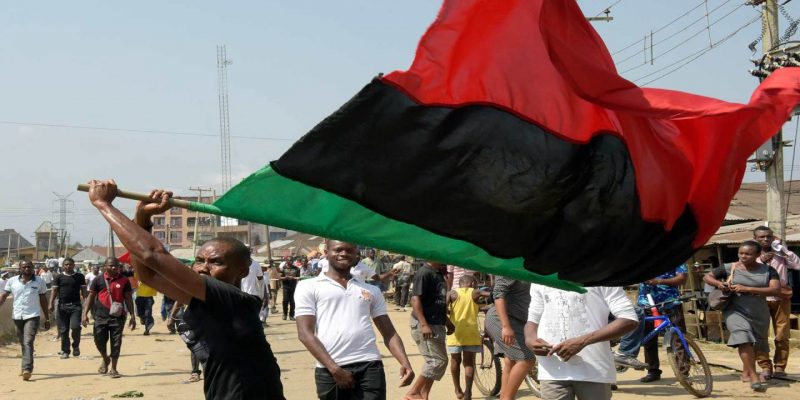
IPOB Gives FG 14-Day Ultimatum to List Nnamdi Kanu’s Appeal or Face Election Boycott
Separatist group accuses government of avoiding court after rushing to convict Kanu, demands urgent listing of appeal
The Indigenous People of Biafra (IPOB) has issued a 14-day ultimatum to the Federal Government, demanding the immediate listing and hearing of detained leader Mazi Nnamdi Kanu’s appeal, or face a boycott of the 2027 general election across the South-East and other parts of what the group describes as “Biafraland”. The ultimatum was issued on Monday by IPOB’s Head of Directorate of State (DOS), Mazi Chris Nwaogu, in a video broadcast. The development follows renewed concerns by Kanu’s family over the delay in hearing the appeal against the conviction and life sentence handed to the IPOB leader. The family recently disclosed that Kanu wrote to the Chief Justice of Nigeria and the President of the Court of Appeal, seeking the immediate listing and hearing of his pending cases.
Nwaogu accused the Federal Government of avoiding the court after moving swiftly to secure Kanu’s conviction. “The Federal Government has not filed a Respondent’s brief, they have not listed the appeal, they have not come to court. A country that rushed to convict is now too frightened to defend the conviction,” he said. He warned that the group would consider mobilising for a boycott of the 2027 elections if the government failed to act within the stipulated period. “We are giving them 14 days to list Onyendu Mazi Nnamdi Kanu’s appeal, if they refuse, we will consider boycotting the coming elections across Biafraland and beyond. A government that cannot face its Court of Appeal has no right to demand our votes,” Nwaogu added.
READ ALSO:
- Tinubu’s FBI records: Reno Omokri explains why President opposes release
- Seyi Tinubu Can Change Things at NFF — Obafemi Martins Backs President’s Son for Football Reform
- “I Cursed the Pastor” — Yemi Solade Reveals Why He Quit Church 13 Years Ago
Nwaogu also criticised the handling of Kanu’s case by the Nigerian judiciary, alleging that the proceedings from the trial court through the appellate stages had exposed serious concerns about the country’s judicial system. “This judicial conspiracy through the trial court to the remittal and the present silence will shame the Chief Justice of Nigeria and all lawyers who still pretend this system is healthy. This case will either reset the Nigerian judiciary or expose it,” he said. He particularly faulted the Supreme Court’s decision which overturned Kanu’s discharge and acquittal by the Court of Appeal, insisting that the apex court exceeded its constitutional powers by pronouncing on individual counts that had already been quashed by the Court of Appeal. “Justice Lawal Garba, JSC, crossed a line that the Constitution does not allow. This is the heart of the matter,” Nwaogu stated, arguing that a court “cannot manufacture jurisdiction that has ceased to exist.”
The Okwu-Kanu family had earlier raised the alarm over the delay in hearing Kanu’s appeal against his conviction. In a statement, the family disclosed that Kanu had separately petitioned the Chief Justice of Nigeria and the President of the Court of Appeal, requesting the immediate listing and hearing of his pending cases. The family drew a direct comparison to October 2022, when the Court of Appeal delivered a judgment discharging Kanu and quashing the criminal counts against him. According to the family, the Federal Government obtained a stay of execution just 14 days after that judgment, preventing Kanu from regaining his freedom. “Fourteen days. In fourteen days, the machinery of the Court of Appeal moved from an acquittal-equivalent discharge to a civil stay that kept Mazi Nnamdi Kanu in detention,” the family stated. The family disclosed plans to formally notify the United States Congress, Israeli Knesset, and International Bar Association of what it described as an “unacceptable delay” in the handling of Kanu’s cases.
Kanu commenced proceedings before the Supreme Court on November 7, 2025, challenging the legality of the apex court’s December 15, 2023 remittal judgment. According to the family, the Federal Government was duly served but has not filed a substantive response more than nine months later. There is also a separate appeal before the Court of Appeal challenging Kanu’s November 20, 2025 conviction and life sentence. Kanu’s Appellant’s Brief was filed on June 5, 2026, and served on the Federal Government, but the prescribed period for filing the Respondent’s Brief has elapsed without one being filed. In a related development, the Federal Government has withdrawn its cross-appeal seeking the death penalty against Kanu. Kanu’s Special Counsel, Aloy Ejimakor, confirmed that the government formally communicated its decision not to pursue the aspect of the appeal seeking to replace the life sentence with capital punishment.
IPOB Gives FG 14-Day Ultimatum to List Nnamdi Kanu’s Appeal or Face Election Boycott
-
 metro2 days ago
Kogi Abduction: Kidnappers Demand ₦20m Ransom for Each NYSC Member
-
 metro2 days ago
Anambra Police Arrest 28-Year-Old Suspected Drug Dealer, Recover ₦5.8m Illicit Consignment
-

 metro3 days ago
Two Masquerades Arrested After Allegedly Attacking Residents in Nsukka
-

 metro2 days ago
Igboho, Iru Èkùn: Act Now Before Parallel Authority Emerges — Agunbiade
-
 metro2 days ago
Deadly Ikola clash: Lagos demolishes shanties beneath high-tension lines
-
 metro3 days ago
IMAX Lekki Attack: Two Dead as Machete-Wielding Man Storms Cinema in Lagos
-

 metro2 days ago
DSS moves to halt Sowore’s cybercrime trial until after 2027 election
-
 Railway2 days ago
Nine Oxygen Cylinders Recovered as NRC, NSCDC Thwart Rail Vandalism in Osogbo