
metro
Court rejects FG’s evidence against Nnamdi Kanu
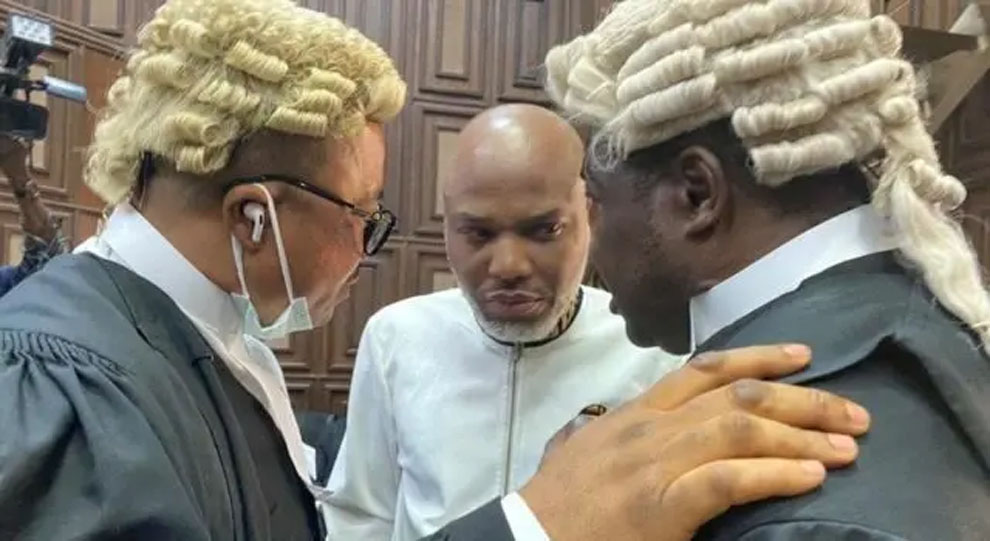
Court rejects FG’s evidence against Nnamdi Kanu
The Abuja Division of the Federal High Court on Thursday rejected the evidence sought to be tendered by the federal government in the ongoing trial of Nnamdi Kanu, leader of the proscribed Indigenous People of Biafra (IPOB).
Justice James Omotosho, in a ruling, agreed with the argument of the defence counsel, Paul Erokoro (SAN), that the Supreme Court had ruled that in extracting an extrajudicial statement from a suspect, the presence of his lawyer is mandatory.
Mr Omotosho held that though a provision of the Administration of Criminal Justice Act (ACJA), 2015, used the word “may” to mean that “the presence of a lawyer to a suspect is not a must while making a statement”, he could not close his eyes to the apex court’s decision.
The judge stood down the matter to deliver a ruling on the admissibility of the evidence sought to be tendered by the federal government.
The development occurred after FG’s counsel, Suraj Saida (SAN), and Mr Kanu’s lawyer, Paul Erokoro (SAN), adopted their written addresses and argued their case for and against the propriety of the evidence.
Ruling after the trial-within-trial, Mr Omotosho held that the issue is whether, with regard to the evidence placed before the court, the statements of Mr Kanu were admissible in law.
He stated that the burden of proof in a trial-within-trial lies with the prosecution to prove its case.
The judge said, in the mind of the court, the defendant did not establish the allegations of involuntariness in any way.
He said the video recordings showed that Mr Kanu was relaxed when he was interviewed by the State Security Services (SSS) operatives. He said the video and the statements showed they were the same.
READ ALSO:
- Hamas official says it will reject new US Gaza ceasefire plan backed by Israel
- Animals in human skin
- Senators link upsurge in banditry, Boko Haram activities to 2027 polls
However, the judge said the court must not close its eyes to the fact that Mr Kanu repeatedly said in the video that his statements were taken without his lawyers.
He held that relevant laws state that under Section 17(2) of ACJA, the statements of a defendant may be taken in the presence of a legal practitioner of his choice or, where he has no counsel, an official of the Legal Aid Council shall be present.
Mr Omotosho, however, added that the Supreme Court had ruled several times that the presence of a lawyer for a defendant when he is making his confessional statements is “mandatory”, and the security agencies must comply with it.
He said the charge against Mr Kanu was a grievous one, requiring the presence of the suspect’s lawyer during the recording of the statements.
“The statements are inadmissible in light of this omission by the prosecution,” Mr Omotosho said.
He held that the 2015 statements obtained from Mr Kanu are inadmissible in law due to the absence of his lawyers.
The judge subsequently expunged the video evidence and statements obtained from Mr Kanu on these grounds.
“The objection of the defendant’s counsel is upheld. The statements of October 23, 2015, and November 2015, earlier admitted in evidence, are rejected,” the judge said.
Mr Omotosho proceeded to mark the statements rejected and also expunge from the court’s record the video recordings of the interview and statement writing sessions that Mr Kanu had with the SSS officials in October 2015.
The video recordings were earlier admitted in evidence by the court during Wednesday’s proceedings and marked as Exhibits PWQ and PWR.
Mr Omotosho, on Wednesday, ordered a trial-within-trial following Mr Kanu’s rejection of the extrajudicial statements sought to be tendered by the prosecution.
The IPOB leader had alleged that he made the statements under duress.
Mr Kanu alleged that SSS officials, who interrogated him, denied him access to his lawyer, threatened not to allow him on bail and denied him the one hour granted to him daily to receive fresh air, given his health challenge.
He said he was threatened by an SSS investigator, whom he described as Brown Ukuaba, an assistant director of investigation.
Mr Kanu also alleged that his interrogators asked him to say things about former President Jonathan and former Governor Rochas Okorocha of Imo. He said he was kept in an underground cell, and the video recordings played in court were edited.
The FG’s witness, an SSS operative, however, insisted that Mr Kanu was never subjected to coercion and that all the complaints he raised were addressed.
He denied that Mr Kanu was subjected to any form of duress or coercion and faulted his lawyer’s claim that he was kept in solitary confinement in an underground cell and that he suffered from any ill-treatment.
The SSS operative said Mr Kanu was given preferential treatment and served bottled water during the interview sessions.
He also denied that anyone asked Mr Kanu to say things about Messrs Jonathan and Okorocha, adding that the IPOB leader “spoke voluntarily and truthfully in the interviews.”
Mr Omotosho then ordered the conduct of a trial-within-trial to ascertain the voluntariness or otherwise of Mr Kanu’s statements.
Court rejects FG’s evidence against Nnamdi Kanu
(NAN)








metro
Nigeria Security: FG Knows Every Terrorist by Name, Location — Sheikh Gumi

Nigeria Security: FG Knows Every Terrorist by Name, Location — Sheikh Gumi
Kaduna‑based Islamic scholar Sheikh Ahmad Abubakar Gumi has alleged that the Federal Government of Nigeria (FG) possesses detailed intelligence on terrorists and armed bandits, including their names and locations, underscoring the government’s awareness of insurgent activities across the country. The statement was made during a recent interview with DRTV, which quickly trended on social media, sparking national discussion about Nigeria’s ongoing security crisis.
Gumi was responding to claims that he personally maintains contact with terrorist and bandit leaders responsible for attacks and kidnappings in northern Nigeria. He clarified that his engagements with armed groups are never conducted alone, but always in coordination with security agencies, including the police and military.
“The government knows every terrorist by name and by location,” Gumi said. “I don’t go alone to negotiate — I go with the police and other security agencies.” He also revealed that some negotiation efforts involved visits to traditional rulers and trips into forested areas believed to be hideouts for armed groups. “I would go to the Emirs. In fact, when we went to one forest, I even went with women into the bush,” he added.
READ ALSO:
- Iran Security Chief Fires Warning at Trump as US-Iran Tensions Escalate
- Egypt Raises Fuel Prices Up to 30% as Middle East War Drives Global Energy Costs
- Nothing Will Happen if You Die, Afenifere Director Tells Peter Obi
Gumi’s Role in Dialogue and Negotiation
Gumi, a former army captain and respected Islamic cleric, has participated in several dialogue initiatives with armed groups, including Boko Haram factions and bandit networks, advocating for negotiation as a means to reduce violence and encourage fighters to lay down their arms. He emphasized that peaceful engagement remains a vital component of Nigeria’s security strategy, particularly in areas where military operations alone have struggled to restore stability.
The cleric’s comments have reignited debate over the effectiveness of Nigeria’s counter-terrorism strategies. While some analysts say Gumi’s claims highlight the wealth of intelligence available to the government, critics question why insurgent activity continues despite this knowledge. Many Nigerians on social media expressed concerns over the implementation of intelligence and the apparent inability to fully neutralize armed groups.
Public Reactions and Security Implications
Reactions to Gumi’s statements were mixed. Supporters argue that his involvement is crucial for mediating conflict and reducing bloodshed, while critics worry that such negotiations could legitimize criminals and undermine military efforts. Similar assertions by regional leaders in the past have also prompted debate about how intelligence and security operations are coordinated across Nigeria’s troubled regions.
As of now, the Federal Government and security agencies have not officially confirmed or refuted Gumi’s claims, leaving the interview as a focal point in ongoing discussions about national security, counter-insurgency strategy, and intelligence deployment.
Nigeria Security: FG Knows Every Terrorist by Name, Location — Sheikh Gumi
metro
Family of Teacher Killed in Student Prank Tragedy Wants Charges Against Teens Dropped

Family of Teacher Killed in Student Prank Tragedy Wants Charges Against Teens Dropped
The family of Jason Hughes, a Georgia high school teacher who died after a student prank went wrong, has called on authorities to drop the criminal charges filed against the teenagers involved.
Hughes, 40, a mathematics teacher at North Hall High School in Hall County, Georgia, died on Friday, March 6, after he was accidentally run over during a prank outside his home.
According to the Hall County Sheriff’s Office, a group of students had gone to the teacher’s residence to carry out a prank commonly known as “toilet papering” or “rolling”, where trees and yards are covered with toilet paper.
Investigators said the students attempted to leave the area in two vehicles when Hughes came outside after noticing the prank.
Because it had been raining, Hughes reportedly slipped while moving toward the students and fell into the road.
Authorities said Jayden Ryan Wallace, 18, was driving one of the vehicles when Hughes fell into the roadway and was struck as the car drove away.
The teenagers stopped immediately and attempted to help the teacher before emergency responders arrived. Hughes was rushed to a hospital but later died from his injuries.
READ ALSO:
- Pregnant Woman Begs Authorities to Free Husband Jailed for Domestic Violence
- Strait of Hormuz Crisis: Iran Threatens to Stop Gulf Oil Shipments
- Turaki‑Led PDP Rejects Court of Appeal Ruling, Heads to Supreme Court
Following the incident, Wallace was charged with first-degree vehicular homicide, reckless driving, criminal trespass and littering, while the four other teenagers involved were charged with criminal trespass and littering.
Despite the charges, Hughes’ family has publicly appealed for leniency, describing the incident as a tragic accident rather than a deliberate act.
In a statement to NBC News, the family revealed that Hughes had actually been aware that students planned to prank him and had been looking forward to catching them in the act.
They explained that the teacher slipped on the wet ground and fell into the street moments before the vehicle passed.
According to the family, Hughes had a deep connection with his students and dedicated much of his life to supporting them.
“He loved these kids, and they loved him too,” the family said, adding that they support dropping the charges against all the students involved.
“Our family is determined to prevent a separate tragedy from occurring by ruining the lives of these students. That would go against Jason’s lifelong dedication to investing in the lives of young people,” the statement read.
The family also asked the public to pray for both their family and the students involved.
“We ask that you continue to pray for our family and also for the students involved in the accident along with their families,” they said.
Hughes’ brother, Richard Hughes, described him as an exceptional person and mentor.
“He was my mentor and someone I looked up to. It’s just tragic and sad all around,” he said.
Meanwhile, Lee Darragh said the case is still under investigation and it is too early to determine whether the charges will proceed.
“It is much too early in this process. I’ll not be commenting until the closure of the case,” Darragh said.
Authorities say the Hall County Sheriff’s Office investigation is ongoing as they continue reviewing the circumstances surrounding the fatal incident.
The tragedy has sparked wider conversations about student pranks, school safety, and how seemingly harmless acts can quickly lead to devastating consequences.
Family of Teacher Killed in Student Prank Tragedy Wants Charges Against Teens Dropped
metro
Pregnant Woman Begs Authorities to Free Husband Jailed for Domestic Violence

Pregnant Woman Begs Authorities to Free Husband Jailed for Domestic Violence
A pregnant Ghanaian woman, 22-year-old Priscilla Sackey, has appealed to authorities to release her husband, Richard Adjei, who is currently serving a six-year prison sentence for domestic violence.
Priscilla made the emotional appeal during an interview with the Crime Check Foundation, explaining that she never intended for the situation to lead to such a lengthy jail term. According to her, she initially reported her husband to the police only to warn and deter him from further abuse, not to have him imprisoned.
Priscilla recounted that the incident occurred after her husband allegedly assaulted her during a domestic dispute. She said she reported the matter to the police after the attack. However, when officers came to their home to arrest him, he was not around.
When Richard later returned and discovered she had reported him to the police, he allegedly became angry and assaulted her again.
“On the day my husband was arrested, he assaulted me, and I went to report him to the police. When the police came to arrest him, he was not home. When he came back, he beat me again for reporting him,” she said.
READ ALSO:
- Strait of Hormuz Crisis: Iran Threatens to Stop Gulf Oil Shipments
- Turaki‑Led PDP Rejects Court of Appeal Ruling, Heads to Supreme Court
- US to Designate Sudanese Muslim Brotherhood as Terrorist Organisation
According to Priscilla, her aunt, who was angered by the renewed violence, reported the matter to the police again, which eventually led to Richard’s arrest and prosecution. The court later found him guilty and sentenced him to six years imprisonment for domestic assault.
Despite the conviction, Priscilla says she now regrets how events unfolded and wants her husband released. The pregnant woman explained that she currently has no family support, as both her family and her husband’s relatives have allegedly turned their backs on her.
She added that she needs her husband’s help to take care of their unborn child and support the household financially.
“At least if Richard were here, he would have worked to take care of us. Please help me get him released,” she pleaded.
Priscilla also stressed that she never expected the police report to result in a prison sentence.
Priscilla and Richard have been married for two years, and the case has drawn attention to the challenges faced by victims of domestic violence in Ghana, where economic dependence and family pressures often complicate such cases.
Legal experts say once a domestic violence case is prosecuted in court, it becomes a criminal matter handled by the state, meaning the victim cannot automatically withdraw the case even if reconciliation is later sought.
Advocates say the situation highlights the need for stronger support systems for domestic violence victims, including financial assistance, counselling, and shelters.
It remains unclear whether Richard’s sentence could be reviewed, as any release would likely depend on legal processes such as an appeal, presidential pardon, or court review.
Pregnant Woman Begs Authorities to Free Husband Jailed for Domestic Violence

-

 News3 days ago
Tinubu Approves Salary, Allowance Increase for Nigerian Armed Forces
-

 International2 days ago
Top 10 Strongest Militaries in the World in 2026 – Full Ranking
-

 metro1 day ago
Viral Video Shows Man Disarming Robbers After Minna Bank Heist, ₦10m Stolen
-

 Business2 days ago
NNPCL, Marketers Increase Petrol Price Again Within 24 Hours After Dangote Refinery Hike
-

 metro1 day ago
Tragedy in Ibadan as Woman, 26, Dies at Boyfriend’s Residence
-

 metro2 days ago
EFCC Intercepts Wife of Federal High Court Chief Judge With $160,000 Cash
-

 metro1 day ago
Students Escape as Four-Storey School Building Collapses in Lagos
-

 News2 days ago
Strait of Hormuz Crisis Threatens Nigeria’s Food Inflation Progress as Oil Prices Surge