

Business
Dangote, marketers slash petrol depot prices amid FG pressure

Dangote, marketers slash petrol depot prices amid FG pressure
Dangote Petroleum Refinery and several major fuel marketers have reduced their petrol depot prices following mounting pressure from the Federal Government for cost-reflective fuel pricing, a move that could pave the way for lower petrol pump prices across Nigeria.
The latest price cuts come amid increasing competition in the downstream petroleum sector, improved domestic refining capacity and sustained moderation in global crude oil prices, all of which are reshaping the country’s deregulated fuel market.
The development followed a high-level stakeholders’ meeting convened in Abuja by the Nigerian Midstream and Downstream Petroleum Regulatory Authority (NMDPRA) to address concerns over the disconnect between falling international crude oil prices and the relatively high retail price of Premium Motor Spirit (PMS) in Nigeria.
The meeting brought together representatives of the Dangote Petroleum Refinery, the Major Energy Marketers Association of Nigeria (MEMAN), the Independent Petroleum Marketers Association of Nigeria (IPMAN), the Depot and Petroleum Products Marketers Association of Nigeria (DAPPMAN), the Nigerian Association of Road Transport Owners (NARTO) and the Petroleum Products Retail Outlets Owners Association of Nigeria (PETROAN).
Addressing industry stakeholders, the Minister of State for Petroleum Resources (Oil), Senator Heineken Lokpobiri, said the current petrol price no longer reflects prevailing international market realities.
According to him, when Brent crude traded above $100 per barrel, marketers quickly adjusted pump prices upward. Therefore, he argued, Nigerian consumers deserve to benefit now that global crude prices have dropped below $70 per barrel.
Lokpobiri stressed that while Nigeria operates a fully deregulated downstream petroleum market under the Petroleum Industry Act (PIA), deregulation should not become an avenue for excessive profiteering. He noted that the law also empowers the NMDPRA to prevent unfair pricing practices and protect consumers from unreasonable fuel costs.
READ ALSO:
- Russian airstrike kills Nigerian medical student days before graduation in Ukraine
- FG meets Dangote, oil marketers to ensure fair petrol prices
- ICYMI: How to Apply for 2026 FRSC Recruitment Successfully
The minister disclosed that discussions with marketers were frank and productive, adding that further engagements would continue until a pricing framework that reflects prevailing crude oil prices is achieved.
“We presented the concerns of Nigerian consumers, and marketers have agreed to review the issues raised. Discussions are ongoing, and we believe meaningful progress is being made,” he said.
Following the meeting, fresh depot pricing data showed that Dangote Petroleum Refinery reduced its Lagos ex-depot petrol price by ₦3 per litre, lowering the price from ₦1,079 to ₦1,076 per litre. The refinery, however, retained its diesel ex-depot price at ₦1,500 per litre.
The latest adjustment adds to a series of recent reductions by the refinery as it continues to leverage increased production efficiency and stronger domestic supply to compete aggressively in Nigeria’s fuel market. Industry observers say Dangote’s pricing strategy is compelling marketers and depot operators to review their prices in order to retain market share.
Several petroleum marketers also announced fresh reductions in their depot prices.
In Lagos, NIPCO reduced its petrol depot price by ₦2 to ₦1,076 per litre, while Pinnacle lowered its price by ₦3 to ₦1,075 per litre. Similarly, Sahara, AIPEC and African Terminal each reduced their depot prices by ₦4, bringing their petrol prices to ₦1,075 per litre, while Aiteo maintained its price at ₦1,075 per litre.
Diesel prices also recorded noticeable declines. Rain Oil cut its Automotive Gas Oil (AGO) price by ₦15 to ₦1,430 per litre, while Ibeto, Duport and Ibachem all reduced their diesel prices to ₦1,430 per litre. Dangote Refinery retained its diesel price at ₦1,500 per litre.
The downward pricing trend extended to other parts of the country.
In Port Harcourt, Matrix reduced its petrol price by ₦8 to ₦1,087 per litre and slashed diesel by ₦55 to ₦1,465 per litre, the largest diesel reduction recorded during the trading session. Sigmund also lowered its petrol price by ₦12 to ₦1,082 per litre, although it marginally increased diesel by ₦2 to ₦1,463 per litre.
In Calabar, Fynfield reduced its petrol price by ₦7 to ₦1,090 per litre, while Soroman lowered its price by ₦5 to the same level.
In Warri, Matrix and Prudent both reduced petrol prices by ₦5 to ₦1,085 per litre. On the diesel side, Prudent cut its price by ₦25 to ₦1,475 per litre, while A.Y.M. Shafa reduced its diesel price by ₦3 to ₦1,455 per litre.
Energy analysts believe the latest reductions underscore how competition is transforming Nigeria’s deregulated downstream petroleum sector. The commencement of large-scale operations at the Dangote Petroleum Refinery has significantly improved domestic fuel availability, reduced dependence on imported petroleum products and compelled depot owners and marketers to compete more aggressively on price. The trend has also been supported by relatively stable international crude oil prices, easing pressure on the cost of refined petroleum products.
The Chief Executive of the NMDPRA, Mallam Rabiu Umar, said government engagement with marketers became necessary because retail petrol prices had not fallen in line with declining global crude oil prices. According to him, deregulation should promote both investor confidence and consumer protection, stressing that sustainable profitability for marketers and affordable fuel prices for Nigerians can coexist within a transparent and competitive market.
Meanwhile, the Independent Petroleum Marketers Association of Nigeria (IPMAN) expressed optimism that petrol pump prices could eventually fall below ₦800 per litre.
IPMAN National President, Abubakar Garima, attributed the projection to plans by independent marketers to begin purchasing products directly from the Dangote Petroleum Refinery, eliminating several intermediary costs that currently push up retail prices. According to him, the association has already reduced petrol prices by about ₦125 per litre in several parts of the country and will continue to lower prices whenever acquisition costs decline.
Industry stakeholders believe that if global crude oil prices remain stable and domestic refining capacity continues to improve, Nigerians could witness additional reductions in petrol prices in the coming weeks, providing much-needed relief for households, transport operators and businesses grappling with high energy costs.
If you’d like, I can also tighten this further into a more concise 700–900-word premium news feature in the editorial style commonly used by major Nigerian news platforms.
Dangote, marketers slash petrol depot prices amid FG pressure







Business
Tantita Operations Push Oil Export Earnings to $9.39bn in Q2

Tantita Operations Push Oil Export Earnings to $9.39bn in Q2
Nigeria’s crude oil export earnings rose to $9.39 billion in the second quarter of 2026, with improved pipeline security, higher production and greater stability in the Niger Delta supporting the stronger performance.
Provisional Balance of Payments (BOP) data showed that Nigeria’s total goods exports increased to $20.08 billion in Q2, up from $15.56 billion in the first quarter.
Crude oil exports increased by 15.78 per cent to $9.39 billion, while natural gas exports climbed by 40.15 per cent to $3.63 billion.
The improvement has renewed attention on the role of pipeline security in protecting Nigeria’s oil production and ensuring that crude reaches evacuation points and export terminals.
Among the companies involved in pipeline surveillance in the Niger Delta is Tantita Security Services Nigeria Limited (TSSNL), which was engaged by the Federal Government to protect oil pipelines and other critical petroleum infrastructure.
Tantita’s operations, carried out alongside government security agencies, have focused on tackling oil theft, illegal bunkering and pipeline vandalism and improving the security of facilities used to transport crude oil.
READ ALSO:
- Fifty Years After “Africa Has Come of Age”: A Personal Reflection on Nigeria’s Silence at the United Nations
- Family seeks N10m to free kidnapped newlywed, other victims
- Trump launches ‘Super Intelligence Force’ to keep US ahead in AI race
Industry stakeholders have linked the improved operating environment in the Niger Delta to increased crude production and stronger export performance. However, the rise in export earnings cannot be attributed to Tantita alone, as production volumes, international oil prices, investments, operational efficiency and wider government measures also influence export receipts.
The broader export figures also showed significant improvements across other sectors of the petroleum industry.
Refined petroleum product exports increased by 66.24 per cent to $3.94 billion, while non-oil exports rose by 25.30 per cent to $3.12 billion during the quarter.
At the same time, Nigeria’s crude oil imports fell sharply from $1.39 billion in Q1 to $580 million in Q2, further strengthening the country’s external position.
The stronger export performance helped push Nigeria’s current account surplus to $7.54 billion, representing a 67.93 per cent increase from the $4.49 billion recorded in Q1. The figure was also higher than the $5.17 billion recorded in Q2 2025.
The increase in the current account surplus was driven largely by higher export earnings and an improved goods account.
The rise in crude earnings also coincided with stronger production, with Nigerian crude output reaching about 1.56 million barrels per day in June 2026, excluding condensates.
The development is significant for Nigeria, which has struggled in recent years to consistently meet its production potential because of crude oil theft, pipeline vandalism, ageing infrastructure and underinvestment in the upstream sector.
Improving security around oil-producing assets has therefore become a key part of efforts to raise output and increase foreign-exchange earnings.
Tantita, led by High Chief Government Oweizide Ekpemupolo, popularly known as Tompolo, has been at the centre of the Federal Government’s pipeline surveillance arrangement in the Niger Delta.
Stakeholders, however, say sustained growth in oil earnings will require more than surveillance operations. They have called for continued investment in exploration and field development, improved infrastructure, enhanced recovery from mature fields and faster development of major deepwater projects.
The Federal Government has also been pursuing measures aimed at attracting fresh investment into Nigeria’s upstream sector, including fiscal incentives for deepwater oil and gas projects.
For Nigeria, the latest export figures offer a boost at a time when the country is seeking stronger foreign-exchange inflows, increased oil production and greater fiscal revenues.
The challenge now is to sustain the improvement by keeping petroleum infrastructure secure, reducing crude losses and ensuring that higher production translates into consistent export earnings and broader economic benefits.
Tantita Operations Push Oil Export Earnings to $9.39bn in Q2
Business
Dangote Sets 40-Month Deadline for $16bn East Africa Refinery in Kenya
Dangote Sets 40-Month Deadline for $16bn East Africa Refinery in Kenya
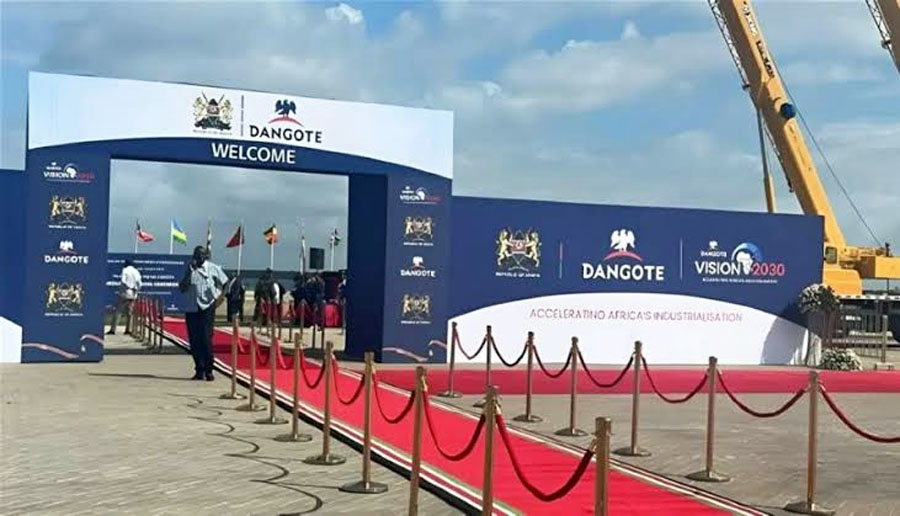
Nigerian industrialist Aliko Dangote has set a 40-month completion target for his planned $16 billion East Africa refinery in Lamu, Kenya, following the official groundbreaking of the project.
Dangote and Kenyan President William Ruto broke ground for the 700,000-barrel-per-day (bpd) refinery on Wednesday, September 30, 2026, with the facility designed to supply refined petroleum products to Kenya and other countries across the region.
Dangote said the refinery would be commissioned within 40 months.
“We will come back here and commission this refinery in 40 months from today,” he said at the ceremony.
The Dangote East Africa Petroleum Refinery and Petrochemicals Complex is expected to process about 700,000 barrels of crude oil daily, making it one of the largest refining projects in Africa and, when completed, potentially the world’s largest single-train refinery.
The project is expected to produce petrol, diesel, jet fuel, polypropylene and base oil, with the products targeted at Kenya and wider East African markets. Dangote has also said part of the refinery’s jet-fuel output could be supplied to Europe and the United Kingdom.
The facility will also include a planned 1,000-megawatt power plant, which Dangote said would provide electricity for the wider industrial complex.
READ ALSO:
- Zimbabwe Tycoon Wicknell Chivayo, Wife Among Six Killed in Helicopter Crash
- 2027: Amaechi Recalls How APC Defeated PDP, Orders ADC Mobilisation
- Adeyanju Faults Okpebholo’s Governance, Commends Edo Anti-Kidnapping Efforts
Beyond refining, the billionaire said the project would create an industrial ecosystem covering petrochemicals, logistics, engineering, marine services, manufacturing, technology and small and medium-sized enterprises.
Dangote also announced plans for a training school that would prepare 1,000 Kenyan engineering graduates for opportunities associated with the project. The wider development is expected to generate thousands of jobs across the refinery and related industries.
The project has attracted major international engineering and technology partners, with Honeywell Technologies providing process technologies, licensing, engineering services, catalysts, equipment and digital solutions.
The use of established designs and experience from Dangote’s Nigerian refinery is expected to shorten the development schedule compared with a typical new refinery.
Engineers India Limited is also involved in the project under a major engineering and project-management contract.
Dangote’s Kenyan project is modelled partly on the experience of his 650,000-bpd refinery in Lagos, with the new facility expected to draw on technology and engineering experience gained from the Nigerian plant.
The refinery is expected to source crude from Uganda and other African producers, while serving a market extending beyond Kenya to countries including Uganda, Rwanda, Tanzania, Ethiopia and South Sudan.
Regional leaders who attended the groundbreaking included Ugandan President Yoweri Museveni and Ethiopian Prime Minister Abiy Ahmed, alongside other African leaders and former Nigerian President Olusegun Obasanjo.
President Ruto described the project as an investment in energy security, industrialisation and regional integration, while stressing the importance of ensuring that Kenyan citizens benefit from the employment and training opportunities created by the refinery.
Dangote has also proposed allowing governments in the region to take a combined 30 per cent stake in the refinery, potentially giving participating countries an opportunity to benefit financially from the project.
However, the project faces a legal challenge over the land on which it is being developed. A Kenyan court ordered parties to maintain the status quo over a disputed parcel in Lamu after residents challenged the development, citing ancestral land claims and other concerns.
Environmental concerns have also been raised over the potential impact of the project on the coastal ecosystem and the wider Lamu area.
Despite the legal and environmental issues, Dangote has said the project will proceed.
Once completed, the $16 billion Kenya refinery is expected to increase refining capacity in East Africa, reduce dependence on imported petroleum products and support the region’s broader industrialisation drive.
Dangote Sets 40-Month Deadline for $16bn East Africa Refinery in Kenya
Business
Dangote Draws Battle Lines as Fuel Import Fight Heads Back to Court
Dangote Draws Battle Lines as Fuel Import Fight Heads Back to Court
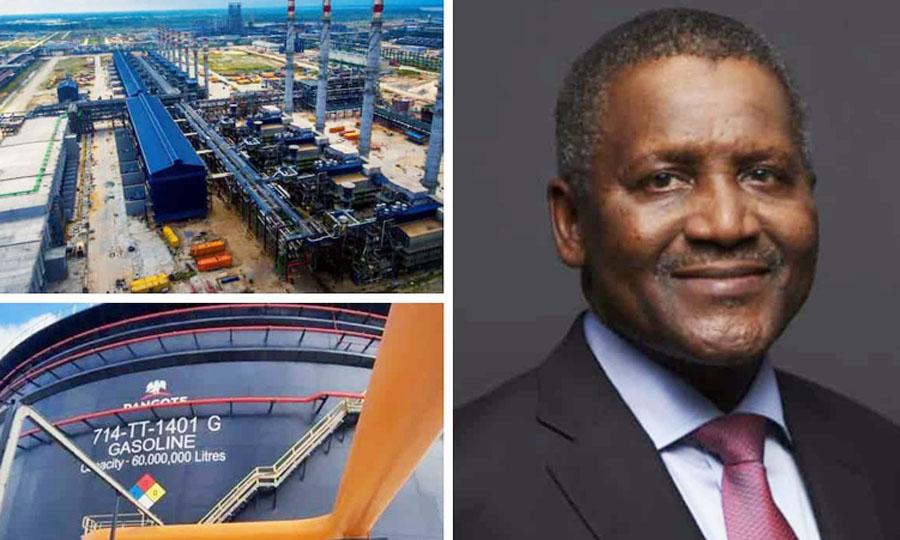
Aliko Dangote, President of Dangote Industries Limited, has said he is prepared to face legal challenges as the dispute over fuel imports, domestic refining and import licences intensifies in Nigeria.
Dangote spoke amid renewed litigation involving the Dangote Petroleum Refinery and the Nigerian Midstream and Downstream Petroleum Regulatory Authority (NMDPRA) over the continued importation of refined petroleum products into Nigeria.
The latest development followed a Federal High Court ruling in Abuja directing the NMDPRA to continue granting, extending or renewing fuel import licences for Matrix Energy, A.A. Rano and AYM Shafa, provided the companies meet the relevant legal and regulatory requirements.
Justice Inyang Ekwo ruled that the regulator’s handling of the companies’ applications did not comply with provisions of the Petroleum Industry Act (PIA). The court also held that the NMDPRA has a responsibility to promote competition in the midstream and downstream petroleum sectors.
The ruling did not give the three companies unrestricted authority to import petroleum products. Their operations remain subject to applicable regulatory and statutory requirements.
READ ALSO:
- Tinubu Returns After 30 Days in Europe, Says ‘I’m Healthy and Ready to Work’
- NMDPRA Moves Against Fuel Pump Fraud, Threatens Licence Revocation
- $2.1m Land Suit: Court Orders Wike’s Son to Produce American Passport
The judgment has added fresh momentum to a wider dispute over whether Nigeria should continue granting petrol import licences as domestic refining capacity expands.
The Dangote Refinery, which has a stated capacity of 650,000 barrels per day, has challenged the continued issuance or renewal of some import licences in a separate case.
The refinery’s position is that continued imports should be restricted where domestic refining capacity is available to supply the local market. The case remains before the court.
The NMDPRA, however, has continued to approve import permits, citing the need to safeguard petroleum supply and energy security.
The regulator approved permits covering about 830,000 metric tonnes of petrol for several marketers for the fourth quarter of 2026. The beneficiaries included Matrix Energy, A.A. Rano, AYM Shafa, NIPCO, Pinnacle Oil and Gas and Bono Energy.
The development has intensified debate over competition in Nigeria’s downstream oil sector, particularly as the Dangote Refinery expands its contribution to domestic fuel supply.
Dangote’s comments also came as his business interests face other legal challenges outside Nigeria.
In Kenya, a court has ordered the preservation of the existing status quo over land earmarked for Dangote’s proposed 700,000-barrel-per-day refinery in Lamu, following a dispute involving residents who claim ancestral rights over part of the proposed project site.
Dangote has maintained that he is prepared to defend his investments through the legal process.
The businessman has also said Africa could largely eliminate its dependence on imported refined petroleum products by 2030, as new refineries come on stream across the continent.
In Nigeria, the continuing dispute places domestic refining, fuel imports, competition, petroleum regulation and energy security at the centre of an increasingly significant legal and commercial battle.
The competing positions have not been finally resolved, with the various court cases still ongoing.
Dangote Draws Battle Lines as Fuel Import Fight Heads Back to Court
-

 metro2 days ago
NYSC Kidnap: Abductors Demand N950m for 19 Prospective Corps Members in Imo
-

 Politics2 days ago
2027: Oshiomhole Dares Opposition Over ₦500 Petrol Promise, Says APC Will Take Argument to Nigerians
-
 metro2 days ago
N500 Petrol, Wage Award: Public Sector Workers Begin Warning Strike
-

 metro2 days ago
Amaechi: Tinubu’s Policies Made My Mother’s Drugs Unaffordable
-

 metro2 days ago
Tension as Kidnappers Threaten to Kill Abducted Oyo Corps Members
-

 metro1 day ago
‘I Thought I Was Dead’ — Hairstylist’s Daring Escape From Kidnappers After Benin-Ore Ambush
-

 Entertainment2 days ago
Less Than Four Months After Wedding, Jarvis Threatens Peller With Lawsuit Over Second-Wife Plan
-

 Politics2 days ago
Wike to Amaechi: What Did You Bring to Rivers After 24 Years in Power?