

metro
EXPLAINED: Proposed tax bills, what they would mean for Nigerians

EXPLAINED: Proposed tax bills, what they would mean for Nigerians
In August 2023, President Bola Ahmed Tinubu inaugurated the Presidential Committee on Fiscal Policy and Tax Reforms in Abuja. As nominally suggested, the committee has been working on reforming how taxes are administered, charged and remitted in Nigeria.
This committee’s activities have culminated in the proposal of the Tax Reform Bills which have caused a stir within policy circles and public debates in Nigeria. The bills include the Nigeria Tax Bill, Nigeria Tax Administration Bill, Nigeria Revenue Service (Establishment) Bill, and Joint Revenue Board (Establishment) Bill.
In the following paragraphs, FIJ simplifies the key aspects of the bills that have become major talking points.
VAT REVENUE SHARING
The topic of Value Added Tax (VAT) in the proposed Tax Reform Bills is a major talking point. VAT is an extra fee paid whenever one buys an item, a small slice added to the price that goes to the government to fund public services.
In Section 40 of the current VAT law in Nigeria, the government takes everything collected and splits it into three big pots. If N1,000,000 is collected in a year, N150,000 goes straight to the Federal Government (15%) and N350,000 (35%) is shared among the 774 local governments. The remaining N500,000 (50%) is shared among the states.
But here is where it gets interesting. The N500,000 is not split among states randomly. Half of it — N250,000 — is shared equally among all 36 states. So, every state gets about N6,944 regardless of how economically viable or large they are.
N150,000 (30%) is shared with the states based on their population. The states with larger populations get a larger cut of this N150,000. The last N100,000 goes to states based on derivation, a fancy word that means “Who brought in the money?” States that generate more VAT get a bigger portion of the amount.
READ ALSO:
- 12 feared dead in Zamfara community bomb explosion
- BREAKING: Senate forms special committee to address tax reform bill concerns
- Manchester United ‘scrap plans to wear LGBT rainbow jacket after devout Muslim player Noussair Mazraoui refused to wear it’
In the proposed tax reform bill, however, FG gets N100,000 (10%) and states have N550,000 (55%) to share. Most importantly, the derivation pot in the proposed reform is bigger. N330,000 (60%) out of the N550,000 will be shared with the 36 states based on how much VAT they generate.
On the more individual level, the current tax system only shares a 7.5% VAT on the goods and services Nigerians use. In the proposed bill, VAT charged on goods and services will go up from 7.5% to 10% first and then progressively to 15% by 2030.
In short, Nigerians will pay more VAT, and it will increase as the years go by.
However, core services such as rent, (public) transportation, health, food and education are exempted from VAT.
PERSONAL INCOME TAX CHANGES
Under the current tax system in Nigeria, people earning less than N300,000 annually don’t pay any tax. Those earning exactly N300,000 are taxed at 7% of their earnings, which amounts to N21,000. For individuals who earn between N300,000 and N600,000, the first N300,000 is taxed at 7% (N21,000), while the next N300,000 is taxed at 11% (N33,000), bringing the total tax to N54,000.
For incomes between N600,000 and N1.1 million, the first N600,000 is taxed as explained (N54,000), and the next N500,000 is taxed at 15%, adding another N75,000. This means you’ll pay a total of N129,000.
Those earning between N1.1 million and N2.7 million pay N129,000 on the first N1.1 million and 21% (N336,000) on the next N1.6 million, which brings their total tax to N465,000. For the people who earn more than N3.2 million, the first N3.2 million is taxed at N465,000, and anything above that is taxed at 24%.
Under the proposed reforms, the tax brackets change significantly. People earning up to N800,000 annually won’t pay any tax at all. For those earning between N800,000 and N3 million, the first N800,000 remains tax-free, while the next N2.2 million is taxed at 15%, amounting to N330,000.
For incomes between N3 million and N12 million, the first N3 million is taxed at N330,000, and the next N9 million is taxed at 18%, which adds N1,620,000, making the total tax N1,950,000.
READ ALSO:
- Lagos govt shuts supermarket accused of selling expired products
- Queen Dami to Portable: I’m only with you for money, will leave if you take new wife [VIDEO]
- Hookups lead to ritual killings, missing girls in Nigeria – Police
For those who earn between N12 million and N25 million, the first N12 million is taxed at N1,950,000, and the next N13 million is taxed at 21%, adding N2,730,000 and bringing the total tax to N4,680,000.
For those earning between N25 million and N50 million, the first N25 million is taxed at N4,680,000, and the next N25 million is taxed at 23%, adding N5,750,000 and bringing the total to N10,430,000. Finally, anyone earning above N50 million pays N10,430,000 on the first N50 million and 25% on anything above that.
Essentially, anyone earning below a million naira a year would not pay taxes under this structure. Also, those who earn a higher income will pay more.
CORPORATE INCOME TAXES CHANGES IN THE BILL
Under the current tax system, companies in Nigeria pay different rates of Corporate Income Tax (CIT) based on their size. Small companies with a total revenue of N25 million or less don’t pay any taxes.
Medium companies, earning between N25 million and N100 million, pay 20% (between N5 million and N20 million). Large companies, making over N100 million, pay the highest rate of 30%. For example, if a company makes N200 million in profits, it owes N60 million in taxes under the current rules.
The proposed reforms simplify this system and reduce rates for many companies. Small companies still won’t pay any taxes, but medium and large companies will pay the same rate.
In 2025, the rate will be 27.5% for both medium companies and larger ones. This will drop to 25% from 2026 onward. That same company making N200 million would pay N55 million in 2025 and N50 million in 2026.
READ ALSO:
- Court orders remand of Farotimi, Atiku says detention to intimidate citizens
- N80bn fraud: Court orders ex-AMCON MD Ahmed Kuru’s arrest
- FCT police impound 296 vehicles with tinted glass, defaced number plates
There’s also a new rule in the proposal to make sure big companies don’t get away with paying too little tax. If a company’s effective tax rate (what it actually pays after deductions) is less than 15%, it will have to pay extra to meet that minimum.
For instance, if such a company earns N20 billion and calculates its taxes at 12%, it would owe N2.4 billion. Under the new rule, it must add N600 million to meet the 15% minimum, bringing its total tax to N3 billion.
SCRAPPING FIRS AND UNIFYING TAXATION
The Nigeria Revenue Service Bill, proposed by the Presidential Tax Reform Committee, proposes replacing the Federal Inland Revenue Service (FIRS) with a new body called the Nigeria Revenue Service (NRS). In simple terms, the NRS will take over from FIRS but with more responsibilities.
One major change is the plan to centralise tax collection. Currently, some taxes are paid to state and local government agencies, but the NRS will handle all tax collection. It will also assist states and local governments in collecting their taxes and ensuring the funds are properly sent to them.
The bill also aims to simplify Nigeria’s complex tax laws. At the moment, taxes are governed by multiple acts, such as the Company Income Tax Act, VAT Act, and Petroleum Profits Tax Act. The proposed law will merge these into a single act, making taxes easier to understand and manage.
Businesses will no longer have to deal with different agencies for different taxes. Instead, the NRS will handle everything in one place, reducing any existing confusion for taxpayers.
The reforms also promise to introduce new tools to make the tax system fairer and more efficient. A Tax Appeal Tribunal will be set up to resolve disputes quickly and without the need for regular courts.
Meanwhile, a Tax Ombudsman will step in when taxpayers face issues like delays, errors or poor service. This office will investigate complaints and recommend solutions to ensure everyone is treated fairly.
READ ALSO:
- How mother of late Dowen College student, Sylvester Oromoni, died, family, others mourn
- Gunmen kill pastor going for burial, kidnap 3 others in Kogi
- Sheikh Gumi supports Tinubu’s tax reform bills, gives reasons
If the bill becomes law, the Joint Revenue Board will also be established to coordinate tax matters across all levels of government. Altogether, these changes promise a simpler, more streamlined tax system for businesses and individuals alike.
WHAT ARE DEVELOPMENT LEVIES AND WHAT HAPPENS TO THEM
The remittance of development levies is one of the major talking points in the Tax reform bill.
Critics like Borno State Governor Babagana Zulum have called the Federal Government out, for ‘planning to merge or scrap’ agencies like the National Information Technology Development Agency (NITDA), the National Agency for Science and Engineering Infrastructure (NASENI), and the Tertiary Education Trust Fund (TET Fund).
Under the current system, Nigerian companies are mandated to pay certain levies to these agencies. Legislations like the NITDA Act, the Finance Act and the TETFUND Act, enforce these levies.
In that system, firms 3% of the assessable profit for each year of assessment to fund education in Nigeria through TEFUND. Companies earning N100 million or more annually also contribute 1% of their pre-tax profits to the National Information Technology Development Fund to boost IT innovation.
Additionally, some industries, such as banking and telecommunications, would pay a newer 0.25% levy to fund science and engineering projects through NASENI.
The proposed bill simplifies this structure with just one development levy. Medium and large companies will contribute, but small businesses and foreign companies are exempt. From 2025 to 2026, the companies pay 4% of profits. This covers remittances to education, science and research, and innovation funds.
The levy drops to 3% between 2027 and 2029, and stays at 2% from 2030 onward. The collected funds will be split among key agencies if the new bill becomes law.
In the first year post-signing (2025-2026), The TET Fund gets the lion’s share — 50%. This share of the development levy will increase to nearly 67% by 2027. But after 2029, the TETFUND will phase out.
A new Student Education Loan Fund starts smaller at 25% in 2025–2026, grows to 33% in 2027, and takes over the entire levy by 2030. After 2026, funding for tech, innovation and engineering will stop.
EXPLAINED: Proposed tax bills, what they would mean for Nigerians
FIJ









metro
Oyoland Grand Chief Imam Celebrates Dr Sharafudeen Raji for Service to Islam

Oyoland Grand Chief Imam Celebrates Dr Sharafudeen Raji for Service to Islam
OYO — The Grand Chief Imam of Oyoland, Fodhilatu Shaykh Bilaal Husayn Akinola Akeugberu, has honoured renowned Islamic scholar and educationist, Dr Sharafudeen Gbadebo Raji, for his outstanding contributions to Islamic scholarship, teaching, da’wah and the development of Islamic educational institutions.
The Grand Chief Imam described Dr Raji’s years of commitment to the propagation of Islamic knowledge as worthy of recognition, saying his efforts had continued to impact Muslims within and outside Oyo State.
The recognition was announced by the Office of the Grand Chief Imam of Oyoland on Saturday, September 6, 2026, in Oyo State.
Dr Raji, who is the founder and director of Al-Madeenah Islamic Centre and Al-Madeenah Academy, Ogbomoso, has over the years established himself as a prominent voice in Islamic education and da’wah.
The Grand Chief Imam’s office particularly praised his efforts to make Islamic knowledge accessible to Muslims through lectures and educational materials shared on digital and social media platforms.
The scholar was also commended for his approach to explaining complex Islamic jurisprudence and fiqh issues in a manner that ordinary Muslims can understand, often drawing on practical examples and relatable illustrations.
His teachings, according to the statement, consistently emphasise adherence to the Qur’an and authentic Sunnah in matters of faith, worship and everyday conduct.
Dr Raji’s academic credentials were also highlighted during the celebration. He reportedly obtained a First-Class honours degree from the Islamic University of Madinah, Saudi Arabia, and graduated third in his class globally.
READ ALSO:
- 11 feared killed as terrorists invade Adamawa community
- Omotola: I get Hollywood royalties but nothing from 30 years in Nollywood
- Adeleke’s re-election faces tribunal battle as APC, PDP file petitions
The achievement, the Office of the Grand Chief Imam said, reflected his dedication to academic excellence and Islamic scholarship.
Beyond his academic accomplishments, Dr Raji was recognised for his ability to communicate Islamic teachings across linguistic and cultural boundaries. His proficiency in Yoruba, Hausa, Arabic and English has enabled him to reach diverse audiences in Nigeria and beyond.
In his congratulatory message, Shaykh Akeugberu described the contribution of Islamic scholars and teachers to the preservation and transmission of beneficial knowledge as invaluable to the Muslim Ummah.
He said public recognition of scholars who dedicate their lives to serving Islam and humanity should be encouraged as a means of appreciating their sacrifices and inspiring younger generations.
The Grand Chief Imam noted that the responsibility of scholars goes beyond acquiring knowledge, stressing the importance of transmitting beneficial knowledge to present and future generations.
The celebration of Dr Raji was therefore presented as a recognition not only of his academic achievements but also of his years of teaching, da’wah and institutional development.
The Grand Chief Imam prayed for Allah’s continued protection and preservation of Dr Raji, asking for good health, strength, increased beneficial knowledge and wisdom.
He further prayed that Allah would keep the scholar firm upon the Qur’an and authentic Sunnah, bless his family, students and institutions, and make his scholarship a lasting source of benefit to generations yet unborn.
The Office of the Grand Chief Imam of Oyoland extended its warm congratulations to Dr Raji, wishing him long life, good health and continued strength in his service to Islam and humanity.
The message ended with prayers for the scholar: “Ameen Ya Rabbal-‘Alamin.”
Oyoland Grand Chief Imam Celebrates Dr Sharafudeen Raji for Service to Islam
metro
11 feared killed as terrorists invade Adamawa community
11 feared killed as terrorists invade Adamawa community
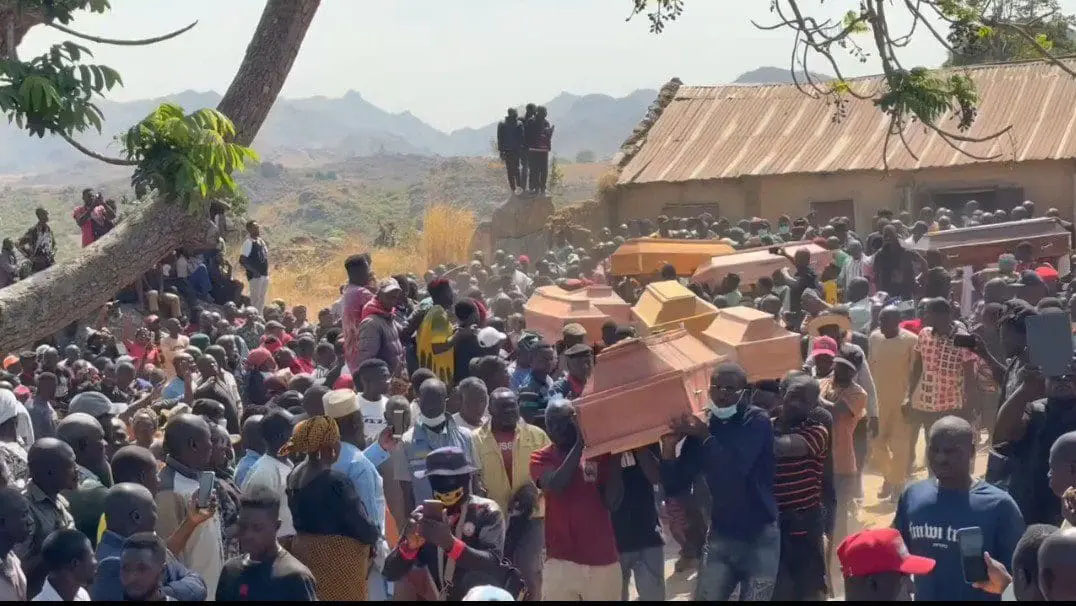
At least 11 people are feared dead after suspected terrorists attacked Zaranga village in Gombi Local Government Area of Adamawa State in the early hours of Monday, leaving residents dead, homes burnt and several people missing.
The attackers reportedly invaded the community while residents were asleep, opening fire on people before setting several houses ablaze.
The assault sent residents fleeing for safety, with some reportedly escaping into nearby bushes and surrounding forests as the attackers moved through the community.
A resident who spoke by telephone on condition of anonymity because he was not authorised to speak to the media said 11 bodies had been recovered following the attack.
“For now, 11 dead bodies have been recovered. Many people are still missing. Search teams and security personnel are in the forest searching for the missing people,” the resident said.
The resident said the search operation was continuing, raising fears that the death toll could increase if more victims are found.
Another resident described the attack as a devastating loss to his family, saying his wife and two other relatives were among those killed.
“My wife and two of my family members were also killed during the early morning invasion of my village,” he said.
The identities of the attackers could not be independently established at the time of reporting, although residents described them as suspected Boko Haram terrorists.
READ ALSO:
- Omotola: I get Hollywood royalties but nothing from 30 years in Nollywood
- Adeleke’s re-election faces tribunal battle as APC, PDP file petitions
- I always think I’m the best – Mbappé speaks on Ballon d’Or chances
The Adamawa State Police Command had yet to officially confirm the reported casualty figure as of the time of filing this report.
Repeated calls to the command’s Public Relations Officer, SP Suleiman Nguroje, seeking confirmation of the attack and details of the security response were reportedly unanswered.
The circumstances surrounding the attack, including the number of attackers involved and whether security personnel engaged them during or after the assault, were also unclear.
The latest incident has renewed concerns about the security of rural communities in Gombi LGA, an area that has suffered deadly attacks and other forms of insecurity in the past.
In April 2026, at least 29 people were killed in attacks on Guyaku and Telabala communities in Gombi Local Government Area, highlighting the persistent security challenges facing communities in the area.
The latest attack underscores the continuing challenges faced by communities in Adamawa State, particularly settlements located in remote areas where security response can be difficult.
Gombi has historically faced threats linked to Boko Haram and other armed groups, with previous attacks forcing residents to flee their homes and disrupting farming and other economic activities.
Security agencies have continued counter-terrorism operations in the North-East, including efforts to identify and disrupt terrorist networks operating across Adamawa, Borno and Yobe states.
However, the reported attack on Zaranga has once again raised questions about the protection of vulnerable rural communities and the need for faster responses to security threats.
For families in Zaranga, the immediate priority remains locating residents who are still missing and establishing the full extent of the casualties and destruction.
The reported figure of 11 deaths remains provisional pending official confirmation by the police or other security authorities. The number could change as search teams continue efforts to locate missing residents and recover possible additional victims.
The incident is expected to further heighten security concerns in Gombi and neighbouring communities, where residents have repeatedly called for stronger protection against attacks by armed groups.
Authorities are yet to issue a comprehensive statement on the Zaranga incident, including whether any suspects have been identified or arrested.
As security personnel and community members continue search operations, residents are hoping for the safe return of those still unaccounted for and stronger measures to prevent another attack.
11 feared killed as terrorists invade Adamawa community
metro
Three Women Killed, 10 Injured in Multiple Crash on Lagos-Ibadan Expressway Bridge
Three Women Killed, 10 Injured in Multiple Crash on Lagos-Ibadan Expressway Bridge
Excessive speeding and loss of control caused one vehicle to plunge off the Long Bridge into a ditch, according to eyewitness accounts and preliminary investigations.
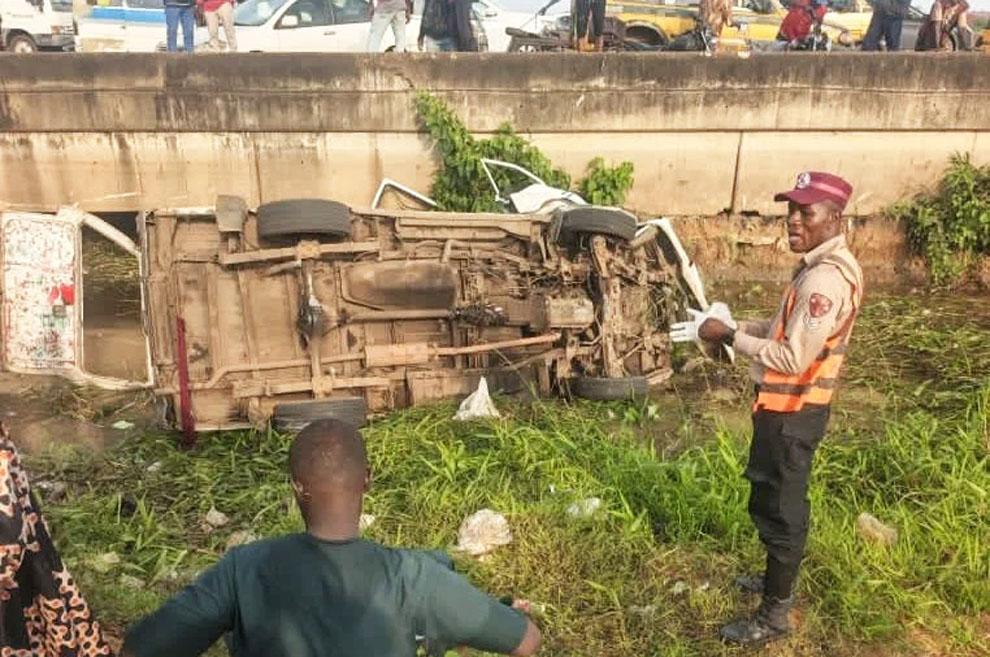
OGUN STATE, Nigeria – Tragedy struck the Lagos-Ibadan Expressway on Friday, September 4, 2026, when a multiple-vehicle crash at the Long Bridge claimed the lives of three women and left 10 others with varying degrees of injuries. The crash occurred around 5:10 p.m. at the Long Bridge, opposite Mikano, inward Lagos, according to the Federal Road Safety Corps (FRSC), Ogun State Sector Command. The spokesperson for the Ogun State Traffic Compliance and Enforcement Agency (TRACE), Babatunde Akinbiyi, confirmed the incident, placing the time at approximately 5:24 p.m. Three vehicles were involved in the crash: a white Mazda bus with registration number AGL 891 XX, a white Toyota bus with registration number KJA 247 YM, and a white Toyota Corolla with registration number BDG 867 HG. According to the FRSC, a total of 16 people—comprising 12 males and four females—were involved in the crash. Ten victims, including nine males and one female, sustained injuries, while three female occupants were confirmed dead.
Preliminary investigations identified speed violation (SPV) and loss of control (LOC) as the probable causes of the crash. Eyewitness accounts indicated that excessive speeding and loss of control caused one of the vehicles to somersault into a ditch. The FRSC stated that further investigation is ongoing to establish the full circumstances surrounding the incident.
READ ALSO:
- Socialite Igho ‘Tiny’ Ubiribo Dies After Penis Enlargement Surgery
- +Senator Shehu Buba Denies Bandit Links, Says Viral Videos Manipulated
- Two Weeks to His Wedding: Groom-to-Be Beaten to Death by Lagos Mob
The crash was reported to the FRSC at 5:34 p.m., and rescue teams arrived at the scene six minutes later, at 5:40 p.m. Emergency responders from TRACE, the FRSC, the Nigeria Police Force, and the Ogun State Ambulance and Emergency Service all responded to the scene. Some of the injured victims were evacuated to the Lagos State Accident and Emergency Centre in Ojota by the Ogun State Ambulance and Emergency Service, while others were transported to AZ Hospital in Magboro by the FRSC. The remains of the deceased were deposited at the General Hospital, Ifo, morgue, and the Idera Hospital morgue in Sagamu. The vehicle that plunged into the ditch was recovered and moved to the Warewa Police Station, alongside the other vehicles involved in the crash, for further investigation.
The crash caused significant traffic disruptions along the expressway during evacuation operations, but normalcy was restored after the vehicles were cleared from the scene. The Ogun State Sector Commander, Corps Commander Oludare Ogunjobi, expressed condolences to the families of the deceased and wished the injured victims a speedy recovery. He urged motorists plying the Lagos-Ibadan Expressway to exercise maximum caution, avoid excessive speed, maintain proper control of their vehicles, and remain alert throughout their journeys. Ogunjobi further advised motorists to “drive within safe speed limits and avoid any behaviour capable of compromising their safety and that of other road users”.
The incident follows a pattern of fatal accidents on the busy expressway. On August 25, 2026, seven people were killed and two others injured in a multiple road crash involving three vehicles around the Kara area of the Lagos-Ibadan Expressway.
Three Women Killed, 10 Injured in Multiple Crash on Lagos-Ibadan Expressway Bridge
-
 Business2 days ago
BREAKING: OPay Warns Customers Against Viral Shutdown Message, Threatens Legal Action
-
 metro2 days ago
Osinbajo raises alarm over chemicals in fruits, recalls wife’s orange juice experience
-
 metro3 days ago
NSCDC Rescues 15 Trafficked Minors Sold for ₦2m Each by Fake NGO Official
-

 metro2 days ago
APC rally: Suspected thugs attack journalists, smash Radio Nigeria vehicle in Kano
-

 Auto2 days ago
NAJA 19th Auto Awards: Industry’s best to battle for honours December 3
-
 Politics2 days ago
15 northern states may collapse if fuel subsidy returns, OAU professor warns Atiku
-

 Education2 days ago
JAMB Releases Underage UTME Results, Sets Strict Conditions for Admission
-
 metro2 days ago
Lagos-Ibadan Expressway: FG begins Kara Bridge repairs Tuesday, deploys traffic agencies