

metro
Kidnappers on the rampage in Lagos, Ondo, Ogun

The spate of kidnapping in the last three months across the South-West is becoming worrisome despite the advent of the Western Security Network codenamed Amotekun by the South-West governors.
Though kidnap cases have been on the increase, Amotekun, in collaboration with the police, Department of State Service, DSS and other security agencies, have worked round the clock to rescue victims from kidnappers’ dens.
In Ondo State, there have been countless abductions over the last three months. While some victims were rescued alive, others died at the hands of their captors.
Unfortunately, in one of the abductions, a chieftain of the All Progressives Congress, APC, who was abducted by bandits, Mr. Bamidele Emmanuel Isibor, was shot dead.
Isibor, 62, a father of five was a member of the state executive committee of the party. He was attacked in the company of three others on their way from Imoru to Ifon, the headquarters of Ose Council Area of the state.
They were heading back to Ifon after a church programme when five armed men attacked them.
The late party chieftain died of gunshot wounds.
Also, 13 passengers on transit from Abuja en route to Lagos were abducted by 10 gunmen at a bad portion of the Ifira-Akoko highway in Akoko South-East area of Ondo State at about 6:30 pm.
Although, Amotekun claimed it rescued the victims but it was gathered that the bandits took three of the victims away including two women and a man.
They immediately sent words to the family of one of the victims requesting for N10 million ransom before she could be released.
The father of one of the victims, Ojo Fajana said: “The kidnappers demanded N10 million and they were given rigid instructions. Something went out of my pocket.”
Another case was the kidnap of a 14-year-old JSS 2 student, Felix Adekunle of Furaben International College Owo, in Owo Council Area of the state, who was kidnapped while hawking slippers after school hours and a 12-year-old groundnut seller, Abibat Saani in Ofosu, Ore in Odigbo Council Area of the state.
Their parents reportedly parted with an undisclosed amount of money as ransom before they were released.
Similarly, last weekend, gunmen abducted a university lecturer, Mayowa David Adinlewa and demanded N10 million ransom.
Adinlewa, who is of the Adekunle Ajasin University, Akungba, Akoko, AAUA, was abducted along bad Akure-Ikere Ekiti road.
The victim’s brother, Toyin confirmed that the kidnappers opened a line of communication with the family and demanded N10 million ransom.
Within the week, a family of four on a religious trip was again abducted at Iju-Itagbolu in Akure North Council Area of the state.
The family, including the father, his two children and another family member were abducted while on transit from Ado Ekiti, Ekiti state to attend a religious programme in Akure, the Ondo State capital. Three other passengers in the vehicle escaped.
Findings by Vanguard indicated that relations and family members of victims may have parted with almost N10 million as ransom to kidnappers within the last three months in the state.
When contacted, the state commander of Amotekun, Chief Adetunji Adeleye said that the security outfit was working in synergy with the DSS and Police to rid the state of criminal elements.
Adeleye, who noted that the state security network agency would make the state uncomfortable for criminals and make it crime-free, said they have foiled 35 kidnap cases.
He said: “We have arrested no fewer than 400 suspected criminals in the ongoing Operation Clean up across the state.
“We started from the state capital and combed all the black spots and made over 400 arrests before we headed to the local government areas and concentrated on the Northern Senatorial District where we embarked on 24 hours patrol.
“We engaged the services of local hunters and vigilante to join our men and patrol the forest. Substantially, we were also able to drive out the bad guys in recent times. You will find out that most of the kidnap cases you get nowadays are at the border.
“We have put out searchlight and we have mapped out security strategies to checkmate the activities of those bad people. But we are checking them.
“We want to ensure that all persons travelling along the highways, major roads, remote areas, hinterland, forests, inland waterways, and sea are free to carry out their normal social and economic activities without fear or hindrance.”
We’re not aware of the demand, payment of ransom —Police
Also reacting, the state Police Command spokesperson, Funmilayo Odunlami said the Command’s anti-kidnapping unit was on top of the situation.
Odunlami said that several suspected kidnappers have been arrested and charged to court.
On payment of ransom by victims, Odunlami said: “I don’t know anything about the ransom demand.”
Retired AVM, 4 others abducted in Lagos
It is the same story as there seems to be a resurgence in kidnapping in Lagos, following the abduction of five persons, including Air Vice-Marshal Sikiru Smith, retd, in two days.
Vanguard gathered that retired AVM Smith was abducted at about 6 pm on Monday, September 27, 2021, at a site near Blenco Mall on Addo Road, Ajah area of Lagos.
The gunmen, who were hooded, announced their presence with sporadic gunshots before abducting him.
He was said to have put up some resistance, demanding to know who the intruders were but were overpowered and dragged into the kidnappers’ speedboat.
Eyewitnesses said the gunmen released some shots into the air to scare people, thus causing a stampede among passers-by who scampered in different directions to avoid being hit by stray bullets.
While the operation lasted, his driver, Corporal Odiji, was absent, as he was said to have gone on an errand for his boss.
RCCG pastor, wife, others abducted
Aside from the retired Air Chief, other persons also fell victim to kidnapping in Lagos, including a pastor with the Redeemed Christian Church of God, RCCG, and his wife. The kidnappers intercepted their vehicle at Dopemu, Agege area of Lagos, on their way home.
The kidnappers, it was gathered, fired some shots into the air, dragged the couple’s driver out of the car and forced him into one of their operational cars.
His wife has been released by the gunmen after an unspecified amount was paid as ransom.
The abductors were said to have demanded N50 million for her husband’s release.
In another attack, a man with an unknown identity was kidnapped by hooded gunmen on Admiralty Way, Lekki Phase 1, 24 hours earlier, another Pastor, Kingsley Ogbuagu, was also kidnapped by unknown gunmen near Catholic Church of the Visitation, Festac Town, last Sunday.
Ogbuagu had parked his car and was about to enter the church when three masked gunmen dragged and bundled him into a waiting Lexus SUV and drove off.
Vanguard learned that the Lekki-Ajah axis is prone to kidnap attacks, some of which the Police have botched.
Vanguard also gathered that the kidnappers pose as private taxi drivers, only to take their unsuspecting passengers to unknown destinations.
13 people kidnapped in Ogun
In Ogun State, no fewer than 13 persons were kidnapped by suspected gunmen between July and September 2021, while about 12 kidnappers were arrested during the period under review by the state command of the Nigeria Police. Also, one policeman lost his life in one of the operations, while three kidnappers were killed during a gun duel with the police.
Analysis of series of kidnappings in the state within the three months under review showed that a retired lecturer of Federal Polytechnic, Offa, Kwara State, Fasasi Olanigan, was kidnapped while travelling from Abeokuta to Imasai in Yewa North Local Government Area of the state.
In August, a Swiss national and his Nigerian driver were abducted after a gunfight between the victim’s police escort and unknown attackers, while coming from a farm on the Ibese-Itori road.
Also, the 25-year-old son of a former National Secretary of the Nigerian Medical Association, Adewunmi Alayaki; Ademola Alayaki was kidnapped at his father’s farm in Isaga Orile, Abeokuta North Local Government Area of the state and demanded N20 million ransom before freeing Ademola.
In September, an eight-month pregnant woman and two others were kidnapped along Igbo-Ora-Sokoto road in Abeokuta North Local Government Area of the state and demanded a ransom of N30 million. Also, three workers of Obasanjo Holdings in Kobape, Obafemi/Owode Local Government were kidnapped by unknown gunmen around Seseri village.
The abductees were the company’s Financial Controller, the Group Auditor and the Group Store Manager.
The Police, however, made headway as men of the State Command of the Nigeria Police arrested 10 suspected kidnappers.
While five of the kidnappers were arrested in Ogere-Remo while trying to collect N3.5m ransom for an eight-year-old boy, Sadiq Abass, they had kidnapped, others were arrested in different locations in the state.
No cause to fear—Ogun Amotekun boss
Reacting to the series of kidnappings in the state, Ogun State Commander of Amotekun Corps, Mr. David Ajibola Akinremi, has said that the corps was established to serve the people of the state
Akinremi said: “Amotekun has always been collaborating with other security agencies in the state to ensure the security of lives and property, especially when issues like kidnapping occur. I want to assure our people that they have no cause to fear. The governor had given a mandate and we are ready to ensure the actualisation of that mandate. That is to say, we assure of protection of lives and property for everybody living in the state.
“There is no security without human beings and no human beings without security. It is a symbiotic relationship. The work of security agencies at whatever level cannot be done without the support of the people.
“That is why we want to build a people-oriented organisation.
“As we all know, security is everybody’s business and we must all join hands to ensure a safe environment. They should collaborate with us.”
In Osun State, there was no incident of kidnapping reported in the last three months.
The Amotekun Corps Commandant in Osun State, Brig. Gen. Bashir Adewinmbi (retd), said this is largely due to surveillance and past successes in tackling kidnapping in the state.
Adewinmbi said: “Presently, there is no case of kidnapping reported so far. I believe, to a large extent, it was due to past successes security agencies achieved in rescuing victims of kidnap in the state.
“Amotekun is not doing this alone, we work with other security operatives and local hunters in areas where such incidents occurred to trail suspects and in most cases, rescue victims.
“More importantly, recently at the inauguration of Amotekun Corps in the state, Governor Adegboyega Oyetola also announced the engagement of vigilante groups on intelligence gathering to forestall any form of criminality.’
Vanguard News Nigeria












metro
Osogbo Food Bonanza Turns Nightmare as Discount Vendor Vanishes With Customers’ Millions
Osogbo Food Bonanza Turns Nightmare as Discount Vendor Vanishes With Customers’ Millions
Panic erupted in Osogbo, Osun State, on Monday after a food distribution outlet offering heavily discounted food items suddenly shut its premises, leaving hundreds of customers stranded and worried over millions of naira reportedly paid in advance for supplies.
The outlet, identified as Global Food Initiative, was located in the Odi-Olowo area of Osogbo, opposite the former NEPA office.
The business had reportedly attracted customers with unusually low prices for essential food commodities, including rice, cooking oil, spaghetti, semovita and other food items.
Customers were required to pay in advance and return after about a week to collect their purchases.
According to reports from the area, a 50kg bag of rice was being sold for about N27,000, far below the prevailing market price. Radio Nigeria reported that 25 litres of cooking oil was offered for N30,000, while a pack of spaghetti was sold for about N10,000.
The attractive prices reportedly drew traders and other residents from Osogbo and neighbouring communities, with some customers placing orders in large quantities for resale or personal events.
But the seemingly lucrative arrangement turned into anxiety on Monday when customers arrived at the premises expecting to collect their goods and found the outlet locked.
Attempts to reach the operators by telephone reportedly failed, leaving customers gathered around the premises demanding answers and seeking the return of their money.
PUNCH reported that one customer, identified as Mistura, said she paid N300,000 for 11 bags of rice at N27,000 per bag. Another customer, Olamide, said she paid N1.2 million for various food items intended for a family wedding.
The newspaper also reported that some participants displayed evidence of much larger payments, with one woman reportedly claiming to have paid N35 million, while another man allegedly presented a receipt showing N10 million.
Vanguard similarly reported that customers presented receipts for payments ranging from tens of thousands of naira to much larger sums, while one trader was alleged to have committed as much as N50 million to the scheme. These figures are claims by participants and have not been independently established as the total amount involved.
Tension reportedly rose at the premises as some angry customers threatened to damage the building housing the outlet’s warehouse.
The development prompted the deployment of policemen to the area to prevent a breakdown of law and order.
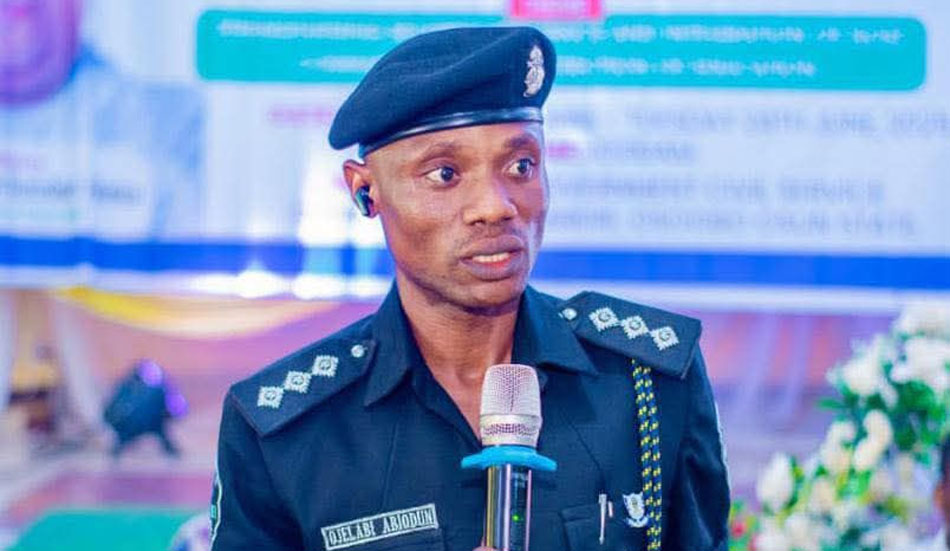
The spokesperson for the Osun State Police Command, Abiodun Ojelabi, confirmed the deployment, saying the police became aware of the situation after arriving at the scene to control the growing tension.
According to him, the command had not yet received a formal complaint from affected customers at the time of his statement, but officers were monitoring the situation.
He said the police had discovered at the scene that Global Food Initiative had been collecting money from people with promises of supplying subsidised food items after advance payment.
The incident has revived concerns over schemes that use exceptionally low prices to attract large numbers of customers before collecting advance payments.
For many of those affected, what initially appeared to be an opportunity to beat the rising cost of food has suddenly become a desperate search for their money and answers.
The Osogbo incident also bears similarities to reports of an earlier case in Auchi, Edo State, in July 2025, where a man reportedly sold 50kg bags of rice for N20,000, attracted more than 1,000 pre-orders and allegedly disappeared after collecting advance payments. Reports at the time put the alleged losses at more than N20 million. However, those figures were based largely on social-media reports and were not accompanied by an official police confirmation in the reports reviewed.
The latest development has therefore triggered renewed calls for residents to exercise caution before making large advance payments for commodities being offered at prices substantially below prevailing market rates.
As of the latest reports, the operators of Global Food Initiative had not publicly explained the closure or disclosed when the business would reopen, while affected customers continued to await clarification and possible recovery of their funds.
Osogbo Food Bonanza Turns Nightmare as Discount Vendor Vanishes With Customers’ Millions
metro
24 Hours in Darkness: Iju Ishaga Residents, Businesses Count Losses as Ikeja Electric Fails to Restore Power

24 Hours in Darkness: Iju Ishaga Residents, Businesses Count Losses as Ikeja Electric Fails to Restore Power
Residents of Iju Ishaga, Ake-Ayo and adjoining communities in Lagos have been thrown into frustration as a prolonged blackout entered its second day, forcing households and businesses to battle with the consequences of more than 24 hours without electricity.
The power outage began at about 5pm on Sunday, September 27, 2026, and had persisted as of Monday evening, leaving residents scrambling for alternative sources of electricity.
For many residents, the blackout has gone beyond the inconvenience of darkness, with business owners counting losses and households spending additional money on fuel to power generators.
Small businesses that depend heavily on electricity have been particularly affected.
Operators of laundries, barbing salons, hairdressing shops, restaurants, food businesses, refrigeration outlets and other electricity-dependent enterprises have either had to suspend operations or resort to generators at additional cost.
Residents said the prolonged outage was putting further pressure on household finances, with many already struggling with the rising cost of fuel and other essential commodities.
One resident said electricity supply disappeared around 5pm on Sunday and had still not returned as of Monday evening.
The resident said many people initially expected the fault to be resolved within a few hours but became increasingly frustrated as the outage stretched into the following day.
The situation has also affected households dependent on electricity-powered water pumps, while residents with refrigerators and freezers have expressed concern about food and other perishable items.
Residents demand explanation
Frustrated consumers contacted personnel of Ikeja Electric Distribution Company to demand information about the cause of the outage and when supply would be restored.
A conversation with an Ikeja Electric staff member on Monday indicated that the company was aware of the problem and that efforts were being made to resolve it.
However, residents were still waiting for full restoration as of Monday evening.
The specific cause of the latest outage affecting Ake-Ayo, Iju Ishaga and surrounding communities had not been independently established as of the time of filing this report.
Previous prolonged outages in parts of Ikeja Electric’s network have been linked to faults involving distribution infrastructure as well as incidents on the transmission network.
Businesses bear the brunt
The prolonged blackout has created a fresh financial burden for small business operators in the affected communities.
For laundry operators, every hour without electricity can mean delayed jobs and customers waiting longer for their clothes.
Barbers and hairdressers have also been forced to depend on generators, while restaurants, food vendors and businesses dealing in frozen products face the additional challenge of preserving their stock.
Some business owners said the cost of purchasing fuel to run generators could further reduce their already narrow profit margins.
For households, the situation has also meant additional expenditure on fuel and other alternatives to electricity.
Anger mounts
As the outage continued into Monday evening, residents became increasingly frustrated over the absence of electricity and uncertainty surrounding the restoration time.
They appealed to Ikeja Electric to provide regular and transparent updates whenever prolonged faults occur, particularly when large communities are affected.
Residents also called for improved maintenance of electricity infrastructure to reduce the frequency and duration of outages.
The latest incident has once again highlighted the difficulties faced by residents and small businesses that depend on public electricity supply but are often forced to maintain generators as backup.
For the affected residents of Iju Ishaga, Ake-Ayo and neighbouring areas, the immediate demand is simple: restore the power and end the darkness.
But with the outage already stretching beyond 24 hours, many households and businesses are left counting the financial cost of another prolonged blackout.
24 Hours in Darkness: Iju Ishaga Residents, Businesses Count Losses as Ikeja Electric Fails to Restore Power
metro
Why Akpabio Rejected ‘Acting President’ Title — Rufai Oseni

Why Akpabio Rejected ‘Acting President’ Title — Rufai Oseni
LAGOS — Arise Television Morning Show anchor, Rufai Oseni, has offered insight into why Senate President Godswill Akpabio reportedly rejected the title of “Acting President” during the recent absence of President Bola Tinubu and Vice President Kashim Shettima from the country.
In a commentary that has sparked widespread debate across political circles, Oseni suggested that Akpabio’s refusal to embrace the title was not merely a matter of constitutional propriety, but a reflection of the legislature’s unwillingness to assert its independence as a co-equal branch of government.
The controversy arose when, with both the President and Vice President out of the country, some political associates reportedly began referring to Akpabio as the acting president. Akpabio swiftly moved to quell the speculation, clarifying that he remains the Senate President and that there is no vacancy in the presidency, noting that President Tinubu was still running the country from abroad.
However, Oseni, speaking on his morning show, argued that the situation raises fundamental questions about the balance of power in Nigeria’s presidential system. He contended that the Senate President’s eagerness to dismiss the acting title highlights a deeper issue: the National Assembly’s reluctance to genuinely challenge or check the executive arm of government.
Oseni pointed to the legislature’s earlier endorsement of a state of emergency in Rivers State as evidence that the current leadership under Akpabio would not stand up for the independence of the parliament. He questioned whether a Senate President who shies away from the constitutional implications of a power vacuum can effectively champion the legislature’s role as a separate arm of government.
“The refusal to accept the acting president title is not just about protocol; it is about the willingness of the National Assembly to assert its constitutional independence,” Oseni said during the broadcast. “If the Senate President cannot stand up for the legislature in a moment like this, it raises serious questions about the checks and balances in our democracy.”
The political analyst’s remarks have reignited conversations about the relationship between the executive and the legislature under the current administration, with critics arguing that the National Assembly has become increasingly subservient to the presidency.
While Akpabio’s allies maintain that his decision was a mark of respect for constitutional order and the sitting president, Oseni’s analysis suggests that the move may have wider implications for the balance of power in Abuja.
As the debate continues, observers say the incident underscores the ongoing tension between constitutional duty and political reality in Nigeria’s democratic experiment.
Why Akpabio Rejected ‘Acting President’ Title — Rufai Oseni
-

 Politics3 days ago
2027: Fayemi Denies Galadima’s Claim He Is Coordinating Opposition Group Against Tinubu
-

 metro3 days ago
$155m Left Behind, $750m Liabilities: Anambra Govt Opens Fresh Obi Files
-

 News2 days ago
Fake Agency Scandal: Gbajabiamila Says He Never Betrayed Tinubu’s Trust
-

 metro3 days ago
Unexplained Wealth: Obasanjo, Osinbajo, Others for Shittu’s Book Launch
-

 metro2 days ago
Woman Busted With Alleged Alcohol Hidden in Water Pack at Ogun Prison
-
News2 days ago
Anambra Govt Demands Unreserved Apology From Peter Obi Over Debt Claims
-

 metro3 days ago
Mohbad: Court Dismisses Fresh Bid to Reopen Investigation Into Singer’s Death
-

 International2 days ago
Iran Claims Capture of Second US Underwater Drone in Strait of Hormuz