
News
PenCom debunks N10trn loan to FG, says Commission not owing pensioners
PenCom debunks N10trn loan to FG, says Commission not owing pensioners
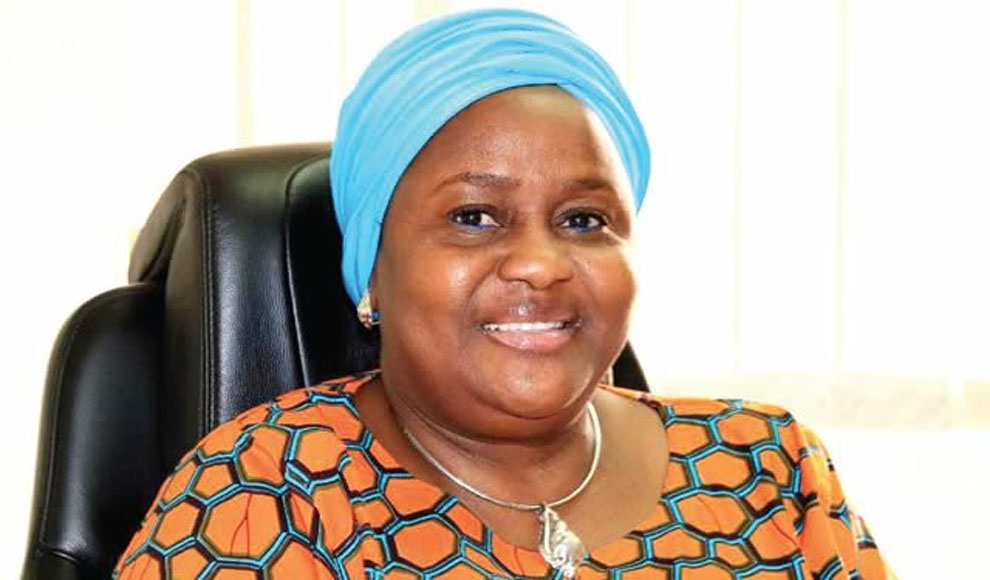
The Director-General of the National Pension Commission (PenCom), Mrs Aisha Dahir-Umar, has debunked the widespread reports that the Commission gave a N10 trillion loan to the Federal Government.
The PenCom’s DG, also, clarified the claim that PenCom was owing Federal Government retirees arrears of pensions as well as insinuations that Pension Fund Administrators (PFAs) are not fulfilling their obligations to retirees with regards to access to their retirement savings.
Mrs Dahir-Umar, in a media interaction, explained that apart from the fact that PenCom is not a bank and does not warehouse or manage pension funds, the Federal Government did not take a loan of N10 trillion from the Commission.
According to her, Investments by the PFAs in the securities of the Federal Government of Nigeria (FGN) are not loans as erroneously portrayed, but investments in securities, through bonds and treasury bills, as approved by the relevant government agencies, in this case the Debt Management Office (DMO) and Securities and Exchange Commission (SEC). They are traded on authorized capital markets. That is, the Nigerian Exchange Limited and FMDQ OTC Securities Exchange.
“Moreover, pension fund assets are not managed by PenCom. I have said repeatedly that when we say pension assets have grown to N15 trillion, that does not mean PenCom has N15 trillion locked somewhere in its office or bank accounts. Pension fund assets are managed by the licensed PFAs and held in custody by the licensed Pension Fund Custodians (PFCs). The PFAs are responsible for investing pension fund assets in allowable asset classes, including FGN debt instruments.
READ ALSO:
- Just in: Bandits kidnap fresh 30 persons as IGP visits Kaduna
- Join me dialogue with bandits, Gumi tells Tinubu
- Trial of Fubara’s loyalists on terrorism offences resumes in full scale
“The objectives are safety and fair returns. All these are in line with the provisions of the enabling law, the Pension Reform Act 2014, and the rules issued by the Commission. It is obvious from the above that what is referred to as a ‘loan to FGN’ is just investment in FGN securities by the PFAs, as is done by other institutional investors such as banks, insurance companies, asset managers, etc.”, she further explained.
Mrs Dahir-Umar added that it is an international best practice to invest in investible instruments issued or backed by the sovereign authority and that the FGN securities meet the objectives of safety and fair returns.
“The FGN has consistently met its repayment obligations, both principal amount and accrued interest, for all investments in bonds and T-bills to all investors including pension funds. The information is always in the open and accessible on our website, www.pencom.gov.ng,” she said.
The PenCom DG further clarified claims about outstanding benefits to Federal Government retirees.
“The delayed payment of retirement benefits to some Federal Government retirees and deceased employees is because of the inadequate and delayed funding for the payment of Accrued Pension Rights for those who were in service before the Contributory Pension Scheme (CPS) was introduced when PenCom was established in 2004.
“Payment of the accrued rights is subject to release of funds by the Federal Government. So, it is beyond the powers of the Commission. However, we have been engaging the Federal Ministry of Finance for more funds to be released to settle these liabilities, but it is not a secret that the government itself has budgetary constraints”, she said.
PenCom debunks N10trn loan to FG, says Commission not owing pensioners







News
Falana, Jibrin, Bugaje Lead Opposition to US Military Presence in Nigeria
Falana, Jibrin, Bugaje Lead Opposition to US Military Presence in Nigeria
Some prominent Nigerians have condemned the reported US military presence in Nigeria, describing it as a violation of Nigeria’s sovereignty, a potential breach of the 1999 Constitution, and a dangerous precedent for foreign military interference in the country’s security affairs.
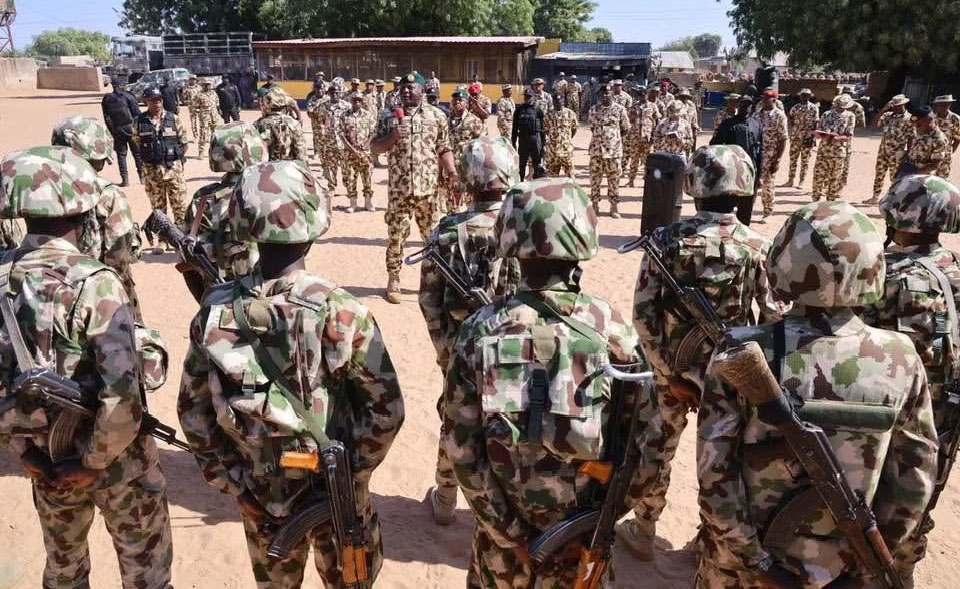
The criticism followed the arrival of United States military aircraft in Nigeria last week, shortly after American and Nigerian officials disclosed plans to deploy about 200 US soldiers in advisory and training roles. US officials said the aircraft movements would continue for several weeks as part of a temporary counterterrorism mission.
Nigeria’s Defence Headquarters (DHQ) has insisted that the US personnel are technical specialists, not combat troops, and that they will operate strictly under the authority and control of the Nigerian government, in coordination with the Armed Forces of Nigeria. The military stressed that the deployment does not amount to the establishment of a foreign base or independent US operations on Nigerian soil.
Despite these assurances, a coalition of lawyers, academics and civil society figures issued a joint statement titled “No to Foreign Forces in Our Land: Defend Our Sovereignty”, warning that the presence of foreign troops raises serious constitutional, legal and national security concerns.
The statement was signed by human rights lawyer Femi Falana (SAN), political scientist Jibrin Ibrahim, Dr Abubakar Siddique Mohammed, Dr Dauda Garuba, Prof Massaud Omar, Prof Mohammed Kuna, Engr YZ Ya’u, and political activist Usman Bugaje.
They recalled Nigeria’s long-standing resistance to foreign military domination, warning against what they described as a creeping neo-colonial security arrangement. According to the group, Nigeria’s independence was founded on firm opposition to external military control, a principle they said must not be compromised under any guise.
READ ALSO:
- Insurgents Acquire 35 Drones as ISWAP Shifts to Aerial Attacks
- Seven Killed in Horrific Crash at Ota Toll Gate
- Nigerian Equities Post World’s Second-Best Dollar Returns in 2026, Recover $21bn
The signatories referenced the Anglo-Nigerian Defence Pact of 1960, which was abrogated in 1962 following widespread public protests, arguing that political independence without military sovereignty is incomplete. They also cited Nigeria’s rejection of foreign pressure during the 1976 Organisation of African Unity (OAU) summit on Angola, recalling the historic declaration by Murtala Mohammed that Africa would no longer operate under the influence of extra-continental powers.
The group further highlighted past attempts to impose military cooperation agreements on Nigeria, including a proposed US–Nigeria defence pact in 2001 that was withdrawn after opposition from the Ministry of Defence, and the Bilateral Immunity Agreement (BIA) signed in 2003 and later nullified by the Senate in 2005 for violating constitutional provisions and the Rome Statute.
They cited Section 12(1) of the 1999 Constitution, which requires National Assembly approval before any international treaty can have the force of law in Nigeria, insisting that any foreign military deployment must follow due legislative process.
Rejecting claims that Nigeria lacks the capacity to defend itself, the group pointed to the strong peacekeeping record of the Nigerian Armed Forces under the United Nations, African Union, and ECOMOG missions in Liberia and Sierra Leone. They argued that Nigeria should prioritise modernising its military, strengthening intelligence coordination, improving troop welfare, investing in local defence production, and addressing the root causes of insecurity rather than outsourcing national defence.
In a separate interview, Prof Jibrin Ibrahim warned that Nigerians appear less vigilant today than in the 1960s, when public resistance forced the government to abandon foreign defence pacts. He questioned the effectiveness of US military interventions globally, arguing that such involvement often deepens insecurity rather than resolves it.
Observers say the controversy has reignited debate over how Nigeria should balance international security cooperation with the need to protect national sovereignty, constitutional order, and democratic accountability amid rising security challenges across the country.
Falana, Jibrin, Bugaje Lead Opposition to US Military Presence in Nigeria
News
Ramadan Begins in Nigeria as Sultan Confirms Crescent Sighting
Ramadan Begins in Nigeria as Sultan Confirms Crescent Sighting
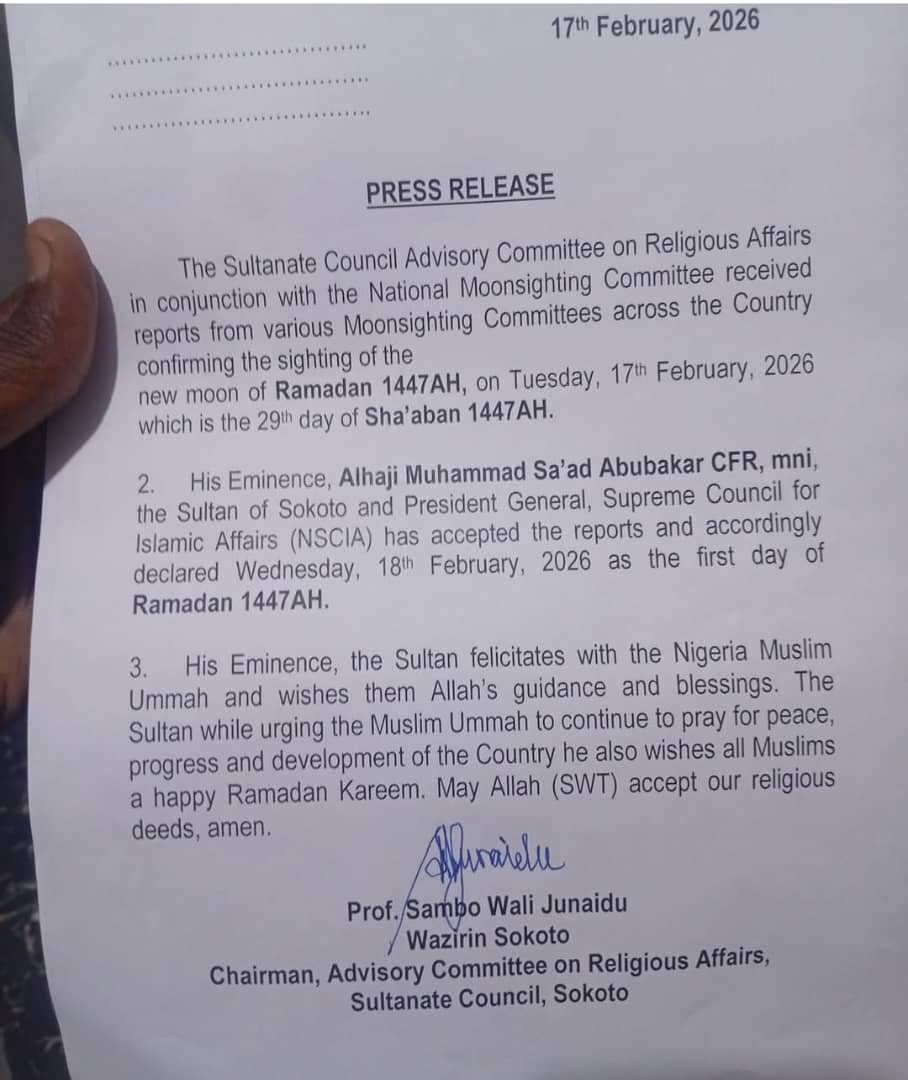
Abuja — The Sultanate Council on Tuesday night confirmed the sighting of the crescent moon, officially signaling the commencement of Ramadan 1447AH in Nigeria.
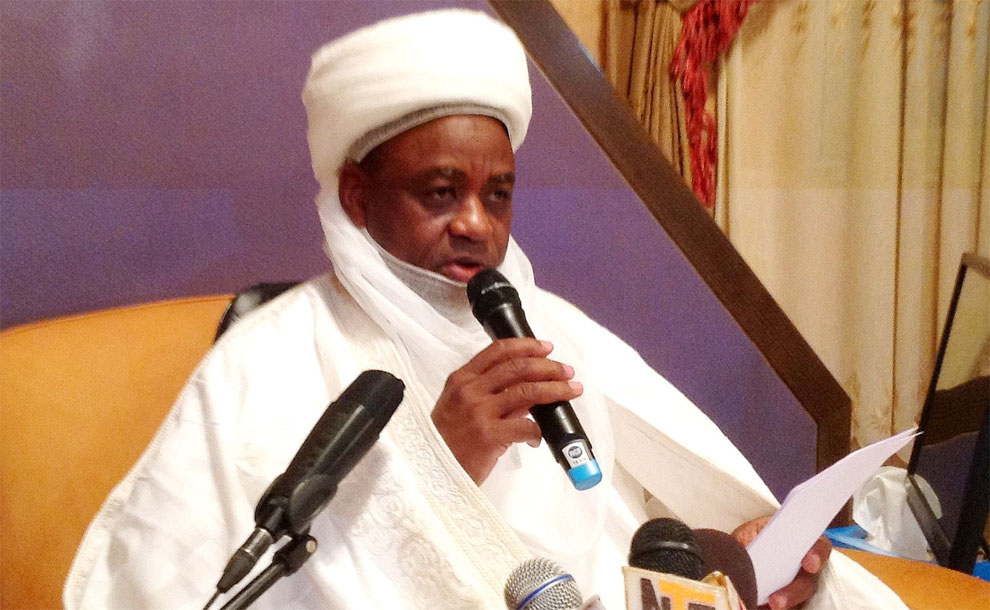
The President-General of the Nigerian Supreme Council for Islamic Affairs (NSCIA) and Sultan of Sokoto, Muhammad Sa’ad Abubakar III, announced that the new moon was sighted in parts of the country, thereby declaring Wednesday, February 18, 2026, as the first day of fasting for Muslims nationwide.
The announcement followed verified reports from moon-sighting committees across several states, in line with Islamic tradition which requires physical sighting of the crescent to mark the beginning of the ninth month of the Islamic lunar calendar.
In his message to the Muslim faithful, the Sultan urged Nigerians to use the holy month to pray for peace, unity, and national development. He also called on Muslims to embody the virtues of patience, compassion, charity, and self-discipline which Ramadan represents.
READ ALSO:
- Deadlock at National Assembly as House Snubs Electoral Act Bill Meeting on E-Transmission Clause
- Maikori Accuses Ex‑Governor El‑Rufai of Persecution Over 2017 Tweet
- Shari’ah Council Defends Kwankwaso, Rejects US “Christian Genocide” Claims
 Ramadan, one of the five pillars of Islam, requires adult Muslims to abstain from food, drink, and other physical needs from dawn until sunset throughout the month. The period is also marked by increased devotion, nightly congregational prayers in mosques, recitation of the Qur’an, and acts of charity to the less privileged.
Across major cities including Abuja, Lagos, Kano, and Port Harcourt, mosques recorded increased attendance for special night prayers following the announcement. Markets also witnessed heightened activity as families made last-minute purchases in preparation for the fasting period.
Ramadan will last 29 or 30 days, depending on the sighting of the next crescent, and will culminate in the celebration of Eid al-Fitr, marking the end of the fasting month.
Muslim leaders have encouraged faithful to observe the fast in accordance with Islamic teachings while maintaining harmony and mutual respect within Nigeria’s diverse society.
Ramadan Begins in Nigeria as Sultan Confirms Crescent Sighting
News
Saudi Arabia Confirms Sighting of Ramadan Crescent, Fasting Begins Wednesday
Saudi Arabia Confirms Sighting of Ramadan Crescent, Fasting Begins Wednesday
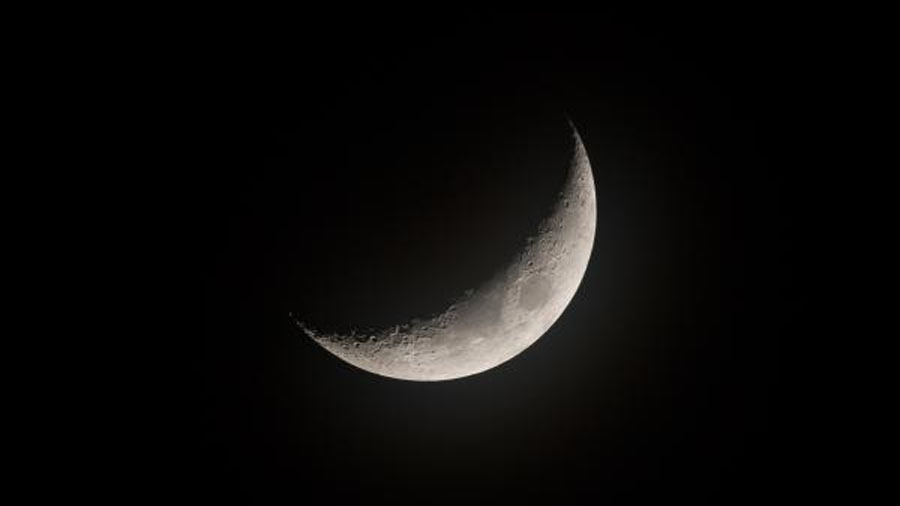
Riyadh, February 17, 2026 — Authorities in Saudi Arabia have officially confirmed the sighting of the crescent moon marking the beginning of the holy month of Ramadan, signaling that fasting will commence on Wednesday, February 18, 2026.
The announcement was made Tuesday evening following reports from moon-sighting committees across the Kingdom. In a statement carried by state media, the Supreme Court confirmed that verified testimonies of the crescent’s sighting had been received after sunset on the 29th day of Sha’ban.
With the confirmation, Muslims throughout the Kingdom will begin the first fast of Ramadan at dawn on Wednesday.
READ ALSO:
- Deadlock at National Assembly as House Snubs Electoral Act Bill Meeting on E-Transmission Clause
- Maikori Accuses Ex‑Governor El‑Rufai of Persecution Over 2017 Tweet
- Shari’ah Council Defends Kwankwaso, Rejects US “Christian Genocide” Claims
Religious authorities had earlier called on citizens and residents to look for the crescent on Tuesday evening and report any confirmed sightings to the nearest court. Observations were conducted in various regions, including areas around Riyadh and Mecca, as part of the Kingdom’s longstanding tradition of physical moon sighting.
Ramadan, the ninth month of the Islamic lunar calendar, is observed by Muslims worldwide as a period of fasting, prayer, charity, and spiritual reflection. The start of the month is determined by the sighting of the new crescent moon, in accordance with Islamic tradition.
Several other countries in the Gulf region are also expected to begin fasting on Wednesday following similar confirmations, while some nations may rely on local moon sightings to determine their own start date.
Further announcements regarding the duration of nightly Taraweeh prayers and official Ramadan working hours are expected from relevant authorities in the coming days.
Saudi Arabia Confirms Sighting of Ramadan Crescent, Fasting Begins Wednesday

-

 News3 days ago
Osogbo Sons and Daughters Mark 5th Anniversary with Awards, Political Undertones
-
 News20 hours ago
Saudi Arabia Confirms Sighting of Ramadan Crescent, Fasting Begins Wednesday
-

 metro2 days ago
US Freezes Assets of Eight Nigerians Over Boko Haram, ISIL, Cybercrime Links
-

 News15 hours ago
Ramadan Begins in Nigeria as Sultan Confirms Crescent Sighting
-

 metro17 hours ago
Lagos Woman Shares Ordeal After Alleged Rape, Sparks Nationwide Outcry
-
 Entertainment2 days ago
Mystery in Lekki: Police Probe Death of Two Nollywood Crew Found Lifeless in Parked Car
-

 metro2 days ago
Terror in Lagos Traffic: Cutlass Gang Unleashes Mayhem on Mile 12–Ketu Road
-

 Auto2 days ago
Appeal Court Ruling on VIO Limited to Abuja, Not Lagos — LASG