

International
Saudi drums global support for Palestine, end to Israeli aggression

Saudi drums global support for Palestine, end to Israeli aggression
NEW YORK CITY: Saudi Arabia reaffirmed its support for a two-state solution to the conflict between the Israelis and Palestinians, during a peace conference co-chaired by the Kingdom and France at the UN General Assembly in New York on Monday.
Saudi authorities also called for global recognition of the State of Palestine, and an end to Israeli aggression in Gaza and the West Bank.
Delivering a statement on behalf of Crown Prince Mohammed bin Salman, the Kingdom’s foreign minister, Prince Faisal bin Farhan, began by sharing greetings from King Salman, along with the crown prince’s best wishes for the success of the conference.
He also thanked the French president, Emmanuel Macron, for the formal declaration of France’s recognition of the State of Palestine.
The one-day Saudi-French conference took place amid escalating violence in the Middle East. Prince Faisal condemned Israel’s ongoing aggression in Gaza, the West Bank and Al-Quds Al-Sharif (Jerusalem), including what he described as “brutal crimes,” as well as “repeated attacks on the sovereignty of Arab and Muslim countries,” citing in particular the recent Israeli strike on Doha.
“These actions underline the insistence of Israel to continue with its aggressive practices that threaten regional and international peace and stability and undermine efforts of peace in the region,” he said.
Only the implementation of a two-state solution can bring lasting peace, he added.
Prince Faisal also welcomed the recent successful vote by the UN General Assembly on the “New York Declaration on the Peaceful Settlement of the Question of Palestine and the Implementation of the Two-State Solution,” in which 142 member states out of 193 voted in favor.
“This reflects the will of the international community to render justice to the Palestinian people and consolidate their legal, historic rights in line with international frameworks, relevant UN resolutions, and the Arab Peace Initiative,” he added.
READ ALSO:
- Lagos urges children to speak up against abuse
- Coscharis Motors elevates 2025 Kano Polo Tournament with luxury auto experience, lifestyle innovation
- We must reject false narratives on Danfodiyo’s jihad – Sheikh Mafara
He said Saudi Arabia stands ready to work with France and other peace-seeking nations to follow up on the outcomes of Monday’s conference, help end the war in Gaza, halt unilateral actions that undermine Palestinian sovereignty, and establish an independent Palestinian state along the 1967 borders, with East Jerusalem as its capital.
In his closing remarks, Prince Faisal thanked those states that have already officially recognized the State of Palestine, or plan to do so, and urged others to take “a similar historic step.”
He added: “Such action will have a great impact on supporting the efforts towards the implementation of the two-state solution, achieving permanent and comprehensive peace in the Middle East, and finding a new reality whereby the region can enjoy peace, stability and prosperity.”
FULL SPEECH:
In the name of God, the Merciful, the compassionate,
Your Excellency President of the Republic of France, your Excellency Secretary General, your Excellency President of the General Assembly, distinguished guests,
God, peace, and blessings be upon you. I have the honor to deliver the statement of the Kingdom of Saudi Arabia as a co-chair of this conference, on behalf of His Royal Highness Prince Mohammed bin Salman bin Abdulaziz Al-Saud, Crown Prince and Prime Minister of the Kingdom.
It is my pleasure to convey to you the greetings of His Majesty King Salman bin Abdulaziz Al-Saud, the Custodian of the Two Holy Mosques, and his wishes along with the crown prince’s wishes for the success of this conference. We thank His Excellency President Macron and His Excellency Antonio Guterres for their efforts towards achieving the two-state solution; we thank him also for recognizing the State of Palestine.
This conference is co-chaired by the Kingdom of Saudi Arabia and France at a time when the Israeli occupation authorities continue their aggression and their brutal crimes against our brothers the Palestinians in Gaza Strip and its violations in the West Bank and Al-Quds Al-Sharif and its repeated attacks on the sovereignty of Arab and Muslim countries, the latest of which was the attack against Qatar.
READ ALSO:
- Osun seeks transfer of LG funds case from Abuja to Osogbo
- Pros, cons of Lagos landlord and tenancy bill (Source: The Nation)
- Fear grips Osogbo community as man found murdered after morning prayers
This underlines the insistence of Israel to continue with its aggressive practices that threaten regional and international peace and stability and undermine efforts of peace in the region. This reiterates our deeply rooted conviction that the implementation of the two-state solution is the only way to achieve a just and permanent peace.
The historic position of his Excellency the French President to recognize the State of Palestine, and the fact that many countries have taken this similar courageous position, and the broad support for the resolution of the General Assembly to adopt (the declaration) the New York Declaration on the Peaceful Settlement of the Question of Palestine and the implementation of the two-state solution that received 142 votes in its favor reflects the will of the international community to render justice to the Palestinian people and consolidate their legal historic right in line with international frameworks and relevant UN resolutions and the Arab Peace Initiative.
The Kingdom is keen on continuing its partnership with France and all countries calling for peace to follow up on the implementation of the outcomes of this conference to put an end to the war in Gaza and stop all unilateral measures that threaten Palestinian sovereignty, to work on ending the conflict in the region, and establish the Palestinian independent state on the 1967 borders, with East Jerusalem as its capital.
In conclusion, we thank again those countries that have recognized or have announced their intention to recognize the State of Palestine; we call all other countries to take a similar historic step that will have a great impact on supporting the efforts towards the implementation of the two-state solution, achieve permanent and comprehensive peace in the Middle East, and find a new reality whereby the region can enjoy peace, stability, and prosperity.
Thank you.
Saudi Arabia and France issued a statement after the peace conference at the UN General Assembly.
The text of the joint statement:
1. We, Leaders of the Republic of France and the Kingdom of Saudi Arabia, Co-Chairs of the High-level International Conference for the Peaceful Settlement of the Question of Palestine and the Implementation of the Two-State Solution, commend States who gathered at the United Nations in New York on the 22nd of September 2025 at a historically critical moment for peace, security, and stability in the Middle East.
2. The High-Level International Conference led to the adoption of the New York Declaration endorsed by the General Assembly with an outstanding majority of 142 votes. This ambitious declaration reaffirms the unwavering international commitment to the Two-State solution and charts an irreversible pathway to build a better future for Palestinians, Israelis and all peoples of the region.
3. As we are gathered, the situation in Gaza continues to deteriorate with the intensification of the Israeli ground offensive in Gaza city, and with civilians and hostages paying an unjustifiable price due to the ongoing war. The New York Declaration aims at providing a principled, yet realistic alternative to the cycle of violence and endless wars.
READ ALSO:
- Breaking: Dembele wins 2025 Ballon d’Or
- Trump’s H-1B visa policy threatens Nigerian tech workers, others
- Aitana Bonmati wins Women’s Ballon d’Or third time in row
4. It is now time for the international community to move from words to deeds. We commend the important work done by the seventeen co-chairs of the working groups of the conference to draw a path for a swift implementation of the Two-State solution. We call on all States to swiftly implement the New York declaration through tangible, concrete and irreversible measures. We welcome the important commitments and measures already taken by UN Member States.
5. We welcome the recognition of the State of Palestine by Australia, Belgium, Canada, Luxembourg, Malta, Portugal, the United Kingdom of Great Britain and Northern Ireland, Denmark, Andorra, Monaco and San Marino, alongside France, confirmed today at the United Nations’ General Assembly. We invite States which have not done so to join this movement.
6. Ending the war in Gaza and ensuring the release of all hostages remains our absolute priority. We call for a permanent ceasefire, the release of all hostages, exchange of prisoners, and unhindered delivery of humanitarian assistance throughout Gaza and the full withdrawal of Israeli forces from Gaza.
7. In order to secure the Day After for Palestinians and Israelis, we commit to supporting the deployment of a temporary international stabilization mission upon invitation by the Palestinian Authority, to be mandated by the UN Security Council, in line with the New York Declaration. Meanwhile, we commit to scaling up our support to train and equip Palestinian police and security forces, building on existing programs, including USSC, EUPOLCOPPS and EUBAM Rafah.
8. We stress the importance of unifying the Gaza Strip with the West Bank under the Palestinian Authority. We welcome the “One State, One Government, One Law, One Gun” policy of the Palestinian Authority and pledge our continued support to its implementation. In the context of ending the war in Gaza, we reiterate that Hamas must end its rule in Gaza, disarm and hand over its weapons to the Palestinian Authority, with international engagement and support, in line with the objective of a sovereign Palestinian State.
9. This Conference, and the recognition of Palestine, aims at the realization of a sovereign, democratic and economically viable State of Palestine, living side by side in peace and security with Israel. In that regard, we commend the historic commitments made by President Mahmoud Abbas including to the peaceful settlement of the question of Palestine, the continued rejection of violence and terrorism, and his statement that the Palestinian State has no intention to be a militarized State and is ready to work on security arrangements beneficial to all parties, in full respect of its sovereignty.
10. We welcome the reforms already underway by the Palestinian Authority, including:
The abrogation of the prisoners’ payment system, that is now effective;
The schooling/curricula reform, under EU supervision and with Saudi support;
The commitment to hold democratic and transparent general and presidential elections within a year after a ceasefire, enabling democratic competition between Palestinian actors committed to respect the PLO platform and principles.
We support President Abbas in advancing further measures to reform the governance of the Palestinian Authority.
11. We welcome the launching of the Emergency Coalition for Palestine to mobilize emergency budgetary support to the Palestinian Authority. We invite all States and international organizations to join this effort. We reiterate our call for the immediate release by Israel of withheld Palestinian tax revenues and commit to the revision of the Paris Protocol on Economic Relations and the establishment of a new framework for clearance revenue transfers.
12. We urge the Israeli leadership to seize this opportunity for peace, and to issue a clear public commitment to the Two-State solution, immediately end violence and incitement against Palestinians, halt all settlement, land grabs, and annexation activities in the Occupied Palestinian Territory and put an end to settlers’ violence. As a first step, we urge Israel to rescind the E1 project, and publicly renounce any annexation project. We reiterate that any form of annexation is a redline for the international community that bears serious consequences and constitutes a direct risk to existing and future peace agreements.
13. In that regard, we welcome concrete measures taken by Member States to respond to unilateral measures against the Two-State solution and to violations of international law until Israel puts an end to actions that are endangering the Two-State solution, in full compliance with international law.
14. We reaffirm that ending the Israeli occupation and achieving just and lasting peace between Israelis and Palestinians, based on the relevant UN resolutions, is the only way to achieve full regional integration, as provided for in the Arab Peace initiative. In that regard, we welcome the commitment to explore a regional security architecture that could provide security guarantees for all, building on the experience of ASEAN and OSCE, paving the way for a more stable Middle East. We reiterate our support to renewed effort on the Syria-Israel and Lebanon-Israel tracks with the aim of achieving a comprehensive, just and lasting peace in the Middle East, in accordance with international law and the relevant UN resolutions.
15. We reiterate our call to all States to join this dynamic to ensure peace and security for all in the Middle East, mutual recognition and full regional integration.
Saudi drums global support for Palestine, end to Israeli aggression
ARAB NEWS









International
$100 Crude Returns: Escalating US-Iran War Strains Global Maritime Chokepoints

World oil markets entered dangerous territory on Wednesday as Brent crude breached the symbolic $100 per barrel barrier amid mounting fears of sustained supply shocks in the Middle East. With the clash between the United States and Iran now stretching into its seventh month, commercial energy traders are growing increasingly convinced that diplomatic efforts have stalled and that physical barrels could become harder to move out of the Gulf.
Brent crude serves as the premier global benchmark because it sets the pricing baseline for roughly two-thirds of the world’s internationally traded oil contracts. Sourced from the North Sea, its light, sweet quality and direct access to deepwater marine terminals make it easy to refine and ship anywhere in the world. When Brent moves, it immediately resets the price tag for physical cargoes and national crude streams from West Africa to the Middle East, making its climb past $100 a direct trigger for broader global price shifts.
The immediate catalyst for the rally came from fresh exchanges in the Persian Gulf and surrounding transit hubs. Iran announced a retaliatory strike on a U.S. facility in Jordan following American operations against Iranian naval assets in the Strait of Hormuz. Adding to the market alarm, Iranian authorities declared commercial oil tankers near Kuwait and Bahrain to be potential targets, effectively freezing merchant shipping confidence across the waterway.
Alternative export pathways offer little immediate relief. Saudi efforts to bypass the blocked Strait of Hormuz by redirecting crude toward the Red Sea have collided with renewed military strikes by Houthi forces targeting energy installations around the Bab al-Mandab strait. With both primary and fallback shipping lanes compromised, the flow of crude faces its most severe maritime disruption in years.
Beyond the energy trade, triple-digit crude threatens to undo recent progress against global inflation. Central banks worldwide are facing renewed pressure to keep borrowing costs elevated to prevent higher transport and production bills from embedding into retail prices. The prospect of persistent inflation and high interest rates pulled down major equity indices in the United States and Europe, overshadowing selective gains in Asian tech sectors.
International
Truly Depraved Rapist Jailed for 17 Years After Violent Attack on Woman

A 24-year-old Nigerian national, Gift Oladele, dragged a young woman into woodland and violently raped her has been jailed for 17 years after a judge described his actions as “truly depraved”.
Gift Oladele carried out the attack in Wrexham, North Wales, in September last year after approaching the victim, who was 19 at the time, as she walked home from a night out.
Oladele was convicted of rape and sexual assault at Mold Crown Court in March. He was sentenced on Thursday.
How the Attack Happened
The court heard that Oladele approached the woman and her friends outside a takeaway in Wrexham city centre. He initially appeared friendly and flirtatious before offering to walk home with her.
According to prosecutor James Coutts, Oladele accompanied the woman until they reached an isolated area, where he grabbed her by the mouth and forced her into the woods.
He then carried out a violent rape.
“She described being terrified,” Coutts told the court. “She did what she thought she needed to do to get through the attack.”
Oladele threatened to find and harm the victim if she reported the rape. He also threatened to take photographs of her and post them online.
Despite the threats, the woman returned home and immediately told her parents, who contacted the police.
Oladele was arrested the following day at his cousin’s home in Wrexham. Officers said he had attempted to hide a mobile phone, which contained searches relating to sexual attacks.
The court heard that Oladele had a “fascination in forced sexual abuse and rape” and that he appeared to be acting out a fantasy shown in the videos he had searched for.
Victim Describes Lasting Trauma
In a victim impact statement, the woman told the court that she continued to wake up from nightmares in which Oladele had tracked her down.
“I’m petrified,” she said.
She also described taking medication to prevent HIV infection after the assault and suffering long-term emotional and psychological effects.
“I feel ashamed, and somehow damaged, since what he did to me,” she said.
“The emotional impact has been very significant.
“I can’t go anywhere on my own anymore.
“I feel unsafe.”
Judge Simon Mills praised the woman for her courage during and after the attack.
“You showed exceptional courage during the incident and afterwards,” he told her.
Previous Conviction and Deportation Appeal
At the time of the Wrexham attack, Oladele was already on bail over another rape allegation in Manchester dating from November 2024.
He had also been jailed in 2022 for a sexually motivated attack.
The court heard that Oladele was later due to be deported to Nigeria but successfully challenged the decision on human rights grounds.
An immigration tribunal judge described the deportation case as “finely balanced”, acknowledging the seriousness of Oladele’s previous offence and the public interest in deporting foreign criminals.
However, the tribunal also considered his ties to the United Kingdom, where he had grown up, and the consequences of relocating to Nigeria.
The Home Office made two attempts to appeal the decision, but both appeals were rejected.
Judge Calls Defendant Dangerous
During sentencing, The Judge described Oladele’s actions as “truly depraved”.
“You subjected her to a terrible violation,” he said.
“You are a dangerous offender.”
The judge said Oladele posed an exceptionally high risk of harm to young women and had shown “absolutely no remorse whatsoever”.
The Home Office described the case as horrific and said Oladele’s imprisonment was the right outcome.
The victim’s account has highlighted not only the brutality of the attack but also the lasting fear and emotional damage that sexual violence can cause long after the offender has been convicted.
International
More Than 1,000 Migrants Rescued Off West Africa in One Week
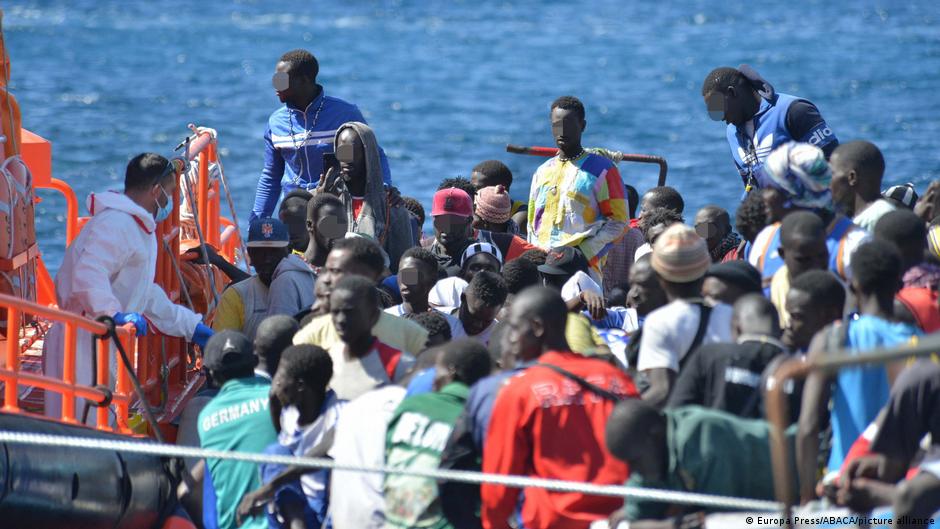
More than 1,000 migrants attempting to reach Spain’s Canary Islands have been rescued from the Atlantic Ocean after seven boats reportedly broke down during the dangerous journey from West Africa.
-

 Auto2 days ago
Kaduna to Lead Govt Patronage of Local Vehicles as Sani Unveils Peugeot 5008
-

 metro1 day ago
El-Rufai Demands ₦10bn from Defence Minister Over Southern Kaduna Killings Allegation
-

 metro1 day ago
Catholic priest leaves priesthood, weds Kenyan woman after 12 years in Kenya
-

 metro2 days ago
Socialite Igho ‘Tiny’ Ubiribo Dies After Penis Enlargement Surgery
-

 Politics3 days ago
Demystifying the Political Monolith: Wike’s ‘See Finish’ Doctrine and Nigeria’s New Political Calculus
-

 Politics1 day ago
Why Did Peter Obi Attend Seyi Makinde’s Campaign Launch? Here’s What He Said
-

 metro1 day ago
No US Case Against Tinubu, Family Enjoy Unimpeded Transit for UNGA — Ambassador Ibrahim
-

 News1 day ago
Lagos Moves to Slash Agency Fees, Curb Rent Hikes With New Tenancy Bill