

International
UK to give Ukraine further £1billion of military support to help fight Putin
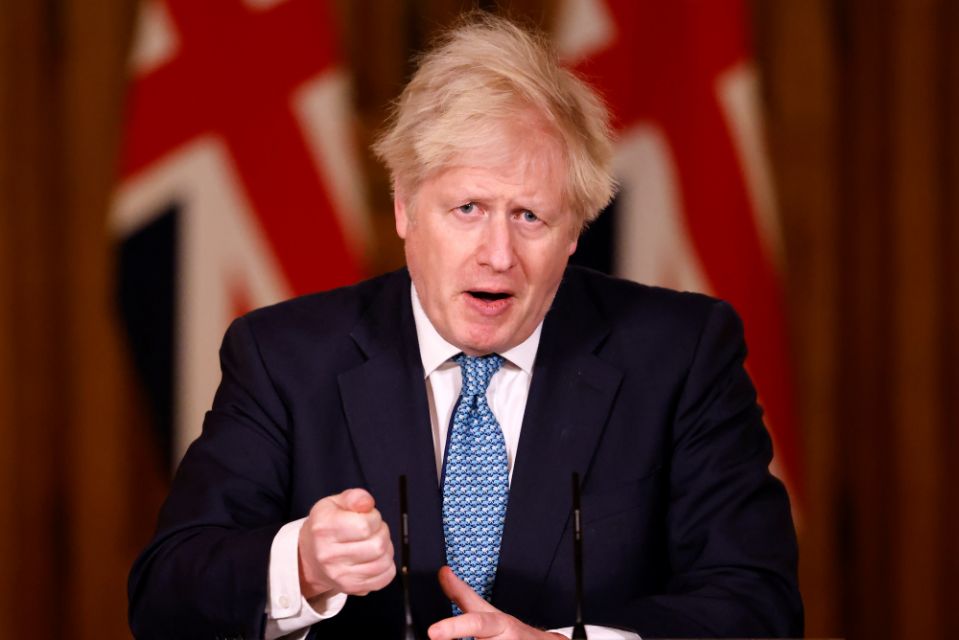
The UK has announced a further £1billion of military support to help Ukraine resist Vladimir Putin’s brutal invasion.
The latest announcement, which came at the end of the first full day of the Nato summit in Madrid on Wednesday, takes Britain’s total economic and military support for Kyiv to £3.8bn this year.
Prime Minister Boris Johnson said: “UK weapons, equipment and training are transforming Ukraine’s defences against this onslaught. And we will continue to stand squarely behind the Ukrainian people to ensure Putin fails in Ukraine.”
The new commitment from Britain is part of a wider package of support for Ukraine agreed at the Nato summit. Earlier on Wednesday the Ukrainian President Volodymyr Zelensky told Nato leaders that the cost of fighting the war against Russia was around $5bn a month.
He renewed his appeal for more weapons to help his forces resist Russia but added that it was financial support which was now crucial to the future of his country.
Number 10 said Britain’s new tranche of support for Ukraine will go towards boosting Kyiv’s defensive capabilities including sophisticated air defence systems, drones, innovative new electronic warfare equipment and thousands of pieces of vital kit for Ukrainian soldiers. It is also understood it will include ammunition.
READ ALSO:
- Police kill two gunmen in Anambra
- 5 die, nine injured in Lagos-Ibadan road crash
- Joshua vows to reclaim titles in Usyk rematch
- Minister-designate plans to end ASUU strike, Senate confirms nominees
The Government says the extra £1bn means only the US has provided more military support to Ukraine since the start of the war on February 24.
Support has so far included more than 5,000 NLAW anti-tank missiles which are made in Northern Ireland, long-range multiple launch rocket systems, and artillery systems, including 155mm self propelled guns.
Britain has also offered a comprehensive new training programme to the Ukrainian Armed Forces.
In his statement announcing the new support, Mr Johnson added: “Putin’s brutality continues to take Ukrainian lives and threaten peace and security across Europe.
“As Putin fails to make the gains he had anticipated and hoped for and the futility of this war becomes clear to all, his attacks against the Ukrainian people are increasingly barbaric.”
Downing Street said funding for the new support would come from the underspend of departments across the UK Government and £95 million in contributions from the Scottish and Welsh Governments’ budgets.
Defence Secretary Ben Wallace said Britain’s commitment to Ukraine was “real and constant” and that the UK would stand by Kyiv “until Russia changes course”.
He added that that he was “relieved” the funding for the new support was not coming out of his already stretched defence budget.
“If it wasn’t coming as extra money it would be coming out of my budget so I am pretty relieved it’s extra money,” he told reporters in Madrid.
“I don’t care how the money is labelled…its fundamentally now helping Ukraine defeat Russia in Ukraine and a worn out Russian army is a definite medium and long term benefit to the United Kingdom.”
In his virtual address to Nato leaders earlier, President Zelensky said the war was not being waged by Russia against only Ukraine but “a war for the right to dictate conditions in Europe – for what the future world order will be like”.
READ ALSO:
- Osimhen sued by former agent
- Sultan Declares Thursday Dhul Hijjah 1, Saturday Eidul Adha
- 17 Delegates Refunded Money I Gave Them, Says APC Senator Who Lost Re-Election Ticket
He added: “Financial support for Ukraine is now no less important than aid with weapons. We need about $ 5 billion a month – and that’s a fundamental thing. This is exactly what is needed for defence, for security.”
On Wednesday Moscow’s battle to wrest the entire Donbas region from Ukraine saw Russian forces pushing towards two Luhansk province villages south of the city of Lysychansk, while Ukrainian troops fought to prevent their encirclement.
Meanwhile, crews continued to search through the rubble of the shopping centre in Kremenchuk where Ukrainian authorities said 20 people remained missing. Authorities in the city declared three days of mourning.
The blast from Monday’s airstrike was so powerful, relatives may not be able to recover any trace of their loved ones’ remains.
Ukrainian state emergency services press officer Svitlana Rybalko said that along with the 18 people killed, investigators had found fragments of eight more bodies. A number of survivors were being treated for injuries such as skull fractures and severed limbs.
Following talks on day one of the summit, Nato issued a declaration announcing more support for Ukraine and a new 10 year strategy which will significantly enhance the organisation’s defences against Russia on Europe’s eastern borders.
It also confirmed Finland and Sweden would be invited to join the alliance – a process which must now be rubber stamped by the parliaments of each of its 30 members – and acknowledged for the first time the “systemic competition” presented by China.
Evening Standard









International
Gaza Building Collapse Kills 21, Including Eight Children
Gaza Building Collapse Kills 21, Including Eight Children
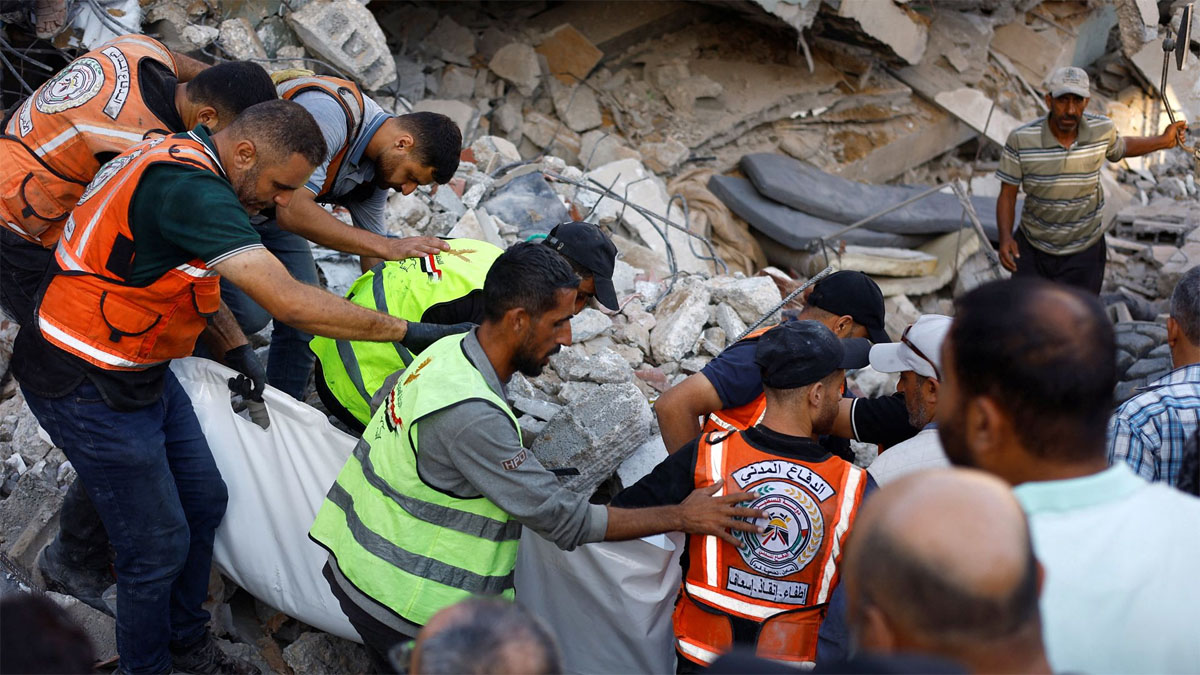
At least 21 people have been killed, including eight children, after a war-damaged building collapsed in Gaza City overnight, rescuers and medics say. The tragedy has renewed concerns about the collapse risk facing hundreds of bomb-damaged structures across the Gaza Strip as winter approaches.
The six-storey residential building in Gaza City’s Tal al-Hawa area collapsed in the early hours of Wednesday. According to the United Nations humanitarian coordinator for the occupied Palestinian territories, Ramiz Alakbarov, an estimated 100 people, including 50 children, were living in the building when it came down. The Gaza Civil Defence agency confirmed that rescuers extracted 21 bodies and rescued 20 unharmed individuals from the rubble on al-Sinaa Street in Tal al-Hawa. Dozens remain missing or injured underneath the debris.
Witnesses told the BBC that the building had been left tilting dangerously to one side after an Israeli strike more than a year ago. Displaced families had moved inside because they were desperate, with nowhere else to go. The building had been hit multiple times in 2024 and March 2025, leading to warnings for Gazans not to return, according to Civil Defence spokesman Mahmoud Basal. More than 10 families, totalling around 80 people, lived in the building, according to residents, with dozens of them being children. Sherif, whose sister was killed, said: “They couldn’t find a tent or somewhere to live. This was the last place they could turn to, despite the danger. They were aware that it would likely end in tragedy. A lack of resources drove them towards certain death.“
A woman living in a tent nearby, Umm Mohammed Bakrun, said she had been talking to her son when the building collapsed suddenly. “It felt like an earthquake. There was a loud sound and I couldn’t stand up. Stones rained down on us and when I looked outside I saw a lot of dust,” she told the BBC. “Within minutes, there were screams everywhere.” Another witness, Mansour Abu Mohammed, said the building collapsed “in a few seconds”. “Every day, a stone or a few stones would fall from it, but the people inside couldn’t find anywhere else to live. I used to live next door to it and you could see that it was tilting to one side.”
READ ALSO:
- Niger Mosque Abductions: Terrorists Execute 30 of 500 Captive Muslim Worshippers
- OAU Investigates Death of Final-Year Student as Police Begin Probe
- 57-Year-Old Man Arrested Over Sexual Abuse of Stepdaughter in Edo
UN and Egyptian teams joined the search for survivors, which was slow due to a lack of heavy machinery. Initially, rescuers from the Hamas-run Civil Defence agency had to use their bare hands. Egypt provided heavy machinery for the rescue operation, while the United Arab Emirates and Qatar were set to deliver relief items. The Palestinian Civil Defence said rescue teams had been working continuously since the collapse, but lacked even the most basic tools. “In the first moments after the collapse, we had to ask neighbours and displaced people nearby to bring hammers, shovels and other tools because of the severe shortage of equipment,” said Abdullah al-Majdalawi, director of public relations at Gaza’s Civil Defence. The head of the United Nations Development Programme (UNDP) Gaza office, Alessandro Mrakic, told reporters at the scene that “the situation… is tragic because we don’t have the equipment and machinery that is needed”.
Mrakic warned that approximately 400 other war-damaged buildings across Gaza were at imminent risk of collapse, particularly as winter approaches. The Civil Defence agency has identified around 2,000 buildings across the territory at risk of collapse. “We need support, most importantly with machinery, equipment, among others. Our colleagues here don’t have [engine] oil and spare parts to continue to work with all the equipment that is still in Gaza.” The UN’s humanitarian relief coordinator, Ramiz Alakbarov, said he was “devastated” by the reports. “No-one should have to risk their life simply to find a safe place to shelter,” he said. He also urged Israeli authorities to approve deliveries to Gaza of heavy machinery for rescue operations, as well as tents, tarpaulins and other non-food items for displaced people ahead of the winter rains. Israel says its restrictions are meant to keep equipment out of the hands of Palestinian armed groups that could also have military uses.
An estimated 80% of all structures in Gaza have been destroyed or damaged during the war between Israel and Hamas, according to the UN. More than 1.9 million people — about 90% of the territory’s population — have been displaced, many of them multiple times, and 1.2 million of them are currently living in tents or makeshift shelters. The UN has warned that the humanitarian situation in Gaza remains dire despite the ceasefire agreed last October, as Israeli air strikes and other attacks continue to hit populated areas, causing casualties and property damage and driving further displacement. According to Gaza’s health ministry, 1,369 Palestinians have been killed and 4,627 wounded since the fragile ceasefire took effect on 11 October 2025. The total death toll since the war began has reached 73,783, with 174,738 injured.
On Tuesday, Israeli air strikes killed at least five Palestinians, including two children and a Hamas commander, according to health officials and Hamas sources. The Israeli military said it killed a Hamas commander in southern Gaza and another fighter in the north. In both cases, a child was also reportedly killed. Separately, the British charity Medical Aid for Palestinians said that a patient was killed by an Israeli drone at a health centre it supports in Jabalia in northern Gaza. A spokesperson for the Israeli military told the BBC it was not aware of such an incident.
The Gaza war was triggered by the Hamas-led attack on southern Israel on 7 October 2023, when about 1,200 people were killed and 251 others were taken hostage. Since then, more than 73,790 people have been killed in Gaza, according to the territory’s Hamas-run health ministry, whose figures are considered reliable by the UN. In a statement, the Gaza government media office under Hamas said it held “the Israeli occupation and the international community fully and directly responsible for this catastrophe befalling our Palestinian people“.
Gaza Building Collapse Kills 21, Including Eight Children
International
Pope Leo XIV Warns Against Letting AI Make Human Decisions
Pope Leo XIV Warns Against Letting AI Make Human Decisions
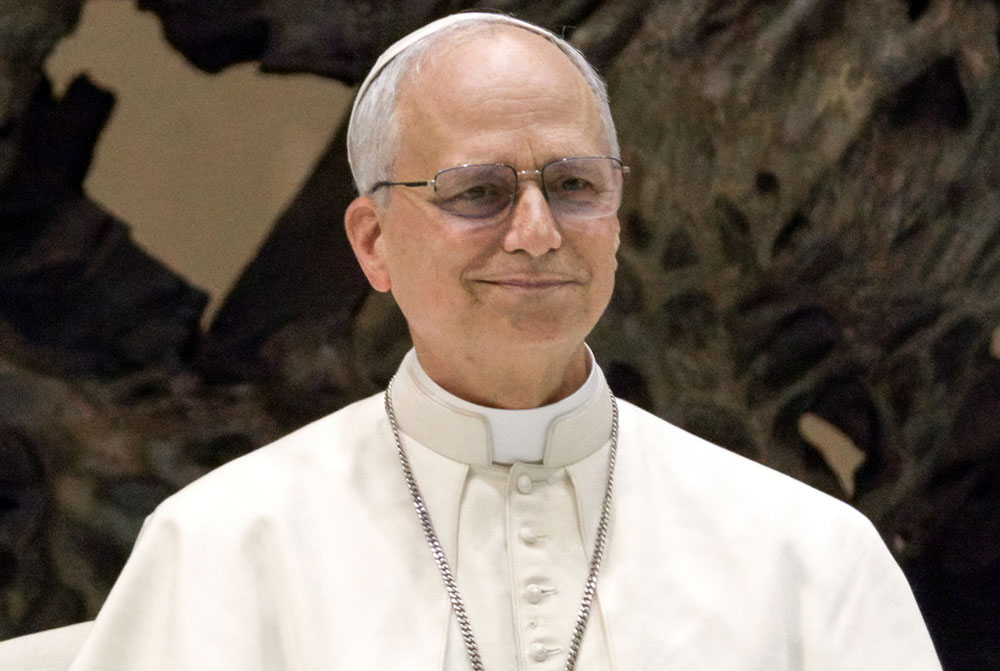
The rapid advancement of artificial intelligence has prompted a fresh warning from Pope Leo XIV, who says some decisions should never be handed over to algorithms.
The Pope made the remarks at his weekly audience in St Peter’s Square, where he addressed thousands of faithful and reflected on the impact of technology on modern human interaction.
While acknowledging that AI, social media and other forms of technological development can reduce barriers and connect people across great distances, he said they also carry a risk of making human relationships increasingly virtual.
His particular concern was the possibility that society could become accustomed to allowing algorithms to determine matters that should instead be guided by human conscience.
“Ensuring that social relationships have real substance and personal depth” is one way the Christian community seeks to respond to this challenge, he said.
The comments come amid broader concerns about the direction of AI development. Recent security incidents, along with the growing ability of some AI systems to improve their own performance without human intervention, have intensified debate about the technology.
Another major question is whether companies and organisations within the AI sector are capable of regulating themselves effectively as the technology becomes more powerful.
The Pope has previously made AI a major focus of his public interventions. His first major document, the May encyclical “Magnifica Humanitas”, urged efforts to prevent AI from becoming a force that dominates humanity.
The Holy See has also become more active in calls for international rules governing AI, grounding its position in the protection of human dignity. Its initiatives have extended to discussions involving nuclear technology, culture and artistic creation.
The latest warning places the Vatican’s concerns within a wider debate over how humanity should balance the benefits of increasingly powerful AI with the need to keep important decisions under human control.
Pope Leo XIV Warns Against Letting AI Make Human Decisions
International
Islamic Council Condemns Attempted Attack on Holy City of Mecca

Islamic Council Condemns Attempted Attack on Holy City of Mecca
International leaders call for accountability after Saudi defense systems neutralize an incoming drone before it entered protected airspace.
The Organisation of Islamic Cooperation has strongly criticized a failed drone attack directed toward the holy city of Mecca and the surrounding Medina region.
The international group, which represents 57 member nations, stated that any attempt to strike sacred places of worship or harm everyday people goes against basic human decency and international law.
The statement came after Saudi defense forces reported stopping an unmanned aircraft on Tuesday evening. Coalition officials confirmed that defense teams tracked the incoming drone and destroyed it south of Mecca before it could enter protected airspace.
Military representatives explained that keeping visiting worshippers and local communities safe remains an absolute priority, warning that threats against sacred sites will not be tolerated.
The OIC expressed full support for the safety steps Saudi Arabia uses to protect its borders, communities, and historical religious centers.

Although Houthi representatives in Yemen have previously stated that they do not intend to strike holy landmarks, global leaders emphasized that all groups must respect civilian safety and ensure that sacred religious spaces remain free from military conflict.
Islamic Council Condemns Attempted Attack on Holy City of Mecca
-

 Politics3 days ago
2027: Northern Lecturers Back Tinubu, ASUU Disowns Endorsement
-

 metro3 days ago
Police Arrest Mother Over Alleged Brutal Abuse of 7-Year-Old Girl in Anambra
-

 Sports2 days ago
‘I Was Never the Chosen One’ — Dembele Responds to Mbappe
-

 International1 day ago
Islamic Council Condemns Attempted Attack on Holy City of Mecca
-

 Education2 days ago
JAMB Moves 2027 UTME Time — Here’s What Candidates Need To Know
-

 News1 day ago
Keep Politics Out of My Office — Ogbomoso Grand Chief Imam Warns Politicians, Bloggers
-

 metro2 days ago
Lagos Power Outage: Ikeja Electric Blames TCN as Businesses, Homes Groan
-

 Politics2 days ago
2027: APC Governors Reject Wike’s Rainbow Coalition, Insist on Party Loyalty