

Auto
Updated: Lagos rolls out mini-buses to replace okada in two months

Lagos State Governor, Babajide Sanwo-Olu, has unveiled cashless First and Last Mile (FLM) buses that will ply inner routes expected to replace commercial motorcycles (okada) in the state.
A total of 300 FLM buses in the first phase of the scheme were rolled out on Tuesday out of the expected 5,000 units
Sanwo-Olu, while unveiling the FLM bus scheme at the Lagos State House, Ikeja, on Tuesday, said the need to phase out okada was the reason their introduction.
He said government would observe the operation of the FLM for two months to know its performance in meeting the needed demand before he would pronounce total ban on okada operation.
A statement by the governor’s Chief Press Secretary, Gboyega Akosile, said the FLM vehicles were assembled locally, adding that the mini-passenger buses (with capacity for seven to 11 people) would operate on 286 community routes.
Part of the statement read, “They will take passengers from closest points to their areas of residence to standard transportation corridors. Payment for FLM services will be through an automated payment system, using Cowry Travel Cards. Cowry Travel Card holders who use them on BRT buses and standard route buses can use their cards on FLM buses.
“For ease of operation of the scheme, the Lagos State Government delineated the FLM’s corridors into eight zones, comprising Ikeja and Ketu (Zone 1), Oshodi, Mushin, and Surulere (Zone 2), Berger, Yaba and Oyingbo (Zone 3) and Lagos Island, Ajah and Ibeju Lekki (Zone 4).
Others are Iyana-ipaja and Agege (Zone 5), Mile 2, Iyana-Iba and Ajeromi (Zone 6), Ikorodu (Zone 7) and Epe and Badagry (Zone 8).”
Sanwo-Olu also inaugurated brand-new 100 high- and medium-capacity buses into the fleet of Lagos Bus Service Limited (LBSL) to replace vehicles burnt at BRT stations during the wave of violence that marred the EndSARS protests, last October.
The governor said the mini-buses would address okada-related crises that had generated widespread concern on safety among residents. They would offer services which the high-capacity buses were not designed for, he added.
He said, “The launch of the First and Last Mile (FLM) Bus Scheme today is an important milestone in our quest to achieving the intermodal transport system which gives our teeming population the choices they deserve, reducing congestion and journey times, and improving the quality of life.
“It is also in fulfilment of one of the measures we promised as a solution to the security situation discussed at our recent Security Stakeholders’ Town Hall Meeting.
“As a responsible Government, we are launching this scheme in response to two major issues. One is the alarming statistics of fatal accidents recorded from the operations of okada in Lagos between 2016 and 2019, and the use of okada for the facilitation of crime across the metropolis.
“The goal is the full implementation of a safer and more efficient alternative transport solution that takes out the need for okada and replaces them with safer buses that will help us curb incidents of Okada-related accidents, crime and robberies.”
The statement also disclosed that a ride on the FLM buses would come with a premium insurance policy on the lives of passengers and the drivers, adding that the operation and maintenance of the buses had been handed over to private operators for efficiency and turnover.
Sanwo-Olu said the State Government had been working with the National Union of Road Transport Workers (NURTW) and the Road Transport Employers Association of Nigeria (RTEAN) as major stakeholders in the state’s Bus Reform Initiative (BRI) being implemented by Lagos Metropolitan Area Transport Authority (LAMATA).
He said, “I call on NURTW, RTEAN and all other stakeholders in the public transportation value chain to ensure that these new buses are well maintained and protected, so that the goals of the new service can be fully realised, and all those who invested can derive maximum value from their investments.
“Our local councils’ chairmen must play their parts in ensuring the roads are free from encumbrances likely to impede the smooth running of the FLM buses. I charge our security and law enforcement agencies to be alive to the crucial role they have to play in the success of this scheme.”
Commissioner for Transportation Dr Frederic Oladehinde said the scheme was a component of the state’s transport system meant to offer relief to residents in the hinterland in accessing the standard transport corridors through safe means.
He said, “In line with the Transport Sector Reform Law of 2018, the Lagos State Government, through the Ministry of Transportation and LAMATA, has put in place various measures aimed at readjusting its transportation strategies to accommodate FLM scheme to provide all inclusive, safe, convenient, affordable, and accessible services in line with global practices.”
Managing Director of LAMATA, Mrs Abimbola Akinajo, said the FLM buses operations would start immediately in Zones 2,3,4,5, and 7 captured in the first phase of the bus scheme.
Akinajo said a monitoring mobile application had been designed for real time data collection as well as vehicle tracking purpose to ensure safety, adding that all drivers to be engaged in the FLM scheme would be certified by the Lagos State Drivers Institute (LASDRI) to ensure that they are fit to operate the buses.
“We will ensure proper maintenance of the buses to guarantee their service longevity. Maintenance of the buses will be outsourced to the Original Equipment Manufacturers (OEM), which will be responsible for executing all preventive and corrective maintenance needs. Operators will ensure that buses are maintained in line with the best engineering standard,” she said.







Auto
Nigeria Takes Centre Stage at UN Road Safety Summit as Tinubu Delegates FRSC Corps Marshal
Nigeria Takes Centre Stage at UN Road Safety Summit as Tinubu Delegates FRSC Corps Marshal
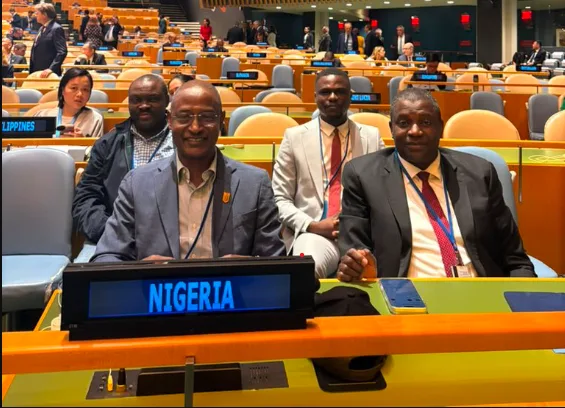
President Bola Ahmed Tinubu has reinforced Nigeria’s commitment to the global campaign against road traffic fatalities by appointing the Corps Marshal of the Federal Road Safety Corps (FRSC), Shehu Mohammed, to lead the country’s delegation to the United Nations High-Level Meeting on Improving Global Road Safety in New York, United States.
The high-level gathering at the United Nations General Assembly Headquarters has brought together Heads of State, ministers, global policymakers and road safety experts to review progress and accelerate efforts towards achieving the UN target of reducing road traffic deaths and serious injuries by 50 per cent before 2030 under the Decade of Action for Road Safety.
Representing President Tinubu at the plenary session, Shehu Mohammed delivered Nigeria’s national statement on the meeting’s theme, “Scaling Up and Accelerating Implementation of Commitments to Halving Road Traffic Deaths and Injuries by 2030.”
He reaffirmed the Federal Government’s determination to strengthen road safety governance through sustained political commitment, strategic investments, innovation and stronger international partnerships in line with the administration’s Renewed Hope Agenda.
The Corps Marshal highlighted the significant progress Nigeria has recorded in advancing road safety, noting that the Federal Government has strengthened the institutional capacity of the FRSC through strategic reforms, technology-driven enforcement systems, enhanced emergency response mechanisms and intensified public education campaigns aimed at reducing crashes and fatalities.
He also showcased Nigeria’s growing influence in road safety across Africa, citing the recent launch of the Nigeria Road Assessment Programme (NigeriaRAP) in partnership with the International Road Assessment Programme (iRAP).
According to him, the initiative adopts the globally recognised Safe System Approach to improve road infrastructure safety and reduce crash risks.
Mohammed further pointed to Nigeria’s role as host of the Secretariat of the African Association of Road Safety Lead Agencies (AARSLA), describing it as a strategic platform for promoting collaboration, knowledge sharing and institutional development among road safety agencies across the continent.
On sustainable transportation, the FRSC boss told delegates that Nigeria is aligning its mobility agenda with global environmental goals through the Presidential Initiative on Compressed Natural Gas (CNG) and Electric Vehicles (EVs), while developing comprehensive safety standards for heavy-duty vehicles and emerging transport technologies.
While acknowledging the progress already made, Mohammed stressed that achieving the 2030 target would require stronger international cooperation in areas such as intelligent enforcement technologies, road infrastructure safety assessments, institutional capacity development and technology transfer.
He therefore urged development partners and the international community to expand technical cooperation and support capacity-building programmes that would help countries accelerate the implementation of global road safety commitments.
Reaffirming Nigeria’s position, the Corps Marshal declared that road safety remains a national priority under President Tinubu’s administration, assuring the global community that the country would continue to collaborate with international partners to build safer roads, save more lives and contribute meaningfully to the attainment of the Sustainable Development Goals.
The UN High-Level Meeting, convened by the President of the United Nations General Assembly in collaboration with the World Health Organization (WHO), is expected to adopt a Progress Declaration that will shape global road safety actions towards meeting the 2030 target.
The meeting is also reviewing countries’ progress since the 2022 Political Declaration and the Fourth Global Ministerial Conference on Road Safety held in Marrakech, Morocco, in 2025.
Auto
Jetour Nigeria Unveils RELY R8, Rugged Luxury Pickup Built to Dominate Work, Adventure

Jetour Nigeria Unveils RELY R8, Rugged Luxury Pickup Built to Dominate Work, Adventure
Jetour Nigeria has unveiled the RELY R8, a premium pickup truck designed to combine rugged performance with luxury, advanced technology and exceptional versatility, setting a new benchmark for work and recreational vehicles in Nigeria.
Engineered to thrive in the country’s demanding terrain, the RELY R8 is built for agriculture, construction, logistics, security escort operations and weekend adventures, offering the toughness of a workhorse without sacrificing the comfort and refinement of a modern SUV.
The pickup boasts high ground clearance, impressive approach and departure angles, and a reinforced chassis designed to withstand harsh road conditions while delivering excellent stability, even in strong crosswinds.
Its all-terrain capability is enhanced by multiple driving modes, allowing drivers to switch effortlessly between mud, sand and paved roads. Whether tackling heavy-duty tasks or venturing off the beaten path, the RELY R8 is built to perform with confidence.
Inside, the vehicle departs from the traditional utilitarian pickup design, featuring a spacious SUV-inspired cabin that comfortably accommodates five adults while offering a premium driving experience.
Speaking on the new model, Jetour Nigeria representative, Kemi Adeola, described the RELY R8 as a perfect blend of strength, innovation and comfort.
“The RELY R8 delivers strength, reliability and advanced technology in one vehicle. It offers the capability of a modern workhorse without compromising on premium comfort or safety,” she said.
The pickup is equipped with a high-performance processor that powers its L2+ intelligent driving assistance system. It also features a 12.3-inch HD touchscreen infotainment system with Apple CarPlay, Android Auto and remote engine start for enhanced convenience.
Safety is another major highlight of the RELY R8, with features including Intelligent Cruise Control, Lane Keeping Assist and Autonomous Emergency Braking, all designed to provide greater confidence and protection on every journey.
Jetour Nigeria has continued to strengthen its presence in the country’s automotive market, earning recognition as the Fastest Growing Auto Brand in Nigeria, while its Jetour Dashing SUV won the prestigious Car of the Year award. The company has served as the sole authorised distributor of Jetour vehicles in Nigeria since 2022.
The RELY R8 is backed by comprehensive manufacturer support, genuine spare parts and professional after-sales service through Jetour Nigeria’s network of authorised dealers, including Elizade Nigeria Limited, New Era Autovehicle Services Limited, Kojo Motors, Germaine Auto Centre, R.T. Briscoe Plc, TAB Autos Limited and Mandilas Motors.
Jetour Nigeria has invited prospective customers to visit any of its authorised dealerships nationwide to book a test drive and experience firsthand the RELY R8’s blend of rugged capability, cutting-edge technology and premium comfort.
Auto
No Hiding Place for Traffic Offenders as FRSC Unleashes 12 Special Operations Nationwide

No Hiding Place for Traffic Offenders as FRSC Unleashes 12 Special Operations Nationwide
The Federal Road Safety Corps (FRSC) has launched one of the most ambitious nationwide road safety operations in its history, deploying 12 intelligence-driven, code-named special enforcement campaigns across the country’s Zonal Commands in a decisive bid to curb road crashes, crack down on traffic offenders and save lives.
The coordinated initiative, known as the Zonal Special Intervention Patrol (ZSIP), commenced on July 20, with all 12 Zonal Commands simultaneously rolling out operations specifically designed to tackle the peculiar road safety challenges within their jurisdictions.
The operations are peration Fushin Zuma (Anger of the Bee) in Kaduna, Operation Ride Safe in Bauchi, Operation Shark Smile in Port Harcourt, Operation ABO (Safe Passage) in Lagos, Operation Sauka Lafia in Abuja, Operation Kasolayo in Ilorin, Operation Kwushi Ihe Mberede in Enugu, Operation Sanity in Osogbo, Operation Total Compliance in Benin, Operation Harbin Kunama (Scorpion Sting) in Yola, Operation Hadarin Kalangu in Jos, and Operation Daidaita Loading in Zone 10.
The Corps said the coordinated intervention reflects its determination to confront the major causes of road traffic crashes through intelligence-led enforcement, aggressive public enlightenment, enhanced operational visibility, stakeholder engagement and strategic collaboration with other security agencies.
Approved by the Corps Marshal, Shehu Mohammed, the Special Intervention Patrol is designed to empower each Zonal Command to tackle the unique crash patterns and traffic violations prevalent in its area of responsibility.
According to the Corps Marshal, the initiative marks a significant departure from conventional traffic enforcement, shifting instead to targeted, intelligence-based operations capable of delivering measurable results in reducing road crashes and fatalities.
He explained that each operation had been carefully crafted to address dangerous driving behaviours and recurring traffic offences responsible for avoidable deaths and injuries on Nigerian roads.
Mohammed disclosed that the operations would witness massive deployment of FRSC personnel to highways, motor parks, loading points and other critical traffic corridors across the country.
The enforcement exercise, he added, would be complemented by sustained public awareness campaigns, stakeholder engagement and close collaboration with sister security agencies to ensure effective enforcement and prompt emergency response.
He warned motorists, commercial vehicle operators and fleet owners that there would be no hiding place for traffic offenders, stressing that anyone found violating traffic regulations would face firm but professional enforcement in line with the Corps’ statutory mandate.
The Corps Marshal, however, assured law-abiding road users that the operations were not designed to harass or punish responsible motorists but to safeguard lives and property.
He urged Nigerians to cooperate with FRSC patrol teams by obeying traffic regulations, avoiding dangerous practices such as overloading, mixed loading and reckless driving, while encouraging members of the public to report unsafe road users.
Mohammed also called on transport operators to embrace voluntary compliance, noting that road safety remains a shared responsibility requiring the collective commitment of government, transport stakeholders and every road user.
Summing up the Corps’ renewed determination to reduce road carnage on Nigerian highways, he declared: “Every Zone has a mission. Every patrol has a purpose. Every operation is a commitment to saving lives.”
-
 metro2 days ago
PFICP scandal: How ₦1.3bn ‘fake agency’ traced to Buhari’s government entered 2026 budget
-

 Politics3 days ago
Atiku denies Obasanjo’s N5m bribery claim, links accusation to 2027 presidential race
-

 Education3 days ago
Oluwo Urges Youths to Pair Degrees with Skills, Commends Westland University’s Excellence
-

 metro2 days ago
Dalung gives Mutfwang 72-hour ultimatum to withdraw apology to Igbos over civil war role
-
 metro3 days ago
Police Detain 4 Officers Over Viral Ethnic Profiling Video on Lagos–Benin Expressway
-
Politics1 day ago
2027 election: Atiku accuses Obasanjo of reviving false allegations to favour preferred candidate
-

 metro9 hours ago
NDLEA intercepts ₦10bn worth of cocaine, Loud, opioids in Lagos
-
 metro3 days ago
“No Governor Has Such Power” – MC Oluomo Fires Back at Gov Adeleke Over Osun NURTW Ban