

International
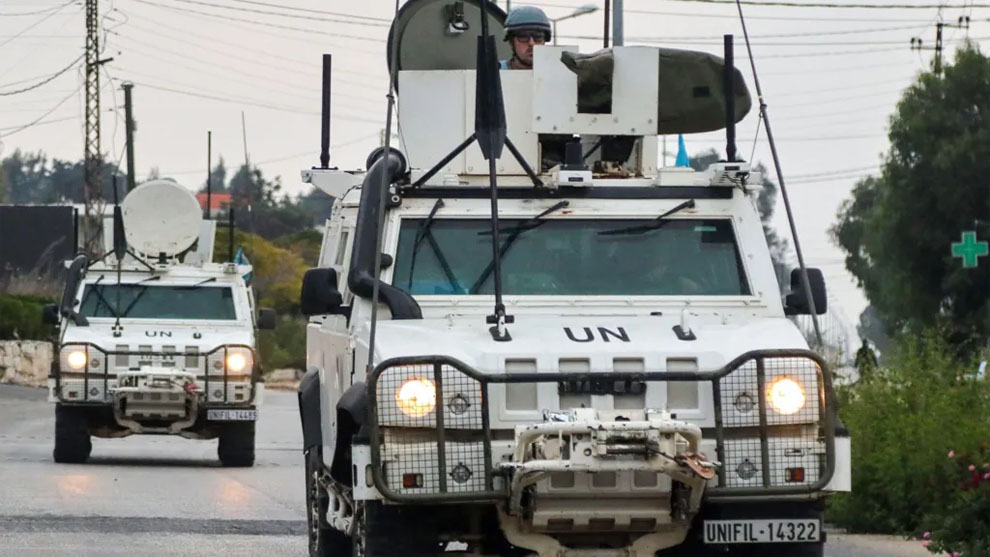
US to Israel: Stop shooting at UN peacekeepers in Lebanon
US to Israel: Stop shooting at UN peacekeepers in Lebanon
US President Joe Biden has said he is “absolutely, positively” urging Israel to stop firing at UN peacekeepers during its conflict with Hezbollah in Lebanon, following two incidents in 48 hours.
On Friday, the Israel Defense Forces (IDF) said its troops were responsible for the incident, in which two Sri Lankan soldiers for the UN Interim Force in Lebanon (Unifil) were injured.
IDF soldiers operating around the Unifil base in Naqoura identified a threat and opened fire, the Israeli army said, adding the incident would be investigated “at the highest levels”.
On Thursday, Unfil’s two Indonesian soldiers were injured falling from an observation tower after an Israeli tank fired towards it.
The leaders of France, Italy and Spain issued a joint statement condemning Israel’s actions, saying they were unjustifiable and should immediately come to an end.
Sri Lanka’s foreign ministry said it “strongly condemns” the IDF attack which injured two of its soldiers.
The head of UN peacekeeping said there was reason to believe some firing on UN positions in southern Lebanon had been direct, though he did not ascribe responsibility for the incidents.
“For example we have a case where a tower was hit by a fire and also damages to cameras at one of the positions – which obviously to us very much looked like direct fire,” Jean-Pierre Lacroix told the BBC’s Newshour programme.
As Israel’s invasion of southern Lebanon continues, the IDF and the Lebanese armed group Hezbollah continued to fire missiles and rockets across the Israel-Lebanon border.
READ ALSO:
- Customs seize smuggled fuel, sell at N630/ litre
- Lebanon calls for UN decision on ceasefire as Israeli strikes expand
- Tinubu, Remi and Akpabio mocking Nigerians’ hardship, By Farooq Kperogi
The IDF said it had detected about 100 rockets crossing into northern Israel from Lebanon within the space of half an hour on Friday. Two unmanned aerial vehicles (UAVs) were detected crossing from Lebanon, one of which was intercepted, the IDF said.
The Lebanese ministry of health said three people, including a two-year-old girl, were killed in an Israeli raid on the city of Sidon in southern Lebanon. Two Lebanese soldiers were killed after Israeli forces targeted an army post in the town of Kafra in southern Lebanon, the Lebanese army said.
In the capital, Beirut, emergency workers continued to comb through the wreckage of buildings hit by two Israeli air strikes on Thursday.
Lebanese Prime Minister Najib Mikati said the attacks came with no warning and killed 22 people, all civilians, and injured another 117. Israel has not commented.
Israeli forces launched a ground invasion into southern Lebanon last month as they escalated their response to rocket fire from Hezbollah.
Hezbollah and Israel have been trading near-daily cross-border fire since last October, when the Palestinian armed group Hamas in the Gaza Strip carried out a deadly attack in southern Israel.
The IDF has said the UN post struck in Naqoura on Friday was about 164ft (50m) away from the source of the threat identified by soldiers. It said it had told peacekeeping troops to stay in protected spaces at the time.
Unifil said Israeli military vehicles had knocked over barriers at another UN site in Labbouneh, closer to the border with Israel.
The incidents represented a “serious development”, it said.
Mikati said Friday’s attack was “a crime which is directed at the international community”.
Israel argues that Unifil has failed to stabilise the region, and has asked peacekeepers to withdraw northwards so it can confront Hezbollah.
READ ALSO:
- NNPCL boss Mele Kyari loses daughter, Shettima sends condolences
- Libya frustrated us, one-goal victory a relief – S’Eagles Coach Eguavoen
- Chisco Transport deploys new buses, plans expansion, reward for travellers
The Israeli ambassador to the UN, Danny Danon, has reiterated Israel’s call for Unifil personnel to withdraw north by 5km (3 miles) to “avoid danger,” but the UN’s Jean-Pierre Lacroix said they would remain in position.
About 10,000 peacekeepers from 50 countries are stationed in Lebanon, alongside around 800 civilian staff.
Since 1978, they have patrolled the area between the Litani River and the UN-recognised boundary between Lebanon and Israel, known as the “Blue Line”.
Hezbollah began firing rockets into northern Israel on 8 October last year, the day after Hamas’s deadly attack on southern Israel. The Iran-backed group says it is acting in solidarity with the Palestinians and has said it will stop firing if there is a ceasefire between Israel and Hamas in Gaza.
Over the past three weeks, Israel has dramatically escalated its campaign against Hezbollah, intensifying air strikes against southern Lebanon and southern parts of Beirut, assassinating Hezbollah’s leader Hassan Nasrallah and launching a ground invasion.
Lebanon says more than 2,000 people have been killed, mainly in the recent escalation, and hundreds of thousands have been displaced. This week Hezbollah rocket fire has killed two Israeli civilians and a Thai national, Israeli authorities say.
In a separate development on Friday, Gaza’s Hamas-run civil defence agency was quoted by the AFP news agency as saying at least 30 people were killed in Israeli strikes in the Jabalia town and refugee camp in the north of the Palestinian enclave.
The IDF has not commented on the issue.
Meanwhile, the medical charity Doctors Without Borders (MSF) said “thousands are trapped” in the Jabalia refugee camp, including five of its staff.
The MSF said Israeli forces had issued evacuation orders on 7 October in Jabalia, “while carrying out attacks at the same time”, meaning people could not leave safely.
Dr Mohammed Salha, the acting director of the al-Awda Hospital in Jabalia, told the BBC’s Newshour programme the area had been under siege for seven days.
He warned that the hospital would run out of fuel on Saturday, as Israeli forces were “cutting Jabalia from the rest of Gaza”.
“No medication, no medical supplies, no healthy water, no fuel, so pressure, pressure on these people to move and go directly to the south,” Dr Salha said.
Israel has been conducting a new ground operation in the area, saying it is targeting regrouping Hamas fighters who aim to launch attacks, with dozens of people reportedly killed or wounded in northern Gaza in recent days.
US to Israel: Stop shooting at UN peacekeepers in Lebanon
BBC








International
US Judge Blocks Trump From Tying Counterterrorism Grants to Election Rules

US Judge Blocks Trump From Tying Counterterrorism Grants to Election Rules
A US federal judge has blocked the Donald Trump administration from conditioning counterterrorism grants for states and local governments on changes to how elections are administered.
US District Judge Amir H. Ali of the District Court for the District of Columbia issued the ruling on Monday, September 28, 2026, finding that the Federal Emergency Management Agency (FEMA) exceeded the authority granted to it by Congress by attaching the election-related conditions to homeland security funding.
The case followed a lawsuit filed by Nashville and Davidson County, Tennessee; Columbus, Ohio; and several Texas counties, including Harris, El Paso, Dallas and Travis counties.
The local governments challenged conditions FEMA had attached to its 2026 Homeland Security Grant Program, arguing that Congress authorised the programme to help communities prevent, prepare for and respond to terrorism and other security threats, rather than to regulate routine election administration.
The programme provides more than $1 billion in federal funding to state, local and tribal governments. Under the policy challenged in court, FEMA planned to withhold 20 per cent of certain grant awards until recipients complied with specified election-related requirements.
READ ALSO:
- School Attack: 13-Year-Old Student Kills Teacher, Injures Two
- Bauchi Woman Arrested After Co-Wife Dies in Alleged Pestle Attack
- Breaking: Tinubu Ends Extended European Vacation, Departs Paris for Nigeria
Among the requirements were plans to move away from voting systems that use QR codes or barcodes to count ballots and toward equipment that accepts hand-marked paper ballots.
Recipients also had to demonstrate that they conducted a manual audit of at least five per cent of ballots, reconcile the number of voters who participated in federal elections with the number of ballots cast, and use the Department of Homeland Security’s Systematic Alien Verification for Entitlements (SAVE) database to verify citizenship information in voter-registration records.
The conditions also covered citizenship verification for people working at polling places or operating election systems.
The Trump administration defended the requirements as measures intended to strengthen election security against threats including foreign interference and cyberattacks.
However, Judge Ali ruled that the disputed conditions were not sufficiently connected to the purpose of the counterterrorism grants and that Congress had not authorised FEMA to use the programme to impose the election-administration requirements.
In his 24-page ruling, Ali distinguished between measures designed to protect election infrastructure from security threats and requirements governing routine election procedures, such as ballot formats, voter-roll administration and election audits.
The ruling prevents the administration from conditioning the affected Homeland Security Grant Program funding on compliance with the challenged election requirements while the litigation continues.
A separate lawsuit brought by a coalition of states challenging similar conditions remains pending.
The case comes ahead of the November 3, 2026 US midterm elections, adding another legal dispute to the wider debate over the division of authority between the federal government and states in administering US elections.
The latest ruling does not determine whether the individual election-security measures are effective or appropriate as policy. Instead, it addresses whether FEMA had the legal authority to make compliance with those measures a condition for receiving counterterrorism funding.
The broader Homeland Security Grant Program remains in place, while the administration and the plaintiffs may pursue further legal proceedings.
US Judge Blocks Trump From Tying Counterterrorism Grants to Election Rules
International
Five Arrested Near US-Used RAF Fairford in UK Terror Probe
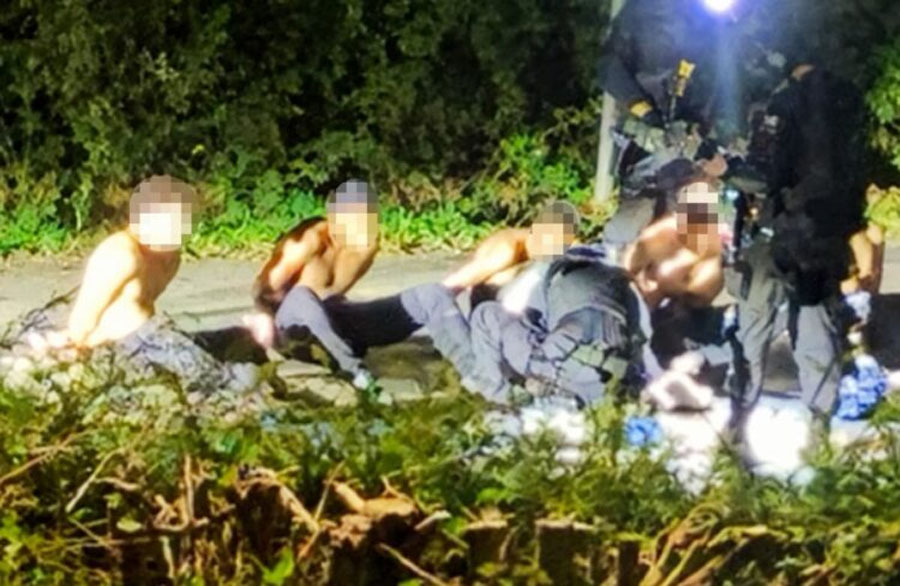
Five Arrested Near US-Used RAF Fairford in UK Terror Probe
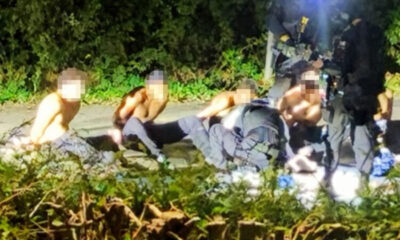
British police have arrested five men near RAF Fairford in Gloucestershire over suspected explosives offences, with the suspects subsequently detained on suspicion of preparing a terrorist act.
The arrests followed a report at about 12:45 a.m. on Sunday, September 27, 2026, concerning three suspicious vehicles that appeared to be travelling towards the air base. Armed officers responded and arrested the five men in the nearby Whelford area.
According to Counter Terrorism Policing, the men were initially arrested on suspicion of offences under the Explosives Act before being further arrested on suspicion of preparing a terrorist act contrary to Section 5 of the Terrorism Act. All five remained in custody as investigators continued gathering evidence.
The incident prompted authorities to declare a major incident, with about 85 households evacuated from Whelford as a precaution.
The evacuated residents were taken to a nearby leisure centre while police established a cordon around the vehicles. The Army’s specialist explosive ordnance disposal team was deployed to examine the vehicles and assess any potential threat.
Counter Terrorism Policing said the investigation was still in its early stages and that officers were working with Gloucestershire Police and other agencies to establish the circumstances surrounding the incident.
Police have not publicly confirmed that an attack on RAF Fairford was planned or that the suspects had entered the military installation. Investigators are examining why the vehicles were in the area and what materials, if any, were associated with them.
READ ALSO:
- Kano Upgrades Five PHCs to General Hospitals, Begins Assessment
- Iran Claims Capture of Second US Underwater Drone in Strait of Hormuz
- Kubwa Explosion: Vehicle Crashes Into Gas Outlet, Damages Nine Shops
The investigation is particularly significant because RAF Fairford is a British military air base used by the United States Air Force. The installation hosts US military personnel and has been used by American aircraft during operations connected with the conflict involving Iran.
The US Air Force said its personnel at Fairford remained vigilant but declined to disclose specific force-protection measures for operational security reasons.
The security operation involved armed police, roadblocks and specialist bomb-disposal personnel. A 400-metre cordon was established around the vehicles while the evacuation was carried out.
Investigators are expected to examine the vehicles, materials and other evidence recovered during the operation as they seek to establish whether there was a planned attack and, if so, its intended target and motive.
The arrests have drawn additional attention because of heightened security around US military installations in Britain. RAF Fairford has become strategically important because of its use by US forces during the conflict involving Iran.
However, British authorities have not publicly linked the five suspects to Iran, any other state or a particular extremist organisation. Any claims about their motive or intended target remain subject to investigation.
The US military has said it remains in close coordination with British authorities and continues to take appropriate measures to protect its personnel and facilities.
British officials have said the incident is believed to be contained, although a substantial security presence is expected to remain in the area while investigators complete their work.
Deputy Assistant Commissioner Vicki Evans, the UK Counter Terrorism Policing senior national coordinator, said investigators were still working to establish what happened.
The five men remain in custody and have not been convicted of any offence. The allegations against them will have to be tested through the British legal process as the UK counter-terrorism investigation continues.
Five Arrested Near US-Used RAF Fairford in UK Terror Probe
International
Iran Claims Capture of Second US Underwater Drone in Strait of Hormuz
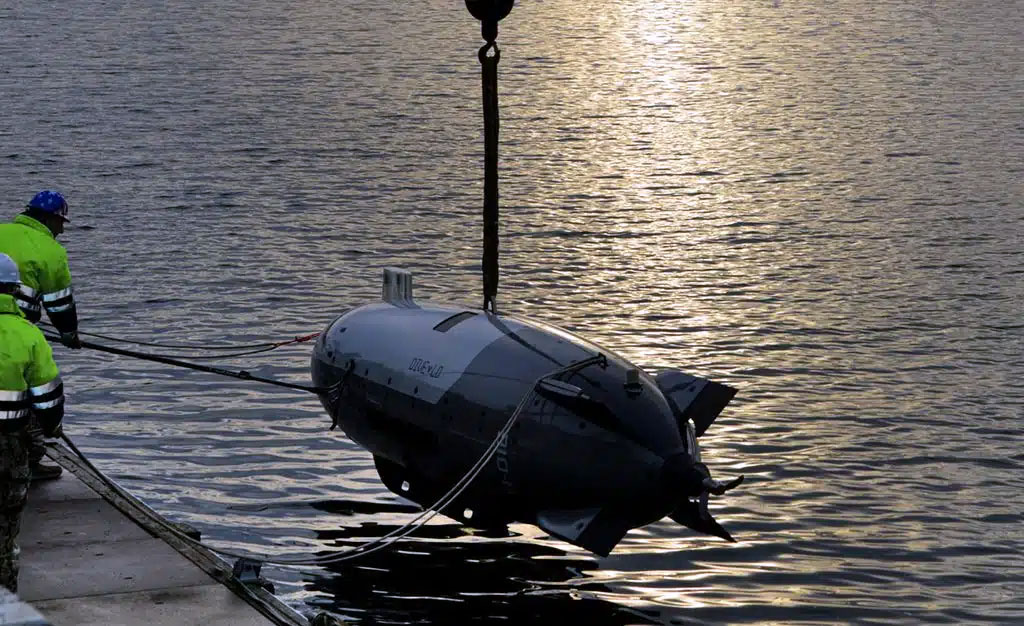
Iran Claims Capture of Second US Underwater Drone in Strait of Hormuz
Iran’s Islamic Revolutionary Guard Corps (IRGC) has claimed that its naval forces captured a second U.S. unmanned underwater vehicle in the strategically important Strait of Hormuz, accusing the vehicle of conducting surveillance activities in the waterway.
The IRGC Navy said on Sunday, September 27, that the Remus 600 autonomous underwater vehicle was intercepted during what it described as a complex operation involving intelligence capabilities and electronic warfare.
According to the Iranian military, the vehicle was operating in the Strait of Hormuz for what it described as espionage purposes when it was captured.
The IRGC said the underwater drone has been handed over to specialists who are working to retrieve and examine information stored on the system. (Arab News)
The claim represents the second reported Iranian capture of a U.S. underwater drone in September, following an earlier incident involving a much larger Dive-LD autonomous underwater vehicle.
On September 8, Iran said its forces had captured the Dive-LD at the entrance to the Strait of Hormuz. The IRGC subsequently released images of the vehicle and described it as an advanced U.S. military unmanned submarine.
The U.S. military acknowledged around that time that one of its underwater drones had malfunctioned while operating in regional waters but did not publicly confirm that Iran had captured it. Reuters footage from the incident showed the vehicle identified by Iran as a Dive-LD. (Reuters Connect)
The latest vehicle, the Remus 600, is substantially smaller than the Dive-LD. It is an autonomous underwater system designed to operate without a crew and can be configured for a range of underwater missions.
Available technical information indicates that the Remus 600 can operate at depths of up to about 600 metres and can remain underwater for extended periods, depending on its configuration and operating conditions.
READ ALSO:
- Kubwa Explosion: Vehicle Crashes Into Gas Outlet, Damages Nine Shops
- Newlywed Arrested After Allegedly Excreting 72 Cocaine Wraps at Enugu Airport
- Bauchi Police Arrest Four Over Alleged Gun-Making, Rape
The system can be equipped for missions including seabed mapping, mine detection and intelligence, surveillance and reconnaissance (ISR). Its modular design also allows different sensors and equipment to be fitted according to mission requirements.
Reports indicate that the vehicle is about 3.25 metres long and can operate autonomously for up to about 70 hours on a single charge, although actual endurance depends on mission configuration and conditions. (Seoul Economic Daily)
Iran’s latest announcement comes amid heightened military tensions surrounding the Strait of Hormuz, a narrow waterway connecting the Persian Gulf with the Gulf of Oman.
The strait is strategically important to global energy markets because of the large volume of oil and gas shipments that traditionally pass through it.
The ongoing conflict in the region has severely disrupted commercial shipping through the waterway. Iran has said it considers the strait closed and has warned against what it describes as dangerous or unauthorised activity.
In its latest statement, the IRGC again declared the Strait of Hormuz closed and said it would respond to what it considers dangerous movements or unauthorised passage. (ایرنا)
The United States has not publicly provided a detailed account of the latest alleged seizure, leaving important questions about the circumstances of the incident unresolved.
In particular, it remains unclear when and where the Remus 600 was deployed, what mission it was conducting, whether it was operating under direct U.S. military control at the time and how Iranian forces allegedly took possession of it.
Iran’s assertion that the vehicle was conducting espionage also remains an Iranian military claim and has not been independently established.
The seizure claim nevertheless highlights the growing importance of autonomous underwater vehicles in modern military and maritime operations.
Such systems can conduct surveillance, map underwater terrain, detect mines and gather information without placing personnel aboard a conventional submarine.
The reported Iranian effort to retrieve data from the Remus 600 could also provide Tehran with an opportunity to examine the vehicle’s sensors, navigation systems and other technologies if the equipment is intact.
The significance of any information Iran could obtain from the system would depend on the condition of the vehicle and the amount of recoverable data and technology.
The latest development comes as Iran-US tensions remain high over the Strait of Hormuz, with Tehran and Washington pursuing opposing positions on access to the waterway.
For now, the capture of the Remus 600 remains a claim by Iran, while the absence of a detailed U.S. account means that several aspects of the incident cannot yet be independently confirmed.
Iran Claims Capture of Second US Underwater Drone in Strait of Hormuz
-
 International2 days ago
Iran Claims Capture of Second US Underwater Drone in Strait of Hormuz
-

 metro2 days ago
Woman Busted With Alleged Alcohol Hidden in Water Pack at Ogun Prison
-

 News2 days ago
Fake Agency Scandal: Gbajabiamila Says He Never Betrayed Tinubu’s Trust
-

 metro13 hours ago
Osogbo Food Bonanza Turns Nightmare as Discount Vendor Vanishes With Customers’ Millions
-

 metro1 day ago
24 Hours in Darkness: Iju Ishaga Residents, Businesses Count Losses as Ikeja Electric Fails to Restore Power
-

 News2 days ago
Anambra Govt Demands Unreserved Apology From Peter Obi Over Debt Claims
-

 metro2 days ago
Passenger Dies After Jumping From Moving Bus In Lagos
-

 Politics2 days ago
APC Sweeps Enugu LG Election, Wins All 17 Chairmanship, 260 Councillorship Seats