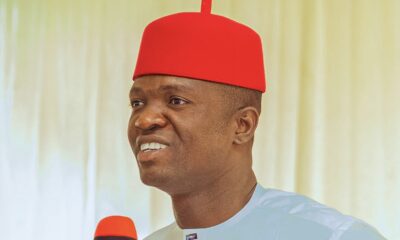
The Academic Staff Union of Universities, Federal University of Technology Minna, Chapter, has called on the Federal Government not to treat its members as casual workers.
The Chairman of the union, Gbolahan Bolarin, who made this known during a protest in Minna on Friday, described the payment of half salaries to university lecturers as demeaning.
“Our members were paid for the number of days they had worked and this is unfortunate and demeaning to us,” Bolarin said.
“FUT Minna has resolved to reject in totality the reduction of Nigerian scholars to casual workers and attempts by the minister of labor and employment to destroy our public universities under any guise. We will not allow Chris Ngige to ridicule us because Nigerian lecturers are among the best in the world,” he added.
Speaking further, he noted that the half salary paid to lectures was an insult to academia, and Nigeria.
Bolarin said the Federal Government was pushing lecturers to a point where the aggression would be shifted to innocent students, adding that the union would do everything to resist the plans of the government.
Also speaking, the President of the Students Union Government at the university, Shuaib Yahaya, said, “The survival of the Nigerian university system is not only the responsibility of the lecturers but the students and everyone.”
He said the SUG joined the protest to show support for the lectures and was willing to go to any extent to ensure that their lecturers were treated better.
“Whatever decision ASUU takes, we are in support and we will follow them and shut down any place. The government should get ready to kill all of us,” he added.
Meanwhile, lecturers at the Federal University, Lafia, Nasarawa State, have called for the immediate sack of the Minister of Labour and Employment, Dr Chris Ngige.
Speaking during a demonstration, the Chairman of ASUU in the institution, Adam Abdullahi, said, “The reason for this protest is to tell the Federal Government to sack the Minister of Labour and Employment, Chris Ngige, for his handling of the ASUU strike and the effect of that strike on the Nigerian educational system.
“The protest is also to tell the FG to pay us our withheld salaries. The Minister of Education has also failed. They paid us pro rata and we are not casual workers. Pro rata (payment) is the casualisation of the university workforce, and we are saying no to this.
“The government should listen to our demands and grant our requests. The demands that we put on the table before the strike are still on; none of them have been met.
“Anytime it was due for the government to pay, instead of paying, they create an emergency and we are saying no to this. So because of all these, academic activities in the institution will be grounded for today (Friday) and we may continue if nothing is done about our demands.”
One of the students of the university, Muhammed Musa, who spoke on behalf of others, expressed concern about the lingering crisis between the government and ASUU and appealed to the two parties to resolve the issues to enable the students to continue their studies without any hitches.
Kaduna APC Calls for Probe Into Alleged Attacks, Vandalism
The Kaduna State chapter of the APC has appealed for calm after reporting alleged attacks, vandalism and intimidation involving its members and party-related facilities.
The party wants the police and other security agencies to determine what happened and identify those responsible for any offences established by the evidence.
APC Publicity Secretary Sani Dan Azare said vehicles were allegedly damaged during an incident at party premises, while some members and supporters were reportedly assaulted or intimidated elsewhere in the state.
Rather than draw conclusions from the competing claims, the party asked security agencies to examine all credible leads and evidence before taking action.
The appeal comes as political activities intensify in Kaduna ahead of the 2027 elections. The state has already recorded a separate dispute involving ADC supporters and security operatives during a campaign-related walk, with the parties giving different accounts of the confrontation.
The APC said such incidents should not undermine what it described as progress made in reducing political, ethnic and religious tensions in the state.
It therefore urged political parties, candidates and supporters to conduct their activities peacefully and within the law.
Dan Azare also asked APC members and support groups to avoid retaliation, warning against any form of self-help.
“Let the facts be established. Let due process prevail. Let the law take its course” the party said.
The APC added that anyone with relevant information should make it available to security agencies to help establish what happened and determine whether anyone should face legal action.
Kaduna APC Calls for Probe Into Alleged Attacks, Vandalism
Lagos Power Outage: Ikeja Electric Blames TCN as Businesses, Homes Groan
Residents and businesses in several parts of Lagos are enduring prolonged power outages, with Ikeja Electric attributing the disruption to significant constraints on the Transmission Company of Nigeria (TCN) network.
The development has triggered frustration among electricity consumers who say the prolonged blackout is disrupting household activities and commercial operations, while increasing their dependence on generators and other alternative sources of power.
Ikeja Electric, one of Nigeria’s largest electricity distribution companies, said the situation was caused by a reduction in the amount of electricity available to it from the transmission network.
According to the company, the transmission constraints have affected the volume of power it can distribute to customers across parts of its franchise area, resulting in extended periods of load-shedding.
The company said it was engaging with TCN over the situation and was working to improve supply to affected communities as soon as additional transmission capacity becomes available.
The latest disruption has affected customers in several parts of Lagos, with residents in areas including Akoka, Egbeda, Ojodu Berger, Ogudu and Shomolu reporting prolonged interruptions.
Some residents said electricity supply had been unavailable for several consecutive days, while others reported intermittent restoration followed by further outages.
The disruption has also affected small businesses and households that rely heavily on electricity for daily activities.
Business operators such as barbers, hairdressers, food vendors, cold-room operators, charging-centre owners, internet-dependent businesses and other small enterprises have been particularly affected by the unreliable supply.
For many households, prolonged outages have also affected refrigeration, water pumping, phone charging, internet access and other basic activities that depend on electricity.
The situation has forced some residents and businesses to increase their use of generators, adding to operating costs at a time when fuel and other energy expenses remain high.
Some consumers have also resorted to commercial charging centres and other paid alternatives to keep phones, rechargeable devices and business equipment operational.
The latest disruption comes amid continuing challenges across Nigeria’s electricity value chain, where problems involving generation, gas supply, transmission infrastructure and distribution networks can affect electricity availability to consumers.
TCN operates the country’s transmission network, while electricity distribution companies such as Ikeja Electric are responsible for delivering available power to customers through their distribution networks.
This distinction is significant in the latest Lagos outage because Ikeja Electric has attributed the immediate supply shortfall to constraints on the transmission network, rather than announcing a fault affecting its entire distribution system.
Power interruptions in Lagos, however, have previously resulted from different causes.
Parts of the state have experienced outages linked to distribution equipment faults, infrastructure damage, planned maintenance and other incidents affecting electricity infrastructure.
Earlier disruptions in Lagos have also been associated with incidents such as tanker fires damaging electricity infrastructure, while transmission maintenance and constraints have caused supply reductions in other instances.
The varying causes mean that the duration and geographical spread of an outage can differ significantly from one community or electricity feeder to another.
Ikeja Electric has apologised to affected customers over the latest disruption and said it understands the difficulties caused by the reduced supply.
The company said it was monitoring developments and engaging relevant stakeholders in an effort to restore improved electricity supply.
The latest development has again highlighted concerns over the vulnerability of Lagos residents and businesses to fluctuations in electricity supply.
For many small businesses, prolonged blackouts mean additional spending on diesel or petrol-powered generators, while households face similar costs when alternative electricity sources are required.
The disruption also comes at a time when businesses are already dealing with high operating costs, making extended reliance on generators an additional financial burden.
Consumers have increasingly called for more reliable electricity supply and better coordination among the different operators in Nigeria’s power sector.
The TCN, generation companies and distribution companies form interconnected parts of the electricity supply chain, meaning a constraint at one stage can quickly affect consumers downstream.
For Ikeja Electric customers, the immediate expectation is that transmission constraints will ease and supply will gradually improve across the affected feeders.
Until then, residents and businesses in the affected areas may continue to experience irregular electricity supply depending on available transmission capacity and the operational condition of individual distribution feeders.
The latest outage has therefore renewed the debate over Nigeria’s long-standing electricity challenges and the need for sustained investment in power generation, transmission and distribution infrastructure to provide more stable electricity for homes and businesses.
For Lagos, where thousands of businesses depend on electricity for daily operations, prolonged outages carry consequences beyond inconvenience, affecting productivity, household welfare and the cost of doing business.
Ikeja Electric said it would continue to provide updates as the situation develops and work with TCN to improve supply to affected customers.
Lagos Power Outage: Ikeja Electric Blames TCN as Businesses, Homes Groan