
Politics
2023: INEC preparing for possible rerun elections
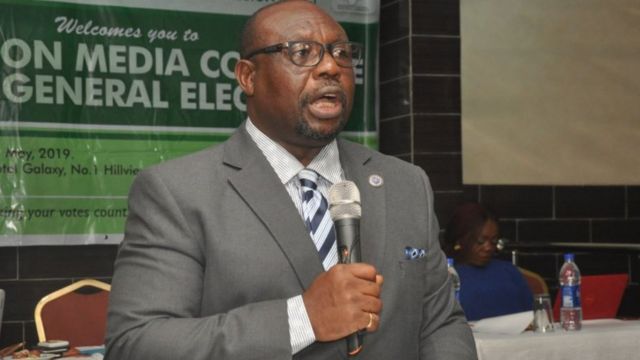
The Independent National Electoral Commission (INEC) says it is already making plans and preparations for the conduct of a run-off presidential election, where no candidate meets the conditional requirements for declaring a winner from votes cast on Feb. 25, 2023.
The INEC National Commissioner and Chairman, Information and Voter Education Committee, Mr Festus Okoye, gave the hint at a meeting with Bureau Chiefs/Editors of media organisations on Friday in Abuja.
Okoye said that such plan had been the tradition of INEC for all elections conducted by the commission since the return of democracy since 1999.
He said that INEC was already planning to print double of the total number of ballot papers required for the first ballot, should in case there was rerun election.
He explained that the preparations were always made alone the first because the commission had just 21 days to conduct the rerun or run-off election.
The national commissioner said that before candidate could be declared winner of the presidential election, he or she must have the highest number of votes cast and secure a quarter of the votes cast in two-thirds of the states of the federation and the FCT.
He said where the threshold is not met by any candidate, the constitution stated that second election should be conducted for two of the candidates with highest and majority votes in line with the provisions of the constitution.
“Section 134 subsection 2 of the Constitution of the Federal Republic of Nigeria, which is the fundamental law of the land, makes it mandatory that before anyone is deemed to have been elected as a president of the Federal Republic of Nigeria, that candidate must secure the highest number of votes cast at the election.
“He must also secure a quarter of the votes cast in two-thirds of all the states of the federation and the Federal Capital Territory. That is mandatory.
“Now, if no candidate secures this highest number of votes and the mandatory threshold, the Constitution says we must have a second election within a period of 21 days.
“Now, not all candidates are going to participate in this second election. Eighteen candidates will be on the ballot for the first election, ” he said.
Okoye also explained that: “If no candidate emerges on the first ballot, only two candidates are going to be on the second ballot or only two candidates are going to contest the second election.
“Who are those candidates that will be on the ballot for the second election?
“The Constitution has made it very clear that two candidates will be on the ballot are; one amongst the candidates who scored the highest number of votes at the election, the one that scored the highest number of votes at the election.
“The second candidate that will be on the ballot will be one amongst the remaining candidates who have the majority of votes in the highest number of states.”
He emphasised that: “The Constitution did not say that the person who came second will be the person who will be on the ballot. That’s not what Constitution says.”
Okoye said that due to the number of ballot papers, over 90 million required for the election and the number of days to conduct the second election, INEC would always print the paper along with those for the first poll.
“If 93 million ballot papers are required for the presidential election, INEC will print 186 million ballot papers just to be ready for a possible second presidential election.
“This is because the law gives the commission just 21 days within which to engage in reverse logistics and conduct a run-off election in case there’s no winner.”
On how INEC would determine the two candidates to be on the second ballot since it was printing the ballot papers along the first, Okoye said that in order to meet up with the timeline, the commission would still print for all the political parties that participate in the fist ballot.
He said it was the responsibility of the political parties to sensitise the voters on who they should vote for among the two candidates that meet the requirements for second election.
He said any vote cast for all other candidates expected not to be on the second ballot would be counted as void votes.
Okoye also said that all sensitive materials for the 2023 general elections would be kept with the Central Bank of Nigeria (CBN), except the Bimodal Voter Accreditation System (BVAS).
“We have classified the BVAS as a sensitive material and we have engaged with different security agencies to provide security for the BVAS because the BVAS will be in the custody of the commission.
“So, we have adopted a hybrid approach as the BVAS will remain with the commission while the ballot papers will be in the custody of the Central Bank of Nigeria.
“This was the agreement we had with political parties, security agencies, Civil Society Organisations and media.”
In her presentation, the INEC Director of Legal Drafting Department, Mrs Oluwatoyin Babalola, said INEC would continue to evolve and improve on the electoral process vis-à-vis international best practices and electoral legal framework in its quest for credible elections.
Babalola described the Electoral Act 2022 as a laudable effort to bring the Nigerian electoral process up to standard with countries all over the world, and meet the aspirations of Nigerians.
“It is believed that the provisions of the Act will guarantee the delivery of free, fair, transparent and credible elections which will in turn increase the acceptance of the electoral processes and outcomes in the 2023 general election and beyond.” (NAN)






Politics
AMAC Polls Shock: Another PDP Candidate Withdraws from FCT Race, Backs APC
AMAC Polls Shock: Another PDP Candidate Withdraws from FCT Race, Backs APC
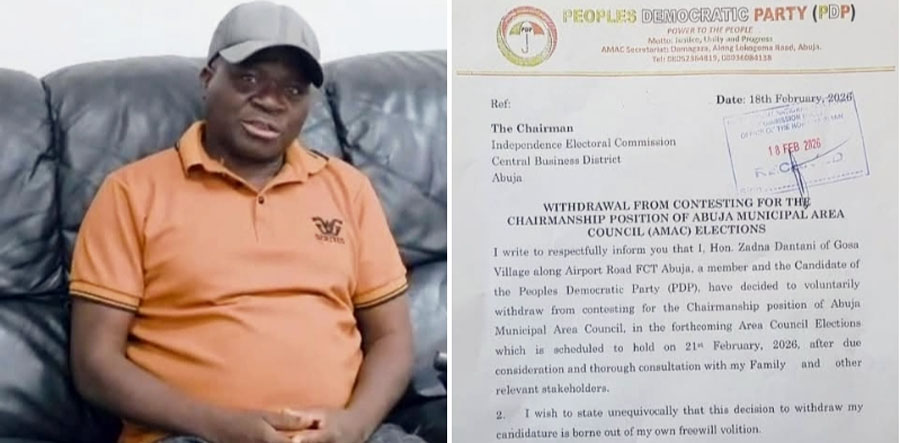
Less than 48 hours before the Federal Capital Territory (FCT) Area Council elections, the Peoples Democratic Party (PDP) chairmanship candidate for Abuja Municipal Area Council (AMAC), Hon. Zadna Dantani, has pulled out of the race and declared support for the All Progressives Congress (APC) candidate, Hon. Christopher Zakka Maikalangu.
Dantani’s withdrawal follows a similar move in Bwari Area Council, where the PDP candidate, Hon. Julius Adamu, stepped down in favour of APC’s Joshua Ishaku Musa, signalling a major shift in political alignment ahead of Saturday’s elections.
In a formal declaration, Dantani explained that his decision was influenced by high-level intervention from the FCT Minister, Nyesom Wike, whom he described as both “party leader and FCT leader.”
READ ALSO:
- Updated: Rivers Senator Mpigi Barinada dies at 64
- Railway track vandalism: Urgent need for laws prohibiting scrap/metal picking to protect critical assets
- MOMAN, ALCMAN Partner BKG to Drive Nigeria’s Shift from Auto Imports to Industrial Production
“I want to sincerely appreciate everyone who supported us. This decision is not about personal interests. The Honourable Minister of FCT, Barrister Nyesom Wike, emphasized that this is a brotherhood election. I am aligning with APC in support of the good works of President Bola Ahmed Tinubu,” Dantani said.
Dantani also confirmed that he had completed all legal formalities, including submitting a letter of withdrawal to the Independent National Electoral Commission (INEC), stating that the move was entirely voluntary and made after consultations with family and stakeholders.
He called on his supporters across AMAC’s 12 wards to vote for APC’s Christopher Maikalangu, describing the alignment as a step toward unity and effective governance in the territory.
Political analysts note that these high-profile PDP withdrawals in both AMAC and Bwari have reshaped the FCT political landscape, increasing APC’s chances of sweeping the elections and stirring debates about PDP’s internal cohesion ahead of upcoming local and national contests.
AMAC Polls Shock: Another PDP Candidate Withdraws from FCT Race, Backs APC
Politics
Updated: Rivers Senator Mpigi Barinada dies at 64
Updated: Rivers Senator Mpigi Barinada dies at 64
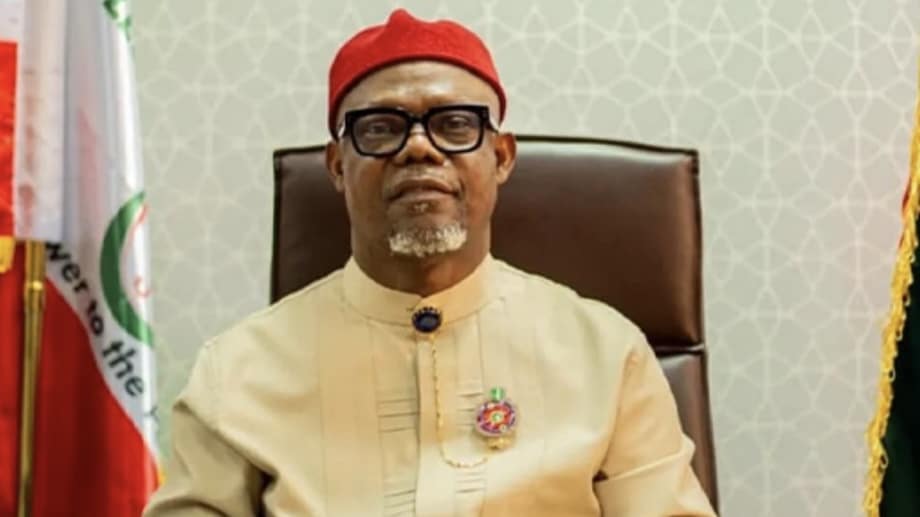
Lawmaker representing the South East Senatorial district of Rivers State, Senator Mpigi Barinada is dead.
He was aged 64.
The Chairman of the House of Representatives Committee on Works, Akin Alabi, confirmed the sad development in a tribute post on his official X handle on Thursday.
He wrote, “Good night my dear friend. Rest in Peace, Senator Mpigi Barinada. Sen Mpigi represented Rivers South East in the Senate”.
The Rivers Senator was the Chairman, Senate Committee on Works.
READ ALSO:
- Osun Awards 55.6km Iwo–Osogbo–Ibadan Road Project to Three Contractors
- Mexico‑Based Nigerian fraudster Gets 8 Years for $1.3M U.S. Tax Fraud
- Ademola Lookman Scores Historic Goal as Atletico Madrid Draw 3–3 With Club Brugge
Senator representing Nasarawa South, Mohammed Onawo, also paid glowing tribute to the late Rivers senator and urged his colleagues to honour his memory.
He spoke during the session of the Senate Committee on Culture and Tourism on Thursday.
First elected in 2011 to the lower house, he was re-elected for a second term in December 2016.
In 2019, he was elected as the Senator representing Rivers South East Senatorial District under the platform of the Peoples Democratic Party (PDP).
Updated: Rivers Senator Mpigi Barinada dies at 64
Politics
LP Crisis Deepens as Abure Faction Rejects Otti’s Reconciliation Call
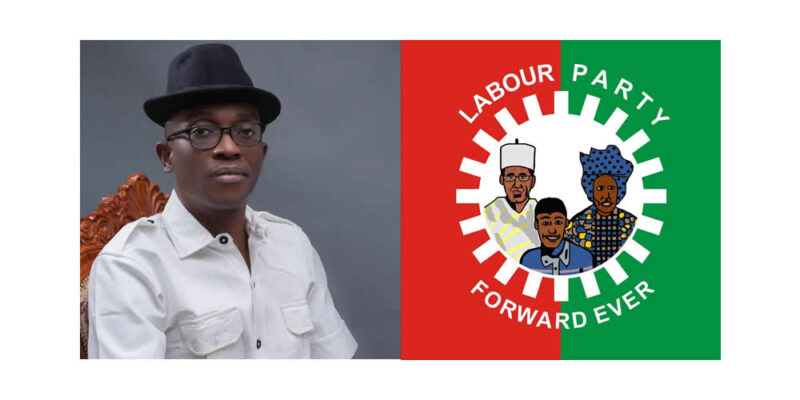
LP Crisis Deepens as Abure Faction Rejects Otti’s Reconciliation Call
The leadership crisis rocking the Labour Party (LP) has taken a new turn as the Julius Abure–led faction firmly rejected reconciliation efforts initiated by Abia State Governor Alex Otti, declaring it has no interest in any peace move proposed by him.
In a strongly worded response, the factional National Working Committee (NWC) led by Julius Abure described Governor Otti’s call for unity as dishonest, premature, and ill-fated, insisting that the internal dispute within the party is far from being resolved.
The Abure camp was reacting to Otti’s recent appeal for aggrieved factions within the party to sheathe their swords and work towards rebuilding the LP ahead of future elections. The governor had announced plans to set up a reconciliation committee, stating that the interim leadership would determine the appropriate timing.
However, the Abure faction dismissed the move outright, accusing Otti of playing a central role in triggering and escalating the crisis. According to the party’s National Publicity Secretary, Obiora Ifoh, the governor lacks the moral authority to champion reconciliation.
READ ALSO:
- Rivers Assembly Halts Impeachment Proceedings Against Gov Fubara
- PDP Chairmanship Candidate Withdraws, Backs APC Ishaku in FCT Polls
- Court Adjourns Trial of Ex‑JAMB Registrar Ojerinde, Others
“We are not interested in any reconciliation being proposed by Governor Alex Otti because he is largely responsible for the crisis facing the party today,” Ifoh said. He questioned why the governor was rushing reconciliation talks when legal battles over the party’s leadership are still ongoing, stressing that the matter is “far from over.”
The rejection comes amid heightened tensions following the removal of Abure’s leadership details from the INEC portal, a development that further deepened divisions within the opposition party.
Background: How the Labour Party Leadership Crisis Began
The Labour Party crisis stems from a prolonged power struggle over national leadership, which intensified after the 2023 general elections that significantly boosted the party’s national profile.
At the heart of the dispute are two rival factions: one led by Julius Abure, the party’s embattled national chairman, and another aligned with Nenadi Usman, who heads an interim leadership structure.
The crisis escalated when a court of first instance issued an order that effectively recognized the Nenadi Usman–led group as the authentic leadership of the party. Acting on the ruling, the Independent National Electoral Commission adjusted its records, delisting the Abure-led NWC from its official portal.
While Abure’s faction has since filed an appeal and maintains that the court ruling is not final, the Usman-aligned camp has continued to operate as the recognized leadership, widening the rift within the party.
Governor Otti, one of the most prominent LP officeholders, has publicly aligned with reconciliation efforts, arguing that internal unity is critical for the party’s survival. However, the Abure faction views his actions as politically motivated interference, rather than a genuine peace initiative.
With legal proceedings still pending and both factions refusing to back down, the Labour Party remains deeply divided, raising fresh concerns about its cohesion and electoral prospects ahead of future political contests.
LP Crisis Deepens as Abure Faction Rejects Otti’s Reconciliation Call

-

 News2 days ago
Saudi Arabia Confirms Sighting of Ramadan Crescent, Fasting Begins Wednesday
-

 metro2 days ago
Lagos Woman Shares Ordeal After Alleged Rape, Sparks Nationwide Outcry
-

 News2 days ago
Ramadan Begins in Nigeria as Sultan Confirms Crescent Sighting
-

 metro2 days ago
Seven Killed in Horrific Crash at Ota Toll Gate
-

 International13 hours ago
Canada Opens New Express Entry Draw for Nigerian Workers, Others
-
 metro3 days ago
Deadlock at National Assembly as House Snubs Electoral Act Bill Meeting on E-Transmission Clause
-
 News1 day ago
Korope Drivers Shut Down Lekki–Epe Expressway Over Lagos Ban (Video)
-

 Health2 days ago
Ramadan Health Tips: Six Ways to Stay Hydrated While Fasting