
Opinion
Farooq Kperogi: Why we should stop renaming well-established universities

Farooq Kperogi: Why we should stop renaming well-established universities
In Nigeria, there’s a disturbingly haunting temporariness in the appellative identity of every university that derives its name from its location. If the current trend holds, they will sooner or later be renamed after a dead or living politician.
The University of Ibadan; the University of Nigeria, Nsukka; the University of Lagos; the University of Calabar; the University of Port Harcourt; the University of Benin; the University of Ilorin; the University of Jos; the University of Uyo; and the federal universities in Lafia, Wukari, Dutse, Gusau, Gashua, Dutsin-Ma, Kashere, Birnin Kebbi, Lokoja, and Otuoke would be wise not to be too cocky in the stability of their onomastic and institutional identities.
I often joke that those of us who graduated from Nigerian universities that were named after cultural or political figures from their very beginning or in the inchoate stages of their existence are the true “first-generation” universities because our alma maters are not in danger of a sudden, unwelcome onomastic and institutional rebirth in the image of a dead or living politician.
Seriously, though, we need to have an honest, soul-searching national conversation about the violent disrespect for institutional identity that the abrupt, top-down renaming of well-established universities represents.
Renaming a university that already has a strong institutional identity to honor a dead politician is problematic for historical, academic, political, and emotional reasons.
Although people in government may not know this, universities are repositories of tradition, intellectual heritage, and regional identity. They are expected to represent knowledge, critical thinking, and universal values, not the legacy of an individual whose contributions to society may be narrow, contested, or politically motivated.
READ ALSO:
- Galatasaray hit jackpot on Osimhen Youtube broadcast
- More trouble for ADC defectors, faction confronts David Mark
- Atalanta reject Inter £36.5m for Lookman, Garnacho gun for Chelsea
Take the University of Abuja that has now been arbitrarily renamed Yakubu Gowon University. It’s the first university to be located in our capital. Its old name communicates its locational identity, which is central to its uniqueness.
It has been known by that name for more than three decades. Renaming it after a person, however historically significant that person may be, erases the core of its identity, especially after several decades.
The name University of Maiduguri, now renamed Muhammadu Buhari University, connects the institution to a geographic and cultural region. The school even has a catchy slogan that derives from its informal short form that I absolutely love: “If you want to be made, come to UNIMAID.”
It’s a powerfully poetic yet irresistibly persuasive marketing slogan. It signalizes the message that the university is the laboratory for churning out successful people. Replacing the school’s name with a political name robs it of this unique promotional poetry. It also erases and rewrites its institutional memory.
That’s not the only damage. Renaming well-established universities after politicians also risks turning the universities into political monuments. It suggests that universities are mere tools for political patronage or historical revisionism, not neutral centers of learning and research.
Renaming universities that already have a healthy, time-honored institutional profile also creates branding anarchy. Certificates issued by the universities, research papers written by their faculty and archived in global databases, their international rankings, alumni associations, and legal documents suddenly become inconsistent or outdated.
This can hurt global recognition and academic reputation, especially for our first- and second-generation universities that already have decades of international visibility. That was why the students, staff, and alumni of the University of Lagos resisted the renaming of their school to Moshood Abiola University Lagos with all that they had.
Most UNILAG people had no problems with the late MKO Abiola. In fact, I would hazard a guess that most UNILAG people loved (still love) and voted for him on June 12, 1993. But they also cherish and want to protect their institutional identity.
READ ALSO:
- I’m no longer a Nigerian by identity – Kemi Badenoch
- We haven’t called off strike – Nurses disown minister’s claim
- Lagos taskforce clears Agege under bridge, impounds 55 vehicles
Those are not mutually exclusive sentiments. You can love a political and cultural figure but never want him or her to supplant the identity of the school you love or are associated with.
When the University of Ife was renamed Obafemi Awolowo University in 1987, there was resistance, which wasn’t as successful as the resistance to the renaming of UNILAG was because it was during a military regime.
Yet, we all know that Chief Awolowo was and is a widely respected figure at the university who, in fact, founded it and resisted naming it after himself like his counterpart in the North was compelled to do.
The students, faculty, and alumni of the university resented the renaming of the former University of Ife (fondly known as Great Ife by its students and alumni) because they felt it was an unsolicited political decision that altered the university’s original vision.
That is why students, lecturers, and graduates of the University of Maiduguri are appealing to President Bola Tinubu to reverse his renaming of their university after the late Muhammadu Buhari. “UNIMAID is more than a name; it is a brand and a beacon of hope in the Northeast,” they said in a statement on July 18.
Like previous resistance to the renaming of universities, this wasn’t about the person of Buhari (although many university lecturers can’t easily forget that he withheld their salaries when they were on strike for several months), but about history, identity, and even emotional attachment to an institutional identity.
Buhari’s mother was Kanuri, and he was governor of North-East State and later Borno (which includes present-day Yobe State), but the issue transcends him as a person. Stakeholders of universities, including the host communities, often feel a deep emotional and symbolic attachment to the name of their university. A top-down renaming can come across as insensitive and can ignite deep resentment.
Most well-established universities that changed their names did so within the first few years of their existence. For example, Harvard University wasn’t always known by that name. It was originally known as “New College” or sometimes “the college at New Towne” when it was founded in 1636.
READ ALSO:
- Sermon: The reality of death!
- School principal, others arrested over killing of pupil, nurse
- IHRC seeks presidential pardon for Super Cop Abba Kyari
- Group alleges plot to sabotage reforms at NNPC
It was renamed to Harvard College in 1639, three years later, in honor of John Harvard, a young minister who died of tuberculosis and left his library and half of his estate to the school.
Yale University also underwent a name change in its early history. It was founded in 1701 as the Collegiate School. The name changed to Yale College in 1718 after a significant donation from Elihu Yale, a wealthy merchant and former governor of the British East India Company settlement at Fort St. George in Madras (now Chennai, India).
But Oxford, Cambridge and other well-known universities have retained their geographic names from the time of their founding.
Interestingly, Nigeria is different from its neighbors in its oversized fondness for naming and renaming universities after politicians. For example, the one time that the Republic of Niger renamed a university (from the University of Niamey to Abdou Moumouni University), it was to honor a prominent, consequential academic. Most other public universities bear geographic names.
This is also true of Senegal. Its universities either bear geographic names or are named after intellectuals, but never politicians. The University of Dakar was notably renamed Cheikh Anta Diop University in 1987 after the prominent Senegalese historian, physicist, and anthropologist.
In short, Niger’s and Senegal’s university naming practice emphasizes institutional neutrality, professional merit, and geographic inclusion. But Ghana is witnessing a more contested shift, in which political figures increasingly lend their names to public universities amid criticism about academic independence, reputation, and public trust.
A university’s name is a vessel of history, identity, and collective memory. When we rename well-established universities after political figures, no matter how revered, we disfigure their symbolic architecture and turn them into contested monuments rather than enduring institutions of learning.
The integrity of a university should rest on its academic tradition and its connection to place, not on the whims of transient political power. If we must honor our heroes, let us do so in ways that elevate without erasing, that celebrate without displacing, and that remember without rewriting.
Farooq Kperogi is a renowned Nigerian columnist and United States-based Professor of Journalism
Farooq Kperogi: Why we should stop renaming well-established universities









Opinion
How opposition Tinubu would treat President Tinubu, By Farooq Kperogi
How opposition Tinubu would treat President Tinubu, By Farooq Kperogi
How opposition Tinubu would treat President Tinubu, By Farooq Kperogi
Opinion
Adelabu’s Power Lines as Laundry Lines
Adelabu’s Power Lines as Laundry Lines
Azu Ishiekwene
In many parts of the country, the rains poured down earlier in the week, bringing much physical and psychological relief from the searing heat.
The absence of electricity from public supply channels made it worse. Average daytime temperatures throughout March ranged from 33 degrees to 38 degrees centigrade in Lagos and Abuja, respectively.
Nigeria’s public electricity grid must rank among the most intractable problems any developing country could face. There is hardly anything more constant than the announcement of grid collapse, which leaves businesses and homes seeking alternatives and incurring unplanned expenses while paying for electricity not supplied.
What Candidate Tinubu promised
During his 2023 campaign, President Bola Ahmed Tinubu said that if he didn’t fix the problem, he shouldn’t be voted in for a second term. He must be regretting that statement now. Since the beginning of his administration in May 2023, there have been multiple grid collapses, with the highest number recorded in 2024 at 12. Even when incidents were fewer, sporadic outages have continued. The failure, on face value, is attributed to a mix of technical, structural and administrative weaknesses in the system. But there is more to it in the sense in which it is said: “The more you see, the less you understand.”
So unreliable is the public electricity supply that the Presidential villa appropriated N10 billion in 2025, and an additional N7 billion in 2026 for the installation of a solar mini grid that will effectively disconnect Nigeria’s seat of power from the national grid, bedevilled by ageing transmission lines which collapse repeatedly from sabotage, poor maintenance, and frequency imbalances.
The joke is on us
Nigerians, ever ready to make a jest of their tragic maladies and long suffering, are beaten when it comes to power outages. They are shocked beyond humour. If the high-tension cables were not too high overhead, people in communities through which they run would not hesitate to hang their laundry on them – knowing from experience that the lines are just part of the landscape and are very likely to be without electricity.
READ ALSO:
- Ondo PDP Rejects Wike Faction, Affirms Loyalty to Turaki‑Led NWC
- Bandits Abduct Seven Family Members, Three Neighbors in Kaduna
- Festus Keyamo Urges ADC to Thank INEC Over Derecognition of Rival Factions
I have seen a video of a masquerade performing on a streetlight pole. Of course, the crowd applauded its invincibility; yet, both the crowd and the masquerade knew better. The lines had not been electrified for months and were unlikely to be for the spell of the circus.
Hope was rekindled at the beginning of the Tinubu administration when news filtered through that the currently embattled former governor of Kaduna State, Nasir El-Rufai, had not only produced a blueprint, but was going to be given the assignment of sorting out Nigeria’s notorious electricity sector. I learnt reliably that, as part of his plan, El-Rufai was discussing a $10 billion investment agreement with the Saudis before he ran into rough weather.
The coming of Adebayo
That was how Adebayo Adelabu took the job – a job at which he has performed so disastrously, saying he failed would be an honour. But it’s not his fault – it’s the fault of the President who appointed him and the Senate that cleared him for a job that he was clearly incompetent to perform, either based on his record or based on any hope of redemption. He is brilliant, but the power sector is littered with the remains of brilliant people, among whom he is now a fossil.
His better years were when he worked as an auditor at PWC. He was also the Executive Director/CFO at First Bank, and later a deputy governor at the Central Bank. He may not have been directly responsible for the misfortunes of these institutions at the time, but he doesn’t exactly smell of roses.
In the normal course of things, his banking career should have been a yellow flag. Still, Nigeria being Nigeria, the quota system and political connections ensured that he defied gravity.
Then, in 2023, Tinubu offered him the position of Minister of Power, after his failed attempt to become governor of Oyo State on the platform of the Accord Party. That only worsened our misery. Adelabu will be best remembered for splitting electricity consumers into parallel payment bands that do not necessarily reflect improved services.
The thing is not that Adelabu failed at his job. It’s the lack of evidence that he tried. Mr Dan Kunle, an energy expert familiar with the history of that sector, told me that, “No one is saying a power minister should provide the resources to fix the sector from thin air. It’s for him to provide a solid framework that would create the right environment and attract sovereign intervention.”
Adelabu, like many of his predecessors, is running the power ministry in 2026 with the 1950 operational manual of the Electricity Corporation of Nigeria (ECN). Yet, even then, when the country had a population of about 50 million, the British knew that electricity was an economic good. To provide meaningful and sustainable service, they had to prioritise not just the key administrative centres but also areas that could pay. That was why, for example, coal was shipped from Enugu to the Ijora Power Station in Lagos.
No roadmap
Adelabu has no roadmap, or if he has one for a population four times what it was under ECN, it’s a roadmap to nowhere. The same old problems persist: gas shortages, moribund plants, infrastructure deficits, massive debts, and frequent grid collapses, limiting supply to about 4,000 MW despite a capacity of 13,000 MW.
READ ALSO:
- INEC Warns ADC Against Holding Convention Without Supervision
- APC Rejects ADC Claims, Says Tinubu Not Responsible for Party’s Legal Troubles
- Fani‑Kayode Fires Back at Peter Obi, Defends NADECO’s Legacy
While Adelabu may wring his hands alongside Nigerians when the lights trip off, the sector has been drowning under the yoke of N6 trillion in debt as of late 2025, fuelled by non-cost-reflective tariffs and unpaid bills to both generating and distribution companies. Some of the problems predate Adelabu, but his incompetence has worsened them.
Yet, he still has ambition. Not to redeem himself after his disastrous three years as minister, but to become the governor of Oyo State. Obviously, he believes the reward for poor performance is a higher office. He is so shameless, it means nothing to him that he holds the Olympic record for national grid collapse. It means nothing to him that Nigerian businesses are powered by Indian generators and their homes by Chinese solar panels.
Examples from Africa
Egypt, with a population of 110 million, has 100 percent universal electricity access, supported by a heavy reliance on gas (81 percent) and growing low-carbon sources like hydropower. This ensures a stable supply amid population pressures.
South Africa serves 85-90 percent of its 62 million residents but faces severe shortages. Frequent load shedding persists due to Eskom’s debt, ageing infrastructure, and maintenance issues, despite high per-capita generation.
Ghana reaches 88-89 percent coverage for 34 million people, with hydro and thermal power dominating. Urban areas enjoy near-99 percent access, while rural areas still have gaps and occasional outages.
Kenya hits 76 percent for 56 million, excelling in urban (97 percent) and geothermal power. Rural expansion lags, though targets aim for full access by 2030.
Compared to the countries above, only 57 percent of Nigerians are grid-connected, with outages occurring 85 percent of the time, and poor metering and corruption that sustain estimated billing and inefficiencies.
After watching Adelabu perform so poorly over the last two years on the national stage, I was hoping he would go away quietly, under the shadow of the darkness he has fostered. But since he insists that he won’t leave quietly – or appears determined to stay on – I’m considering a self-appointed mission to drag him to Oyo State to see how he will turn their night into day.
Adelabu’s Power Lines as Laundry Lines
Ishiekwene is the Editor-In-Chief of LEADERSHIP and author of the book, Writing for Media and Monetising It.
Opinion
Super Bowl: Can Africa Spring Up anew?
Super Bowl: Can Africa Spring Up anew?
With a landmass of approximately 9.83 million km² and a population of 334–336 million as of 2025—making it the third-largest country in the world—the United States is massive. It is four times the size of Algeria, Africa’s largest country, and dwarfs Nigeria, the continent’s most populous nation.
The United States is a titan among nations. Who knows—perhaps neologists will coin a new term if the U.S. eventually purchases or forcefully takes Greenland from Denmark, further surging its landmass and population. When this massive scale fuses with unparalleled infrastructure, world-class venues, and a vast market, the USA becomes an ideal host for international sporting events with strong returns on investment.
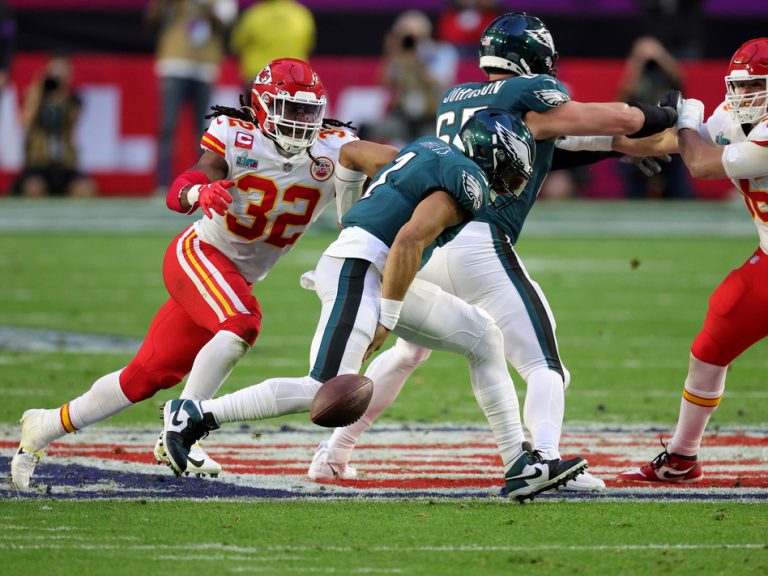
Between 1904 and 2025, the USA hosted one FIFA World Cup (with another to be co-hosted in 2026 with Mexico and Canada), four Summer Olympics, four Winter Olympics, and one FIBA Basketball World Cup. Unlike soccer, which is still finding its footing in the United States—even with Major League Soccer (MLS) having existed for 30 years—American football is the undisputed number-one sport. The Super Bowl—born from Lamar Hunt’s “light-bulb moment”—is the crown jewel. The Super Bowl has become what sociologists call a secular ritual, binding the social fabric of Americans together.
Beyond the Vince Lombardi Trophy, the Super Bowl has evolved into a global marketing masterpiece. From the famous 1984 Apple commercial introducing the Macintosh, which is studied in MBA classes worldwide, to the 1979 Mean Joe Greene Coca-Cola commercial that showed genteel human warmth winning over fearsomeness, the intentionality of brands going head-to-head with rivals has been a recurring feature of every Super Bowl.
While the USA is always attractive for hosting events, the Super Bowl’s success pivots on intellection that results in ingenious marketing. For the recent Super Bowl LX on February 8, 2026, two brands mirrored David Ben-Gurion’s principle of “taking the fight to the enemy.” Pepsi and Anthropic’s Claude entered with an offensive strategy: Claude’s AI ad—“Ads are coming to AI. But not to Claude.”—was a calculated strike in the competitive AI market, while Pepsi’s polar bear blind test revived the sulphurous rivalry with Coca-Cola. Many companies use their ad slots to build brand identity and equity or announce arrival in the business world.
Where does Africa stand in this Super Bowl business and sports calculus? While developed nations are making groundbreaking launches with chutzpah and creativity from creative shops—all resulting in a participatory economy—Africa’s involvement is largely an on-the-field display of Négritude spirit and ravenous passion.
For Africa, the Super Bowl has become a “badge of honor” through representation. Mohammed Elewonibi, a Nigerian raised in Canada, was the first player of African origin to win a Super Bowl (XXVI, 1992, with the Washington Redskins). Since then, nearly 41 players of Nigerian origin or heritage have won—the most of any African country—including six who tasted victory with the recent Seattle Seahawks: Uchenna Nwosu, Nick Emmanwori, Boye Mafe, Jaxon Smith-Njigba (of Nigerian and Sierra Leonean roots), Jalen Milroe, and Olu Oluwatimi.
Yet, as impressive as African athletes are in making the continent proud, we have blatantly failed to translate that audience engagement into commercial windfalls like the Super Bowl on home soil. It is appalling that most of Africa’s sporting events—the Durban July Handicap, Senegalese wrestling (Laamb), or the Safari Rally—have not fully harnessed the intersection of sports and marketing. Even the Africa Cup of Nations (AFCON), despite its 3.45 billion cumulative viewers (far surpassing the Super Bowl’s ~125–127 million), lacks comparable marketing prestige. Why are there no global product launches during our matches? Why aren’t AI giants capitalizing on Africa’s tech startup boom?
Africa is being fed celery when it deserves the whole salad. This asymmetry stems from structural economic factors, but the genie is out of the bottle—we must be forward-looking. To turn African sporting events into “goldmines,” we must reinvent the industry, much as Cirque du Soleil did for the circus. Facing declining audiences, rising costs, and fierce competition, it lost its grip on the circus business. Cirque, however, escaped the dying circus business by reinventing it.
By viewing competition through a new lens, Africa can transform massive viewership into unparalleled economic advantage and value. Just as Cirque du Soleil created uncontested market space, African sports must adopt what W. Chan Kim and Renée Mauborgne called a “Blue Ocean Strategy”—creating uncontested market space and making competition irrelevant. Much as we can not compete toe to toe with advanced economies , we should not follow them like zombies.
In their book Blue Ocean Strategy: How to Create Uncontested Market Space and Make the Competition Irrelevant, the authors highlight how companies in “red oceans” fight for shrinking profits in crowded, defined markets. African sports events currently sit in those crowded red oceans. To elevate them, we need disruptive leaders willing to venture into untapped markets, create new demand, and unlock unlimited growth opportunities.
Joseph Pine and James Gilmore, in their book The Experience Economy, wrote about the need to transform commodities into experiences. As Africans, we have been able to move our sporting events from the commodity stage to the third stage—service delivery—but the experience stage is the North Star we should aspire to reach.
Our cultures, as varied as they are, define us. Despite dilution by Western civilization, our culture stands uneroded, like the mountains that litter our landscape and serve as a canopy to preserve our common heritage. This means our forefathers took culture into the realm of experience—something we are still grappling with in our sporting spectacles today. For us to make headway, our cultures—already bubbling with experience—must mix seamlessly with our sporting spectacles.
Now is the time to merge cultural events like the Eyo Festival, Argungu Festival, Gnaoua World Music Festival, Osun Osogbo Festival, Meskel Festival, and others with our sporting spectacles—that is the Blue Ocean Strategy. This can only be achieved through close collaboration between leaders in sports administration and marketing professionals selling experiences, and the time is now. As this is done, a line from David Diop’s poem Africa—“That is your Africa springing up anew”—would fill our lips.
The experience stage is the nirvana!
Toluwalope Shodunke
Can be reached via tolushodunke@yahoo.com
Super Bowl: Can Africa Spring Up anew?

-
 metro2 days ago
Arise News Yet to Confirm Reported Suspension of Rufai Oseni
-
 metro18 hours ago
Tension in Osogbo as Protesters Demand Respect for Court Judgments in LG Dispute
-

 metro2 days ago
Fresh Boko Haram Attack Leaves Colonel, Six Soldiers Dead in Borno
-

 International3 days ago
Trump Sparks Global Outrage After Calling Pope Leo XIV “Weak, Terrible”
-

 News3 days ago
FG Opens Application for Second Cohort of TVET Programme to Tackle Unemployment
-

 International3 days ago
Trump Claims 158 Iranian Ships Destroyed as US Enforces Naval Blockade in Gulf Region
-
 metro3 days ago
Fake Image of Governor Alia Bowing to Sultan Sparks Controversy, Palace Reacts
-
 Politics3 days ago
2027: Tinubu Knows Opposition Playbook, Always Ahead — Festus Keyamo