

News
Tinubu Govt Launches Unified System to Lift 50 Million Nigerians Out of Poverty
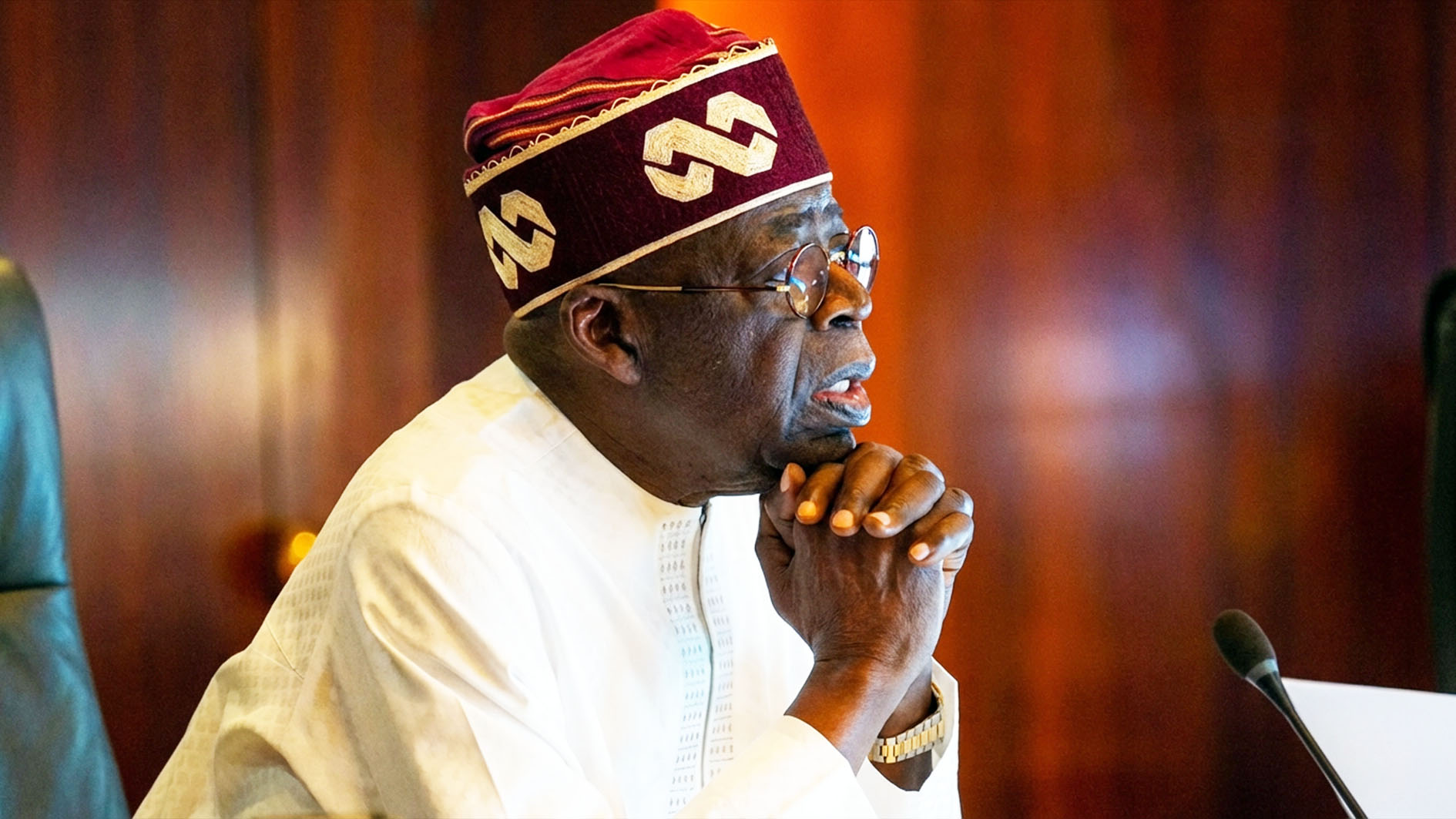
Tinubu Govt Launches Unified System to Lift 50 Million Nigerians Out of Poverty
President Bola Tinubu’s administration has officially launched the One Humanitarian-One Poverty Response System (OHOPRS), a nationwide framework designed to lift 50 million Nigerians out of poverty by 2030 through a coordinated and data-driven approach to social intervention and humanitarian support.
The initiative was unveiled by the Minister of Humanitarian Affairs and Poverty Reduction, Bernard Doro, at a national technical workshop held at the UN House Abuja, where key stakeholders from government agencies, development partners, and international organisations were in attendance.
Doro explained that the OHOPRS is designed as a centralised national system that integrates humanitarian relief, social protection, and long-term development programmes into a single coordinated structure. He said the goal is to move Nigeria from fragmented interventions to a unified framework capable of delivering measurable impact.
According to him, over 63 per cent of Nigerians are affected by multidimensional poverty, highlighting the urgency of a more structured and efficient response. He noted that existing poverty alleviation efforts have been undermined by fragmentation across ministries, departments and agencies (MDAs), as well as duplication of efforts and poor coordination among federal, state, and local governments.
He listed several systemic challenges, including siloed data, uncoordinated beneficiary registers, weak funding mechanisms, limited transparency, and lack of a unified poverty exit strategy, adding that these issues have prevented interventions from reaching the most vulnerable populations effectively.
READ ALSO:
- Colleagues, Community Rally GoFundMe for Nigerian Nurse Killed in US Wrong-Way Crash
- Kwankwaso Set to Join ADC Wednesday as Defection Talks Intensify
- Makoko Crisis: Falana Condemns Forced Evictions, Warns Lagos Govt
“We have been managing poverty, not ending it. It is time for a paradigm shift,” Doro said, stressing that Nigeria already has numerous intervention programmes but lacks the integrated systems needed to optimise them.
The minister outlined the core structure of the OHOPRS, which includes a single national database described as the ‘Single Source of Truth’, a unified beneficiary registry to prevent duplication, and a coordinated coordination platform that aligns all stakeholders under one framework.
He added that the system introduces a structured “poverty exit pathway”, aimed at transitioning beneficiaries from vulnerability to self-reliance through targeted support, skills development, and access to economic opportunities.
Doro further emphasised that the initiative will leverage digital accountability tools, real-time monitoring, and data-driven governance to improve transparency and ensure that resources are properly tracked and utilised.
He reiterated that President Bola Tinubu’s vision is to implement a fully integrated system that ensures alignment across all levels of government and development partners, with the ultimate goal of reducing poverty at scale.
“There is a clear national direction. The mandate is to lift 50 million Nigerians out of poverty by 2030 through one system, one register, and one coordinated response,” he said.
Also speaking at the event, the Minister of State for Humanitarian Affairs and Poverty Reduction, Tanko Sununu, said the OHOPRS will help harmonise efforts across sectors and improve execution through better planning, tracking, and evaluation of outcomes.
Sununu noted that the framework will combine immediate humanitarian assistance with long-term development strategies, ensuring that vulnerable populations receive both short-term relief and sustainable pathways out of poverty.
He added that the system will improve coordination among stakeholders, reduce inefficiencies, and create a more reliable mechanism for measuring the impact of government and partner interventions.
The workshop was attended by representatives of major international and development organisations, including the International NGO Forum, the European Union, United Nations Office for the Coordination of Humanitarian Affairs (UNOCHA), International Organization for Migration (IOM), UNICEF, European Civil Protection and Humanitarian Aid Operations (ECHO), and the World Bank, alongside subnational stakeholders.
Officials say the OHOPRS represents a major shift in Nigeria’s poverty reduction strategy, moving from multiple disconnected programmes to a unified national architecture capable of delivering coordinated, measurable, and scalable results.
With its emphasis on data integration, accountability, and collaboration, the government believes the framework could play a critical role in achieving its long-term poverty reduction target, while strengthening the overall effectiveness of social intervention programmes across the country.
Tinubu Govt Launches Unified System to Lift 50 Million Nigerians Out of Poverty







News
Italy-Based Businessman Excretes 98 Wraps of Cocaine at Enugu Airport
Italy-Based Businessman Excretes 98 Wraps of Cocaine at Enugu Airport
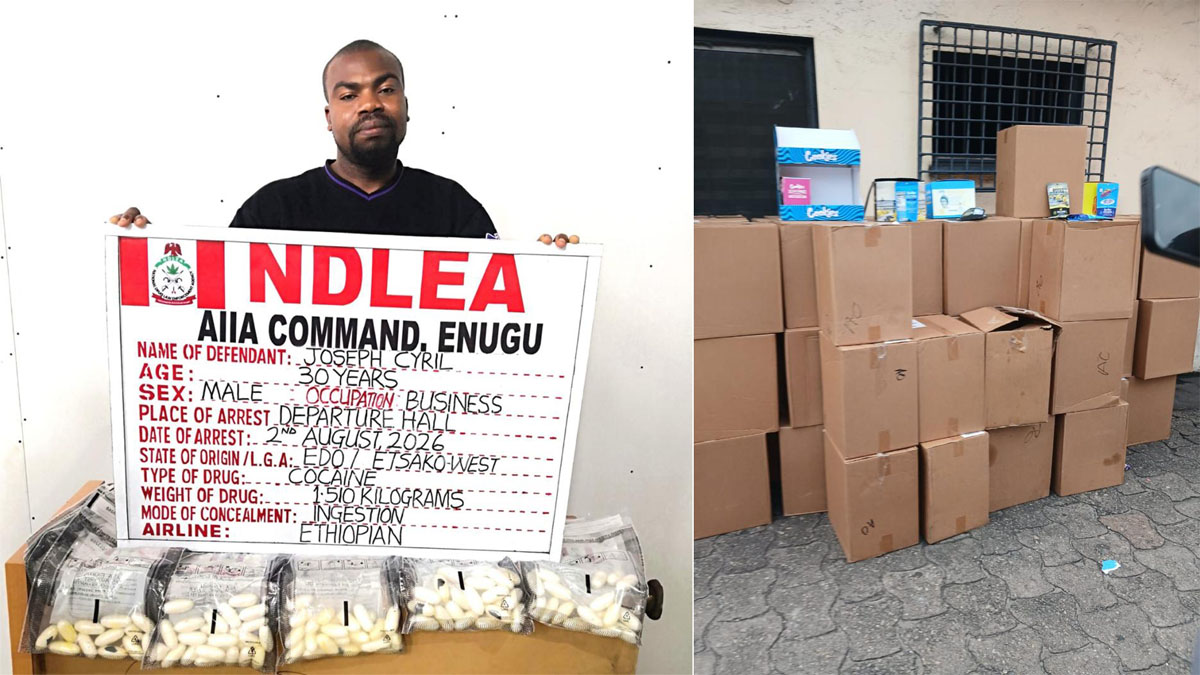
In a major breakthrough, operatives of the National Drug Law Enforcement Agency (NDLEA) have arrested a 30-year-old Italy-based businessman at the Akanu Ibiam International Airport (AIIA), Enugu, after he excreted 98 wraps of cocaine weighing 1.510 kilograms while attempting to board a flight to Europe. The suspect, Joseph Cyril, was nabbed on August 2, 2026, at the departure hall of the Enugu airport during the outward clearance of passengers on Ethiopian Airlines flight ET930, which was en route to Italy via Addis Ababa and France. According to a statement by NDLEA Director of Media and Advocacy, Mr. Femi Babafemi, Cyril was immediately placed under excretion observation, during which he expelled all 98 pellets of the banned substance. The total weight of the recovered cocaine was put at 1.510 kilograms. Investigations revealed that Cyril had arrived in Nigeria from Italy on July 13, 2026, and ingested the drug at a hotel in Awka, Anambra State, before proceeding to Enugu to catch his return flight to Europe on August 2.
In his confessional statement, the suspect disclosed that he had been running a legitimate business in Italy for several years before agreeing to traffic the cocaine consignment. He claimed he accepted the task in exchange for €3,500 (about ₦5.8 million) to help him raise funds to relocate to Germany, where his immediate family is based. The NDLEA noted that the arrest is part of the agency’s intensified efforts to curb drug trafficking through Nigerian airports and land borders.
Beyond the Enugu operation, the NDLEA recorded several other significant seizures across the country within the same period, demonstrating the widespread nature of the agency’s crackdown. In Lagos, operatives thwarted attempts by trafficking syndicates to export 1.2 kilograms of cocaine concealed inside 25 pieces of phone chargers destined for Saudi Arabia through a courier company. In a similar operation, officers intercepted 500 grams of cocaine hidden in the false bottom of a backpack that was being shipped to Italy via another logistics firm on August 3, 2026. Also in Lagos, a consignment containing 2.3 kilograms of Loud — a potent synthetic strain of cannabis — originating from the United States, was seized at a shipping company on August 4, 2026.
READ ALSO:
- Biden condition deteriorates as cancer spreads to bones
- “Don’t Paint What Doesn’t Exist”: Kamo State Addresses Funke Akindele Speculation
- Onaiyekan: Is Tinubu insensitive to Nigerians’ plight? By Bolanle BOLAWOLE
- Osun 2026: Police arrest commissioner over APC rally gunshots as Adeleke alleges political intimidation
At the Tincan Port complex, a joint examination involving NDLEA officers, Customs officials, and other security agencies uncovered 73 cartons containing 442 packets of cookies and gummies infused with cannabis. The total weight of the seized edibles was 309.4 kilograms, and a suspect, Larry Nnaji, has been arrested in connection with the shipment. Following this discovery, the NDLEA issued a public health alert, warning parents and guardians to monitor what children consume, as traffickers increasingly disguise illicit substances as ordinary snacks.
In Ondo State, on August 4, NDLEA patrol teams along the Akure-Ilesha expressway intercepted a truck heading to northern Nigeria with 1,633 kilograms of skunk (a strong strain of cannabis) cleverly concealed in bags of rice chaff. Two suspects — Buba Jamilu and Sanusi Ibrahim — were arrested in connection with that seizure. Additionally, a raid at Ita Ogbolu forest on August 3 led to the recovery of 147 kilograms of skunk, further crippling trafficking networks in the region.
In Oyo State, acting on credible intelligence, operatives raided a drug warehouse in Elebure village, Orire Local Government Area, on August 3, recovering 731.03 kilograms of cannabis. One suspect, Felicia Thompson, was arrested, while her accomplice, Thompson Vincent Nwaka, remains at large as authorities continue their manhunt. Meanwhile, in Edo State on August 5, NDLEA operatives supported by soldiers raided a storage facility at Ewe Luleha in Owan West Local Government Area, recovering 65 jumbo bags of skunk weighing a total of 604.5 kilograms.
In Abia State, operatives arrested Chibuike Charles, 31, a drug joint operator, during a raid at his base in Osisioma Local Government Area on August 6, seizing about 7 kilograms of skunk from his premises. In Lagos, a notorious and wanted drug dealer, Adome Claude Sikuru, was arrested on August 8 at the Fibre Market drug jungle in Badagry after a three-month manhunt. Officers recovered 88.5 kilograms of skunk from him, marking a significant victory in the agency’s efforts to dismantle drug hideouts in the city.
Commending the officers and men of the DOGI, AIIA, Ondo, Oyo, Edo, Abia, Seme, and Tincan Commands, NDLEA Chairman and Chief Executive Officer, Brig-Gen. Mohamed Marwa (rtd) , praised their professionalism and dedication. He urged all personnel to sustain the balanced approach to drug control, combining enforcement, public education, and rehabilitation, while vowing to intensify the fight against illicit drug trafficking across Nigeria.
Italy-Based Businessman Excretes 98 Wraps of Cocaine at Enugu Airport
News
Police Arrest Five Pakistani Nationals in Benue, Recover 35 Mobile Phones
Police Arrest Five Pakistani Nationals in Benue, Recover 35 Mobile Phones
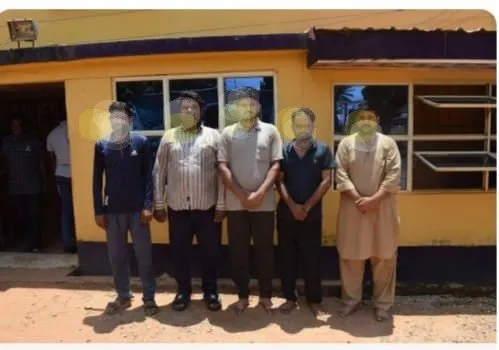
The Benue State Police Command has arrested five Pakistani nationals and recovered 35 mobile phones in separate intelligence-led operations conducted in Otukpo and Ugbokolo areas of the state . According to a statement issued by the Command’s Public Relations Officer, DSP Orchia Peter Aondongu, operatives acting on credible intelligence arrested three Pakistani nationals on August 4, 2026, at Adoka Motor Park in Otukpo Local Government Area . The suspects were identified as Younas Mohammad, 36; Ahmad Nunil, 38; and Aslam Muhammad, 46. They were intercepted while attempting to board a vehicle to Adoka village . During preliminary questioning, the suspects claimed they were in Otukpo to market cosmetics and mobile gadgets. However, police noted that none of the items they claimed to be selling was found in their possession, raising questions about their activities and movements in the area .
In a separate operation on August 5, 2026, police arrested two other Pakistani nationals, Juma Sharif, 30, and Muhammed Sharif, 25, at a local hotel in Ugbokolo following credible intelligence . The two suspects reportedly told investigators they were dealers in Android phones. A search of their belongings led to the recovery of 11 Tecno Camon 50 Pro mobile phones . Further investigation and operational follow-up resulted in the recovery of an additional 23 Tecno Camon 50 Pro phones and one Infinix Hot 60 phone, bringing the total number of recovered mobile devices to 35 .
The police disclosed that the five suspects have been transferred to the State Criminal Investigation Department (SCID) in Makurdi, where discreet and comprehensive investigations are ongoing to establish the circumstances surrounding their presence, activities, and movements within the state . The Command stated that it strongly suspects the possession of the mobile phones is a decoy for clandestine activities in the rural areas of the state, noting that this is even more probable as the suspects have limited proficiency in speaking or understanding English . The Commissioner of Police, Benue State Command, CP Cletus Nwadiogbu, commended the officers involved in the operations and members of the public whose timely information contributed to the arrests . He further urged residents to remain vigilant and promptly report suspicious persons, movements or activities to the Police, pledging that the Command will continue to work with relevant stakeholders and members of the public to maintain peace and security across Benue State . The Command reassured the public that the operations form part of its proactive, intelligence-led policing strategy aimed at identifying potential security threats, preventing criminal activities, and safeguarding lives and property across the state .
Police Arrest Five Pakistani Nationals in Benue, Recover 35 Mobile Phones
News
EFCC Acted Lawfully in Freezing Osun Account – Falana

EFCC Acted Lawfully in Freezing Osun Account – Falana
Senior Advocate of Nigeria and human rights lawyer, Femi Falana, has declared that the Economic and Financial Crimes Commission (EFCC) did not act illegally by restricting the Osun State Government’s statutory allocation account. He cited landmark court judgments that affirm the anti-graft agency’s powers to investigate state finances, while also faulting President Bola Tinubu’s intervention on procedural grounds.
The controversy surrounding the EFCC’s decision to place a Post-No-Debit restriction on an Osun State Government account domiciled with First Bank has sparked intense debate across the country. The commission disclosed that the action was part of an ongoing investigation into the alleged fraudulent handling of approximately ₦11 billion in Ecology Funds, Intervention Funds, and Federation Account Allocation Committee (FAAC) allocations . According to the EFCC, investigators detected what it described as “precipitate and unwarranted movement of funds” from the account to various corporate entities beginning on August 2, 2026, prompting the need for swift intervention to prevent further diversion of public resources . The commission clarified that the restriction applied to only one account and was not a blanket freeze on all state government finances, a distinction that has been largely overlooked in public discourse surrounding the matter . The EFCC’s Director of Public Affairs, Wilson Uwujaren, defended the action, stating that the commission derived its powers from Section 34 of the EFCC Act and Section 7(6) of the Money Laundering (Prevention and Prohibition) Act, 2022 .
Falana made his declaration on Friday during an appearance on Channels Television’s Politics Today, wading into the controversy with a clear legal opinion that sought to clarify the legal basis for the EFCC’s action. The senior lawyer stated categorically that “as far as the law is concerned, the EFCC has not acted illegally” . He explained that under Nigerian law, the commission possesses the legal authority to freeze accounts belonging to the federal government, state governments, and local governments, provided it complies with the statutory requirement to obtain a court order within the prescribed period . According to Falana, the EFCC can impose a temporary restriction on an account for up to 72 hours without judicial authorisation, after which it must secure a court order to maintain the freeze . He maintained that the commission followed this legal framework in the Osun case, noting that the EFCC had indeed approached the Federal High Court, which “intervened based on information provided by the EFCC” . This judicial intervention, he argued, validated the EFCC’s actions under the existing legal framework, and the Osun State Government had appropriately challenged the legality and validity of the court order, rather than merely questioning the timing of the action .
READ ALSO:
- Osun election: Police pledge neutrality, warn against vote buying, violence
- VIDEO: Lagos Bridge Vandalism: 27 Arrested as Scavengers Strip Pillars of Iron Bars
- Ronaldo predicts Cristiano Jr. will be ‘bigger than me’, reveals biggest challenge
The legal history of the EFCC’s powers provides important context for understanding the current controversy, and Falana traced this history to demonstrate that the commission’s authority had been repeatedly affirmed by superior courts. He recalled that in 2019, the Federal High Court in Benue State had ruled that the commission lacked the authority to freeze the state government’s account and awarded N50 million in damages against the agency . However, he said the EFCC successfully appealed that decision, and in September 2022, the Court of Appeal overturned the lower court’s ruling, affirming the commission’s power to impose a Post-No-Debit restriction on a government account for up to 72 hours before obtaining a court order . “That remains the law in Nigeria today,” Falana said, emphasising that the Court of Appeal’s decision had not been overturned by any higher court and therefore remained binding on all lower courts and government agencies .
Beyond the Court of Appeal decision, Falana also referenced a 2024 Supreme Court judgment that further solidified the EFCC’s authority to investigate state finances. This judgment arose from a suit instituted by the Kogi State Government and joined by several other states, which challenged the authority of federal anti-corruption agencies to investigate state government finances . Falana stated that the apex court examined all relevant constitutional and statutory provisions and concluded that agencies including the EFCC, the Independent Corrupt Practices and Other Related Offences Commission (ICPC), and the Nigerian Financial Intelligence Unit (NFIU) have the power to probe accounts at the federal, state, and local government levels . He added that anyone dissatisfied with the existing legal framework should seek an amendment through the National Assembly rather than questioning the EFCC’s statutory mandate . “If Nigerians—those who are concerned—want the law changed, they can go to the National Assembly. But for now, as of today, EFCC has the power to freeze the account of any state and, in not more than 72 hours, has to go to court,” he said, making it clear that the legal question had been definitively settled .
The political dimension of the controversy emerged when President Bola Tinubu directed the EFCC to approach the court to vacate the order and discontinue the restriction, citing concerns about the timing so close to the August 15 Osun State governorship election . Tinubu stated that he was “deeply embarrassed” by the timing of the action, although he acknowledged the commission acted within its statutory powers by obtaining the court order . He said preserving public confidence in the integrity and credibility of the election informed his decision, a position that drew both support and criticism from various quarters . The President’s intervention raised questions about the appropriate limits of executive authority in relation to independent anti-corruption agencies, and whether such intervention could set a dangerous precedent for future investigations .
Falana, however, faulted President Tinubu’s intervention, arguing that the President ought to have respected the statutory independence of the EFCC and acted through the Attorney-General under Section 174 of the Constitution . He stated, “In intervening in the Osun State crisis, President Tinubu ought to have respected the independent status of the EFCC and the due process of law. As far as the law is concerned, the EFCC chairman is not at the beck and call of the President” . Falana noted that the Osun State Government had already taken legal steps to challenge the freezing order before Tinubu intervened, meaning the matter should have been resolved through the judicial process rather than through a direct presidential instruction to the anti-graft agency . He suggested that Tinubu could have directed the Attorney-General to take over the case under Section 174, with a view to withdrawing the case or not opposing the motion filed by the Osun State Government to vacate the ex parte order . Despite faulting the procedure, Falana appeared to welcome the eventual move towards restoring access to the state government’s funds, quoting William Shakespeare: “All is well that ends well” , indicating his pragmatic acceptance of the resolution while still criticising the process .
Looking beyond the immediate controversy, Falana also warned against establishing a precedent under which anti-corruption agencies would be expected to suspend investigations merely because an election is approaching . He argued that such an approach could provide governments with a window to move public funds without scrutiny during election periods, warning that “we must be very careful that we don’t give a dangerous impression that when elections are 10 days away, 20 days away, 30 days away, the anti-graft agencies must turn the other eye” . This warning reflects broader concerns about the integrity of electoral processes and the need for continued oversight of public finances, particularly during periods when governments may be tempted to use state resources for political purposes . Falana’s comments underscore the delicate balance between ensuring free and fair elections and maintaining robust anti-corruption enforcement, a balance that Nigerian authorities continue to navigate in practice .
EFCC Acted Lawfully in Freezing Osun Account – Falana
-

 metro2 days ago
Osun Govt Sues EFCC, First Bank for ₦2 Billion Over Unlawful Account Freeze
-

 metro2 days ago
Customs Intercepts 140 Pump-Action Rifles, Cannabis-Infused Products Worth ₦373.8 Million at Tin Can Port
-

 metro1 day ago
NRS Boss Under Fire Over Alleged Secret Transfer of $279m Oil Fund
-

 News3 days ago
Nigeria’s first indigenous female neurosurgeon appointed medical director of US hospital
-
 metro1 day ago
VIDEO: Lagos Bridge Vandalism: 27 Arrested as Scavengers Strip Pillars of Iron Bars
-
 metro2 days ago
ISWAP Overruns Rival JAS Enclave In Borno Following ₦40m Cash Theft
-
 metro3 days ago
ICPC recommends prosecution of alleged fake PFIPC boss after Tinubu-ordered investigation
-

 News2 days ago
School Shooting: 14-Year-Old Student Kills Grandparents, 6 at Nonthaburi School