

International
Oil Prices Slide as Trump Announces Fresh Iran Talks, Easing Supply Fears

Oil Prices Slide as Trump Announces Fresh Iran Talks, Easing Supply Fears
Global oil prices fell sharply in early Asian trading on Monday after United States President Donald Trump announced fresh negotiations with Iran, raising hopes of easing tensions in the Middle East and restoring normal shipping through the strategically vital Strait of Hormuz.
Brent crude, the international oil benchmark for September delivery, dropped 4.69 per cent to $83.81 a barrel as of 2250 GMT on Sunday, while the US benchmark, West Texas Intermediate (WTI), declined 4.67 per cent to $80.72.
The decline followed Trump’s announcement on Sunday that Washington would resume diplomatic engagement with Tehran instead of pressing ahead with major military strikes against the Islamic Republic.
READ ALSO:
- Political Realignments: Kwankwaso Receives APC Defectors into NDC in Kano
- DSS, Vigilantes Ambush, Kill Notorious Bandit Kingpin Idi Abasu Aiki, Over 60 Fighters in Katsina
- Nigeria Shines in Commonwealth Games, Tops Africa with 10 Gold Medals
“Now what we’re doing is we’re talking to them in the form of a negotiation. It begins tomorrow afternoon,” Trump said, without disclosing the venue or those expected to participate in the talks.
Oil markets have remained highly volatile since the conflict between the United States, Israel and Iran escalated in late February, disrupting traffic through the Strait of Hormuz—a critical maritime corridor for global crude oil and liquefied natural gas exports.
The renewed diplomatic push has fuelled optimism that the waterway could soon reopen fully, reducing the risk of prolonged disruptions to global energy supplies.
Adding to the positive sentiment, Iran said on Sunday that it was close to reaching an agreement with Oman on establishing a new shipping arrangement through the Strait of Hormuz, a development that could further stabilise oil exports from the region.
Oil Prices Slide as Trump Announces Fresh Iran Talks, Easing Supply Fears







International
US Strikes Iran’s Qeshm Island as Tensions Escalate Around Strait of Hormuz

US Strikes Iran’s Qeshm Island as Tensions Escalate Around Strait of Hormuz
The United States has carried out fresh military strikes on Iran’s strategically important Qeshm Island, raising fears of renewed escalation in the conflict between Washington and Tehran amid mounting tensions around the Strait of Hormuz.
The strikes, conducted on Monday, November 2, 2026, reportedly targeted Iranian military installations, including missile launchers and radar systems, according to US officials cited by international media.
The operation was described by American officials as a limited defensive action intended to prevent Iranian forces from threatening US military assets and commercial vessels navigating the strategic waterway.
According to reports by Reuters and The Wall Street Journal, the strikes followed an incident in which Iranian forces allegedly fired surface-to-air missiles at an American aircraft operating in the region.
A US official also said American forces intercepted another Iranian missile launched from Qeshm Island towards commercial shipping.
The Pentagon referred enquiries about the operation to the US Central Command, which had not publicly provided details of the strikes as of Tuesday.
Iranian state media subsequently reported several explosions on Qeshm Island and in the nearby coastal city of Bandar Lengeh.
READ ALSO:
- APC Dumps Adeleke’s Campaign Structure, Unveils Separate 168-Member Council in Osun
- Three Homeless Men Shot Dead in Midnight Attack at Lagos Bus Stop
- Super Falcons Receive $100,000 Each as Tinubu Finally Fulfils WAFCON Pledge
The Iranian state news agency, IRNA, reported that the explosions occurred late Monday, with witnesses claiming to have seen aircraft flying over the island.
However, Iranian authorities had not provided a confirmed account of the extent of the damage or possible casualties.
The latest military operation comes after Iran’s Islamic Revolutionary Guard Corps (IRGC) claimed to have intercepted three American drones operating near the Strait of Hormuz.
Iranian state media reported that two reconnaissance drones were brought down south of Qeshm Island using electronic warfare systems, while another MQ-9 drone was allegedly destroyed east of the strait.
The claims had not been independently verified, and the US military had not publicly confirmed the alleged losses.
Qeshm Island occupies a strategic position near the entrance to the Strait of Hormuz, one of the world’s most important maritime routes for crude oil and natural gas shipments.
The waterway connects the Persian Gulf with the Gulf of Oman and the Arabian Sea, making it a critical passage for international energy supplies.
Before the conflict, approximately one-fifth of global oil and liquefied natural gas supplies passed through the strait.
Military confrontations around the area have already disrupted commercial shipping, raising concerns about the security of oil tankers and the potential consequences for global energy markets.
The latest strikes also come against the backdrop of diplomatic efforts to end the conflict, which began in late February 2026.
Despite the military developments, US President Donald Trump has played down the possibility of renewed large-scale fighting, suggesting that a diplomatic agreement with Tehran could be within reach.
Trump said on Monday that Iran wanted a settlement and expressed optimism that negotiations could produce an agreement.
Vice-President JD Vance also indicated that Washington believed progress was being made towards a possible negotiated settlement.
Iran, however, has maintained that any agreement must address the American naval blockade of its ports and guarantee an end to hostilities.
Iranian Foreign Ministry spokesman Esmaeil Baghaei said Tehran had communicated its conditions to Washington, adding that the United States must respond to its proposals.
Iran also indicated that its proposal for reopening the Strait of Hormuz could be implemented within two days if Washington met its conditions.
The latest strikes have nevertheless exposed the fragile nature of the diplomatic efforts, with military confrontations continuing even as both sides signal interest in negotiations.
The development has also unsettled international oil markets, with crude prices rising in early Asian trading on Tuesday following reports of the American operation.
Brent crude futures rose by 0.5 per cent to $105.25 per barrel, while US West Texas Intermediate crude increased by 0.5 per cent to $96.93 per barrel, according to Reuters.
Analysts warned that further military escalation around the Strait of Hormuz could increase the risk premium on oil prices and prolong disruptions to global energy supplies.
With Washington describing its latest operation as defensive and Tehran maintaining its military posture, uncertainty remains over whether diplomatic negotiations will prevent another round of direct confrontation.
US Strikes Iran’s Qeshm Island as Tensions Escalate Around Strait of Hormuz
International
Iran Offers to Reopen Strait of Hormuz Within 48 Hours If…

Iran has offered to reopen the strategically important Strait of Hormuz within 48 hours, but says the move depends on the United States accepting a series of conditions aimed at easing tensions and paving the way for renewed negotiations.
Iranian Foreign Ministry spokesperson Esmaeil Baghaei announced the proposal on Monday, November 2, 2026, describing it as part of Tehran’s efforts to resolve the ongoing confrontation through diplomatic engagement.
Under the proposed arrangement, the United States would first have to meet Iran’s demands, after which the country could begin restoring access to the strategic waterway within two days. The proposal also provides for the resumption of negotiations between the two countries.
The offer marks a shift from an earlier seven-day framework reportedly communicated through mediators in September. Iran had previously proposed a sequence under which the Strait would reopen after certain conditions were met.
Baghaei described the shorter timeline as evidence of Tehran’s willingness to pursue a diplomatic solution. However, he made clear that the proposal would depend on Washington agreeing to the conditions.
Among Iran’s key demands is an end to the US naval blockade of Iranian ports, which Tehran regards as a major obstacle to negotiations. It is also seeking the removal of sanctions targeting its oil industry and the release of Iranian assets frozen abroad.
READ ALSO:
- I Believe God Has Answered My Prayer, Says Tinubu After Entering Holy Ka’abah
- Footballer Dies as Trailer Rams Car Into Bus on Lagos-Ibadan Expressway
- Gunmen Intercept Family Car, Abduct Woman, Two Children, Release Husband in Abuja
Iran has further called for an end to hostilities across the region, including the conflict involving Lebanon, arguing that any agreement should address the wider security situation rather than focus exclusively on the confrontation between Tehran and Washington.
Iranian Foreign Minister Abbas Araghchi has also outlined a proposed arrangement for maritime traffic through the Strait. Under the plan, ships would use a new route agreed upon by Iran and Oman, with passage taking place under Iranian supervision.
Tehran has additionally called for a reduction in the presence of US military forces in the region and the removal of sanctions imposed on Iran since August.
Qatar is among the countries involved in diplomatic efforts to ease the crisis. Iranian Deputy Foreign Minister Kazem Gharibabadi has also travelled to Doha as part of the consultations surrounding the proposed framework.
However, there has been no indication that the United States has accepted Iran’s conditions. Consequently, the proposed 48-hour timeline should not be interpreted as confirmation that the waterway will reopen within that period.
The proposal comes amid continued tensions between the two countries. US President Donald Trump has warned that military action could resume if diplomatic efforts fail, while leaving room for negotiations to continue.
The Strait of Hormuz is one of the world’s most important maritime energy corridors. Connecting the Persian Gulf with the Gulf of Oman and the Arabian Sea, it provides a major route for crude oil and liquefied natural gas shipments from Gulf producers to international markets.
Any prolonged disruption to shipping through the passage could affect global energy supplies, increase transportation costs and put further pressure on oil prices and fuel markets.
Iran’s latest offer has therefore attracted international attention, particularly among energy-importing countries and shipping operators concerned about the security of vessels using the route.
For now, the proposed reopening remains conditional on an agreement with Washington. Whether the two sides can bridge their differences over sanctions, the naval blockade and regional security will determine whether the 48-hour proposal translates into the restoration of normal maritime traffic.
Iran Offers to Reopen Strait of Hormuz Within 48 Hours If US Meets Demands
International
Nine Killed as Learjet Crashes Into Florida Residential Area, Erupts in Flames
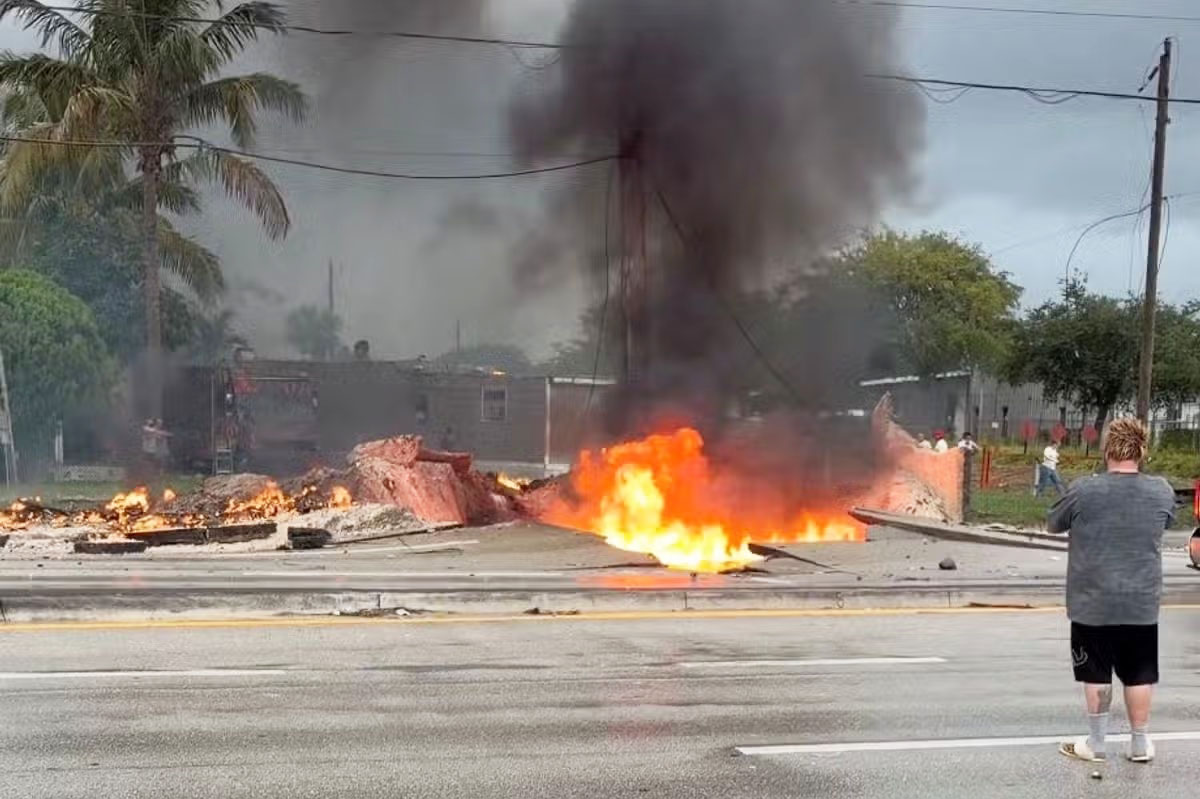
Nine Killed as Learjet Crashes Into Florida Residential Area, Erupts in Flames
Nine people have been killed after a private Learjet 60 aircraft crashed into a residential area in Palm Beach County, Florida, United States, and burst into flames, triggering an emergency response and the evacuation of hundreds of residents.
The aircraft, which was travelling from Texas to the Bahamas, crashed at approximately 12:50 p.m. local time on Sunday, November 1, 2026, near Military Trail, between Cresthaven Boulevard and 10th Avenue North.
US Transportation Secretary Sean Duffy confirmed that all nine people aboard the aircraft died in the crash, describing the incident as a horrific tragedy.
The Federal Aviation Administration (FAA) said the Learjet 60 departed from Austin-Bergstrom International Airport in Texas and was heading to North Eleuthera Airport in the Bahamas when the accident occurred.
Videos recorded by motorists and other witnesses showed the aircraft descending rapidly before plunging towards the ground and exploding into a massive fireball. Thick black smoke subsequently billowed above the neighbourhood as emergency responders rushed to the scene.
The impact created a large crater beside the roadway, scattering aircraft debris across the surrounding area and damaging nearby infrastructure.
Florida Governor Ron DeSantis, who visited the crash scene, described the incident as a catastrophic accident.
He said the aircraft appeared to have plunged towards the ground like a missile, leaving a large crater along the road.
DeSantis added that there were no immediate reports of deaths or injuries among people on the ground, apart from those aboard the aircraft.
However, the crash prompted authorities to evacuate approximately 600 residents from a nearby mobile home community as emergency teams secured the area and assessed possible dangers.
READ ALSO:
- 2027 Election: Seun Okinbaloye Explains ‘Rigging’ Remark, Says Warning Was Not Against Any Party
- Christians Still Under Attack in Nigeria, US Lawmaker Tells Trump
- Gunmen Abduct 100-Level Female Student, Shoot Another Person in Plateau
Palm Beach County Commissioner Joel Flores said the affected residents were being assisted with temporary shelter and other emergency support at two designated locations.
The evacuation was necessary to protect residents while investigators and emergency personnel worked around the crash site.
Preliminary information from air traffic control recordings has provided some insight into the aircraft’s final moments before it crashed.
According to recordings of communications between the pilots and air traffic controllers, the crew reported ice accumulating on the aircraft while encountering moderate turbulence at high altitude.
The pilot initially described the icing as manageable but later reported worsening weather conditions and requested permission to climb to a higher altitude.
The situation deteriorated shortly afterwards as the aircraft began losing altitude rapidly.
In one of the final communications, the pilot declared an emergency and reported that the aircraft was descending at an alarming rate.
The crew initially reported a descent of about 10,000 feet per minute before indicating that the rate had increased to approximately 20,000 feet per minute.
The pilot eventually issued a distress warning, saying the aircraft was going to crash into the ground.
Flight-tracking information indicated that the jet lost approximately 27,000 feet in altitude within about a minute before tracking data stopped.
However, investigators have not established whether ice accumulation, turbulence, thunderstorms, mechanical failure or another factor caused the aircraft to lose control.
The Federal Aviation Administration and the National Transportation Safety Board (NTSB) have launched investigations to determine the circumstances surrounding the disaster.
The NTSB is leading the investigation, with support from the FAA. Investigators are expected to examine the wreckage, flight records, aircraft systems, weather conditions and communications between the crew and air traffic controllers.
The investigation will also seek to establish whether the aircraft experienced a technical malfunction or encountered conditions that affected its ability to maintain controlled flight.
The aircraft’s manufacturer, Bombardier, has indicated its willingness to cooperate with investigators.
Authorities had not publicly released the identities of the nine victims or provided a detailed breakdown of the passengers and crew as of the latest reports.
The crash site remained subject to emergency restrictions, with authorities closing sections of Military Trail and advising motorists to avoid the area.
The Florida accident has been described as one of the deadliest aviation disasters in the United States in 2026.
According to records cited by CNN, it was the second-deadliest US plane crash of the year, following a skydiving aircraft crash in Butler, Missouri, in June that killed 12 people.
The Learjet 60 accident was also reported as the deadliest crash involving the aircraft model.
The tragedy has renewed attention on aviation safety, particularly the risks associated with severe weather conditions and the importance of determining what happened during the aircraft’s final moments.
For families of the nine victims, the immediate concern remains the confirmation of identities and the circumstances surrounding the deaths, while investigators work to establish the cause of the disaster.
Nine Killed as Learjet Crashes Into Florida Residential Area, Erupts in Flames
-

 Politics3 days ago
2027: INEC Rejects Adebutu, Gwarzo, Clears Pantami as Ogun, Kano Opposition Parties Face Setback
-
 metro1 day ago
Three Dead, Five Rescued as Two-Storey Building Collapses in Osun
-

 metro2 days ago
Adeboye Fires Back at Journalists Over Viral Jonathan Protest Photo, Says It Was Prayer Walk
-

 Auto2 days ago
Nigeria’s Auto Dealers Face New Challenge as After-Sales Service Takes Centre Stage
-

 News3 days ago
Breaking: Two Fresh Ebola Cases Emerge in North-East, says NCDC, begins test
-

 metro2 days ago
Lami Dawa: CAN Takes 14-Year Jail Sentence to Appeal Court, Borno Govt Reacts
-

 Sports3 days ago
EPL: Chelsea Hand Manchester United 2-0 Defeat to Deepen Carrick’s Crisis
-

 News3 days ago
2027 Presidency: Allah’s Will Must Prevail, Tinubu Declares in Makkah