

Business
Buhari: We are set to reopen land borders
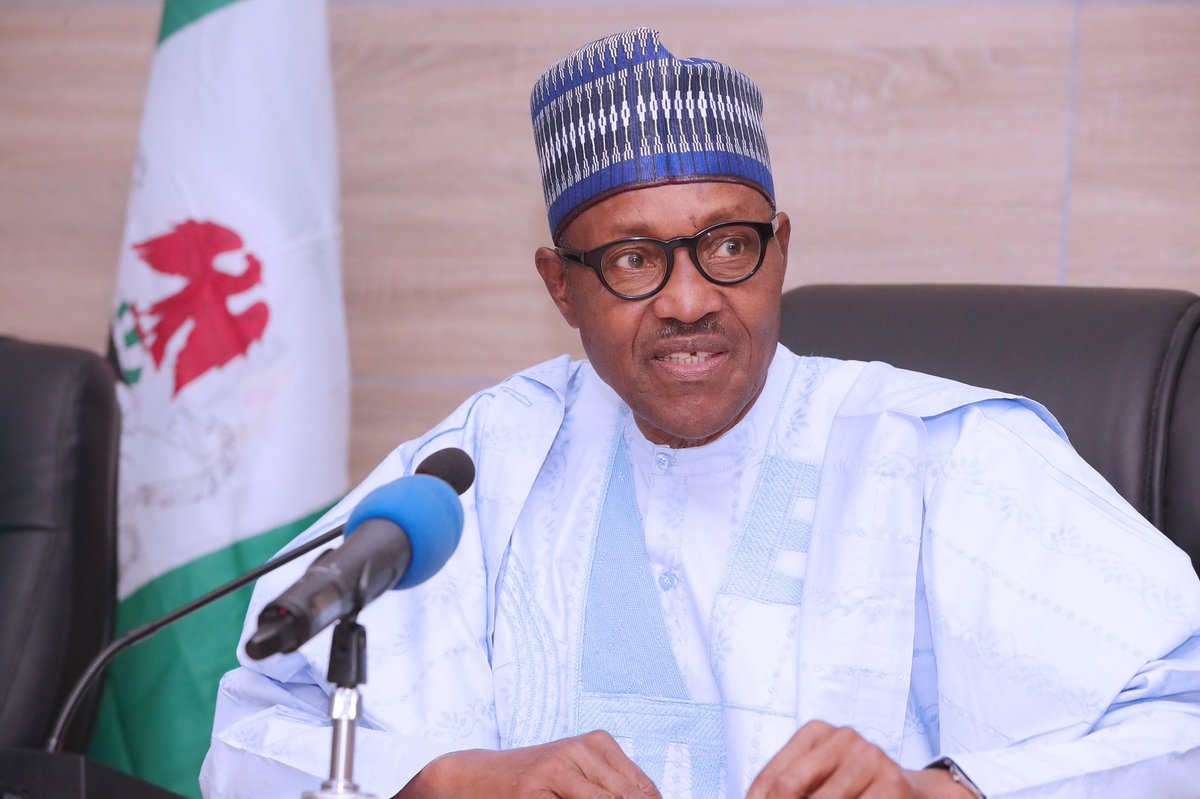
President Muhammadu Buhari on Tuesday said the Federal Government was set to reopen the nation’s land borders.
He gave this indication after a closed-door meeting with the 36 state governors even as he urged the governors to work more with traditional rulers and community members to improve local intelligence gathering to aid the work of security agencies.
The meeting held at the Presidential Villa, Abuja focused on the issue of security.
The President explained that the closure of the nation’s land borders was partly an attempt to control the smuggling in of weapons and drugs.
A statement issued by Senior Special Assistant to the President (Media & Publicity), Garba Shehu, quoted the President as saying, “Now that the message has sunk in with our neighbours, we are looking into reopening the borders as soon as possible.”
The President, who listened to presentations by a governor from each of the six geopolitical zones on their specific security challenges, recalled that in the old order, communities identified newcomers and passed information to constituted authorities.
Buhari said, “The sub-region is no longer safe, more so with the collapse of the former Libyan leader, Muammar Gaddafi’s regime and the cross border movement of weapons and criminals.
“Governors must work with traditional rulers. Try and work with traditional rulers to boost intelligence gathering.”
The President said his administration had done well in the North-East and South-South, adding that the South-South situation was still worrisome.
He said, “Every day I get situation reports about illegal refineries and the blowing up of pipelines. You must stop local rogues from sabotaging oil installations.”
Addressing the issue of banditry and kidnapping in each of the geo-political zones, President Buhari said, “Security is important and we must secure the whole country. We are thinking very hard on the issue of kidnapping. We will make it possible for the military to get to the bandits and kidnappers and eliminate them.”
He gave assurances that the country’s military would continue to get the support needed to fight criminals.
“I am not going to the public to speak about the vehicles and equipment we have ordered. What I can say is that the military received armoured cars and other equipment and they are training the trainers. More of such equipment, including military aircraft will come in,” he said.








Business
Dangote Refinery IPO approved at ₦525 per share, targets ₦2.15trn
Dangote Refinery IPO approved at ₦525 per share, targets ₦2.15trn
The Securities and Exchange Commission (SEC) has approved the commencement of the Dangote Refinery initial public offering (IPO), clearing the way for the highly anticipated public sale of shares in one of Africa’s largest industrial projects.
Under the approved offer, Dangote Petroleum Refinery and Petrochemicals FZE will offer 4.1 billion ordinary shares at ₦525 per share, with the transaction capable of raising approximately ₦2.15 trillion if fully subscribed.
The development represents a major milestone for the Dangote Refinery IPO and could make the transaction one of the largest public offerings ever undertaken in Nigeria and potentially one of the biggest in Africa.
The SEC conveyed its approval in a letter to Vetiva Advisory Services Limited, the Lead Issuing House for the transaction. The letter was signed by Abdulkadir Abbas, Director of the SEC’s Securities and Investment Services Department.
The regulator also registered the company’s existing 120.13 billion ordinary shares, while approving the refinery’s draft offer documents and authorising it to proceed with the Completion Board Meeting and Signing Ceremony.
The approval brings the refinery significantly closer to its planned entry into the Nigerian capital market, where investors will have an opportunity to acquire a direct stake in one of the country’s most strategically important energy assets.
The Dangote Refinery shares are expected to be offered to a broad range of investors, with the order book scheduled to open on September 14, 2026, according to the latest details surrounding the transaction.
The proposed offer involves 4.1 billion shares priced at ₦525 each, translating to a potential gross fundraising of about ₦2.15 trillion, or roughly $1.5 billion at prevailing exchange rates.
The transaction is also expected to include a 15 per cent greenshoe option, which would give the company the flexibility to sell additional shares if demand exceeds the initial offer.
READ ALSO:
- No One Can Live on N70,000, Not Even a Newborn – Sowore
- Defence Minister Musa accuses El-Rufai of deliberately planning Southern Kaduna killings
- Kano Rainstorms: Nine Lives Lost, Over 4,500 Displaced
The proceeds are expected to support Dangote Group’s ambitious plans to expand the refinery’s capacity from its current 650,000 barrels per day nameplate capacity to approximately 1.4 million barrels per day.
The refinery reached its 650,000-barrel-per-day nameplate capacity earlier in 2026 and has subsequently tested production of up to 700,000 barrels per day.
If the planned expansion to 1.4 million barrels per day is completed, the facility would become the world’s largest refinery, surpassing existing mega-refineries in other parts of the world.
The expansion is expected to strengthen Nigeria’s position in the global refined petroleum products market while further increasing the country’s ability to process crude oil domestically.
Located in Ibeju-Lekki, Lagos State, the Dangote Petroleum Refinery and Petrochemicals Complex occupies approximately 2,635 hectares and forms part of one of Africa’s largest integrated industrial developments.
The complex combines crude oil refining, petrochemical production, power generation, storage and marine logistics infrastructure.
It includes a 900,000-tonnes-per-annum polypropylene plant and a dedicated 435-megawatt power plant, giving the facility substantial internal energy-generation capacity.
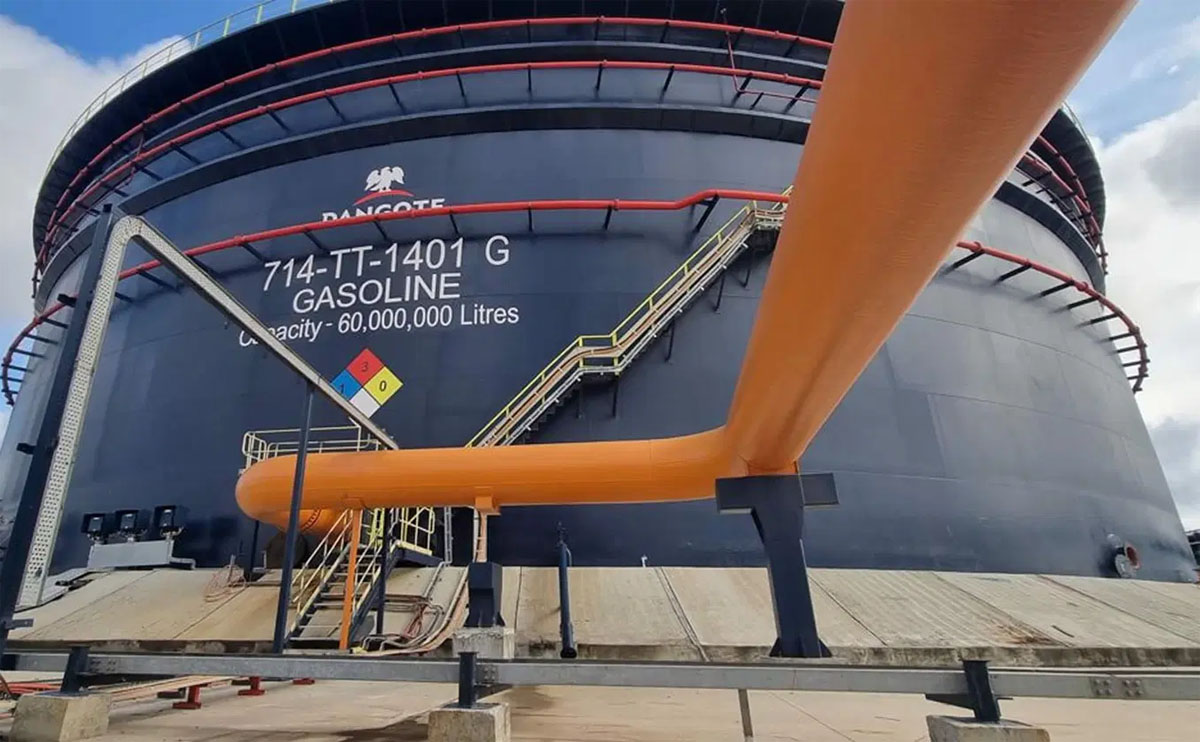
The refinery also has extensive storage infrastructure comprising 177 tanks with a combined capacity of approximately 4.742 billion litres.
Its marine facilities include multiple quays capable of handling large vessels, liquid cargo shipments and roll-on/roll-off operations, while its crude and product-handling infrastructure is designed to support large-scale domestic distribution and exports.
The complex also has five Single Point Moorings (SPMs) designed to facilitate the efficient loading and unloading of crude oil and petroleum products.
The scale of the facility has enabled Dangote Refinery to increasingly serve both the Nigerian market and international destinations as production expands.
Since commencing operations, the refinery has become an increasingly important supplier of refined petroleum products in Nigeria, while also developing an export business serving markets across Africa and Europe.
READ ALSO:
- Atiku, X user clash over Almajiri crisis, street begging
- Court restrains Lizzy Anjorin from posting Priscilla Ojo’s son’s photos
- NBA controversy: VDM apologises to security agencies over ‘unknown gunmen’ remarks
Growing exports of refined petroleum products have further strengthened the refinery’s strategic importance, particularly as Nigeria seeks to reduce its historic dependence on imported petroleum products.
The Dangote Refinery IPO is therefore being launched at a significant stage in the company’s development.
The refinery has already undergone major capital investment and is now seeking additional funding to increase its processing capacity and strengthen its position as a major regional energy hub.
Ahead of the IPO, the refinery also completed a major private fundraising exercise and secured additional financial backing to strengthen its position ahead of the public offering.
The proposed listing will also broaden investor participation in the refinery. Until now, ownership of the facility has largely remained within the Dangote Group and associated investors, meaning ordinary investors have had limited opportunities to directly participate in its growth.
The planned NGX listing could change that by opening the refinery’s ownership to a much wider pool of Nigerian and international investors.
Aliko Dangote has previously described the planned listing as an opportunity to broaden participation in the company and allow more Africans to benefit from the growth of one of the continent’s largest industrial investments.
The transaction could also have a significant impact on Nigeria’s capital market because of its sheer size.
A successful ₦2.15 trillion IPO would represent a substantial injection of new capital and could increase the depth, liquidity and attractiveness of the Nigerian equities market.
The listing is also expected to attract considerable attention from institutional investors, pension funds, asset managers, high-net-worth individuals and retail investors seeking exposure to the energy and industrial sectors.
For investors considering the Dangote Refinery shares, however, the ₦525 offer price will be only one part of the investment decision.
Prospective investors will need to examine the company’s final offer documents, financial performance, profitability, debt position, expansion requirements, dividend policy and exposure to changes in crude oil prices, petroleum product prices, exchange rates and global refining margins.
The ability of the refinery to maintain high utilisation rates and generate sufficient cash flow while simultaneously funding its planned expansion will also be closely watched by investors.
The company’s ability to expand its export markets could become increasingly important as its production capacity grows beyond Nigeria’s domestic requirements.
With the proposed expansion to 1.4 million barrels per day, Dangote Refinery is seeking to move beyond its role as Nigeria’s largest refinery and establish itself as a major global refining and petrochemical hub.
The ₦525 per share Dangote Refinery IPO consequently represents more than another stock market transaction. It could mark a new phase in the development of Nigeria’s downstream petroleum sector while giving investors direct access to one of the country’s most ambitious industrial projects.
As the expected September 14 opening approaches, market attention will increasingly focus on investor demand, the final terms of the offering and whether the refinery succeeds in raising the targeted ₦2.15 trillion.
If successfully completed, the IPO would give the Dangote Refinery a new ownership structure, provide additional capital for expansion and potentially establish one of the most significant new listings in the history of Nigeria’s capital market.
Dangote Refinery IPO approved at ₦525 per share, targets ₦2.15trn
Auto
Jetour G700 PHEV Lands in Abuja for 3-Day Luxury Mobility Showcase

Jetour G700 PHEV Lands in Abuja for 3-Day Luxury Mobility Showcase
Jetour Nigeria is taking its premium mobility campaign to the Federal Capital Territory, with the flagship G700 Plug-in Hybrid Electric Vehicle (PHEV) set to headline a three-day luxury automotive showcase in Abuja from September 22 to 24, 2026.
The Abuja experience, coming on the heels of the brand’s major showcase in Lagos, is part of Jetour Nigeria’s aggressive drive to deepen its presence in the country’s premium automotive market while introducing consumers to a new generation of electrified mobility.
The G700 PHEV, positioned as Jetour’s flagship luxury SUV, combines executive-class comfort with advanced hybrid technology and serious off-road capability.
The model’s arrival in Abuja also comes at a time the brand is gaining increasing recognition in Nigeria’s automotive industry. Jetour Nigeria was recently honoured by the Nigeria Auto Journalists Association (NAJA) as the Fastest Growing Auto Brand of the Year, underscoring its expanding market presence.
At the heart of the G700 is Jetour’s Kunpeng Super Hybrid system, paired with dual electric motors. The powertrain delivers a claimed combined driving range of up to 1,400 kilometres, offering a response to one of the major concerns surrounding electrified vehicles—range anxiety.
The flagship SUV also comes equipped with adaptive suspension, triple differential locks and up to 970mm wading capability, giving it the muscle to handle demanding terrain while retaining the refinement expected of a luxury vehicle.
Inside, the six-seat G700 delivers a premium cabin experience, featuring Nappa leather upholstery, massage seats, a 35.4-inch 3K panoramic display, an 18-speaker Lexicon sound system and an onboard refrigerator.
READ ALSO:
- Sambisa Forest: Over 23 terrorists reportedly killed as Boko Haram, ISWAP clash in Borno
- NAF recruitment 2026: Step-by-step guide to applying for BMTC 47/2026
- Oyo kidnap rescue: Five security personnel, four civilians killed — DSS DG
The Abuja showcase is expected to attract government officials, corporate executives, fleet managers, motoring enthusiasts and members of the media. Participants will have the opportunity to experience the G700 through an exclusive vehicle reveal, hands-on demonstrations and VIP test drives.
Jetour Nigeria promises ownership support
Beyond the vehicle itself, Jetour Nigeria is highlighting its after-sales support as a key component of the ownership proposition.
Customers purchasing through its authorised network will benefit from a five-year or 150,000-kilometre manufacturer warranty, access to genuine spare parts, software upgrades and certified technical support.
The company currently operates through seven accredited dealerships, including Elizade Nigeria Limited, New Era AutoVehicle Services, Kojo Motors, Germaine Auto Centre, Tab Autos, R.T. Briscoe Motors and Mandilas Motors.
Jetour Nigeria is inviting prospective customers and automotive stakeholders to register for the Abuja experience and secure VIP test-drive slots.
Registration, vehicle specifications and event updates are available through www.jetournigeria.com, Instagram @jetour_nigeria and @Jetourngofficial, or via info@jetournigeria.com.
Jetour G700 PHEV Lands in Abuja for 3-Day Luxury Mobility Showcase
Business
IPMAN Plans Petrol Price Review as Dangote Refinery Raises Depot Cost

IPMAN Plans Petrol Price Review as Dangote Refinery Raises Depot Cost
The Independent Petroleum Marketers Association of Nigeria (IPMAN) has said filling stations across the Federal Capital Territory will begin reviewing petrol pump prices in the coming days as new products enter the market. The National Publicity Secretary of IPMAN, Chinedu Ukadike, disclosed this in an interview with the News Agency of Nigeria on Thursday in Abuja. He said marketers were preparing to adjust their pricing and sales strategies in response to changes in the cost of petroleum products. Ukadike, however, said the exact timing of the adjustment remained uncertain because marketers were yet to receive a definite date for the arrival of the new products. “Once the new products begin arriving, marketers are expected to respond quickly by reviewing their prices and updating their product offerings,” he said. He added that purchases could commence within the next few days, depending on when the process officially begins, and assured that the adjustments would be made in line with existing rules and regulations.
The development follows a series of adjustments to the gantry, or ex-depot, price of Premium Motor Spirit by the Dangote Refinery. According to the News Agency of Nigeria, the refinery raised its petrol ex-depot price from N1,165 per litre to N1,185, then N1,200 and subsequently N1,265 within the last week. The latest adjustment, which took effect on August 29, represented a N65 per litre increase from the previous N1,200 price. It was the third price adjustment by the refinery in eight days, adding N100 to the price of petrol at the refinery’s gantry—an 8.6 per cent increase within just eight days. The repeated adjustments have created uncertainty for both marketers and consumers, as the cost of replacing products could change substantially within a short period.
READ ALSO:
- FBI Arrests Podcaster Over Alleged Threats to Kill President Trump
- Baby Among Over 80 Migrants Dead After Boat Drifts for 27 Days Near Canary Islands
- Man Faces Treasonable Felony Charge Over Alleged Destruction of Tinubu Campaign Billboards
The increases have already been reflected in pump prices across filling stations in the FCT. Checks in Abuja showed NNPC Retail stations increased their price from N1,250 to N1,270 per litre, while TotalEnergies and Bovas stations adjusted to about N1,275 per litre. In some areas, petrol prices have reportedly climbed to between N1,310 and N1,350 per litre. In parts of Lagos and Ogun, petrol has been reported at about N1,310 per litre, while prices in some northern states and areas farther from the refinery have climbed to N1,350 and above. IPMAN had previously explained that marketers could not continue selling petrol below their replacement cost, particularly amid frequent changes in the cost of replenishing their stocks. “Every time Dangote increases his price, our price will also rise,” Ukadike said. He noted that the volatility was making it difficult for both marketers and consumers to plan, as the cost of replacing products could change substantially within a short period.
The frequent price movements have raised concerns among motorists, who have urged the Federal Government to take steps to stabilise petrol prices. The impact extends beyond motorists, as higher petrol prices could increase transportation and operating costs for households and businesses, potentially putting additional pressure on the prices of goods and services. IPMAN’s latest position indicates that further price adjustments could occur once marketers begin taking delivery of new products, with the final pump prices expected to vary depending on supply costs, transportation and other distribution expenses.
Beyond the planned price review, IPMAN has also appealed to the Federal Government to intervene in the operations of Dangote Refinery to help reduce retail fuel prices. The National President of IPMAN, Abubakar Maigandi, urged the government to broker a deal with Dangote Refinery as part of its intervention to reduce fuel pump prices nationwide. He stressed that government intervention in the downstream petroleum sector should not be seen as a return to fuel subsidy. “We are appealing to the Federal Government to broker a deal with Dangote Refinery to reduce fuel prices. The government should intervene with Nigerian refiners, and this will lead to a reduction in fuel prices. It is different from fuel subsidy. In a situation where there is difficulty, the government should step in,” Maigandi said.
The development has also attracted criticism from the Nigeria Labour Congress (NLC) , which condemned the latest price hike, describing it as “avoidable and unacceptable.” The acting General Secretary of the NLC, Benson Upah, questioned why the Federal Government has not done more to ensure that the Dangote Refinery receives adequate supplies of Nigerian crude. “The latest increase is avoidable and unacceptable in light of falling prices in the international market and our local capacity to sell more crude oil to Dangote. Why are we not doing so?” he said. The debate comes as figures from the Nigerian Upstream Petroleum Regulatory Commission showed that oil producers offered 68.1 million barrels of crude to Dangote Refinery in the second quarter of 2026, against the refinery’s requirement of 63 million barrels, but the refinery accepted only 52.6 million barrels, highlighting the complexity of the domestic crude supply debate.
The price changes have continued to generate debate because they occurred alongside a decline in international crude oil prices in the period under review. The development underscores the sensitivity of Nigeria’s downstream petroleum market to changes in product acquisition and replacement costs, even as consumers continue to monitor pump prices across the country. Ukadike expressed optimism that the Dangote Refinery’s free transportation initiative for petroleum marketers could reduce distribution costs and eventually ease pump prices if sustained. He also welcomed the inclusion of Imo and Anambra states in the initiative, describing the two states as important gateway markets in the South-East.
IPMAN Plans Petrol Price Review as Dangote Refinery Raises Depot Cost
-

 Auto3 days ago
Uber exits Nigeria after 12 years
-
 metro3 days ago
We were offered $3m to drop Tinubu records campaign — US firm
-

 Politics3 days ago
Atiku, Obi Unite in Fresh Bid to Unseat Tinubu as 2027 Election Campaign Heats Up
-

 metro1 day ago
20-year-old arrested over alleged gang-rape of 19-year-old woman in Ogun
-

 metro2 days ago
Ogun Pastor Dies in Crash Hours After Allegedly Killing Wife in Domestic Dispute
-

 Sports2 days ago
NFF crisis: FIFA delays approval of Normalisation Committee, plans Nigeria visit
-

 Entertainment2 days ago
Mama G Advises Parents: Don’t Shield Children from Life’s Struggles
-

 International2 days ago
Two Filipino Seafarers Killed in Strait of Hormuz Tanker Attack
You must be logged in to post a comment Login