

Politics
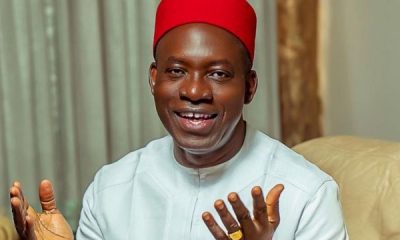
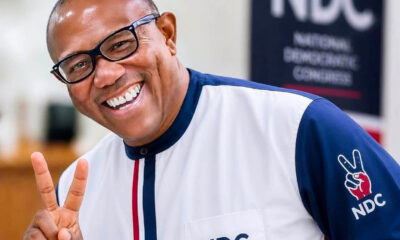
Obi knows he can’t win 2023 presidential poll – Soludo

Anambra State Governor, Chukwuma Soludo, has again tackled the Labour Party presidential candidate, Peter Obi, saying the latter knows he cannot win the 2023 poll.
Soludo, who was reacting to attacks that followed his recent comment on Obi’s investment in Anambra, said in an article released on Monday that the LP standard bearer was only playing game.
The article was titled, ‘History beckons and I will not be silent (Part 1)’.
He said, “Let’s be clear: Peter Obi knows that he can’t and won’t win. He knows the game he is playing, and we know too, and he knows that we know.
“The game he is playing is the main reason he didn’t return to the All Progressives Grand Alliance. The brutal truth (and some will say, God forbid) is that there are two persons/parties seriously contesting for president: the rest is exciting drama!”
Soludo concluded by saying, “Let me once again wish my brother Peter Obi good luck. He should have fun and enjoy the fleeting frenzy of the moment…
“I hope that after February 2023, Peter Obi will return to APGA (the party that made him everything he is politically) as I offered him on 8th March, 2022 and begin the hard work, if he truly wants to be president of Nigeria. It won’t happen by desperately jumping from one party to another or by unleashing a social media mob on everyone who slightly disagrees with you.”
Read the full article below:
14th November, 2022
History Beckons and I will not be Silent (Part 1)
Chukwuma Charles Soludo, CFR
My attention has been drawn to some of the tirades on social media following my frank response during an interview on Channels TV regarding the “investments” Mr. Peter Obi claimed to have made with Anambra state revenues. Sadly, several of the comments left the issue of the interview to probe or suggest motives, inferred from my response on “investment” that I am opposed to Peter Obi’s ambition and therefore committed a “crime” for which the punishment is internecine abuse and harassment even to my family. Some people even suggest that the gunmen who went to attack a checkpoint at my hometown on Saturday 12th November but were gunned down was part of the mob reaction. I used to think that for decent people, certain conducts are off-limits, and that in Anambra, politics is not warfare.
Of course, as a Christian, I know that telling the truth can be very costly, even suicidal. Our Lord and saviour was crucified simply for telling the truth the people did not want to hear. I promised that I won’t be the usual politician, and will not knowingly lie to the people. I am not an Angel but rather than knowingly repeat the same deceitful character that politicians are known for, I would leave public office. It is a vow I made to my God and to my family. Only God knows how many days I will be on this seat but whether I am on it or not I will always say it as it is— knowing fully the suicidal consequences of telling the truth in a political arena, especially in a country where lying and deceit by politicians have become culture and celebrated as being “smart”.
Ideally, I should just have laughed off the infantile exuberances as many friends advised (I am used to this, having been in the ‘Arena’ for a while). I always re-read the quote “The Man in the Arena…” by President Theodore Roosevelt (1910) to remind myself of the burden of public office. Several well meaning Nigerians and Ndigbo called to advise that I should just ignore them. A respected Igbo elder-statesman who called, advised that I should just ignore what he described as “Peter Obi and his social media mob”. According to him, “everyone knows that he is going nowhere, but they are looking for who to blame”. After some 20 minutes of discussion, he advised that I should personally author a response— just for the records.
Everyone knows that I don’t follow the winds nor one to succumb to bullies, nor shy away from a good fight especially when weighty matters of principles and future of the people are involved. One lesson I learnt from my former boss and mentor, President Obasanjo, is never to be on the fence. I learnt that one must always take a stand: for better or for worse. I do so with every sense of humility, and leave history to judge. Most people have commended me for “tactfully avoiding being drawn into the Peter Obi issue” until now. Since I am now being forced into the Arena on this matter, I have a duty and a right of reply, if only for the records, and to also give the social media mob something substantive to rant upon and rain their abuses for weeks. In this preliminary response, there are some things I will refrain from saying here because, in the end, February/March 2023 will come and go, and life will continue.
At the outset, let me state that this exhibition of desperation, intolerance and attempt to bully everyone who expresses the slightest of dissent is reprehensible. This is Hitler in the making. When the revered Arch Bishop Chukwuma stated that in Enugu State, they were not obedient, he was ferociously bullied on social media. Any dissent is tagged a saboteur or, in my case, it could be that I want to contest for president after office or that I am envious of Peter Obi. Soludo envious of Peter Obi? Totally laughable! But this is the same person I was asking to return to APGA in March 2022 and contest for president and yet envious or doesn’t want him to be president. This is madness! Seriously speaking, the obdurate attempt to muscle the republican Igbos to maintain the silence of the graveyard is antithetical to everything Igbo. It is not who we are. Insulting other ethnic groups and religions or denigrating others is certainly not the path to Aso Rock. If this is not checked, it may indeed endanger the future political and economic interests of the Igbos.
In his time, Dr. Nnamdi Azikiwe was the undisputed all time leader of the Igbos but he had his arch rivals and even independent candidates won landslide elections against his party, NCNC, in Igboland. Obafemi Awolowo had stiff opposition among the Yorubas while Ahmadu Bello had his share of opponents in the Northern region. Today, no one has accused Afenifere or other strong presidential candidates from the South West of being “anti Yoruba” because Tinubu is a frontrunner, nor has anyone accused Kwankwaso and several other Northern candidates of being “anti-North” for not supporting Atiku. As a full blooded republican Igboman and democrat, I reject this despotic intolerance.
Yes, I fully understand the anger of some urban and Diaspora youths and some Nigerians who are dissatisfied with the trajectory of the country or with the candidates of the major parties and wished other options. Not knowing much about others, some see Peter Obi as the contrast they wished for. I get the point. But this is a democracy: the minority will have their say, but the majority their way. Translating anger and social media agitation into political outcomes requires humongous work.
For full disclosure, let me state that Peter Obi and I are not just friends, we call ourselves “brothers”. But we have political differences: he left APGA for PDP after his tenure as Governor while I have remained in APGA since 2013. During the last two governorship elections in Anambra in 2017 and 2021, he led the PDP campaigns but APGA won landslide in both elections. By the way, in 2016, he visited and proposed that I defect to PDP and contest the 2017 election against the incumbent Willie Obiano, but I declined. After my victory in November 2021, he called to congratulate me as I did to him in 2010. That is the Anambra way: we fight fiercely during campaigns but share drinks at the next social events. After all, it was the great Zik of Africa who taught us that in politics, there are no permanent friends or permanent enemies but only permanent interests.
We sat next to each other during the Emeka Anyaoku lecture at Nnamdi Azikiwe University on 8th March, 2022 and I made an offer for him to return to APGA and contest as its presidential candidate. Yes, I did. In my mind, it was time for Igbos to organize their region politically before stepping out to bargain power with other organized coalitions. On his part, he tried to convince me that he expected APC to unravel while PDP would be the “only one” standing. We debated and he proposed that we could meet later to discuss further. He attended my inauguration on March 17. A few weeks later, he requested and I obliged him to use the Anambra State government house facility to launch his presidential bid under PDP. I was surprised to read in the news later that he had defected to LP (a party with literally zero structure), thereby attempting to weaken the same PDP he saw as the saviour a few weeks earlier. He paid me a courtesy call as the presidential candidate of LP, and we had frank discussions.
During our meeting, I reminded him of my proposal to him to come and contest under APGA. More importantly, I told him (possibly to his surprise) that I did not make the proposal in the belief that he will win in 2023 but that it would give us the opportunity to get our people organized as a bargaining force, with him leading the effort since I was busy as Governor (my immediate predecessor, Willie Obiano had indicated to me that he was not disposed to contest an election). We noted that we were in opposing political parties and in response to my direct question as to how I might help him, he requested that I should just ensure a “level playing field” and let the people decide. In fidelity, my government has provided the atmosphere for him and his supporters to operate freely in Anambra without any molestation (compare with treatments to LP even in other South East states), and allowed his billboards which are, in many places, wrongly placed almost on the roads. As a person, I have several shortcomings but being petty is not one of them. We have shown him tremendous goodwill—which he did not extend to the same Labour Party when he was Governor (Senator Ifeanyi Ubah, as LP governorship candidate in 2013 was denied the use of Ekwueme Square for his rallies).
Someone reminded me that a mob has no head and hence cannot reason. The same Peter Obi was one of those who told Ndigbo that APGA was the vehicle through which Igbos would organize to engage the rest of Nigeria politically. He was said to have sworn to Ojukwu and publicly that he would quit politics the day he leaves APGA. The rest is history. When he was the Vice-Presidential candidate under PDP in 2019, the emotive train then dubbed the ticket “the Igbo project”. As then chairman of planning and strategy committee of Ohanaeze Ndigbo Worldwide, I cautioned for a more pragmatic approach but the emotive blaze of the time held sway. We were vindicated afterwards.
By the way, APGA is Nigeria’s third largest political party today (after APC and PDP, it is the only other party with a state governor and third largest presence at the National Assembly). And some people have the temerity to suggest that APGA’s candidate should “step down” for Peter Obi as the “Igbo candidate”. I wonder when Igbos met to choose a candidate. They even argue that afterall APGA supported President Jonathan and did not field a candidate then. Well, the fact as I was told was that no candidate showed interest under APGA then. Besides, APGA’s unwritten rule then was to support the party at the centre — which, if we apply this time, should actually be APC. But we have our own candidate. Recall that all the political parties had their primaries during the same period. Once Peter Obi realized that he won’t get the presidential or vice-presidential ticket of PDP he ran to Labour Party (a political party known as a transit camp for aspirants who lost primaries in APC, PDP and APGA), and the chorus by a vociferous minority now is that LP has become the “Igbo project”, and the APGA candidate who emerged the same time as Peter Obi should “step down”. Ridiculous! Now I truly understand that a mob cannot reason.
When will Ndigbo understand and learn politics, especially of Nigeria? When Bola Ahmed Tinubu defied the political wind of the time and stood out as the “only man standing” in AD and later AC (before ACN) against a sitting president of Yoruba descent, no one accused him of being “anti-Yoruba”. Indeed, everyone recalls that both Tinubu and President Obasanjo disagreed politically, and probably still disagree—but none is being accused of being “anti- Yoruba”. Under Tinubu, the South West strategically organized under a different political party, the ACN and went into a formidable alliance that kicked out a sitting president (in Africa?), and that alliance is not broken yet. Igbos, in their frenzied Nzogbu nzogbu politics, have sadly found themselves in a political cul de sac. Tragic indeed! When will my people smell the morning coffee?
Let me now address the substance of my response during the interview, and I stand by what I said. On record, I doubt that any governor in Nigeria has paid as much tribute to his predecessors as I have done during campaigns and in office. I always said that ALL of them did well and to the best of their abilities. Yes, Peter Obi was governor for 8 years (2006 -2014) during a period of unprecedented oil boom and prosperity in Nigeria (Nigerian economy was growing at average of 6-8% per annum, and oil price was highest during this time). I have seen all kinds of funny comments and interpretations regarding what I said about the value of his “investments”. Some refer to SabMiller and bandy all kinds of figures as to how the investment of $12 million is now worth less than $3 million. Of course, there is room for legitimate debate about the logic or quality of the investments. For example, people might differ as to the propriety of using taxpayers money to promote a company in which one is a shareholder in the name of “investment”, or even whether so called “savings” are warranted when there were dozens of schools without roofs or classrooms, or local governments without access roads or hospitals without doctors/nurses. A Bishop recently publicly advised that I should please try to construct the “Ngige type of quality roads”, stating that the ones done by his successor (that is, Peter Obi) had washed off, while Ngige’s remained. I promised and we are delivering quality roads that Anambra has not seen before.
For sure, prudence in public resource management is desirable and we are opening new frontiers in that area. People will however differ as to whether saving money in the bank account is a KPI (key performance indicator) for a government where poverty is escalating except where its institutions for absorption are weak or where the government has no robust/big agenda for transformation. Governments exist to save lives, not to save money. We can debate and differ on this— (by the way, I know when/how it is appropriate to “save” as I built Nigeria’s foreign reserves from $10 billion I inherited to all time $63 billion, and even after paying $12 billion to pay-off Nigeria’s external debt and going through unprecedented global financial crisis, I still left behind about $45 billion— Go and verify!).
Funny, in the rabid frenzy to grab every straw, they cut a clip during our governorship debate where I was stating vital statistics and they claimed that I was “praising” Peter Obi then while committing a crime now by “criticising” him. Hahahaha! Well, it is true that I said during the debate that, according to National Bureau of Statistics, poverty in Anambra actually grew (from less than 25% in 2005) to about 53% under Peter Obi in 2010/2011 but fell under Willie Obiano to 14.78% in 2020. Yes, poverty more than doubled under Peter Obi and more than 50% of Ndi Anambra were in poverty under him. Go and verify! I am Governor, and sitting on privileged information which I will not want to use against a political opponent. But on matters of facts, I will always state same as is. As the saying goes, you can fool some of the people some of the time but never all the people all the time. Enough said for now!
Where do we go from here? I listened to my friend Gov El-Rufai on TV explaining why the northern governors decided that power should shift to the South. According to him, they asked themselves what would their founding fathers—Ahmadu Bello, Tafawa Balewa or Aminu Kano have done in the circumstance. Today, I ask my people, Ndigbo: do we ask what Azikiwe or M.I. Okpara or Akanu Ibiam would do in the present circumstance? I worry that Ndigbo as Nigeria’s foremost itinerant tribe and with the greatest stake in the Nigerian project does not yet have a strategy to engage Nigeria—politically! Every four years, we resurface with emotive Nzogbu Nzogbu political dance (“it is our turn dance” but without organization or strategy) and fizzle out afterwards while others work 24/7 strategizing and organizing.
Let’s be clear: Peter Obi knows that he can’t and won’t win. He knows the game he is playing, and we know too; and he knows that we know. The game he is playing is the main reason he didn’t return to APGA. The brutal truth (and some will say, God forbid) is that there are two persons/parties seriously contesting for president: the rest is exciting drama! That many Americans may not like the fact that Joe Biden (79 years) and Donald Trump (76 years) are two frontrunners for president in their parties does not remove the fact that if both of them emerge as candidates, definitely one of them will be president in 2024.
As my brother, I wish him well and even pray for him. I told him during his courtesy call that my prayer is that himself or Prof Umeadi of APGA would win, why not? That is from my heart, but I also told him that my head and facts on the ground led me to know that it’s probability is next to zero (what I cannot say before you, I won’t say behind you). So I already told him my opinion. Indeed, there is no credible pathway for him near the first two positions, and if care is not taken, he won’t even near the third position. Analysts tell him you don’t need “structure” to win. Fantasy! Of course, LP won governorship elections in Ekiti and Osun on social media and via phantom polls, while getting barely 2,000 votes on ground. Creating a credible third force for presidential election in Nigeria requires a totally different strategy and extreme hard work.
Of course, Peter Obi will get some votes, and may probably win in Anambra state— as “home boy”. But Anambra is not Nigeria. If he likes, I can even campaign for him but that won’t change much. From internal state by state polling available to me, he was on course to get 25% in 5 states as at August this year. The latest polling shows that it is down to four states, and declining. Not even in Lagos state (supposed headquarters of urban youths) where Labour Party could not find candidates to contest for House of Reps or Senate. The polls also show that he is taking votes away mostly from PDP. Indeed, if I were Asiwaju Tinubu, I would even give Peter Obi money as someone heading one of the departments of his campaign because Obi is making Tinubu’s pathway to victory much easier by indirectly pulling down PDP. It is what it is!
The current fleeting frenzy, if not checked, will cost Ndigbo dearly for years. The South East has the lowest number of votes of any region, but it is also the only region where the presidential race might be a 4-way race (it is a two-way race in the other 5 regions) thereby ensuring that our votes won’t count in the making of the next president of Nigeria. Afterwards, we would start complaining that we don’t get “what we deserve” or cry of marginalization. During the 2019 presidential election, the five South East States were united for PDP but contributed merely 1.6 million votes to PDP which was about the votes that Kano state gave to Buhari. The emotions might run to heavens but politics-power is about cold calculations, organization and building alliances for power. In a democracy, it is a game of numbers. So far, I don’t see any of these— and 2023 might again be a wasted opportunity for Ndigbo! What is our Plan B when Peter Obi loses in February 2023? Some people prefer that we should play the Ostrich while Peter Obi toys with the collective destiny of over 60 million Igbos. Yes, you pray that he wins, but what if he fails as he is certain to? The Bible says that my people perish for lack of knowledge. As the saying goes, only those who Plan can control the future. Ndigbo, wake up and smell the coffee!
What would Zik of Africa or M.I. Okpara do in this circumstance? Our founding fathers understood that in politics, you don’t get what you deserve but what you bargain/negotiate, and you negotiate with your organization and VOTES. Not social media militancy or bullying (where over 90% of actual voters are not on social media)! Our fathers built alliances with other major political parties in other regions (not with socio-cultural groups that don’t command any votes), and Ndigbo were in the reckoning in the first and second republics. After the elections, we will see how many votes any of the leaders of the socio-cultural groups will get for Peter Obi from their wards. Sometimes I even sense a conspiracy to nudge us on a path to nowhere thereby further pushing us into irrelevance, and I pray that I am wrong. Just my two cents!
It is not too late for Ohanaeze Ndigbo and progressive Igbo leaders to pre-emptively start charting a pragmatic future for Ndigbo in Nigeria after the elections. Armchair social media analysts can have the luxury of fantasizing with wild speculations. Right or wrong, they earn their pay and with no consequences. For us as leaders, the lives of tens of millions are at stake. We have a historic duty to act and being silent or politically correct is not an option. For starters, Ohanaeze should study the report of my committee (planning and strategy) in 2019. It may still be relevant today. Second, Ndigbo should seriously study the MoU signed at the Yar’Adua Centre in 2010. The leader of Igbo Political Association, Chief Simon Okeke and our members are still there. Thirdly and for me, Ndigbo should strategize and bargain especially with the TWO candidates likely to be president on at least four central issues:
A) Lasting peace and security in the South East, including the release and engagement with Nnamdi Kanu.
B) South East Economic transformation agenda and the FGN’s Marshall Plan for the South East as promised since the end of the Civil War (the post war ‘reconstruction’). We appreciate the Second Niger Bridge and recent contract for MTN to reconstruct the Onitsha-Enugu expressway. But the rail-lines to the five state capitals, speedy access to the sea, highways linking South East to the North and South South, addressing our existential threat as gully erosion capital of Africa, Free Trade and Export Processing Zones, etc.
C) Restructuring Agenda for Nigeria that devolves powers/resources to the subnational entities and in which it would no longer matter where the President comes from.
D) Levelling the playing field for the unleashing of the private sector and the full participation of Ndigbo in the economic and governance space; etc.
To conclude, let me once again wish my brother Peter Obi good luck. He should have fun and enjoy the fleeting frenzy of the moment. But he must moderate the desperation as exhibited by his social media mob. There is a limit to propaganda. A mob action often reflects the character of its leader. No one has a monopoly of social media violence, and no one should play God. Life won’t end by February/March 2023.
I hope that after February 2023, Peter Obi will return to APGA (the party that made him everything he is politically) as I offered him on 8th March, 2022 and begin the hard work, if he truly wants to be president of Nigeria. It won’t happen by desperately jumping from one party to another or by unleashing a social media mob on everyone who slightly disagrees with you. I decided to pen my views personally — again for the records. On this, I don’t mind being a one man minority. As history beckons, my conscience and sense of duty to my people dictate that I should never be silent. I will happily accept the judgment of history for standing by the truth!




Politics
Osun APC Warns Adeleke Govt Over Alleged Victimisation of Local Govt Workers
Osun APC Warns Adeleke Govt Over Alleged Victimisation of LG Workers
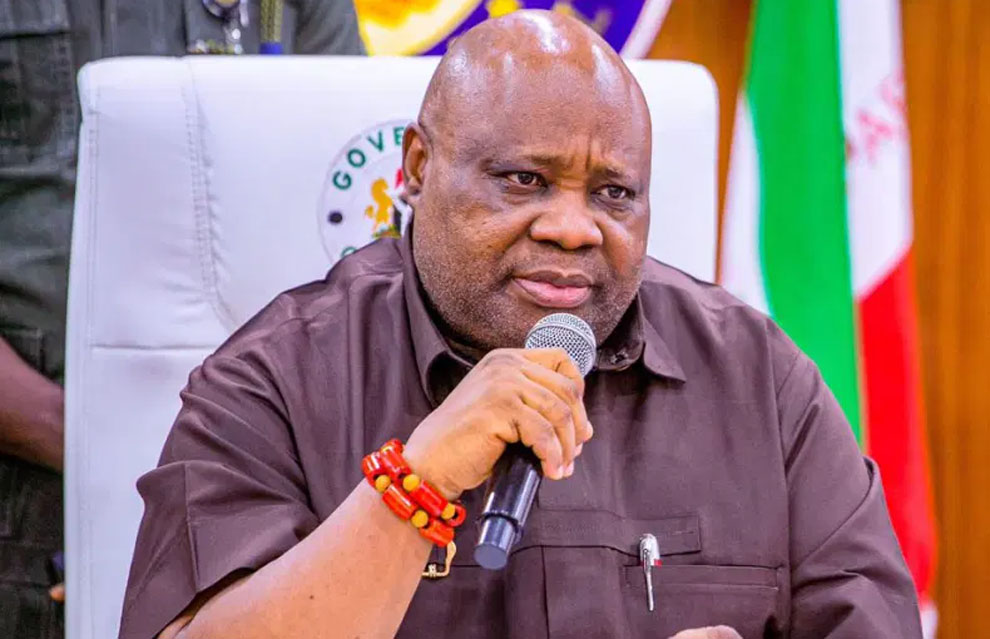
The Osun State chapter of the All Progressives Congress (APC) has issued a fresh warning to the administration of Governor Ademola Adeleke over allegations that some local government workers are being subjected to investigation and disciplinary proceedings because of their perceived political affiliations.
The party alleged that the Osun State Local Government Service Commission had constituted a committee to investigate council employees suspected of supporting the APC during the August 15, 2026 governorship election.
The allegation was contained in a statement signed by the APC Director of Media and Information, Kola Olabisi, who accused the state government of using the ongoing exercise to target workers believed to have supported the party’s candidate, Bola Oyebamiji.
According to the APC, some affected workers have been summoned before an investigative and disciplinary panel at the Local Government Service Commission premises in the state Secretariat, Abere, Osogbo.
The party further alleged that some of the workers were questioned about their political activities and contacts before and during the election.
It also claimed that some workers were asked to submit their mobile phones for scrutiny, with the alleged objective of checking their communications with APC members and supporters.
The APC additionally alleged that some workers’ banking transactions were examined and that some employees had been threatened with suspension, dismissal or other disciplinary measures.
The party described the alleged actions as unacceptable and called on the Adeleke administration to reactivate any salary accounts that had been deactivated and dissolve the committee.
READ ALSO:
- 18 Suspected Bandits Killed as Security Forces Foil Mass Kidnap in Katsina
- Police Arrest Two Arms Dealers, Recover 300 Rounds of Ammunition in Kaduna
- Petrol Depot Prices Fall as Dangote, Marketers Cut Rates, Pump Price Reduction Looms
The opposition party argued that public servants should not be punished for their political choices, noting that elections in Nigeria are conducted through a secret ballot.
However, the Osun State Government has rejected the allegation that the workers are being investigated because of their political affiliations.
Commissioner for Information and Public Enlightenment, Kolapo Alimi, said the workers under investigation were being questioned over alleged double salary payments, rather than their political activities.
According to the commissioner, the investigation followed a petition alleging that some local government employees were receiving salaries from two sources.
Alimi said the government was investigating claims that some workers were allegedly collecting salaries from the state government while also receiving payments from the APC-backed local government officials involved in the prolonged council administration dispute.
He maintained that the exercise was focused on alleged financial infractions and not political affiliation.
The governor’s spokesperson, Olawale Rasheed, also dismissed the APC’s allegation of political victimisation, saying the administration had no policy of targeting local government employees because of their political choices.
The latest dispute comes amid the long-running controversy over the control of Osun’s 30 local government councils, which has pitted the Adeleke administration against APC-backed council officials.
The council dispute has also had implications for local government finances and workers’ salaries. Earlier in the year, the Osun Government said local government workers’ core salaries had continued to be paid despite what it described as the withholding or diversion of local government allocations. (Osun State Official Website)
The competing claims over the latest investigation have therefore added another layer to the broader political and administrative dispute between the APC and the Adeleke administration.
While the APC maintains that the affected workers are being targeted because of their political affiliations, the state government says the investigation concerns alleged financial misconduct, particularly claims of workers receiving salaries from more than one source.
As of the latest reports, there is no independently established evidence showing that the investigation was instituted solely because the affected workers supported the APC. The allegations remain disputed between the opposition party and the state government. (Osun)
Osun APC Warns Adeleke Govt Over Alleged Victimisation of LG Workers
Politics
2027: Tompolo-Backed Group Deploys 44 Vehicles for Tinubu-Shettima Campaign in Borno
2027: Tompolo-Backed Group Deploys 44 Vehicles for Tinubu-Shettima Campaign in Borno
The PBAT Door-to-Door Movement, a political support group backed by Niger Delta businessman and Tantita Security Services Nigeria Limited chief executive, Government Ekpemupolo, popularly known as Tompolo, has commenced grassroots mobilisation in Borno State ahead of the 2027 general elections.
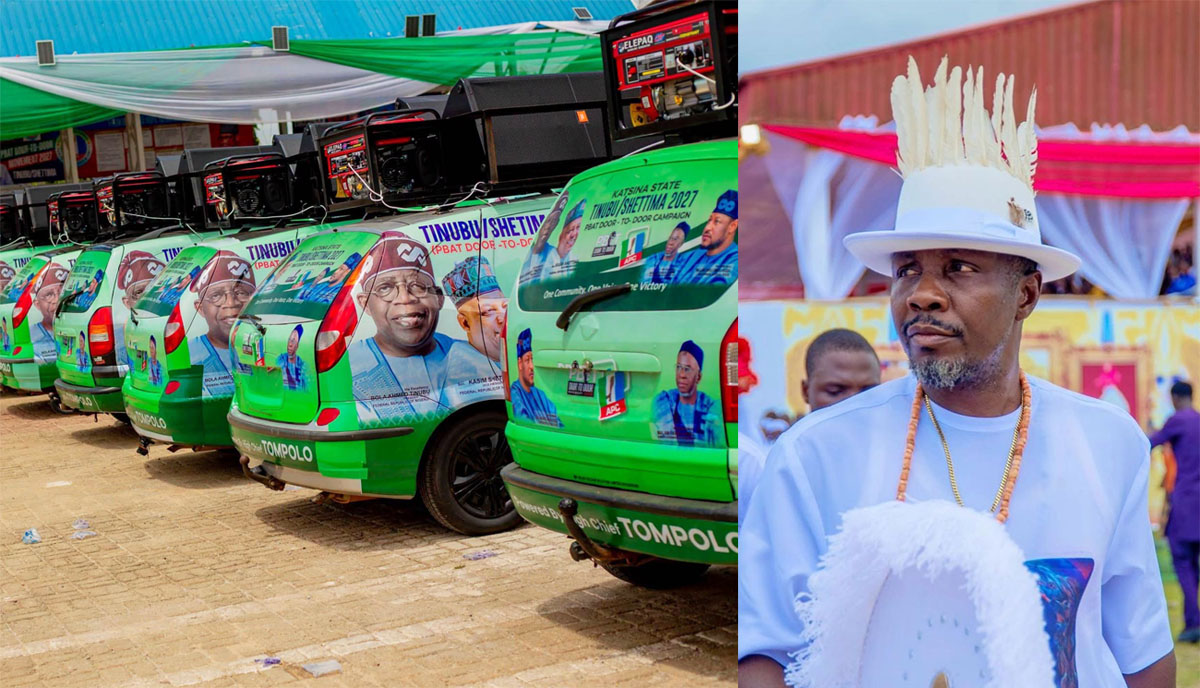
The group, which is campaigning for the re-election of President Bola Ahmed Tinubu and Vice President Kashim Shettima, unveiled 44 campaign vehicles and other mobilisation equipment at an event held at Sir Kashim Ibrahim Square, College of Education, Maiduguri.
The equipment presented during the Borno mobilisation included 44 generators, 44 amplifiers, 44 microphones and 88 speakers, according to reports from the event.
The Borno launch represents another stage in the expansion of the Tinubu 2027 campaign structure being developed by the PBAT Door-to-Door Movement, following its northern launch in Katsina earlier in September.
Tompolo, who is the Grand Patron of the movement, was represented at the Maiduguri event by Kestin Pondi, Managing Director of Tantita Limited.
In his message to the gathering, Tompolo called on residents of Borno to support the Tinubu-Shettima ticket, drawing particular attention to Shettima’s connection to the state.
He urged members and supporters of the movement to take the campaign to communities and engage residents at the grassroots ahead of the 2027 election.
Tompolo also commended the Borno State Government for what he described as development achievements and called on residents to support the APC governorship candidate, Mustapha Gubio, as part of efforts to sustain the current administration’s programmes.
The claims about the performance of the Tinubu administration and the Borno State Government were political assessments made by supporters of the administration and were not independent evaluations.
The mobilisation was formally unveiled with the participation of the Borno State Government. Governor Babagana Zulum was represented by his deputy, Umar Usman Kadafur.
Kadafur said the state was prepared for what he described as significant grassroots support for Tinubu and Shettima in the 2027 election.
READ ALSO:
- MTN, Gates Foundation Launch $25m AI Maternal Health Initiative for 500,000 Nigerian Women
- Niger Mosque Attack: Bago Says 63 Abducted, 14 Freed, Three Killed
- UNGA 81: Trump Threatens to ‘Annihilate’ Iran if No Deal Is Reached
Also present was the APC Deputy National Chairman, North, Ali Bukar Dalori, who urged members of the movement to take the campaign beyond political meetings and into communities across the state.
The APC governorship candidate in Borno, Mustapha Gubio, also expressed support for the Tinubu-Shettima ticket and said the administration had delivered what he described as dividends of democracy.
The Borno mobilisation is part of a broader political organisation by the PBAT Door-to-Door Movement, which was founded and sponsored by Tompolo to mobilise grassroots support for Tinubu’s 2027 re-election bid.
The movement inaugurated its national executives in Abuja in July, with its stated objectives including grassroots mobilisation, voter education, community engagement and communicating the Federal Government’s policies and programmes directly to residents.
At the time of its national inauguration, the movement said it intended to take its activities to wards, local government areas, communities, markets and households across Nigeria.
The group subsequently moved its northern mobilisation campaign to Katsina, where it inaugurated coordinators across the state’s 34 local government areas and presented campaign vehicles to them.
The Katsina deployment involved 34 campaign vehicles, with each of the state’s 34 local government areas assigned a coordinator.
The Borno rollout therefore brings the campaign’s reported vehicle deployment in the two northern states to at least 78 vehicles, based on the publicly reported 34 vehicles in Katsina and 44 unveiled in Borno.
The expansion comes as several political groups and support platforms are beginning to organise ahead of the 2027 Nigerian presidential election.
Other pro-Tinubu mobilisation structures have also been announced, including Arewa for Asiwaju (A4A), a group formed by northern political figures, former governors and lawmakers to support Tinubu’s re-election campaign across the 19 northern states and the Federal Capital Territory.
The development indicates that political parties and affiliated support groups are increasingly establishing grassroots structures ahead of the 2027 election.
For the PBAT Door-to-Door Movement, however, the strategy centres on direct engagement with voters. Its organisers have said the objective is to explain government policies and programmes, promote voter education and mobilise supporters at the ward and community levels.
Tompolo has previously said the movement would rely on local volunteers and place emphasis on engaging ordinary Nigerians, including women and young people, as part of its grassroots outreach.
The group has also framed its campaign around the Renewed Hope agenda of the Tinubu administration, arguing that economic reforms and other government programmes should be allowed to continue.
Those positions represent the movement’s stated political case for supporting Tinubu and are separate from independent assessments of the administration’s performance.
With the Borno launch, the Tinubu-Shettima 2027 campaign mobilisation backed by Tompolo has now established a visible operational presence in at least two northern states, with further grassroots activities expected as political parties and support groups prepare for the 2027 elections.
2027: Tompolo-Backed Group Deploys 44 Vehicles for Tinubu-Shettima Campaign in Borno
Politics
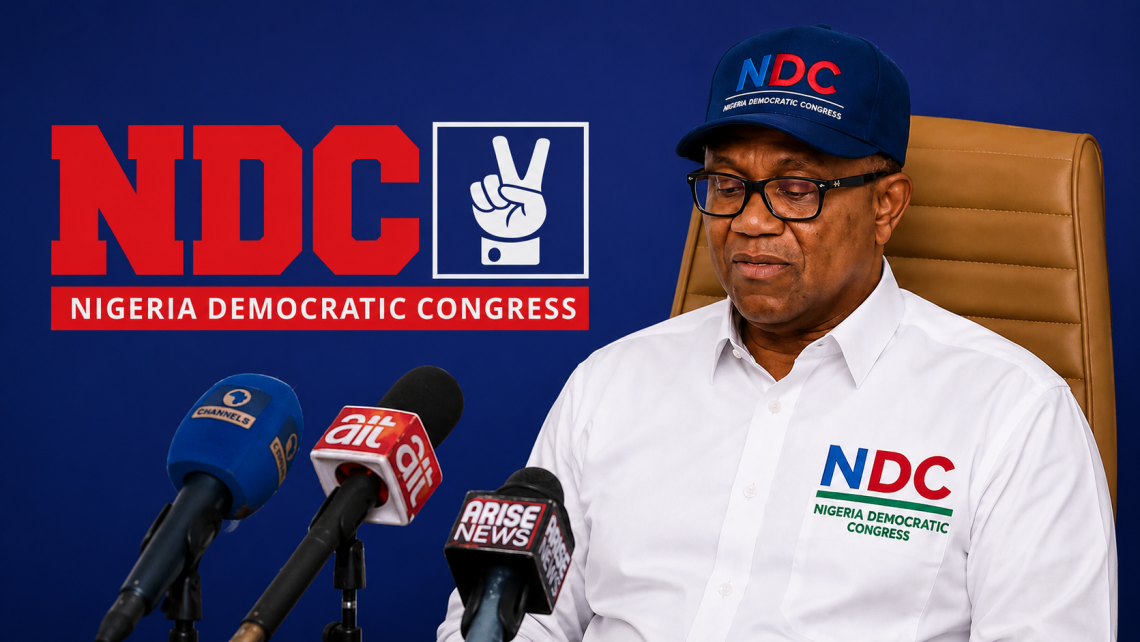
Obi vs Soludo: ₦86.67bn Handover Figure Meets ₦127.37bn Debt Claim
Obi vs Soludo: ₦86.67bn Handover Figure Meets ₦127.37bn Debt Claim
The renewed Anambra debt dispute has intensified after former Governor Peter Obi released his 2014 handover document to counter claims by the state government that his administration left behind substantial outstanding loans and other financial liabilities.
The controversy centres on competing accounts of Anambra State’s finances when Obi handed over power to Willie Obiano on March 17, 2014.
Obi’s handover document shows a positive financial position of about ₦86.67 billion after provisions for certain liabilities, while the current Anambra State Government says eight external financing facilities associated with projects undertaken during Obi’s tenure had an outstanding balance of $92.35 million, equivalent to about ₦127.37 billion, as of June 30, 2026.
However, the two figures describe different things and should not be treated as if they were direct measurements of the same debt position.
The ₦86.67 billion figure comes from the financial position presented in the 2014 handover report. The ₦127.37 billion figure is the value the state government assigns in 2026 to the outstanding balance on eight external financing facilities whose original amounts totalled about $123.77 million.
The central unresolved question is therefore how much of those facilities was actually outstanding when Obi left office in March 2014, how much had been disbursed by then, what was subsequently disbursed, how much was repaid by succeeding administrations and what remains outstanding today.
The dispute was reignited after Anambra State officials said the administration of Governor Chukwuma Soludo was still servicing loans and other obligations incurred by previous administrations, including that of Obi.
Obi rejected the claim, insisting that he did not leave Anambra owing salaries, pensions, gratuities or contractors who had completed certified work.
He subsequently challenged the state government to substantiate its claims and released the 2014 Anambra State Handover Report as part of his response.
The document, dated March 17, 2014, was addressed to Obiano and contained a summary of the state’s financial position as of the close of business on March 14, 2014, described as the final working day of Obi’s administration.
According to the document, Anambra had about ₦27 billion committed to local investments.
It also listed approximately $156 million in foreign-currency investments, which was valued at about ₦25.6 billion at the exchange rate used at the time.
The report further listed approximately ₦28.27 billion in balances relating to certified state ministries, departments and agencies, alongside ₦10 billion refunded to the state by the Federal Government.
Those figures produced a combined financial position of about ₦91.67 billion.
The outgoing administration, however, made provision for about ₦5 billion in liabilities, including March 2014 salaries, pensions, gratuities and certified payments relating to projects that had already been executed.
After that provision, the report placed the net financial position at approximately ₦86.67 billion.
Former Secretary to the Anambra State Government Oseloka Obaze, who served under Obi, has defended the document and said he was involved in the handover process.
Obaze has maintained that the financial records were presented to Obiano during the transition and that the incoming governor acknowledged receipt of the documents.
READ ALSO:
- UK Student Visa: 63 Countries Exempt From Proof of Funds, Nigeria Excluded
- Lagos Intensifies Surveillance as Adulterated Palm Oil Raises Food Safety Concerns
- Saudi Arabia Rejects Nigeria’s Request for More 2027 Hajj Slots
However, acknowledgement of a handover document does not necessarily mean that every figure in it was independently audited or certified by the incoming administration.
There is also historical evidence that some elements of Obi’s financial account were subsequently acknowledged by Obiano.
During a television appearance ahead of the 2017 Anambra governorship election, Obiano reportedly confirmed that he inherited about ₦9 billion in cash and approximately ₦25.6 billion in investment-related assets.
That does not, however, resolve the wider question of the state’s liabilities and outstanding borrowing at the time of the transition.
The Anambra State Government has released a separate set of records to support its claim that loans connected with the period of Obi’s administration remain obligations of the state.
According to the government, eight external financing facilities associated with projects approved or implemented between 2007 and 2013 had a combined original value of about $123.77 million.
The state said the outstanding balance on those facilities stood at approximately $92.35 million as of June 30, 2026, which it valued at ₦127.37 billion using the exchange rate applied in its calculation.
The facilities identified by the state government relate to development programmes covering areas such as healthcare, agriculture, education, malaria control and erosion management.
Among the projects listed are the Malaria Control Booster Project, Third FADAMA Development Project, Health System Development Project II, State Education Programme Investment Project and the Nigeria Erosion and Watershed Management Project.
The government has said successive administrations have continued to service the facilities.
It has also maintained that its criticism is not directed at borrowing as a financing tool, arguing that loans can be justified when used for viable development projects and human-capital investment.
Obi, however, has rejected the description of his administration as having left Anambra with the debt burden now being cited.
He has maintained that his administration paid what was due before leaving office and did not owe workers, pensioners or contractors whose claims had been properly processed.
He has also said his administration saved substantial funds for the incoming government.
The most important issue arising from the competing accounts is that a loan contracted during an administration is not necessarily the same as the debt outstanding at the moment that administration leaves office.
A financing agreement can have an approved or contracted value, but the amount actually drawn down at a particular point in time may be lower.
Similarly, repayments may reduce the principal balance, while subsequent disbursements can increase the amount outstanding.
READ ALSO:
- MURIC Warns FG: Any Move Against Atiku Now Lacks Tact
- Jetour T1 Storms Abuja as Automaker Accelerates Nigeria Expansion
- Kidnapped Female Police Officer Found Dead in Ebonyi as Suspect Leads Police to Remains
The timing of those transactions therefore matters in determining what a government actually inherited.
This is particularly significant in the current Anambra controversy because the $123.77 million cited by the state represents the original amounts associated with the eight facilities, while the $92.35 million figure represents the balance the state says remains outstanding in June 2026.
Neither figure, by itself, establishes the exact debt stock on March 17, 2014.
Official debt records have also been cited in the debate, showing Anambra’s external debt stock at about $30.32 million as of December 31, 2013, alongside domestic debt of approximately ₦3.03 billion at the same period.
Those figures are much closer to the date of Obi’s departure, although they do not by themselves establish the precise financial position on March 17, 2014.
They nevertheless add another layer to the debate because they show why the original value of all financing facilities cannot automatically be equated with the state’s debt stock at the time of handover.
The question of how much had actually been disbursed by March 2014 is therefore central.
So is the question of how much remained unpaid at that date.
The subsequent repayment history is equally important.
If part of a facility was repaid after Obi left office, that repayment would reduce the outstanding balance. Conversely, if additional funds under an existing financing agreement were drawn after the change of administration, those later transactions would need to be reflected in any assessment of the debt inherited by the incoming government.
The current state government’s publication gives a picture of the 2026 outstanding balance, but a complete reconstruction of the financial position at the 2014 handover would require the loan-by-loan balances at that date, disbursement records, repayment schedules and subsequent transactions.
This distinction has become central to the public debate.
The Anambra Government argues that loans associated with projects undertaken during Obi’s administration remain outstanding and are still being serviced.
Obi’s position is that the state had substantial funds and investments when he left office and that he did not leave behind the unpaid obligations being alleged.
Both positions can be examined without treating the ₦86.67 billion handover figure and the ₦127.37 billion current outstanding-loan figure as contradictory measurements of the same financial item.
The handover report primarily addresses the assets, balances and estimated liabilities presented by the outgoing administration.
The state’s latest debt statement addresses the current balance of specific external financing facilities.
The broader financial picture therefore requires the two sets of records to be reconciled rather than simply placed against each other.
The dispute also extends beyond external loans.
The Anambra Government has alleged that some salary, pension and gratuity obligations remained outstanding after Obi left office.
The state has cited arrears involving workers and retirees and said the Soludo administration has continued to settle inherited liabilities.
Obi and his supporters have disputed the characterisation of those obligations and maintained that the outgoing administration had settled the liabilities it was responsible for at the time of handover.
Another contested issue is an alleged ₦2.1 billion ecological fund.
The state government has disputed Obi’s account of the fund and said its examination of the relevant bank records did not support the claim that the amount existed in the account in the manner described.
Obi’s camp has maintained its position regarding the funds.
The dispute over the ecological fund is separate from the question of the eight external loans and should not be conflated with the figures contained in the 2014 handover report.
There is also a broader political dimension to the controversy because Obi is now the NDC presidential candidate for the 2027 election, making his record as Anambra governor a subject of renewed public scrutiny.
However, the financial questions themselves concern historical state records and can be examined independently of the political arguments surrounding the former governor.
At the centre of the matter is a relatively straightforward accounting question: what exactly was Anambra State’s financial position when Obi handed over power in March 2014?
Answering that question requires more than the total amount originally attached to loans contracted between 2007 and 2013.
It requires a loan-by-loan reconciliation showing the original facility, the amount disbursed before March 17, 2014, the amount repaid before and after the handover, subsequent drawdowns and the outstanding principal at each stage.
It also requires reconciliation of the cash balances, investments and liabilities listed in the 2014 handover document with the state’s audited accounts and official debt records.
The current controversy has therefore moved beyond a simple argument over whether Obi left money in Anambra’s coffers.
The available records show that the 2014 handover report recorded substantial assets and financial balances, while the current state government has produced records showing that external financing facilities associated with the period of Obi’s administration still have outstanding balances.
What remains contested is the precise amount of debt Anambra inherited on the day Obi left office and how that figure relates to the loans now being serviced.
Until those figures are reconciled, the Anambra debt dispute remains a matter of competing interpretations of financial records spanning more than 12 years.
For taxpayers and residents, the most useful resolution would be a transparent reconciliation of the state’s finances from the March 2014 handover to the present, showing the assets inherited, liabilities outstanding, loans drawn, repayments made and balances remaining.
Such a record would provide a clearer basis for understanding how Anambra’s current debt position developed and which obligations were inherited, serviced or incurred by successive administrations.
Obi vs Soludo: ₦86.67bn Handover Figure Meets ₦127.37bn Debt Claim
-
 News2 days ago
NLC Backs ₦500 Petrol Demand, Workers Propose ₦500,000 Salary
-

 Politics2 days ago
Obi vs Soludo: ₦86.67bn Handover Figure Meets ₦127.37bn Debt Claim
-

 metro2 days ago
Saudi Arabia Rejects Nigeria’s Request for More 2027 Hajj Slots
-

 Health3 days ago
Aproko Doctor Warns Nigerians Against Rinsing Mouth With Untreated Borehole Water
-
 Education2 days ago
UK Student Visa: 63 Countries Exempt From Proof of Funds, Nigeria Excluded
-

 Health2 days ago
Lagos Intensifies Surveillance as Adulterated Palm Oil Raises Food Safety Concerns
-
 News3 days ago
MURIC Warns FG: Any Move Against Atiku Now Lacks Tact
-

 metro2 days ago
Nationwide Blackout Looms As Electricity Workers Give NAF Three-Day Ultimatum