
International
Court rules against wife who sued husband for forced ‘unnatural sex’

Court rules against wife who sued husband for forced ‘unnatural sex’
An Indian judge has dismissed the complaint of a woman who claimed that her husband committed “unnatural sex,”.
The judge said it is not illegal for a husband to force his wife to engage in sexual acts under the Indian law.
The ruling, made in the Madhya Pradesh High Court last week, highlighted a legal loophole in India that doesn’t criminalise marital rape by a husband against his wife if she’s over age 18, CNN reports.
The woman told police her husband came to her house in 2019, soon after they were married, and committed “unnatural sex,” under Section 377 of India’s penal code, according to the Madhya Pradesh High Court order.
The offence includes non-consensual “carnal intercourse against the order of nature with any man, woman or animal,” and was historically used to prosecute same-sex couples who engaged in consensual sex before the Supreme Court decriminalized homosexuality in 2018
The woman also alleged the act happened “on multiple occasions,” and that her husband had threatened to divorce her if she told anyone about it. She finally came forward after telling her mother, who encouraged her to file a complaint in 2022, the court heard.
Meanwhile, the husband challenged his wife’s complaint with his lawyer claiming that any “unnatural sex” between the couple was not criminal as they were married.
READ ALSO:
- Netanyahu rubbishes Hamas ceasefire proposal
- Nigerian varsity VC suspended over alleged gross misconduct
- Lagos to experience morning, afternoon thunderstorms for 3 days
Delivering his judgement, Justice Gurpal Singh Ahluwalia stressed India’s marital rape exemption, which does not make it a crime for a man to force sex on his wife, a relic of British rule more than 70 years after independence.
“When rape includes insertion of penis in the mouth, urethra or anus of a woman and if that act is committed with his wife, not below the age of fifteen years, then the consent of the wife becomes immaterial … Marital rape has not been recognized so far,” the judge said.
India’s Supreme Court increased marital consent from the age of 15 to 18 in a landmark judgment in 2017.
The woman also accused her in-laws of mental and physical harassment “on account of non-fulfilment of demand of dowry,” the court order said. A trial is pending.
Ahluwalia’s remarks have once again raised questions over India’s treatment of women, who continue to face the threat of violence and discrimination in the deeply patriarchal society.
The world’s largest democracy of 1.4 billion has made significant strides in enacting laws to better safeguard women, but lawyers and campaigners say its reluctance to criminalize marital rape leaves women without adequate protection.
According to the 2019-2021 National Family Health Survey by the Government of India, 17.6% of more than 100,000 women ages 15-49 surveyed said they were unable to say no to their husband if they didn’t want sex, while 11% thought husbands were justified in hitting or beating his wife if she refused.
READ ALSO:
- Your position on state police unacceptable, Lagos Assembly tells IGP
- Fubara blasts Rivers lawmakers: You only exist because I recognise you
- Two men land in Ibadan court for allegedly stealing two loaves of bread
Women alleging rape in India have some avenues of potential legal action against their husbands.
For example, they can seek a restraining order under civil law or charges under Section 354 of India’s Penal Code, which covers sexual assault short of rape, and Section 498A, which covers domestic violence.
These laws are open to interpretation and judges can use them to impose prison sentences for sexual assault in cases where a married woman has alleged rape, but many don’t, lawyer Karuna Nundy previously told CNN.
Many married women are also ignored when they try to file a police complaint, a 2022 study showed.
The study examined records from three Mumbai public hospitals from 2008 to 2017 and found that of 1,664 rape survivors, no rape cases were filed by police. At least 18 of those women reported marital rape to the police, including 10 women who alleged rape by a former partner or husband.
Four women were explicitly told by police that they could not do anything as marital rape was not a crime, the report said.
Over the years, Campaigners have been trying to change the law but said they’re up against conservatives who argue that state interference could destroy the tradition of marriage in India.
Court rules against wife who sued husband for forced ‘unnatural sex’










International
US-Iran MoU Details Emerge: $300bn Reconstruction Aid, Sanctions Relief in 14-Point Deal

US-Iran MoU Details Emerge: $300bn Reconstruction Aid, Sanctions Relief in 14-Point Deal
The United States and Iran have signed a landmark 14-point memorandum of understanding that outlines a path to ending hostilities, lifting economic sanctions, and launching a $300 billion reconstruction plan for Iran. The agreement, dubbed the “Islamabad MoU,” was read out by a senior US official to journalists on Wednesday and sets the stage for a comprehensive final deal within 60 days. The digital signing has already taken place between President Donald Trump and Iranian parliamentary speaker Mohammad Bagher Ghalibaf, with a formal in-person ceremony scheduled for Friday in Switzerland. The Iranian government has released its own version of the text, which largely mirrors the US readout, though with slightly different emphases on certain provisions such as the centrality of Lebanon’s sovereignty and the operational mechanics of sanctions relief.
The Full 14-Point US-Iran Memorandum of Understanding Text
Below is the complete text of the memorandum as read by the senior US official, beginning with the preamble stating that “The United States of America and Islamic Republic of Iran have jointly agreed in good faith on [a date yet to be determined], on the following:”
Paragraph 1 – Permanent Cessation of Hostilities
The first paragraph declares an immediate and permanent termination of military operations on all fronts, including in Lebanon. The United States and Iran, along with their respective allies in the current war, undertake from now on not to initiate any war or any military operation against each other and to refrain from the threat or use of force against one another, while also ensuring the territorial integrity and sovereignty of Lebanon. The final deal will confirm the permanent termination of the war on all fronts, including in Lebanon, and other provisions of this paragraph. A senior US official emphasized that Iran bears responsibility for restraining Hezbollah, stating that “they have to get a collar on their dog in Hezbollah; they’ve got to hold them back,” making clear that Washington views this as a critical test of Tehran’s good faith.
Paragraph 2 – Mutual Sovereignty
The second paragraph commits both parties to respect each other’s sovereignty and territorial integrity and to refrain from interfering in each other’s internal affairs. This provision is designed to establish a baseline of mutual non-aggression that extends beyond the immediate military cessation, addressing long-standing Iranian grievances about US support for regime change and American concerns about Iranian influence across the Middle East.
Paragraph 3 – 60-Day Negotiation Window
The third paragraph establishes a maximum 60-day timeline for negotiating and achieving the final deal, a period that can be extended with mutual consent. This tight deadline reflects the urgency both sides feel to capitalize on the current diplomatic momentum while also creating a sense of pressure that could force difficult compromises during the negotiations. The clock is now ticking on this critical window, with the formal signing in Switzerland set to trigger the countdown.
READ ALSO:
- Former Minister Diezani Speaks on Emotional Toll of 11-Year Battle
- Iyabo Obasanjo Secures PDP Senate Ticket After Party Switch
- P-Square Feud: Peter Okoye’s Absence Delays Jude Okoye’s N1.3bn Fraud Trial
Paragraph 4 – US Naval Blockade Removal
The fourth paragraph requires the United States to begin removing its naval blockade and any disturbances or impediments against Iran immediately upon signing, with full removal within 30 days. During this period, the traffic of vessels will be in proportion to the numbers of pre-war traffic being restored by Iran. The United States further undertakes to remove its forces from the proximity of Iran within 30 days after the final deal. This represents a significant military de-escalation, as the US naval presence in the Persian Gulf and the Strait of Hormuz has been a major point of tension and a primary tool of economic pressure against Iranian oil exports.
Paragraph 5 – Strait of Hormuz Passage
The fifth paragraph places obligations on Iran to make arrangements using its best efforts for the safe passage of commercial vessels with no charge for 60 days only, from the Persian Gulf to the Sea of Oman, and vice versa. The traffic of commercial vessels will immediately start, and considering the need for removing technical and military obstacles and de-mining by Iran, will be instated within 30 days. Iran will also conduct dialogue with the Sultanate of Oman to define the future administration and maritime services in the Strait of Hormuz, in discussion with other Persian Gulf littoral states, in line with applicable international law and the sovereign rights of coastal states of the Strait. This provision is crucial for global energy markets, as the Strait of Hormuz is a vital chokepoint through which roughly 20% of the world’s oil passes.
Paragraph 6 – $300 Billion Reconstruction Fund
The sixth paragraph commits the United States to work with regional partners to develop a definitive mutually agreed plan with at least USD 300 billion for the reconstruction and economic development of Iran. The mechanism for implementation will be finalized as part of a final deal within 60 days, and all required licenses, waivers, and permissions needed for the relevant financial transactions will be granted by the United States. A critical detail is that the US will not directly contribute to this fund. Instead, it serves as a framework for regional partners—particularly Gulf states—to invest in Iran’s reconstruction with US approval and sanctions waivers, representing a significant geopolitical shift that could reshape the Middle East’s economic landscape.
Paragraph 7 – Comprehensive Sanctions Termination
The seventh paragraph is perhaps the most consequential for Iran’s economy, as the United States undertakes to terminate all types of sanctions against Iran, including United Nations Security Council resolutions, IAEA Board of Governors resolutions, and all unilateral US sanctions, both primary and secondary, on an agreed-upon schedule as part of the final deal. Both parties acknowledge the critical importance of the sanctions termination issue and express their intentions to immediately address these issues in the negotiations in order to achieve mutual agreement on them. The Iranian version of the text reportedly places stronger emphasis on this provision as a fundamental pillar of the agreement, reflecting Tehran’s view that sanctions relief is the primary benefit it seeks from the deal.
Paragraph 8 – Nuclear Commitments
The eighth paragraph addresses the most sensitive aspect of the negotiations: Iran’s nuclear program. Iran reaffirms that it shall not procure or develop nuclear weapons, and both parties agree to resolve the disposition of stockpiled enriched material pursuant to a mechanism that will be mutually agreed upon in accordance with the schedule mentioned in Paragraph 7, with the minimum methodology to be down-blending on site under the supervision of the IAEA. The two parties also agreed to discuss the issue of enrichment and other mutually agreed matters related to Iran’s nuclear needs, based on a satisfactory framework being agreed upon in the final deal. The final deal will confirm the provisions of this paragraph, and both parties acknowledge the critical importance of the nuclear issues and express their intention to immediately address them in the negotiation. A US official described this provision as a “major, major win” for the United States, as it commits Iran to verifiable steps that roll back its nuclear program.
READ ALSO:
- Grand Chief Imam Denies Involvement in Prayer Event for Oyo APC Governorship Candidate
- 2027: I’ll Negotiate With Bandits Who Seek Peace, Fight Those Who Choose Violence — Peter Obi
- Ivory Coast Footballer Arrested Over Spot-Fixing Allegations
Paragraph 9 – Status Quo Maintenance
The ninth paragraph establishes a freeze on the current situation pending the final deal. Iran will maintain the current status quo of its nuclear program, and the United States will not impose any new sanctions and will not deploy additional forces in the region. This “standstill” provision is designed to prevent either side from taking actions that could undermine the negotiations or escalate tensions during the 60-day window, creating a stable environment for the difficult talks ahead.
Paragraph 10 – Immediate Oil Export Waivers
The tenth paragraph provides for immediate economic relief, as the United States undertakes that immediately upon signing the MOU, and until the termination of sanctions, the US Department of Treasury will issue waivers for the export of Iranian crude oil, petroleum products and derivatives, and all associated services, including banking transactions, insurances, and transportation. This provision allows Iran to begin ramping up its oil exports immediately, providing a tangible economic benefit that can be presented to the Iranian public as a concrete achievement of the diplomatic process.
Paragraph 11 – Release of Frozen Assets
The eleventh paragraph addresses the billions of dollars in Iranian assets that have been frozen or restricted in various jurisdictions around the world. The United States undertakes to make these funds fully available for use upon implementation of the MOU, with the procedures related to the release to be mutually agreed upon during the negotiations. Such funds, whether retained in the original account or transferred, shall be made fully usable for payment to any ultimate beneficiary designated by the Central Bank of Iran, and the United States undertakes to issue all necessary licenses and authorizations accordingly. This represents a significant financial windfall for Iran, though the exact amount and the timeline for access remain to be determined in the negotiations.
Paragraph 12 – Monitoring Mechanism
The twelfth paragraph establishes that an executive mechanism will be created to monitor the successful implementation of the MOU and the future compliance with the final deal. This monitoring body will be critical for building trust between the two sides and providing verification that each party is meeting its commitments, particularly on the nuclear front and on sanctions relief.
Paragraph 13 – Performance-Based Sequencing
The thirteenth paragraph contains the operational logic of the entire agreement, establishing that after signing the MOU and subject to the beginning of the implementation of Paragraphs 1, 4, 5, 10 and 11, and the continuing implementation of these measures, the United States and Iran will start negotiations regarding the final deal exclusively on the other paragraphs. This is the “performance-based” core of the agreement. Negotiations on the comprehensive final deal only commence after Iran begins implementing its commitments on the ceasefire, maritime security, and the US begins delivering economic relief. A senior US official described the logic: “If the Iranians dial up their good behavior, we respond by dialing up the kind of economic and sanctions relief that can make them a more prosperous country.”
Paragraph 14 – UN Security Council Endorsement
The fourteenth and final paragraph provides for international legitimacy, as the final deal will be endorsed by a binding UN Security Council resolution. This would give the agreement the force of international law and make it more difficult for future US administrations to unilaterally withdraw from the deal, addressing a key Iranian concern following the US withdrawal from the 2015 JCPOA under the first Trump administration.
Analysis: What This Means for US-Iran Relations
The Islamabad MoU represents the most significant diplomatic breakthrough between Washington and Tehran in decades, and several key themes emerge from a close reading of the document. The agreement is structured as a “performance-based” roadmap where Iran’s compliance unlocks specific US actions, creating a dynamic where both sides have ongoing incentives to fulfill their commitments. The $300 billion reconstruction framework, while not a direct US financial commitment, signals a broader realignment in the Middle East where Gulf states may be willing to invest heavily in Iran’s economy as part of a regional stabilization effort. On the nuclear front, Iran has agreed to on-site down-blending of enriched uranium under IAEA supervision, a provision US officials have hailed as a major victory, though the final deal will still need to resolve the broader question of Iran’s enrichment program and the extent to which it will be allowed to continue. The MoU provides for immediate oil export waivers and a phased removal of the naval blockade, but the comprehensive termination of all US sanctions will only come as part of the final deal within 60 days, creating a clear sequence of benefits tied to continued compliance. With provisions addressing Lebanon’s sovereignty, the Strait of Hormuz, and dialogue with Gulf states, the MoU signals a broader effort to stabilize the entire region beyond just the bilateral US-Iran relationship.
What Happens Next?
The 60-day clock is now ticking. Implementation of the initial provisions—ceasefire, naval de-escalation, maritime passage, oil waivers, and access to frozen assets—must begin before negotiations on the final deal can formally start. The final agreement, if reached, will be enshrined in a binding UN Security Council resolution, giving it international legal weight and making it more durable against future political changes in either country. All eyes are now on Friday’s formal signing ceremony in Switzerland and the subsequent negotiations that will determine whether this diplomatic breakthrough leads to a lasting transformation of US-Iran relations or proves to be another temporary pause in a long history of hostility. The coming weeks will test whether both sides can translate the framework of the MOU into a comprehensive agreement that addresses the full range of issues dividing them, from nuclear enrichment to regional influence to economic integration.
US-Iran MoU Details Emerge: $300bn Reconstruction Aid, Sanctions Relief in 14-Point Deal
International
Trump Declares “I’m the Boss” as G7 Summit Ends in France
Trump Declares “I’m the Boss” as G7 Summit Ends in France
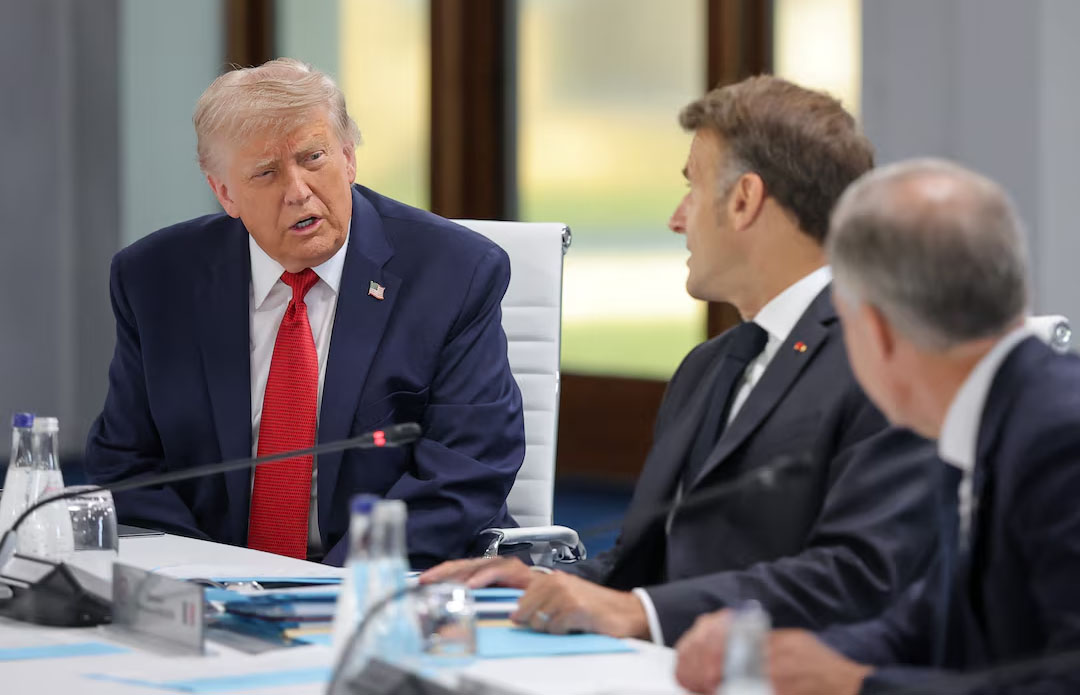
United States President Donald Trump sparked global attention at the closing stage of the G7 summit in France, after declaring “I’m the boss” as he arrived for a morning session attended by fellow world leaders, including French President Emmanuel Macron.
The remark was made as Trump entered the meeting room in Evian, a resort town on the shores of Lake Geneva, where leaders of the world’s major advanced economies gathered for three days of talks on global security, economic stability, and geopolitical tensions.
According to accounts from officials present, Trump made the comment while other leaders were already seated. The statement reportedly triggered laughter in the room, with Macron responding in a relaxed and conversational tone as the session continued.
“I’m the boss,” Trump said before taking his seat, after which proceedings moved on to scheduled discussions.
The G7 summit brought together leaders of the United States, France, the United Kingdom, Germany, Italy, Canada, and Japan, with key talks centered on trade relations, international conflicts, and energy security.
READ ALSO:
- Oshiomhole Clarifies Remarks on Natasha Suspension, Denies Forgery Allegation
- Woman Sentenced to Death for Supplying Ammunition to Bandits in Katsina
- Three Records, One Night: Messi’s Hat-Trick Powers Argentina Past Algeria
Diplomatic sources said Trump remained a dominant presence throughout the summit, actively participating in discussions and supporting a joint communique at the conclusion of the meeting. His full attendance until the end was also noted as significant, contrasting with previous summits where he had departed early.
The gathering came at a politically sensitive moment, following heightened global tensions and recent international negotiations involving the United States. Trump’s presence added increased global attention to the summit’s outcome and policy direction.
At the close of the meeting, Macron extended a private invitation to Trump for a dinner at the Palace of Versailles outside Paris. French officials clarified that the dinner was intended as a working engagement rather than a ceremonial gala, amid domestic political scrutiny over the optics of hosting the US president in such a setting.
Observers say the “I’m the boss” remark has become one of the most talked-about moments of the summit, reflecting Trump’s assertive communication style and continued influence on the global diplomatic stage.
The incident has since circulated widely across international media and social platforms, adding a viral moment to an otherwise formal gathering of world leaders.
Trump Declares “I’m the Boss” as G7 Summit Ends in France
International
TRUMP SAYS IRAN DEAL ‘ALL SIGNED’ AS STRAIT OF HORMUZ PARTIALLY REOPENS

TRUMP SAYS IRAN DEAL ‘ALL SIGNED’ AS STRAIT OF HORMUZ PARTIALLY REOPENS
President Donald Trump on Monday announced that a landmark agreement between the United States and Iran has been finalized, declaring that the deal is “all signed” and that the strategically important Strait of Hormuz has already been partially reopened to maritime traffic.
Speaking to reporters on the sidelines of the G7 Summit, Trump said the agreement would pave the way for the full reopening of the vital shipping route by the end of the week.
“The deal’s all signed. And the strait is already partially opened. On Friday, it’ll be completely open,” Trump stated.
The development marks a significant breakthrough in efforts to ease tensions in the Middle East following months of heightened security concerns and disruptions to international shipping through the Strait of Hormuz, one of the world’s most critical oil transit chokepoints.
According to U.S. officials, the agreement, described as a memorandum of understanding between Washington and Tehran, was digitally signed on Sunday. Vice President JD Vance confirmed that both parties had completed the signing process ahead of a formal ceremony expected to take place in Geneva later this week.
While details of the accord have not yet been made public, reports indicate that the agreement includes measures to restore navigation through the Strait of Hormuz, reduce military tensions in the region, and establish a framework for renewed negotiations over Iran’s nuclear programme.
Trump said the full text of the agreement would be released following the formal signing ceremony.
The announcement was welcomed by global energy markets, with crude oil prices falling amid expectations that shipping activities through the Strait of Hormuz would gradually return to normal levels.
However, security experts cautioned that a complete restoration of maritime operations could take time. Officials familiar with the situation noted that demining operations and security assessments remain ongoing, meaning full commercial traffic may not resume immediately despite the political agreement.
The Strait of Hormuz is a vital waterway connecting the Persian Gulf to the Gulf of Oman and the Arabian Sea. Roughly one-fifth of the world’s oil supply passes through the narrow channel, making its stability crucial to global energy security.
The agreement is expected to be closely scrutinized by lawmakers, regional allies, and international observers as further details emerge in the coming days.
TRUMP SAYS IRAN DEAL ‘ALL SIGNED’ AS STRAIT OF HORMUZ PARTIALLY REOPENS
-

 Politics3 days ago
BREAKING: Court Orders Deregistration of ADC, Four Other Political Parties
-

 News2 days ago
Shot by Bandits, Saved by Soldiers: Dramatic Rescue of General’s Wife in Katsina
-

 metro2 days ago
Drugged, Beaten, Forced to Sleep with 60 Men Daily: Teenage Girl’s Harrowing Escape from Lagos Traffickers
-
 Politics3 days ago
BREAKING: Kenneth Okonkwo Withdraws Support for Atiku
-

 metro16 hours ago
BREAKING: UK Court Clears Diezani Alison-Madueke of All Bribery Charges
-

 Opinion3 days ago
If Nigeria Is Not Divided, We Will Never Have Any Sense in the North
-

 Politics3 days ago
Just in: ADC Formally Unveils Atiku-Amaechi Presidential Ticket
-

 metro16 hours ago
‘They Assigned One Girl to 3 or 4 Men Daily’: Survivor Recounts 20 Days of Rape, Torture in Bandits’ Den