

metro
FG promises nationwide 20-hour daily power supply by 2027

FG promises nationwide 20-hour daily power supply by 2027
The Federal Government has set an ambitious goal to provide Nigerians with 20 hours of daily electricity by 2027. However, this plan is contingent upon securing adequate investment in the nation’s oil and gas industry, which, according to officials, is currently underperforming.
Olu Verheijen, the Special Adviser to the President on Energy, made this announcement during her speech at the Energy Week in Cape Town, South Africa. The statement was shared by Abiodun Oladunjoye, Director of Information and Publicity at the State House, on Thursday.
“By 2027, Nigeria aims to ensure 20 hours of electricity daily for consumers in urban areas and industrial hubs,” Verheijen revealed.
Verheijen’s remarks come amidst the persistent challenges faced by Nigeria’s national power grid, which continues to suffer frequent collapses, resulting in widespread blackouts. The most recent collapse occurred on Tuesday, marking the 10th such incident in 2024 alone. The Federal Government has cited outdated infrastructure, lack of proper maintenance, and insufficient investment as primary reasons behind these grid failures.
Despite an installed generation capacity of around 12,500 megawatts, Nigeria often produces far less, leaving many regions without stable power supply.
At the Energy Week, Verheijen also highlighted the efforts of President Bola Tinubu’s administration to reform the power sector and extend electricity access to the 86 million Nigerians currently without reliable power. She outlined plans to improve revenue collection, reduce losses through the deployment of seven million smart meters, and expand off-grid solutions to remote areas.
READ ALSO:
- NLC threatens strike over ejection of NUPENG members by military
- Tinubu govt speaks on safety concerns as Malaysia dumps CNG vehicles
- Police arrest man who staged his kidnap, demanding N10m ransom from brother
Verheijen expressed confidence that Nigeria is poised for economic growth, particularly following macroeconomic reforms such as the removal of the petrol subsidy and foreign exchange liberalization. “Under President Tinubu’s leadership, Nigeria is championing reforms to unlock its vast economic potential and create jobs,” she said, urging global partners to invest in Nigeria’s energy sector.
Verheijen also noted Nigeria’s underperformance in oil and gas production, despite possessing vast reserves. She compared Nigeria’s output to that of Brazil, which holds just 30 percent of Nigeria’s oil reserves but produces 131 percent more oil. “Despite our abundant resources, we have underperformed against our potential. Brazil holds only 30 percent of Nigeria’s oil reserves but produces 131 percent more. This is largely due to under-investment,” she remarked.
Since 2016, Nigeria has attracted only 4 percent of Africa’s total oil and gas investments, while less resource-rich countries in the continent have seen higher levels of investment. Verheijen also pointed out that between 2013, when Nigeria’s last deepwater project reached Final Investment Decision (FID), and now, international oil companies have committed over $82 billion to deepwater projects in other countries.
Acknowledging these challenges, Verheijen highlighted President Tinubu’s efforts to enact reforms aimed at transforming Nigeria’s energy sector and attracting more investment. She pointed to the introduction of fiscal incentives for deep offshore and non-associated gas projects, marking the first time Nigeria has introduced a specific fiscal framework for deepwater gas.
In partnership with the National Security Adviser’s office, Verheijen’s team has worked to streamline security measures for the oil and gas sector, as well as to reduce lengthy project timelines and high operational costs. “Our target is to shorten the contracting timelines from an extensive 38 months to just 135 days, while also working to eliminate the 40 percent cost premium that currently exists within the Nigerian petroleum industry,” she noted.
The government’s reforms are also opening up opportunities in midstream and downstream sectors, including investments in compressed natural gas, liquefied petroleum gas, and electric vehicles. These initiatives align with the broader Presidential Gas for Growth Initiative, which aims to reduce the use of petrol and diesel in heavy transport, decentralized power generation, and cooking.
Verheijen also confirmed that over $1 billion has already been unlocked in investments across Nigeria’s energy value chain, with expectations of more major projects by mid-2025. The government is also facilitating the transfer of onshore and shallow water assets to local companies, while supporting the transition of international oil companies to deep offshore and integrated gas ventures.
“We have unlocked over $1 billion in investments across the value chain, and by mid-2025, we expect to see FID on two more projects, including a multibillion-dollar deepwater exploration project, which will be the first of its kind in Nigeria in over a decade,” Verheijen concluded.
FG promises nationwide 20-hour daily power supply by 2027








metro
FG Suspends Niger NSCDC Commandant As 37 Suspected Illegal Miners Die In Custody
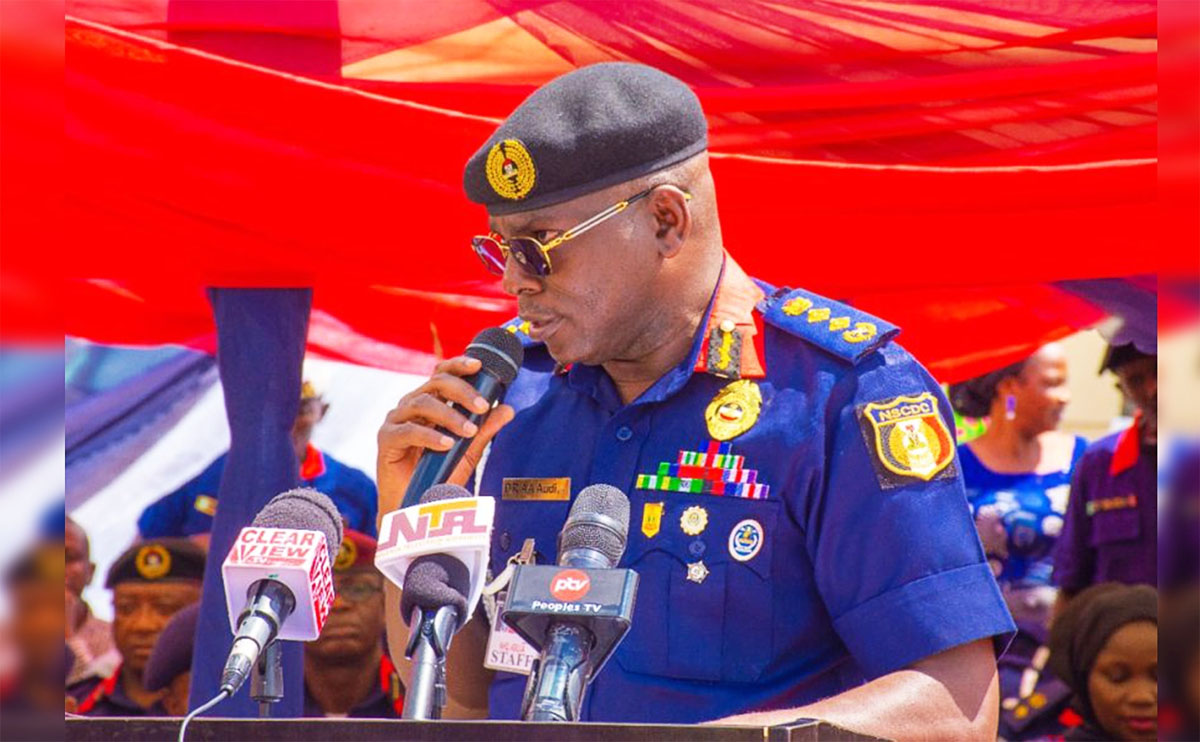
FG Suspends Niger NSCDC Commandant As 37 Suspected Illegal Miners Die In Custody
The Federal Government has suspended the Niger State Commandant of the Nigeria Security and Civil Defence Corps (NSCDC), Suberu Siyaka Aniviye, following the deaths of 37 suspected illegal miners in the Corps’ custody in Minna, Niger State.
The suspension was ordered by the Minister of Interior, Olubunmi Tunji-Ojo, on Friday, September 18, 2026, alongside a directive for a full investigation into the circumstances surrounding the deaths.
The incident occurred after the NSCDC carried out enforcement operations against suspected illegal mining activities in parts of Niger State on September 15 and 16. The operation reportedly focused on the M.I. Wushishi and Lukoto areas of Minna, where scores of suspects were arrested and various exhibits recovered.
The deaths were discovered in the early hours of Thursday, September 17, after the suspects had been taken into custody.
The Niger State NSCDC initially attributed the deaths to a suspected disease outbreak, but the Corps’ national headquarters subsequently cautioned against drawing conclusions about the cause of death before medical and laboratory examinations were completed.
The NSCDC said the bodies had been deposited at the General Hospital, Minna, for medical examination to establish the actual cause of death.
Although early reports put the death toll at 33, Niger State Governor Mohammed Umaru Bago confirmed that 37 suspected illegal miners had died in custody.
The differing figures reported in the immediate aftermath underscore the importance of the ongoing investigation and medical examination in establishing the definitive number of victims and the circumstances of each death.
Following the incident, NSCDC Commandant-General Ahmed Abubakar Audi ordered the constitution of a high-powered investigative team headed by the Deputy Commandant-General in charge of Intelligence and Investigation.
READ ALSO:
- 2027: Sanwo-Olu, Fashola, Ambode Join Lagos APC Campaign Council
- Anambra Debt Row: Presidency Challenges Peter Obi as State Releases N127.4bn Loan Records
- South African Woman Jailed 25 Years for Smuggling 5.75kg Heroin into Nigeria
The team is expected to investigate the condition of the suspects when they were arrested, the period they spent in custody, the conditions of their detention, the medical attention provided to them and other circumstances that may have contributed to the deaths.
The NSCDC also directed that the health and welfare of all persons still in its custody be given priority, while appropriate measures are taken to protect personnel who may have had contact with the affected detainees.
The Corps said it would refrain from speculating about the cause of the deaths until the outcome of the medical examination is available. It stressed that reports linking the deaths to a particular disease had not been medically or scientifically established.
Meanwhile, police authorities in Niger State have opened a separate investigation into the deaths.
The development has also raised questions about the conditions in which the suspects were detained.
A survivor, Dauda Shehu, reportedly said about 65 detainees were held in an overcrowded and poorly ventilated cell. He said some detainees struggled to breathe and banged on the cell door in an attempt to attract the attention of security personnel.
A preliminary intelligence account also suggested that overcrowding and poor ventilation may have contributed to the deaths. However, these remain preliminary accounts and have not been established as the official cause of death.
The official explanation that a possible disease outbreak was involved has also come under scrutiny, with authorities stressing that only medical and laboratory examinations can determine whether disease played any role.
Governor Bago has described the incident as tragic and declared three days of mourning in honour of the deceased.
The Niger State Government also postponed an APC campaign rally scheduled for September 19 in Minna following the deaths.
The Federal Government’s decision to suspend the Niger State NSCDC commandant came a day after the Corps announced its internal investigation.
Tunji-Ojo said the commandant would remain suspended while the investigation continued, stressing that the government had a responsibility to protect lives.
The minister also appealed for calm and urged members of the public to remain law-abiding while the investigation is conducted. He expressed condolences to Governor Bago and the families and relatives of the deceased.
The incident has brought renewed attention to the risks associated with illegal mining in Niger State, where artisanal and small-scale mining activities remain widespread.
Niger State is rich in mineral resources and attracts artisanal miners, particularly those involved in gold mining. Authorities have intensified operations against illegal mining because of concerns over environmental damage, unsafe mining practices and links between illicit mining and criminal networks in parts of the country.
However, the immediate focus of the investigations is the deaths in custody and the treatment of the detainees between their arrest and the discovery of their bodies.
The key issues expected to be addressed include the exact number of people who died, their physical condition at the time of arrest, the number of detainees held at the facility, the adequacy of ventilation and other detention conditions, access to medical care, the timeline of events and the precise medical cause of death.
The NSCDC investigation, the police inquiry and the medical examinations are expected to provide a clearer account of what happened and whether any failures occurred in the handling or detention of the suspects.
Until those investigations are concluded, authorities have not established an official cause of death beyond confirming that the detainees died while in NSCDC custody.
FG Suspends Niger NSCDC Commandant As 37 Suspected Illegal Miners Die In Custody
metro
South African Woman Jailed 25 Years for Smuggling 5.75kg Heroin into Nigeria
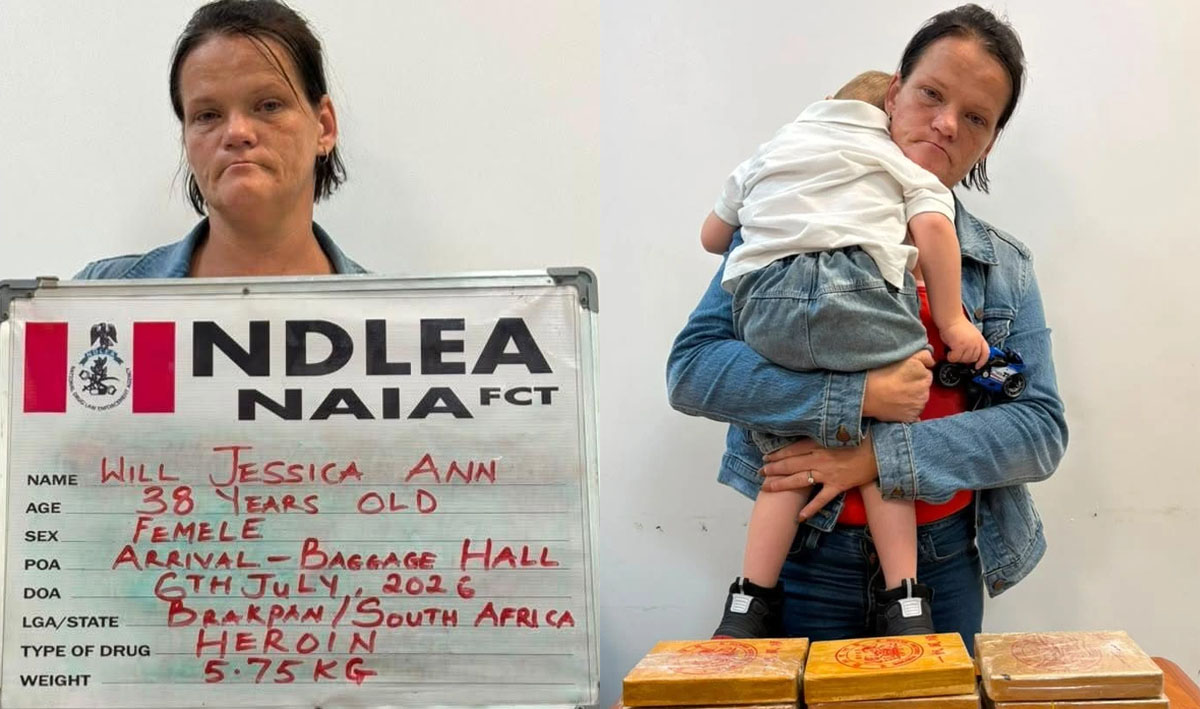
South African Woman Jailed 25 Years for Smuggling 5.75kg Heroin into Nigeria
A Federal High Court in Abuja has sentenced a 38-year-old South African woman, Will Jessica Ann, to 25 years in prison for importing 5.75 kilogrammes of heroin into Nigeria through the Nnamdi Azikiwe International Airport, Abuja.
Justice Obiora Egwuatu handed down the sentence after Ann pleaded guilty to charges brought against her by the National Drug Law Enforcement Agency (NDLEA).
The defendant was sentenced to 15 years on the first count and 25 years on the second count, with both terms ordered to run concurrently. This means she will serve a maximum of 25 years, rather than 40 years.
The case dates back to July 6, 2026, when NDLEA operatives intercepted Ann during the inward clearance of passengers arriving on Qatar Airways Flight QR1433 from Doha at the Abuja airport.
Ann was travelling with her three-year-old son when she was stopped by anti-narcotics officers.
READ ALSO:
- Adunni Ade Reveals Christian Fans Unfollowed Her After Publicly Identifying as Muslim
- Jetour Set to Storm Abuja Show with Rugged Luxury T2
- 25 Universities, Teaching Hospitals Get Solar Power Under REA Programme
According to details presented in court, the NDLEA said Ann initially denied having any checked-in luggage. However, operatives reportedly established that two suitcases containing the illicit substance carried baggage tags corresponding with the claim tags attached to her passport.
The agency said the two suitcases contained 14 large blocks of heroin, weighing a total of 5.75kg.
Ann reportedly admitted ownership of the luggage and told investigators that she had travelled from Cambodia through Doha before arriving in Abuja.
During the proceedings, the prosecution also told the court that Ann had admitted to conspiring with Jan Coenraad De Jager, a South African man who remains at large.
She was subsequently arraigned on a two-count charge bordering on conspiracy and unlawful importation of heroin under the relevant provisions of the law.
Ann pleaded guilty to the charges in August, prompting the prosecution to present the facts of the case before the court proceeded to sentencing.
The court was told that the seized heroin had an estimated street value of about ₦103.5 million, based on an estimated value of approximately ₦18 million per kilogramme.
Ann pleaded for leniency, expressed remorse and promised not to engage in drug trafficking again. She also told the court that she did not know there were illicit drugs in the bags.
After considering the facts of the case, Justice Egwuatu sentenced her to 15 years on Count One and 25 years on Count Two, directing that the sentences run concurrently.
The court also ordered that the seized heroin should be destroyed if the convict does not appeal within the period prescribed by law.
The case is part of the NDLEA‘s efforts to intercept illicit drug consignments being brought into Nigeria through international airports and other entry points.
The seizure at Abuja airport, followed by the defendant’s guilty plea and conviction, has resulted in the 25-year custodial sentence imposed by the Federal High Court.
South African Woman Jailed 25 Years for Smuggling 5.75kg Heroin into Nigeria
metro
Kaduna Troops Rescue Two-Year-Old Boy From Kidnappers, Search for Mother Continues

Kaduna Troops Rescue Two-Year-Old Boy From Kidnappers, Search for Mother Continues
A two-year-old boy is back with his family after troops rescued him from suspected kidnappers in Kaduna State.
Jafaru Baba was abducted with his mother from Ungwan Nungu village in Sanga Local Government Area. Troops later recovered the child after tracking the kidnappers to an area around Tayu Village.
The rescue followed intelligence received by security forces about the movement of the abductors and their victims.
According to security sources cited by security analyst Zagazola Makama, troops launched the operation at about 4pm on Wednesday, September 16.
READ ALSO:
- Gaza Building Collapse Kills 21, Including Eight Children
- Niger Mosque Abductions: Terrorists Execute 30 of 500 Captive Muslim Worshippers
- OAU Investigates Death of Final-Year Student as Police Begin Probe
They searched Tayu High Grounds, Tayu Village and surrounding parts of Sanga LGA. The operation later brought the troops into contact with the suspected kidnappers.
A gunfight followed, forcing the abductors to retreat into the bush. In the process, they left the toddler behind.
The troops quickly secured Jafaru and later handed him over to his father.
Security sources said the troops fired 17 rounds of 7.62mm ammunition during the confrontation.
Meanwhile, the search has not ended. Security personnel are still combing the area for the child’s mother, who remains in the kidnappers’ custody.
They are also pursuing the suspects who fled after the encounter, as efforts continue to rescue the woman and bring those responsible for the abduction into custody.
Kaduna Troops Rescue Two-Year-Old Boy From Kidnappers, Search for Mother Continues
-

 metro3 days ago
Lagos Power Outage: Ikeja Electric Blames TCN as Businesses, Homes Groan
-

 International2 days ago
Islamic Council Condemns Attempted Attack on Holy City of Mecca
-
 Politics3 days ago
2027: APC Governors Reject Wike’s Rainbow Coalition, Insist on Party Loyalty
-
 News2 days ago
Keep Politics Out of My Office — Ogbomoso Grand Chief Imam Warns Politicians, Bloggers
-

 metro1 day ago
Niger Mosque Abductions: Terrorists Execute 30 of 500 Captive Muslim Worshippers
-

 International3 days ago
US Court Blocks Trump Visa Rule Limiting Stay of Foreign Students, Journalists
-

 metro3 days ago
A Son Wouldn’t Have Done Better — Dangote Speaks on Daughters, Succession
-

 Entertainment2 days ago
BREAKING: Olu Jacobs Dies at 84, Atiku Mourns Cultural Icon