

metro
Breaking: Gunmen invade Oyo community, kidnap 2
Breaking: Gunmen invade Oyo community, kidnap 2
Two residents of Otu, Itesiwaju Local Government Area of Oyo State, have been kidnapped on Saturday.
The kidnappers invaded the community in the early hour of the day.
A resident and leader in the community, Mr. Johnson Kehinde revealed that the whereabouts of the kidnapped victims is yet to be ascertained while families have not been communicated by hydra-headed evils.
READ ALSO:
- Appeal Court sacks NFF Board amid ongoing AFCON
- My husband threw me out because I visited my ex-boyfriend’s mum – Woman tells court
- Bandits kill principal while resisting abduction – Shehu Sani
“As we navigate this challenging period, awaiting prompt action from our security forces, we earnestly pray for the safe return of the kidnapped and the comprehensive protection of all.
“Your support is appreciated, and please keep Otu, the headquarters of Itesiwaju Local Government Area in Oyo State, in your thoughts and prayers. May God bring healing to our land”.
Breaking: Gunmen invade Oyo community, kidnap 2











metro
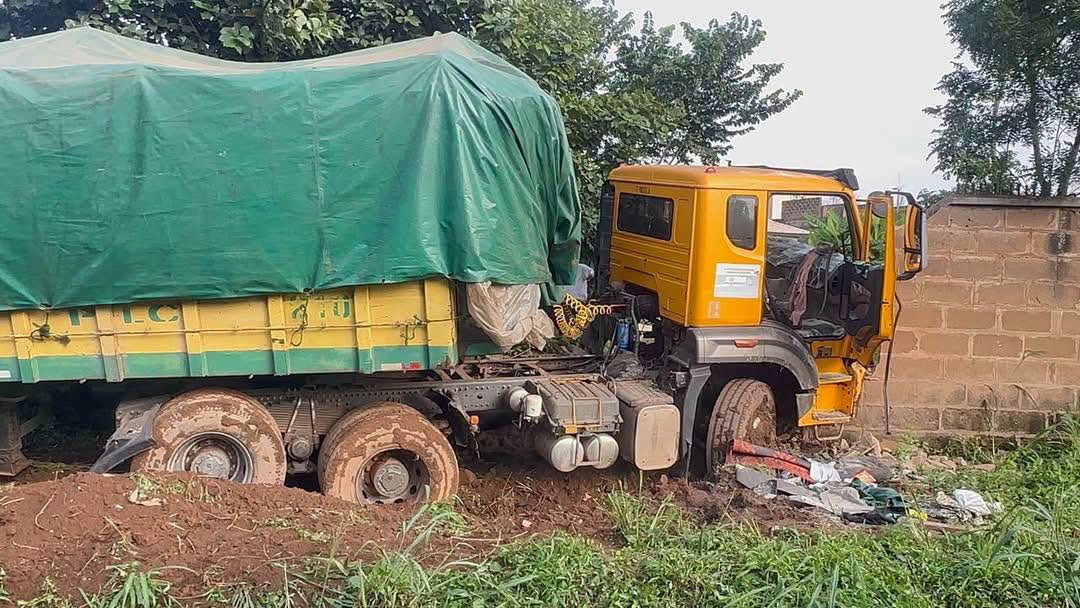
Tragedy in Ibadan as Truck Kills Female Corps Member, Injures Others
Tragedy in Ibadan as Truck Kills Female Corps Member, Injures Others
A female member of the National Youth Service Corps (NYSC) has died after an articulated truck rammed into a motorcycle near Agodi Gardens in Ibadan, Oyo State, leaving several other people injured.
The fatal accident occurred on Monday, October 12, 2026, following reports that the truck had earlier collided with several vehicles around the Sango area before proceeding towards Agodi Gardens.
According to eyewitness accounts, the truck struck a motorcycle carrying the corps member near Agodi Gardens, killing her in the crash. The motorcycle rider sustained a fractured leg.
The Federal Road Safety Corps (FRSC) confirmed the incident, saying the crash involved an articulated truck and a motorcycle conveying the corps member.
The Oyo State Sector Commander of the FRSC, Kehinde Dahunsi, said emergency responders evacuated the deceased’s body to the State Hospital morgue, while the injured motorcycle rider was taken to the University College Hospital (UCH), Ibadan, for treatment.
READ ALSO:
- French Students Return to Streets as Anger Over School Conditions Grows
- Oyo School Kidnappings: How ANSARU Allegedly Used Children to Pressure FG
- Drama as Dutch Police Use Batons, Dogs to Shut Down Nigerian Wedding; Two Arrested
Dahunsi said the identity of the deceased had not been established at the time of the rescue operation.
The NYSC Public Relations Officer in Oyo State, Abimbola Faniyi, said efforts were being made to obtain the corps member’s details, including her Place of Primary Assignment.
Meanwhile, eyewitnesses alleged that the truck had hit several vehicles around Sango before reaching the Agodi Gardens area. One witness claimed that the driver was attempting to flee after the earlier collisions.
However, the circumstances surrounding the earlier crashes and the allegation that the driver was trying to escape had not been independently established.
The accident caused traffic disruption around the affected areas, prompting road users to seek alternative routes as emergency personnel attended to the victims.
The incident has renewed concerns about road safety and the dangers posed by articulated vehicles involved in multiple collisions, particularly in busy urban areas.
As of the latest reports, the deceased corps member’s identity had not been officially disclosed, while further details about the cause of the crash and the status of the truck driver remained unavailable.
Tragedy in Ibadan as Truck Kills Female Corps Member, Injures Others
metro
Oyo School Kidnappings: How ANSARU Allegedly Used Children to Pressure FG

A witness from the Department of State Services (DSS) has told the Federal High Court in Abuja that the proscribed terrorist group Jama’atu Ansarul Muslimina fi-Biladis Sudan (ANSARU) allegedly planned the Oriire school kidnappings in Oyo State with support from Al-Qaeda, seeking to pressure the Federal Government into releasing 30 detained members.
The DSS operative, identified by the code name BBB, gave the account on Monday, October 12, 2026, while testifying as the second prosecution witness in the trial of five men accused of involvement in the group’s activities.
According to the witness, the May 15 attacks in Oriire Local Government Area were part of a wider strategy to use high-profile kidnappings to compel the government to negotiate the release of ANSARU members, including its leaders.
He told the court that the attackers abducted pupils, students and teachers from schools in the area and moved them to a forest near the Old Oyo National Park.
The terrorists allegedly presented a list of 30 detained members they wanted released and threatened to kill the hostages if the government failed to meet their demands.
The witness said the group had adopted a strategy of carrying out attacks and kidnappings whenever its members were arrested, hoping to use the safety of abducted victims as leverage against the authorities.
BBB, who was involved in the investigation, identified Mahmud Muhammad, also known as Abu Bara’a and Abbas Mukhtar, as one of ANSARU’s founding members.
He alleged that Muhammad had previously served as head of security and intelligence within Boko Haram before leaving the group in 2012 to establish ANSARU alongside other members.
The witness further identified Abubakar Abbas, also known as Isah Adam and Mallam Mahmuda Al-Nigeri, as the group’s alleged head of operations.
According to his testimony, ANSARU members planned attacks on prominent targets as part of efforts to secure the release of detained commanders and other members.
He cited the November 4, 2025, attack on the convoy of Jafaru Mohammed Ali, a member of the House of Representatives representing Agwara/Borgu Federal Constituency, as an earlier operation allegedly linked to the strategy.
READ ALSO:
- Drama as Dutch Police Use Batons, Dogs to Shut Down Nigerian Wedding; Two Arrested
- LAWMA Deploying CCTV Cameras to Hunt Down Illegal Dumpers, says MD
- Obasanjo Backs Higher Oil Derivation, Says 13% Is Only the Beginning
The witness said four military personnel were killed and four DSS personnel injured during the attack. He alleged that the assailants intended to abduct the lawmaker and use the incident to intensify pressure on the government.
BBB also told the court that the group had planned to attack the Wawa military base in New Bussa, Niger State, because members believed some of their detained colleagues were being held there.
When that plan failed, the group allegedly shifted some of its operations towards the South-West, where it believed attacks and kidnappings would attract public attention and increase pressure on the authorities.
Regarding the Oriire abductions, the witness said security agencies launched an operation against the group’s hideout after efforts to secure the release of the hostages encountered resistance.
He alleged that two victims were killed during the crisis and that the attackers threatened to kill more hostages as security personnel advanced towards their location.
According to BBB, the terrorists opened fire on security operatives during the operation, escalating the confrontation.
He said security agencies eventually rescued the remaining captives, although the operation resulted in casualties among security personnel, including a senior police officer and an Army officer.
The witness also alleged that security operatives took the wife of the second defendant and other relatives of suspected commanders into custody in an effort to discourage further killings of hostages.
He told the court that the measure contributed to a halt in the killings before the rescue operation was completed.
During his testimony, BBB also discussed ANSARU’s history and ideology, including its alleged involvement in the kidnapping and killing of foreign nationals.
He said the group justified such operations by accusing foreign nationals of involvement in the killing of Muslims in other countries.
The witness recalled that the killing of seven foreign nationals in 2014 contributed to the United States designating ANSARU as a terrorist organisation and declaring Muhammad wanted internationally.
The five defendants standing trial are Mahmud Muhammad, also known as Abu Bara’a and Abbas Mukhtar; Abubakar Abbas, also known as Isah Adam and Mallam Mahmuda Al-Nigeri; Abdulrazak Umar, also known as Abu Khalifa and Abu Khalid; Yunusa Musa, also known as Abu Yunusa Bin Musa; and Shamsu Adamu Sani, also known as Abu Itisar.
They are accused of links to the proscribed group and involvement in its activities, including the attacks and kidnappings under investigation.
The prosecution’s allegations remain subject to judicial determination as the trial continues. The court will assess the evidence presented before reaching any decision on the defendants’ culpability.
Oyo School Kidnappings: How ANSARU Allegedly Used Children to Pressure FG
metro
Drama as Dutch Police Use Batons, Dogs to Shut Down Nigerian Wedding; Two Arrested

Drama as Dutch Police Use Batons, Dogs to Shut Down Nigerian Wedding; Two Arrested
A Nigerian wedding in the Netherlands ended in a police confrontation after complaints about loud music, with officers reportedly using batons and police dogs to disperse guests and arresting two men.
The incident occurred on Saturday evening, October 10, 2026, at Diamond Plaza on Dynamostraat in Rotterdam-Zuid, where an estimated 200 to 300 guests had gathered to celebrate the wedding.
The disruption attracted widespread attention after videos showing uniformed Dutch police officers confronting wedding guests circulated on social media.
The footage showed guests dressed in colourful Nigerian traditional outfits and formal attire leaving the venue as police officers stood outside the hall.
According to Dutch regional media reports, the incident began after residents complained about the volume of music coming from the celebration. The venue owner reportedly asked the organisers to reduce the noise, but the request was allegedly not followed.
READ ALSO:
- LAWMA Deploying CCTV Cameras to Hunt Down Illegal Dumpers, says MD
- Obasanjo Backs Higher Oil Derivation, Says 13% Is Only the Beginning
- How Bandits Demand ₦300m Ransom for Abducted Kaduna Couple, Baby in Viral Video
The owner subsequently decided to terminate the event, triggering anger among some attendees.
When police officers arrived, tensions reportedly escalated as some guests refused to leave the premises. Officers allegedly resorted to using batons and police dogs to disperse the gathering.
Two men were arrested during the incident. Local reports identified them as a 61-year-old Rotterdam resident and a 20-year-old man without a permanent place of residence. They were reportedly suspected of failing to obey police orders.
The confrontation has sparked allegations of racial discrimination, with some guests questioning whether the authorities would have responded similarly if another community had organised the celebration.
In one video circulating online, an attendee accused the officers of treating the guests unfairly, saying, “It is because we are blacks; you’re treating us like animals.”
A woman who identified herself as a wedding guest also challenged the circumstances surrounding the intervention. She claimed that a Moroccan celebration was taking place upstairs in the same building and questioned why the Nigerian wedding was stopped.
The woman further alleged that the guests were given approximately 10 minutes to leave the venue, describing the intervention as intimidating and distressing.
However, the discrimination allegations have not been independently substantiated, and the available reports do not establish whether race played any role in the police action.
The reported noise complaints, the venue owner’s decision to end the celebration and the refusal of some attendees to leave were cited as the circumstances leading to the confrontation.
The incident has divided opinion on social media. While some users have criticised the manner in which the wedding was disrupted, others have argued that organisers of social gatherings must comply with local noise regulations and lawful police instructions.
The episode has also renewed discussions about Nigerian weddings abroad, which often feature lively music, traditional attire, energetic dancing and extended celebrations.
For Nigerians living in the diaspora, the incident highlights the importance of understanding local rules when organising large social events. At the same time, the allegations have prompted calls for clarity about the circumstances surrounding the police intervention and whether the response was proportionate.
The incident has drawn attention to the challenges of balancing cultural celebrations with local regulations, as well as the need to ensure that public-order rules are enforced fairly and consistently.
Drama as Dutch Police Use Batons, Dogs to Shut Down Nigerian Wedding; Two Arrested
-

 metro2 days ago
Tension in Kano as Phone Traders Confront Chinese Sellers Over Cheaper Phones
-

 metro3 days ago
Police Launch Manhunt After Fresh Attacks, Kidnappings Rock Four Nigerian States
-

 metro3 days ago
EFCC Wins ₦132m Money Laundering Case as Court Orders Forfeiture of Lagos Properties
-

 Business3 days ago
NNPC Petrol Discount: Motorists Must Download App to Save ₦66 Per Litre
-

 Entertainment2 days ago
‘My Wife Fed Actresses I Was Dating Despite Knowing About Our Affairs’ – Yinka Quadri
-

 Politics3 days ago
INEC Raises Alarm Over Fake APC Result Naming Okorocha, Seeks DSS, Police Probe
-

 Sports3 days ago
Ronaldo Hits 980th Career Goal as Al-Nassr Win After Portugal Fallout
-

 metro3 days ago
Hardship: ACF Gives Tinubu Three Months to Deliver Relief, Demands Clear Timelines