
News
Court Orders Final Forfeiture of $13m Linked to Achimugu’s Firm

Court Orders Final Forfeiture of $13m Linked to Achimugu’s Firm
A Federal High Court in Abuja has ordered the final forfeiture of $13 million linked to Lagos socialite Aisha Achimugu and her company, Oceangate Engineering Oil & Gas Ltd, to the Federal Government.
Delivering judgment on Wednesday, Justice Emeka Nwite ruled that the funds were convincingly proven by the Economic and Financial Crimes Commission (EFCC) to be proceeds of unlawful activities. The court held that the company failed to establish any legitimate source of the money.
The case stemmed from a suit filed by Oceangate seeking to reclaim the funds. However, the court found that the company could not provide credible evidence of ownership or lawful earnings tied to the $13 million forfeiture.
Justice Nwite dismissed claims that the money came as gifts to the company through Achimugu, noting that neither the alleged donors nor the socialite appeared before the court to substantiate the claims. He further observed that the firm failed to demonstrate any verifiable business activity, customer payments, or contractual engagements that could justify such funds.
READ ALSO:
- Police Bust Robbery Syndicate Using Tricycles, Arrest Six in Ibadan Hotel Raid
- Sango Tollgate: Ogun Bans Street Trading, Demolishes Shanties Over Safety Concerns
- FG Apologises Over Nationwide Blackouts, Promises Improvement Within Two Weeks
The matter originated from an interim forfeiture order granted on August 22, 2025, after the EFCC alleged that the money was linked to illicit financial dealings. The anti-graft agency had published the order, inviting interested parties to explain why the funds should not be permanently forfeited, but no satisfactory response was received within the stipulated period.
According to an affidavit by EFCC investigator Usman Aliyu, the commission uncovered intelligence indicating that Oceangate used suspicious funds to acquire oil blocks from the Nigerian Upstream Petroleum Regulatory Commission (NUPRC).
Investigations showed that the company participated in the 2024 oil block licensing round and emerged as the preferred bidder for PPL 302 and PPL 3007, which required financial commitments exceeding $37 million.
The EFCC alleged that part of the funds—amounting to $13 million linked to Achimugu—was sourced through unregulated channels, including transactions involving unlicensed Bureau de Change operators. The commission further claimed that intermediaries were used to collect large sums of cash across Abuja and Lagos, which were then funneled into the company’s accounts.
Some of the funds were also traced to contractors associated with Lagos State Government projects, despite no formal business relationship with Oceangate.
In its defence, the company denied wrongdoing, insisting that the funds were derived from legitimate business activities and gifts to its Group Chief Executive Officer. It also maintained that it relied on a licensed Bureau de Change operator for foreign exchange transactions.
However, the EFCC described Oceangate as a shell company allegedly used to channel illicit funds into petroleum asset acquisitions. The agency also challenged the credibility of the company’s audit report, stating that it was prepared without access to key financial records.
In his ruling, Justice Nwite agreed with the EFCC, concluding that the company failed to discharge the burden of proof required to overturn the forfeiture. He held that the funds were reasonably suspected to be proceeds of fraud and must be forfeited in the interest of justice.
The court also referenced an earlier forfeiture of $7 million linked to the same company, for which no claimant had come forward.
Court Orders Final Forfeiture of $13m Linked to Achimugu’s Firm






News
Tinubu Govt Launches Unified System to Lift 50 Million Nigerians Out of Poverty
Tinubu Govt Launches Unified System to Lift 50 Million Nigerians Out of Poverty
President Bola Tinubu’s administration has officially launched the One Humanitarian-One Poverty Response System (OHOPRS), a nationwide framework designed to lift 50 million Nigerians out of poverty by 2030 through a coordinated and data-driven approach to social intervention and humanitarian support.
The initiative was unveiled by the Minister of Humanitarian Affairs and Poverty Reduction, Bernard Doro, at a national technical workshop held at the UN House Abuja, where key stakeholders from government agencies, development partners, and international organisations were in attendance.
Doro explained that the OHOPRS is designed as a centralised national system that integrates humanitarian relief, social protection, and long-term development programmes into a single coordinated structure. He said the goal is to move Nigeria from fragmented interventions to a unified framework capable of delivering measurable impact.
According to him, over 63 per cent of Nigerians are affected by multidimensional poverty, highlighting the urgency of a more structured and efficient response. He noted that existing poverty alleviation efforts have been undermined by fragmentation across ministries, departments and agencies (MDAs), as well as duplication of efforts and poor coordination among federal, state, and local governments.
He listed several systemic challenges, including siloed data, uncoordinated beneficiary registers, weak funding mechanisms, limited transparency, and lack of a unified poverty exit strategy, adding that these issues have prevented interventions from reaching the most vulnerable populations effectively.
READ ALSO:
- Colleagues, Community Rally GoFundMe for Nigerian Nurse Killed in US Wrong-Way Crash
- Kwankwaso Set to Join ADC Wednesday as Defection Talks Intensify
- Makoko Crisis: Falana Condemns Forced Evictions, Warns Lagos Govt
“We have been managing poverty, not ending it. It is time for a paradigm shift,” Doro said, stressing that Nigeria already has numerous intervention programmes but lacks the integrated systems needed to optimise them.
The minister outlined the core structure of the OHOPRS, which includes a single national database described as the ‘Single Source of Truth’, a unified beneficiary registry to prevent duplication, and a coordinated coordination platform that aligns all stakeholders under one framework.
He added that the system introduces a structured “poverty exit pathway”, aimed at transitioning beneficiaries from vulnerability to self-reliance through targeted support, skills development, and access to economic opportunities.
Doro further emphasised that the initiative will leverage digital accountability tools, real-time monitoring, and data-driven governance to improve transparency and ensure that resources are properly tracked and utilised.
He reiterated that President Bola Tinubu’s vision is to implement a fully integrated system that ensures alignment across all levels of government and development partners, with the ultimate goal of reducing poverty at scale.
“There is a clear national direction. The mandate is to lift 50 million Nigerians out of poverty by 2030 through one system, one register, and one coordinated response,” he said.
Also speaking at the event, the Minister of State for Humanitarian Affairs and Poverty Reduction, Tanko Sununu, said the OHOPRS will help harmonise efforts across sectors and improve execution through better planning, tracking, and evaluation of outcomes.
Sununu noted that the framework will combine immediate humanitarian assistance with long-term development strategies, ensuring that vulnerable populations receive both short-term relief and sustainable pathways out of poverty.
He added that the system will improve coordination among stakeholders, reduce inefficiencies, and create a more reliable mechanism for measuring the impact of government and partner interventions.
The workshop was attended by representatives of major international and development organisations, including the International NGO Forum, the European Union, United Nations Office for the Coordination of Humanitarian Affairs (UNOCHA), International Organization for Migration (IOM), UNICEF, European Civil Protection and Humanitarian Aid Operations (ECHO), and the World Bank, alongside subnational stakeholders.
Officials say the OHOPRS represents a major shift in Nigeria’s poverty reduction strategy, moving from multiple disconnected programmes to a unified national architecture capable of delivering coordinated, measurable, and scalable results.
With its emphasis on data integration, accountability, and collaboration, the government believes the framework could play a critical role in achieving its long-term poverty reduction target, while strengthening the overall effectiveness of social intervention programmes across the country.
Tinubu Govt Launches Unified System to Lift 50 Million Nigerians Out of Poverty
News
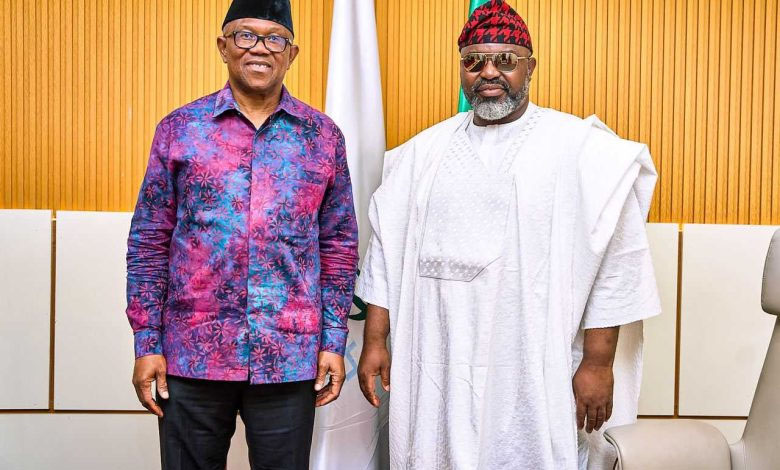
Kaduna Cleric Denies DSS Arrest After Hosting Peter Obi
Kaduna Cleric Denies DSS Arrest After Hosting Peter Obi
A Kaduna-based Islamic cleric, Ahmad Umar, has dismissed claims that he was arrested by the Department of State Services (DSS) following a visit by former presidential candidate, Peter Obi.
The clarification comes amid widespread reports suggesting that the cleric was detained shortly after hosting the Labour Party figure in Kaduna.
In a video message circulating online, Umar refuted the allegations, stressing that he was never arrested or detained, but only invited for questioning by security operatives.
“I come today to correct a false report being circulated in some quarters. I was not detained by the DSS. I was invited for questioning. I cooperated fully, and I was released. I am free, safe and well,” he said.
Providing further clarification, the cleric explained that he honoured the DSS invitation without resistance and was allowed to leave shortly after the interaction. Sources familiar with the situation noted that such invitations are not unusual, particularly following engagements involving high-profile political figures, and may form part of routine security procedures. As of the time of filing this report, the DSS has not issued any official statement regarding the development.
READ ALSO:
- 2027: Abia APC Assures Tinubu of 80% Votes, Dismisses Claims of Otti’s Support
- One Dead as Improvised Explosive Device Detonates in Kwara Community
- 5 Killed in Cult Violence in Lagos as Police Arrest 18 Suspects
Amid the controversy, Umar urged his followers and residents of Kaduna State to remain calm and law-abiding. He cautioned against any action capable of disrupting public peace, stressing that no situation should push citizens into taking the law into their own hands or creating disorder in the name of loyalty.
The cleric also touched on broader political developments, calling for patience in legal matters involving former Kaduna State Governor, Nasir El-Rufai. He encouraged Nigerians to remain engaged in the democratic process, emphasizing that elections remain the most effective way to achieve political change.
The development follows an earlier claim by Obi, who raised concerns in a post on his X (formerly Twitter) account, suggesting that the cleric had been picked up by security agents shortly after hosting him. The situation has since sparked conversations around freedom of association, political tolerance, and the role of security agencies in Nigeria’s evolving democratic space.
Kaduna Cleric Denies DSS Arrest After Hosting Peter Obi
News
Makinde Approves N10,000 Transport Allowance for Workers as Petrol Price Rises

Makinde Approves N10,000 Transport Allowance for Workers as Petrol Price Rises
The Seyi Makinde, governor of Oyo State, has approved a monthly transport allowance of N10,000 for state workers as a palliative measure to cushion the impact of rising fuel costs across Nigeria.
The decision, announced on Monday, March 23, follows a formal request and sustained engagement by the Nigeria Labour Congress (NLC) in Oyo State, which had urged the government to intervene amid increasing transportation expenses linked to higher petrol prices.
Chairman of the Oyo State NLC, Kayode Martins, disclosed that the approval was granted after discussions with the state government. According to him, the intervention reflects the government’s responsiveness to workers’ welfare concerns in light of current economic pressures.
He explained that the allowance is expected to take effect from April 2026 and will apply to all categories of workers in the state’s public service. The measure, he added, is designed to provide immediate relief to civil servants who have been significantly affected by rising commuting costs.
“The newly approved allowance is set to take effect from April 2026, providing much-needed relief to workers grappling with rising transportation costs amid current economic challenges,” the statement noted.
READ ALSO:
- MC Oluomo Insists He Remains NURTW President Amid Baruwa Takeover
- Nigeria Becomes West Africa’s Largest Petroleum Products Exporter Under Tinubu – Reno Omokri
- Japan Announces Largest Oil Reserve Release as Hormuz Crisis Deepens
The development comes as fuel prices continue to fluctuate following the removal of petrol subsidies, a policy shift that has led to increased pump prices and higher transportation fares nationwide. As a result, many workers have faced rising daily commuting expenses, prompting labour unions to seek government intervention.
The NLC stated that the allowance was a direct outcome of continued advocacy efforts aimed at mitigating the economic burden on workers. It added that further details regarding the implementation framework would be communicated by relevant government authorities in due course.
Across Nigeria, several state governments have introduced similar palliative measures, including wage adjustments, transport support schemes, and other welfare interventions, in response to the broader cost-of-living challenges affecting households and public sector employees.
Analysts say such allowances are increasingly becoming necessary as inflationary pressures and energy costs continue to impact disposable income, particularly for salaried workers who rely heavily on daily transportation.
While the transport allowance is expected to provide short-term relief, its long-term sustainability will depend on the fiscal health of the state and broader economic conditions. Nonetheless, the policy is widely viewed as a proactive step toward easing the burden on workers amid ongoing economic reforms.
Makinde Approves N10,000 Transport Allowance for Workers as Petrol Price Rises

-

 Entertainment3 days ago
Baba Ijesha Speaks Out After Prison Release, Denies Sexual Assault Conviction
-

 metro1 day ago
Fatal Truck Crash in Ibadan Leaves Multiple Dead, Several Injured
-

 Education2 days ago
Mock UTME 2026: JAMB Warns No-Show Candidates, Extends Exam Duration to Four Hours
-

 Education2 days ago
NDDC Opens Applications for 2026/2027 Foreign Postgraduate Scholarship Programme
-

 News3 days ago
Nigerian Army Opens Portal for 91st Regular Recruits Intake
-

 Business23 hours ago
8 High-Paying Remote Careers to Pursue in 2026
-

 metro1 day ago
Corps Member’s Death: NYSC Inspector Gets Bail, Remanded Pending Conditions
-

 Entertainment23 hours ago
Miss Nigeria Apologises to Omotola Over Viral Red Carpet Incident