
metro
Falana slams Wike on houses for FCT judges, says it’s unconstitutional

Falana slams Wike on houses for FCT judges, says it’s unconstitutional
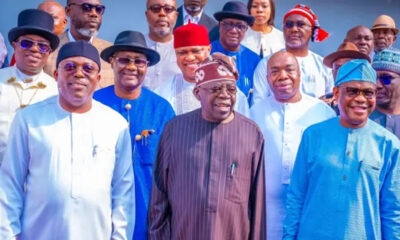
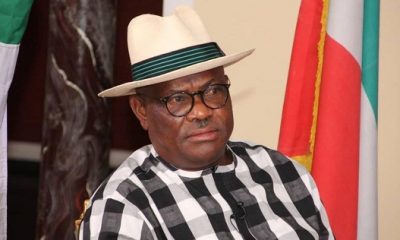
Human rights lawyer, Femi Falana, SAN, yesterday, once again flayed the construction of houses for judges and justices by the Ministry of the Federal Capital Territory (FCT), saying the action is unconstitutional.
Speaking on a programme on Channels Television, he said the action is an embarrassment to the Judiciary which ought to maintain its independence as one of the three arms of government in Nigeria.
It would be recalled that in September, the Federal Executive Council (FEC) approved the construction of 40 housing units for judges and justices in the FCT.
FCT Minister, Nyesom Wike, revealed this to State House correspondents after the 18th Council meeting, which was chaired by President Bola Ahmed Tinubu, at the Aso Rock Villa, Abuja.
He said the decision was part of the government’s Renewed Hope Housing agenda to provide secure and convenient accommodation for judicial officers.
Of the 40 units to be constructed in the Katampe District, 20 will be allocated to the FCT High Court, 10 to the Federal High Court, and 10 to the Court of Appeal.
The land on which the houses would be built was seized by the FCT administration from the construction giant, Julius Berger Nigeria.
Nothing wrong with what I did – Wike
Speaking yesterday during a media chat, the FCT minister denied allegations the building of the houses for judges in Abuja was aimed at “pocketing them for political gains”.
READ ALSO:
- Israel-Palestinian conflict: Two-state solution is a deception, says Gumi
- Court sacks Ondo LP candidate, two days to governorship poll
- FBI raids home of crypto platform Polymarket CEO, after accurate prediction of Trump win
Wike insisted that the project was approved in the 2024 budget, and that he was only performing his duty by implementing it.
He said the building of the judges’ quarters was not his policy but part of welfare packages that President Tinubu designed for the judges to promote the independence of the judiciary.
Wike said Tinubu asked him, ‘Where are the judges living? They have no homes and are, therefore, open to political manipulations and for me as a president, who wants to guarantee the independence of the judiciary, judges must have their homes’.
“I am not Mr. President; I am only lucky to be appointed as a minister under this administration and who is in the position to implement his policies. Mr. President said, look, this is what he wants; come up and see what we can do.
“It was approved by Mr. President, sent to the National Assembly in the 2024 budget that there should be construction of judges and justices’ quarters; that they should move judges from where they are renting houses, living among criminals.
“It is in the budget of 2024, appropriated by the National Assembly, assented to by Mr. President which is a law. What is the problem? I am only the implementer,” he said.
Wike further insisted that there was nothing wrong even if it was his idea to construct homes for judges, adding that he did something similar as governor of Rivers State.
Falana counters minister
Speaking on Channels Television’s Politics Today last night, Mr. Falana maintained that such action was not good for the Judiciary.
“As a member of the body of benchers, there is provision for it under the current democratic dispensation. There are three arms of the government, the Judiciary, the Executive and the Legislature. Each of them today enjoys financial autonomy; in fact, there are three judgments of the Federal High Court to the effect that the judiciary is financially autonomous.
“One of them was obtained by my friend, and the other by the Judiciary Staff Union of Nigeria (JUSUN). Those judgments were disobeyed. When President Muhammadu Buhari also tried to recognise the independence and financial autonomy of the Judiciary via Executive Order at the tail end of 2020, governors also went to court and the Supreme Court declared it illegal. But the National Assembly and all the states’ Houses of Assembly later amended the provisions of the constitution to declare in Section 23, that all the funds of the Judiciary every year at the federal level shall pass to the National Judicial Council (NJC).
“For the states, the budget of the Judiciary, the money would be given to the heads of courts.
“So, if you want to buy cars, build houses, they are to be carried out from the budget of the Judiciary. The minister did not answer the question which was to the effect that; can you give houses to the judges before whom you have cases? Because, justice must not just be done, it must be seen to have been done.
“And people in the Executive must stop embarrassing the Judiciary. Now, look at the contradictions; it is more like the governor of Kaduna, Zamfara, Cross River or Lagos State coming to give federal judges houses in Abuja; no!
“The Minister of FCT operates like a state governor by virtue of Section 299 of the Constitution. So, he cannot say ‘I am going to build 40 houses: 10 have gone to the Federal High Court, 10 to the FCT High Court and 10 have gone to the Court of Appeal and Supreme Court. No!” he said.
Mr. Falana further stated: “Because you are a minister of the federal government like a state governor, your budget is limited towards the affairs of the Federal Capital Territory. So, you cannot as the head of the FCT be dishing out cars and houses to the judges in the Federal High Court, Court of Appeal and the Supreme Court.
“Secondly, you have cases before these courts. On the theory of equality before the law, you cannot be seen to be giving cars or houses to judges who are going to determine your cases. And that is why the autonomy of the Judiciary has now been constitutionalised.
“In 2024, what was initially budgeted for the judiciary was N116 billion, but when the National Assembly was convinced on the need for houses and cars for judges and so on and so forth, the budget was increased to N345 billion.
“So, our judges don’t have business going to the Executive to get cars and houses for them. We must now have to operate under the law. Under the constitution, there is no provision for it”, he affirmed.
Falana slams Wike on houses for FCT judges, says it’s unconstitutional







metro
Court Orders DIA to Produce Cleric Accused of Coup Plot by February 18
Court Orders DIA to Produce Cleric Accused of Coup Plot by February 18
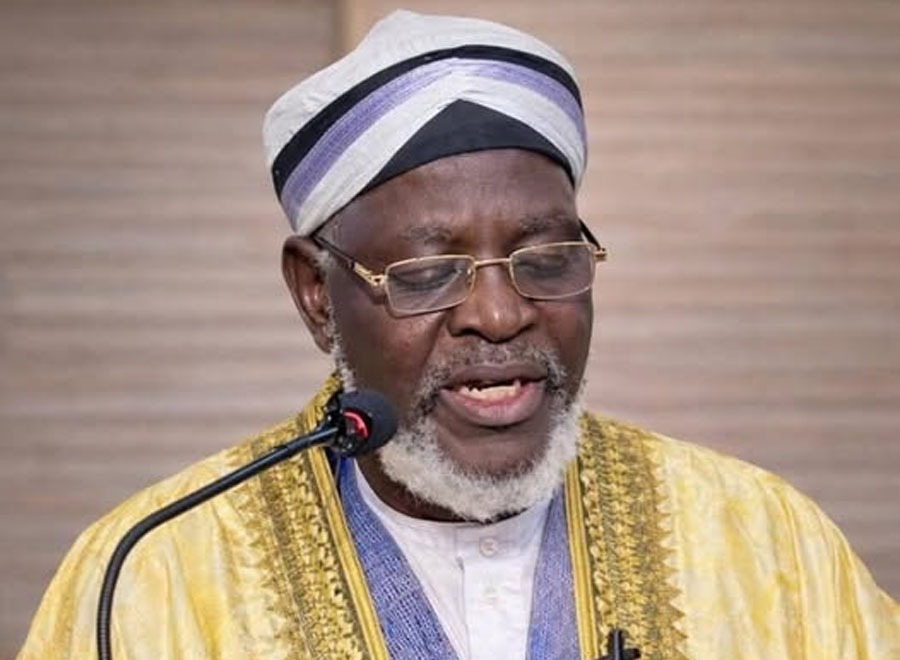
A Federal High Court in Abuja has directed the Defence Intelligence Agency (DIA) to produce Sheikh Sani Abdulkadir Zaria, an Islamic cleric accused of plotting a coup against President Bola Tinubu’s government, before the court on February 18, 2026. The order follows a fundamental rights enforcement suit filed on behalf of the cleric challenging the legality of his detention.
Justice Peter Lifu emphasised that in a democratic society, all security and intelligence agencies are subordinate to civil authority, noting that every citizen is entitled to protection under Sections 36(1), (5), and (6) of the 1999 Constitution. He also reminded authorities that Nigeria’s commitments to international human rights conventions require strict adherence to lawful detention procedures.
READ ALSO:
- End of Weekly Shutdown: Igboho Advocates Negotiation to Resolve Kanu’s Legal Battle
- NELFUND Refutes UniAbuja Loan Diversion Claims
- NRC, Entertainers Finalise Plans for 2026 Valentine Train Ride
The suit, filed by Sheikh Zaria’s legal team led by Sunusi Musa (SAN), Abdul Aliyu (SAN), and Mohammed Sheriff, names the DIA, the Economic and Financial Crimes Commission (EFCC), the Attorney General of the Federation and Minister of Justice, and Jaiz Bank Plc as respondents. The lawyers are seeking either the cleric’s release or an explanation for his continued detention.
During Thursday’s hearing, DIA counsel I.O. Odom Esq informed the court that the cleric was being held on behalf of the Defence Headquarters, but could not provide a valid detention order. The EFCC’s counsel, M.C. Odimbaiwe Esq, supported this position. Justice Lifu adjourned the matter and set February 18 for the DIA to produce Sheikh Zaria or justify his detention, warning that failure to do so could influence the outcome of the rights enforcement case.
Family sources linked Sheikh Zaria’s detention to an ₦2 million gift sent to the cleric’s account by an adherent connected to a suspect in the broader coup allegation. Since December 11, 2025, the cleric has reportedly been held in “safe custody” without access to family or associates, prompting his lawyers to argue that his fundamental rights have been violated.
The case underscores ongoing concerns about civil liberties, human rights, and lawful detention in Nigeria, particularly in high-profile national security investigations. The court’s ruling will be closely watched as it addresses the balance between state security and individual rights.
Court Orders DIA to Produce Cleric Accused of Coup Plot by February 18
metro
End of Weekly Shutdown: Igboho Advocates Negotiation to Resolve Kanu’s Legal Battle
End of Weekly Shutdown: Igboho Advocates Negotiation to Resolve Kanu’s Legal Battle
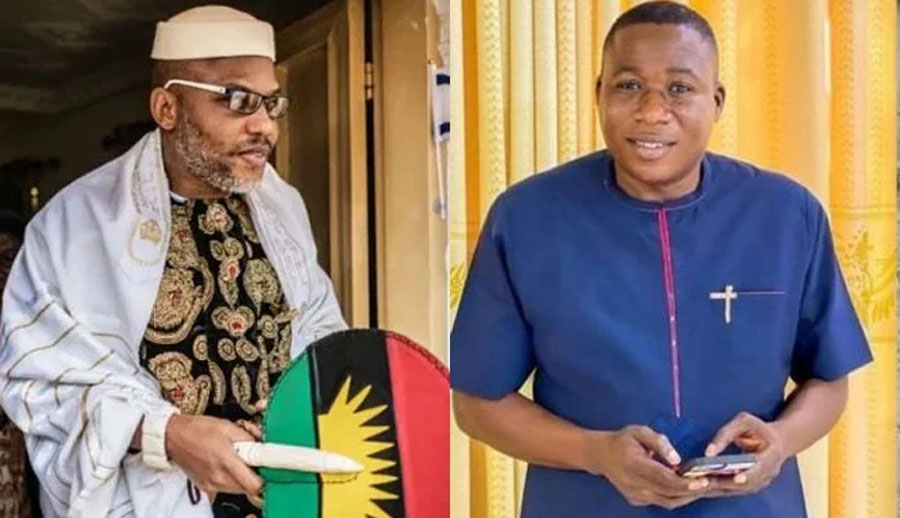
Yoruba nation activist, Chief Sunday Adeyemo, popularly known as Sunday Igboho, has called on the detained leader of the Indigenous People of Biafra (IPOB), Nnamdi Kanu, to engage in constructive dialogue with the Federal Government following the formal end of the controversial Monday sit‑at‑home directive across the South‑East region.
In a statement issued on Friday by his legal counsel, Pelumi Olajengbesi, Igboho applauded Kanu for suspending the weekly protest, which had disrupted economic and social activities in the region for over five years. The directive, first introduced in August 2021, led to periodic shutdowns of markets, offices, schools, and transport services, severely affecting local businesses and daily life.
Describing the suspension as a “thoughtful and necessary” step, Igboho noted that ending the sit‑at‑home signals a shift toward constructive engagement and could help restore stability and economic normalcy in the South‑East. He said the move represents the conclusion of a five-year period of economic disruption that has hampered growth and development in the region.
READ ALSO:
- NELFUND Refutes UniAbuja Loan Diversion Claims
- NRC, Entertainers Finalise Plans for 2026 Valentine Train Ride
- 2027 General Elections: INEC Announces February 20 for Presidential Poll
Beyond applauding the abolition of the civil disobedience measure, Igboho urged Kanu to adopt a conciliatory approach, opening channels for mediation and negotiation with the Federal Government. He emphasised that sustained dialogue could help break the deadlock surrounding Kanu’s legal battle and potentially pave the way for a political resolution to longstanding grievances.
Igboho also warned that those who profit from the destabilisation and violence in the South‑East should desist, highlighting the importance of peace for the economic recovery and prosperity of the region and the nation at large.
“This is a critical moment for the South‑East. True progress depends on dialogue, compromise, and the willingness of all parties to engage constructively,” the statement read. Igboho’s remarks reflect a growing call among activists and stakeholders for peaceful resolution and collaboration to ensure lasting stability in the region.
The end of the Monday sit‑at‑home has been welcomed by several civil society groups and business leaders, who view it as a key step toward restoring normalcy, resuming commerce, and promoting social cohesion in the South‑East.
End of Weekly Shutdown: Igboho Advocates Negotiation to Resolve Kanu’s Legal Battle
metro
EFCC Nabs Three in Borno Over Viral ₦500 Naira Mutilation Video
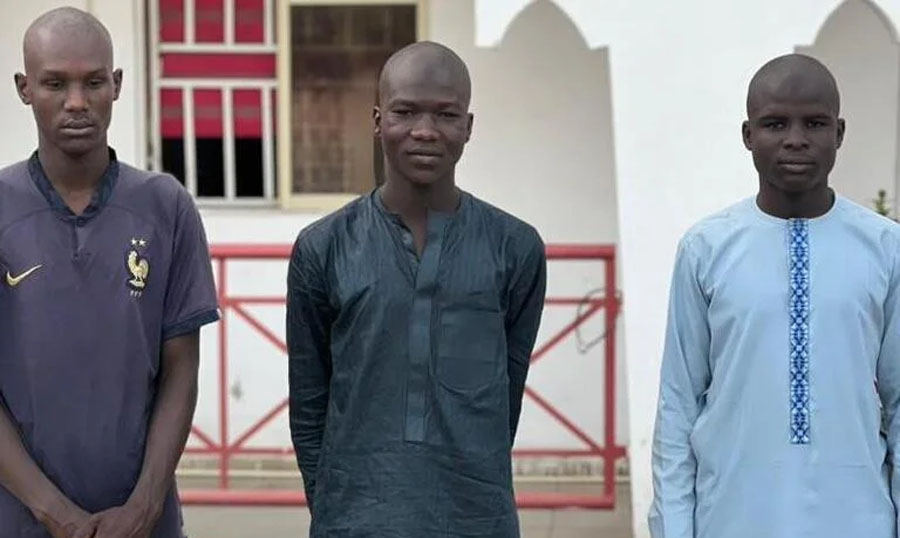
EFCC Nabs Three in Borno Over Viral ₦500 Naira Mutilation Video
The Economic and Financial Crimes Commission (EFCC) has arrested three suspects in Maiduguri, Borno State, over alleged naira mutilation following a viral social media video showing them misusing the Nigerian currency.
In a statement issued on Thursday by its Head of Media and Publicity, Dele Oyewale, the anti-graft agency disclosed that the suspects — Adam Muhammad, Muhammad Muhammad, and Bashir Musa — were apprehended by operatives of the EFCC’s Maiduguri Zonal Directorate.
READ ALSO:
- Omokri Accuses El-Rufai of Rights Abuses During Kaduna Governorship
- Lagos Motor Fair, Autoparts Expo to begin March 17, targeting Investment, Industry Growth
- First Daughter of Murtala Muhammed Reflects on Life Without Father, Preserving His Legacy
According to the commission, the trio was seen in a widely circulated video cleaning mucus from their noses using ₦500 naira notes, an act described as abuse and defacement of the national currency.
The statement said the suspects were traced and arrested within the Maiduguri metropolis shortly after the video surfaced online and triggered public reactions.
They are currently being held at the EFCC’s Maiduguri detention facility while investigations continue. The commission added that the suspects would be charged to court upon the conclusion of investigations.
Under the Central Bank of Nigeria (CBN) Act, abuse, defacement, spraying, or improper handling of the naira constitutes an offence punishable under Nigerian law. The EFCC has in recent months intensified its crackdown on cases involving naira abuse and currency mutilation across the country.
The latest arrest underscores the agency’s renewed enforcement drive aimed at protecting the integrity of Nigeria’s legal tender.
EFCC Nabs Three in Borno Over Viral ₦500 Naira Mutilation Video

-

 metro2 days ago
IKEDC Sets Feb 20 Deadline for Customers to Submit Valid IDs or Face Disconnection
-

 Education2 days ago
Supreme Court Affirms Muslim Students’ Right to Worship at Rivers State University
-

 metro23 hours ago
Lagos Police Launch Manhunt for Suspect in Brutal Ajah Murder
-

 Business3 days ago
Dangote Refinery Slashes Petrol Price to ₦774, Ends PMS Bonus Window
-

 News23 hours ago
Aso Rock Goes Solar as Tinubu Orders National Grid Disconnection
-

 Business2 days ago
Naira Could Trade Below ₦1,000/$ With Dangote Refinery at Full Capacity — Otedola
-
 metro3 days ago
Kwara, Katsina Bloodshed: TMC Condemns Attacks, Dismisses ‘Jihadist Preacher’ Claims
-

 metro2 days ago
Army University Professor Dies in Boko Haram Captivity After Nearly One Year